Showing posts with label Pariyatti yatra. Show all posts
Sunday, 1 February 2015
Burmese Dhamma in the Colorado Rockies
The Rocky Mountain Vipassana Association (RMVA), which offers courses in the tradition of Sayagyi U Goenka, is located in Boulder, Colorado, in the US. Last month, the editor of Shwe Lan Ga Lay gave a presentation to the RMVA Trust that shared some of the inspiring stories from the Pariyatti pilgrimage that took place in Winter 2013-14. Many Trust members commented how much they appreciated hearing stories about the figures in the U Goenka lineage (such as Ledi Sayadaw, Sayagyi U Ba Khin, etc.) in more detail than they had ever heard before. This month, the RMVA has included a short article on the pilgrimages and the Shwe Lan project. Their January Newsletter can be found here.
(Please note: an earlier version of this newsletter incorrectly stated that the 2014-5 pilgrimages are sponsored by Pariyatti, and this is not the case. They were run independently by Compassionate Travels Myanmar. For upcoming pilgrimages, see Muditā Works)
Wednesday, 21 January 2015
A Monastic Kitchen in Ingyinbin...
In January 2014, a Pariyatti pilgrimage descended upon Webu Monastery in Ingyinbin, where meditators from around the world paid respects to the great monk Webu Sayadaw. They stayed on the Patipatti side of the monastery, and their food was lovingly prepared by the lay staff of the monastery. This short clip gives an inside view of the kitchen, where the great food magic took place. Shot with an HD lens, it transports the viewer to rural Burma within seconds...
Saturday, 27 December 2014
An Inspiring Memory
A European meditator who was on the 2014 Winter Pariyatti pilgrimage has recently shared how she remembers the more inspiring memories of this trip. She has made a collage of four important photos from this trip: starting from the upper left and going clockwise, one sees a Shinpyu (or novitiation) ceremony taking place at Shwedagon Pagoda, where a young boy takes on the monks' robes. Next is a photo from Ingyinbin showing Bhante Agga from the Netherlands along with the newly ordained Russell Quinn from New Zealand. Third shows the long line of brown-clad pilgrims making their way to Anauk Monastery in Pyaw Bwe Gyi, where Saya Thet Gyi taught during the last two years of his life. And finally is a wonderful, smiling photo of the Shwekyin Sayadaw and Dr. Khin Maung Aye, who delivered a Dhamma talk to the group.
For those wishing to make such memories of their own, a pilgrimage will take place on January 23, 2015, and spaces are still left... see Muditā Works for more information.
Sunday, 21 December 2014
Patipatti Side of Webu Monastery in Ingyinbin
In interviews with people who were around Ingyinbin at the time of Webu Sayadaw, Shwe Lan Ga Lay has worked to reconstruct a typical day at the monastery: Webu would start his day early and take his breakfast, and offer a plate of food to the Buddha statue in his residence at the San Kyaung building; his attendant recorded that he offered rice three times per day, at dawn before breakfast, after receiving alms, and before lunch. He would then tour his compound and provide instructions to the monks, nuns, and lay yogis and supporters. He would then start his alms round at either seven or eight in the morning (earlier for summer to avoid the scorching heat), which would usually last three to four hours depending on the quantity of food that was donated. After eating lunch, he would give a discourse, and then find some time to do some sweeping. From noon until around 4 pm he would spend time alone in the San Kyaung building, often resting, meditating, and bathing. It was also during this time where he would receive visitors who had made the trek to Ingyinbin to pay respects to him. Between 4:30 and 5 pm he accepted offerings of medicine, jaggery, candy, and juice, and oversee any other activities that needed his attention, such as the nuns’ retaking of sīla, a practice that happened periodically. He would give another Dhamma talk in the evening, this one to many more people who would gather in the main Dhamma hall. He would again retreat in solitude, where it was widely believed he would continue his teachings to invisible beings.
From watching this 90 second video, filmed during the Pariyatti pilgrimages of 2014, one is struck by the deep serenity and silence found still on these grounds today. This was certainly true of Russell Quinn, who decided to forgo the rest of the pilgrimage in order to ordain as a monk and stay here for ten days.
Thursday, 13 November 2014
A Truck in the Sagaing Hills
This video shows pilgrims in January 2014 on the way to a one day group sitting at Pa Bar Monastery in the Sagaing Hills, which was held during the Dhamma pilgrimage.
To read an inspiring journal entry about these three week pilgrimages, see here. To attend one in the future, please see here.
Friday, 7 November 2014
Sitagu Sayadaw and President Obama
The great venerable monk Sayadaw U Nyanissara, more commonly known as Sitagu Sayadaw, is by far the most famous and well-known monk of Burma today. It is then no surprise that President Obama sought out a personal audience with the monk during his brief one-day visit to Myanmar in 2012. Now at Sitagu Academy, the innovative free Buddhist university run by U Nyanissara, this portrait with the American president hangs in a prominent place. As President Obama plans to return to visit the Golden Land next week, he may again take the time to consult and pay respects to the great monk.
For those students of S.N. Goenka, one may also remember their dear friendship over the years. U Nyanissara stayed at Dhamma Giri for three months many years ago, where he wrote a biography of Ledi Sayadaw, and he later led 500 monks in scattering Goenkaji's ashes in the Ayeyarwaddy River. It may be fitting that the first (and second) groups to hold meditation sittings in the new Sitagu Vipassana Center in the Sagaing Hills were pilgrims on the Pariyatti pilgrimage.
Sunday, 24 August 2014
Dana for a Sagaing Hills Monastery
![]() |
| Prekhemma Monastery kappiya Ko Bo Win prepares to take the Dhamma cycle out to pick up the curries with Koyingyi for the upcoming day. |
During the 2013-14 pilgrimages in Burma, pilgrims stopped at Prekhemma Monastery high up in the Sagaing Hills. While here, the foreign meditators generously gave dana to Prekhemma Sayadaw. They also enjoyed a Question and Answer session with the Sayadaw, viewing relics, and meditating in the cave on site.
Prekhemma Sayadaw now wishes to inform these yogis that the dana they have given went into buying, for the first time, a Dhamma cycle for the monastery. In all the past centuries at Prekhemma (for it is one of the oldest monasteries in the Sagaing Hills, with some records suggesting it may have been founded in the 11th century), it was always necessary for monks and novices to walk entirely down the hill and into town to collect the curries that would be offered for lunch from village home, a trip which took several hours. Now, with this recent donation, a kappiya drives the monk with his tiffin to the appropriate homes on the Dhamma cycle. This also means that the monks have more time to study, meditate, and recite suttas; time that in the past was spent in walking.
For all those pilgrims who gave generously on these pilgrimages, may you rejoice in knowing where your dana went. For all those who wish to rejoice at such good deeds upon hearing of them, may you also share in the merits.
For more information on how one can join a pilgrimage this coming winter, please see here.
Friday, 25 July 2014
Pilgrimage Options for Winter in Burma
| View of the supreme Shwedagon Pagoda |
***For updated information, please see Muditā Works***
The following message is from Compassionate Travels Myanmar who, with Pariyatti in 2014, organized two pilgrimages. CTM is now continuing its offering of pilgrimages for this coming winter. For those without the means to afford attending the pilgrimage on their own, some scholarships may also be available.
Please note that Burma Dhamma Blog is not commercial and the following views expressed are entirely from CTM. We share them here to help disseminate their news of pilgrimage options throughout the Golden Land so that more meditators around the world may learn about these precious opportunities.
"To all of our Dear Friends throughout the World, The following message is from Compassionate Travels Myanmar who, with Pariyatti in 2014, organized two pilgrimages. CTM is now continuing its offering of pilgrimages for this coming winter. For those without the means to afford attending the pilgrimage on their own, some scholarships may also be available.
Please note that Burma Dhamma Blog is not commercial and the following views expressed are entirely from CTM. We share them here to help disseminate their news of pilgrimage options throughout the Golden Land so that more meditators around the world may learn about these precious opportunities.
Compassionate Travels Myanmar will be offering Group and Individual Pilgrimages & Tours within Myanmar for the 2014-2015 Winter Season. Our services assist anyone who has the aspiration of coming to Myanmar, wishing to connect with our deeply inspiring Dhammic society.
| Last year's pilgrims served Sangha Dana to Burmese monks and nuns |
For specific pilgrimage information, testimonials, and further communication with CTM, please visit our website at www.compassionatetravelsmyanmar.com. Thank you for your time and constant support!
With all of our Metta from Myanmar. Be Happy, Healthy and Peaceful!
Compassionate Travels Myanmar Team
No. 29,(A-5), 153 rd Street
Tamwe Township, Yangon, Myanmar
(Mobile Numbers): 09-3102-1496, (959) 40164 5521
(Fax): (951) 540205
General Information Email:
info@compassionatetravelsmyanmar.com
Saturday, 3 May 2014
Chanting at Thanboddhay Monastery
When Pariyatti pilgrims descended upon Thanboddhay Monastery in Upper Burma in January 2014, they were pleasantly surprised to find nearly one hundred college students, who had arrived to chant Buddhist suttas at the holy site. The two groups were able to sit together in meditation for some time before making one another's acquaintance. One may be hard-pressed to imagine Western university students doing similar things in their free time!
Today, there are three distinct parts of the grounds: (1) the Thanboddhay area, (2), the old Mohnyin monastery and meditation center (sometimes known in English as Mohnyin Forest Monastery Retreat), and (3) Mogaung Pagoda. All sites were developed by Mohnyin Sayadaw, one of the earliest disciples of Ledi Sayadaw. He was advised by Ledi to spend ten years living in the forest, eating food only from alms rounds and avoiding speech with others. During the lifetime of Mohnyin Sayadaw, there were man-made “caves” or niches at this site where monks and yogis could sleep and meditate. It was also known as a site where many locals came to seek protection from the violence of World War II, and those that arrived were sheltered and kept safe until the war’s end. The Sayadaw was famous for laying down a strict code of discipline guaranteed to ensure the community’s survival, which prohibited waste of fuel and water, regular education to children, and daily maintenance and cleaning of the compound. As a result, thousands of Burmese survived when the Japanese left in 1945, and many of them following a strict Buddhist regimen as they did so. This resulted in the construction of a meditation center on the grounds following the war, as well as a pagoda and a collection of huts where yogis could stay for practice and carry on with their study. The grounds were divided in two, with monastics on one side and laypeople on the other, and further segregated by gender.
The monastery today bursts forward with color like few other Theravada Buddhist sites you will find in Myanmar. Built between 1939 and 1952 upon thirty-seven acres, it is believed to contain 573,888 distinct Buddha images and an additional 7350 relics and other holy material. Arriving at the complex, your eye sense door will be flooded with bright colors and your field of view will be filled with uncountable small Buddha images—some large statues but most are simple hand-sized figurines that literally cover the walls. The complex has been compared to Borobodur in Indonesia, and unlike other Burmese pagodas the entrances are not guarded by chinthe but instead by white elephants. Another unique feature is its shape, which has a square base topped by receding terraces, over which rise hundreds of small stupas (864 to be exact). There are many smaller monasteries to be found between the larger pavilions, each one featuring similar architectural style and motifs. Some statues feature fashionable ladies out of the 1930s on a stroll with parasols, dogs sneaking into open doorways, and some donors even commissioned their own likelihoods. There are several statues of Mohnyin Sayadaw himself, depicted at various stages in his life. One compound was even donated by the Tiger Balm family, easily identifiable by the two plaster tigers trying to scale the wall as two barefoot men in Western suits look on. There is also a large square pool filled with fish and turtles, known as Laik Kan, and the animals here are free from harm. Popped rice and watercress is sold nearby and can be fed to them by pilgrims. The large tower (completed in 1936) is called Arlain Nga Sint, or “Five Stages Spiral Tower”, and symbolizes the hair that Prince Siddhattha cut off before seeking his spiritual journey. The hair was said to float upwards, eventually reaching the King of the Celestials, who built Sulamuni Pagoda in the sky. Additionally there are twenty tagundaing (large decorated pillars), and many stone sculptures of different fruits that are venerated by local farmers.
To learn about current pilgrimage offerings, see here.
Saturday, 29 March 2014
Dhamma discussion at Shwe Kyin Monastery
On the February 2014 pilgrimage, the group was fortunate enough to spend an evening at the age-old Shwe Kyin Monastery. After paying respects as the novices made their traditional procession while reciting Buddhist suttas on their way to meditation, they spent an evening with Dr. Khin Maung Aye, a Burmese Senior Assistant Teacher in the Sayagyi U Goenka tradition. The good doctor is fluent in English and currently resides in England (he has also helped to support the South African Goenka center), thus he was a rare speaker who was able to communicate to the pilgrims across languages and cultures. He also spoke to the January group, so passionately that even one pilgrim late ordained at this very monastery! Being now in robes as well, he was able to speak about topics ranging from lay meditation practice to being a formal member of the Sangha. In this talk, he talks about establishing monasteries in the West, the sotapanna stage attained by Dr. Om Prakesh, and how dhamma practice has benefited his profession. Note that this is a small portion of a much longer evening's talk. Seated by him is Sayadaw U Thuttivara, the current Sayadaw of the monastery. Beside him is the American monk who was ordained temporarily after meeting the venerated monk the previous month; and a European monk who has been in robes for several years.
To learn about current pilgrimage offerings, see here.
Tuesday, 25 March 2014
A Burma Pilgrimage: "The Benefits should not be Overlooked"
![]() |
| Mårten Berg standing outside Sayagyi U Ba Khin's IMC |
"To those training in morality and with devotion making efforts towards development in the Dhamma, going to Burma for a pilgrimage is very auspicious. Burma, the golden land, is a unique place, strong in purity. The benefits of going there as a part of ones practice should not be underestimated nor overlooked. The merits gained on such a journey will last throughout ones life and future lives. It will give a strong push of urgency to keep developing in Dhamma and dismay towards worldly things. It will bring out whatever purity one has and multiply it. Whatever negativities there may be will subside, if they arise they will not be so strong and the good atmosphere all around will settle the mind quite effortlessly. It is important that the pilgrim receives support to overcome cultural, language and religious barriers. It is easy with a western mind, to discard the many ways in which Dhamma expresses itself. Being a country of about 60 million people, Burma has its good and bad qualities as any other country. But as one decides to go on a pilgrimage and ones mind attunes towards Dhamma, it gets connected to all the good vibrations of the golden land. There is a wide spectrum of practitioners all the way from just practicing devotion to being fully liberated. If one really makes efforts to understand and go beyond preconceived views one can fully connect to the gift which Burma is to the people of the world. The actual barriers are nothing but the five enemies, namely; craving, aversion, physical sloth/ mental torpor, agitation/ worry and doubt.
I am so full of gratitude as the pilgrimage hosted by Pariyatti, Joah, Snow, Bhante Agga and many others generated a wonderful environment for Dhamma to flourish. Much like a course there were requirements, rules, guidelines and expectations. We had daily meditation sessions, times for eating and resting, scheduled activities and endless opportunities for doing good deeds. We visited places related to revered Goenkaji and the lineage of teachers, and also other sites related to Dhamma in general. The pilgrims were allowed to submerge in the inner experience of the pilgrimage as the management was discretely taken care of behind the scenes. We also received support from our guides' deep intuitive understanding of the golden land and how Dhamma is expressed there. So much so that we also gained intuition and were inspired to visit monasteries on our own. It has been like from swimming in a fish bowl back home to be let out in the ocean of Dhamma to swim on your own. Burma has enriched my life so deeply. To visit the centers of our Dhamma grandfather and great grandfather and so on, to learn about their struggles and attainments, is so satisfying. To know that there is a serious Sangha, that monks and nuns are practicing very diligently, gives so much faith to the heart. To just be near such noble ones, to benefit from their radiating purity is enough to dispel so much of the negativities. And to meet a people so dedicated to following the Buddhas teaching of generosity and morality certainly inspires one to become a better person. I experienced a clarity of mind greater than ever before. Each day kept building on the previous one. We kept saying to each other, 'how can it get any better than this?', and those who knew better would say 'just wait until tomorrow' or 'just wait until we get to such and such a place' or 'until we meet so and so'. Indeed, the good atmosphere kept building throughout the journey. It is difficult to put into words, it is something to be experienced. The Dhamma-sprout planted several years ago in the depths of Vipassana under the protection of Goenkaji, that then needed so much tending, now had grown and was in bloom. With all the sunshine, water and good nutrition, this tree of Dhamma, tree of happiness, gave fruit. Something marvelous culminated in Burma. The negativities became so feeble, an exhilarating sense of freedom emerged.
I read that the Buddha compered his feelings of relief and happiness to those of a man who has just discharged a debt, or recovered from a painful illness, or been freed from prison, or released from slavery, or who has safely crossed a dangerous wilderness. Such was the experience. I am so happy to let you know, this experience wasn't mundane, not another high to come down from. It was transformative. It is something I have brought with me home, the fruits keep on coming every day. It seems this is a new chapter. Dhamma has taken root within. Not that there are no more negativities. But it certainly has helped me get past so many obstacles that would have taken so much longer otherwise. So much misery has been dispelled. My wish of deep sympathetic joy (mudita) and 'come and see for yourself' (ehipassiko) is that all serious practitioners of Dhamma will make a pilgrimage to the golden land, to benefit from its good vibrations and spread this happiness of Dhamma throughout the world.
As the great emperor Ashoka inscribed on pillar edicts over two thousand years ago: 'Happiness in this world and the next is difficult to obtain without much love for the Dhamma, much self-examination, much respect, much fear (of evil), and much enthusiasm.'"
![]() |
| Mårten with Snow, her mother, and Branden (now U Ariyavamsa), preparing for monks' alms rounds |
I am so full of gratitude as the pilgrimage hosted by Pariyatti, Joah, Snow, Bhante Agga and many others generated a wonderful environment for Dhamma to flourish. Much like a course there were requirements, rules, guidelines and expectations. We had daily meditation sessions, times for eating and resting, scheduled activities and endless opportunities for doing good deeds. We visited places related to revered Goenkaji and the lineage of teachers, and also other sites related to Dhamma in general. The pilgrims were allowed to submerge in the inner experience of the pilgrimage as the management was discretely taken care of behind the scenes. We also received support from our guides' deep intuitive understanding of the golden land and how Dhamma is expressed there. So much so that we also gained intuition and were inspired to visit monasteries on our own. It has been like from swimming in a fish bowl back home to be let out in the ocean of Dhamma to swim on your own. Burma has enriched my life so deeply. To visit the centers of our Dhamma grandfather and great grandfather and so on, to learn about their struggles and attainments, is so satisfying. To know that there is a serious Sangha, that monks and nuns are practicing very diligently, gives so much faith to the heart. To just be near such noble ones, to benefit from their radiating purity is enough to dispel so much of the negativities. And to meet a people so dedicated to following the Buddhas teaching of generosity and morality certainly inspires one to become a better person. I experienced a clarity of mind greater than ever before. Each day kept building on the previous one. We kept saying to each other, 'how can it get any better than this?', and those who knew better would say 'just wait until tomorrow' or 'just wait until we get to such and such a place' or 'until we meet so and so'. Indeed, the good atmosphere kept building throughout the journey. It is difficult to put into words, it is something to be experienced. The Dhamma-sprout planted several years ago in the depths of Vipassana under the protection of Goenkaji, that then needed so much tending, now had grown and was in bloom. With all the sunshine, water and good nutrition, this tree of Dhamma, tree of happiness, gave fruit. Something marvelous culminated in Burma. The negativities became so feeble, an exhilarating sense of freedom emerged.
I read that the Buddha compered his feelings of relief and happiness to those of a man who has just discharged a debt, or recovered from a painful illness, or been freed from prison, or released from slavery, or who has safely crossed a dangerous wilderness. Such was the experience. I am so happy to let you know, this experience wasn't mundane, not another high to come down from. It was transformative. It is something I have brought with me home, the fruits keep on coming every day. It seems this is a new chapter. Dhamma has taken root within. Not that there are no more negativities. But it certainly has helped me get past so many obstacles that would have taken so much longer otherwise. So much misery has been dispelled. My wish of deep sympathetic joy (mudita) and 'come and see for yourself' (ehipassiko) is that all serious practitioners of Dhamma will make a pilgrimage to the golden land, to benefit from its good vibrations and spread this happiness of Dhamma throughout the world.
![]() |
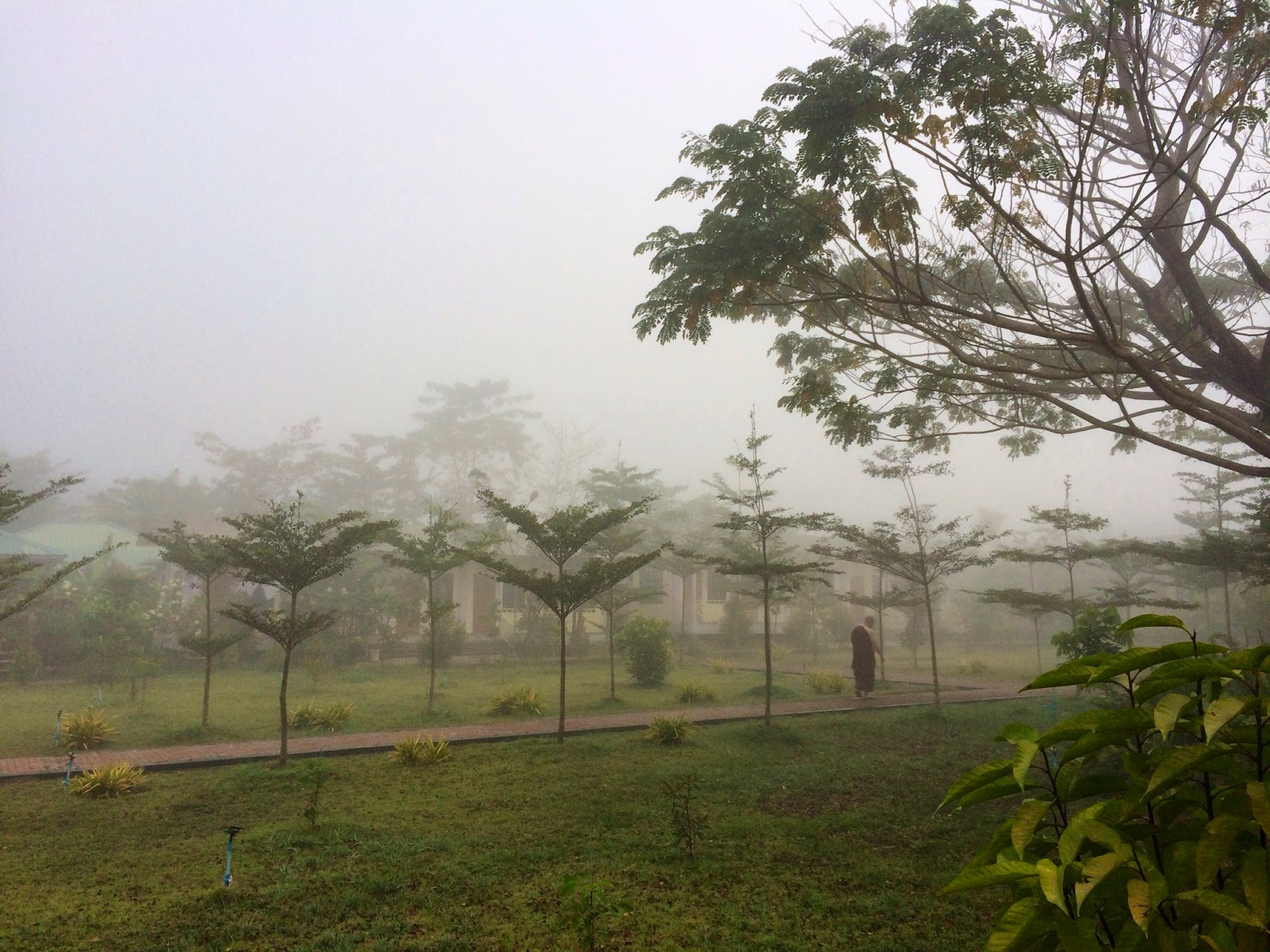
| A Burmese Monastery in the early morning hours |
As the great emperor Ashoka inscribed on pillar edicts over two thousand years ago: 'Happiness in this world and the next is difficult to obtain without much love for the Dhamma, much self-examination, much respect, much fear (of evil), and much enthusiasm.'"
Sunday, 16 March 2014
Dhamma Found in a Burmese Teashop
Sam Hanft, an American yogi, spent several months in Burma in the winter of 2013/2014. He relates some of his more special experiences that he had in the Sagaing Hills:
"I arrived in Sagaing in the evening, having taken the bus from Mandalay, and decided I would get a hotel and start my search for a monastery the next morning. I was approached by a motorcyle taxi as I got off the bus, and within minutes was at a newly built hotel several dusty lanes away. After settling in, I asked the owner where I could get a bite to eat, and he suggested a place just down the road.
In retrospect, I'm sure he was talking about one of several beer stations on the corner. But I was new to Sagaing, and I walked into the first place I saw: a teahouse.
My arrival caused some commotion. The owners, a couple in their 50s, greeted me with smiles and ushered me to a plastic chair in the center of the shop. There were shouts behind the counter. Soon after, their youngest daughter emerged with a bashful smile. 'Myanmar food?' she asked. 'Yes, please.' All around, wide eyes diverted their gaze from the Myanmar movie blaring on the TV and settled on me.
Within minutes, I had a soup, two bowls of curry, and a plate of steaming rice in front of me. I didn't know at the time, but this was from the family's dinner; normally, they only serve noodle dishes to customers. The rest of the teashop's patrons looked on with envy as I dug in. When the owner saw that I had finished my soup, she generously gave me her own as she was sitting down to eat. Another bowl of curry arrived soon after. As I ate, I took in the scene. Customers laughed along with the film, chatted among themselves, or quietly sipped a cup of tea. The owner's three children bustled about taking orders, while two grandchildren ran under and between tables, tossing a ball back and forth. Satisfied, I asked to pay and was charged only for the tea. I was stunned.
| Sam with the family that offered him breakfast each morning |
I spent the next day hunting for a monastery with no success. I was looking for a place with an English-speaking Sayadaw where I could go on solitary retreat. At lunchtime, I headed back to the teahouse, where I was met with more smiles and food. Despite my best efforts, the family once again refused payment.
| U Pinnisami, the Sayadaw at the monastery where Sam stayed |
The next day I heard from a friend who invited me to join him for the tail end of a pilgrimage. He was leading a group of foreign meditators around Myanmar to visit sites of interest to the lineage of U Goenka. Six days and many monasteries later, I was back in Mandalay planning the next leg of my trip. After my experience on the pilgrimage, I felt like sitting a Goenka meditation course. I also had an urge to head east and see the Shan plateau. But the tea shop family had been so generous to me, I felt I couldn't continue on without thanking them. So I bought some toys for the grandchildren and headed back to the monastery in Sagaing, thinking I'd stay a night or two.
I went to the shop the next day for lunch. Still new to the norms of giving in Burma, I was nervous about how my gifts would go over. My entry met with familiar smiles. I offered my gifts, which were received as if my gesture was the most natural in the world. Soon I was sitting next to the mother, sipping tea and snacking on boiled radishes. I spent all day at the shop. Before leaving, War War, the youngest daughter (and only English I speaking member of the family), offered to take me to Mingun the next morning. I hadn't planned on staying in the area long, but I couldn't say no.
| War War and her mother prepare the tea |
I spent the next day with War War and her friend Soe Min Htet, touring Mingun and Kaung Hmu Daw pagoda and getting lunch at their favorite restaurant in town. Again and again, I was caught off guard by their generosity. War War saw that my bag was torn and bought me a new one without saying a word. They paid for all the gas and food--I was never quick enough to beat them to the bill. Having little prior experience with Burmese hospitality, I felt anxious and wondered how I would repay them.
I spent the evening at the teashop, and at the end of the night War War offered to take me somewhere else if I came back the next day. Of course, I agreed.
| The tea making area at the cafe |
I ended up spending six weeks in Sagaing. I slept at the monastery, where I maintained my daily meditation and practiced English with the friendly Sayadaw. Every morning, I was offered breakfast by a family down the street who sold me water. With not a word of English spoken in the household, it promised an interesting start to each day. After that, I headed to the tea shop. War War and I would go to the market to buy the day's supply of food and drink, then sit together while she made tea and served customers. We practiced English and Burmese. Slowly, I learned how to make tea and was eventually allowed to take orders for the shop's regulars, who got a kick out of my serving them. I ate lunch and dinner with the family. I tried to help out wherever I could--washing dishes, cracking peanuts, sweeping--but the family did their best to ensure I didn't do any work. Mostly, I sat around and drank tea.
I met friends and friends of friends and made contacts through the monastery. I was invited to visit local sites, like Inwa, Amarapura, and the pagodas of the Sagaing Hills, as well as nearby villages, which my hosts told me had never before seen foreign visitors. I witnessed several novitiation ceremonies, whose glittering ox-carts and fanciful costumes were unlike anything I'd ever seen. More than once I was invited to stay overnight. The more time I spent in the area, the more I let go of my inhibitions and opened to the local way of living. Soon, I was eating with my hands, sporting jade jewelry and fuzzy flip flops, and smiling more than I ever had before. Everywhere I went, the hospitality was overflowing--food, lodging, smiles--and no one would ever accept a single kyat.
| The novitation ceremony that Sam witnessed |
One such occasion left a particular impression on me. Five young men my age, English students of my monastery's head monk, took me to their village. After a day of eating, swimming in the river, and singing and playing guitar, I was ready to go back to the monastery. I was offered an overnight stay but declined. Feeling a little guilty, I wondered who would take me back. It was dark, the drive was thirty minutes each way, and the windy dirt road was littered with bumps and holes. There was a festival in the village that night to boot. To my surprise, without exchanging a single word, all five of my hosts jumped on two motorbikes and accompanied me back to the monastery, singing and joking the whole way. All I could think of was all the times my friends back home and I had argued over who would give who a ride home. When we got to the monastery, we parted with earnest handshakes and warm goodbyes.
| Sam with his new Burmese friends |
I did my best to give back by teaching English and computer skills to anyone who was interested, which was almost everyone. I bought year-long memberships to the British Council in Mandalay for several friends who were sincere in their effort to study. I also had many long talks with War War, who secretly desired to leave the tea shop to seek professional work but, as the youngest daughter, was too scared to tell her parents (or anyone, for that matter) about her ambitions. Before leaving, I signed her up for an accounting course and facilitated a conversation with her mother, who happily agreed to hire a new worker to allow War War to pursue her dreams. Today, I got an email for War War telling me that she has an interview in Monywa for a hotel reception job.
I finally left Sagaing with plans to attend a Goenka meditation course in Mandalay, spend a couple days in Bagan, and then take a flight from Yangon to Bangkok, and from there back to the States. To my surprise, on the morning of the last day of the course, War War and Soe Min Htet showed up to drive me to the bus station to catch my ride to Bagan. As soon as I arrived in Bagan, I felt like I'd made a mistake. So I made a quick tour of the temples and booked a ticket back to Sagaing, where I spent my last three days before heading to Yangon and leaving the country.
My stay in Sagaing has left me with a lot to think about. I witnessed and received kindness, generosity, and consideration such as I had never known. Just as impressive, I saw people act with a straightforwardness and sincerity I assumed were relics of a bygone era. I also glimpsed some of the darker sides of such traditional life, particularly with respect to the treatment of women. Above all, my experience constantly challenged my ideas about how and why life should be lived, which is the greatest gift I could ask for."
| Thazin Khin, the sister of War War, with her child |
Monday, 10 March 2014
"The Beauty of Burmese Life is Hard to Qualify."
![]() |
| Pilgrims listen to a dhamma talk by monks in Sain Pyin Gyi, the small village where Ledi Sayadaw was born. |
The following essay was written by Branden Macie, an American pilgrim who attended the recent Pariyatti pilgrimage in Burma (and is at present moment sitting a Satipattana course at Dhamma Joti!). The original piece can be found on the Living Vipassana website. To read more about the pilgrimages, see here. To learn about current pilgrimage offerings, see here.
"From January 2012 to March 2012 a nickel of wisdom arose in me while serving long-term at Dhamma Patapa in Jesup, Georgia, U.S.A. I was there to strengthen my individual walk in Dhamma and to share my merits with others who came for meditation alongside other meditators who wanted to apply the technique in daily life-like scenarios. At the time of my stay, I jumped into study (pariyatti) to gain a view of the context of Vipassana being taught there at the Center. Zipping through books with the lightning evaluation capacity which comes with strong concentration episodes, the texts chronicling the lineage of the Vipassana tradition appealed to me most.
One particular book which wedged a great impression in me was the Sayagyi U Ba Khin Journal where details unrelated to the teaching of the typical 10-day courses tested and touched my faithful side, enlivening my understanding of this Path. Leaving the center and maintaining the practice for years following that service period, heavy dreams of pilgrimaging within Burma made their eruption into my conscious stream over and over. Then, Burmese folks I’d meet would lift up those dreams further by inviting me to Dhamma related outings, studies unrelated to the language and practice Goenkaji’s teaching.
For the a long while a needle of uncertainty was lodged into my mind about living Dhamma through different techniques and actions than were known to me through the 10-day retreat center’s presentation. I held on so closely, so personally. The conditioning I’d developed was strong and a barrier to outside Dhamma works, events, and representations of ‘Dhamma’ began to form — I felt a bit off the mark even knowing the Buddha’s Liberation Teachings were specific to each individual. The attachment had to be let go of.
Navigating those walls, the concepts, the emotions they arose became easier with continued acceptance that Buddha’s Dhamma can’t only fit one categorization of language and practice. More important the Real Time at each individual’s mental level, efforts, and energies is where Dhamma exists and that’s gladdening.
Therefore, seeing Burma and the way the society has structured itself while noticing my own inner pilgrimage along the way helped me realize the vastness of walking toward liberation — all the efforts one CAN make for others (regardless of tradition). When one’s mind is settled into the heart of Right Intention much can be shared.
The beauty of Burmese life is hard to qualify. Learning of enlightened Arahats, even ones so recently passed away who revealed their attainments through body relics, were Great teachers of the Dhamma in their own special ways for the Burmese locals. The amount of devotion and merit gaining on a daily level in Burma is astoundingly high. One can go from Alms round serving monks to Pagodas for paying respects to Sayadaws and end the evening with a Dhamma talk on the Abidhamma or any of the hundreds of Suttas contained in the Tipitaka.
The fruit to seeing the wider context of Buddha’s Dhamma is so sweet, so virtuous, so needed and for anyone interested in investigating Burma Dhamma, I would willingly be a contact point once one enters the country.
Here’s a quote by Harold Fielding from Soul of a People to end on:
“To hear of the Buddha from living lips in this country [Burma], which is full of his influence, where the spire of his monastery marks every village, and where every man has at one time or another been his monk, is quite a different thing to reading of him in far countries, under other skies and swayed by other thoughts. To sit in the monastery garden in the dusk, in just such a tropic dusk as He taught in so many years ago, and hearing the yellow-robed monk tell of that life, and repeat His teaching of love, charity, and compassion — eternal love, perfect charity, endless compassion — until the stars come out in the purple sky, and the silver-voiced gongs ring for evening prayers, is a thing never to be forgotten. As you watch the starlight die and the far-off hills fade into the night, as the sounds about you still, and the calm silence of the summer night falls over the whole earth, you know and understand the teacher of the Great Peace as no words can tell you. A sympathy comes to you from the circle of believers, and you believe, too. An influence and an understanding breathes from the nature about you — the same nature that the teacher saw — from the whispering fig-trees and the scented champaks, and the dimly seen statues in the shadows of the shrines, that you can never gain elsewhere. And as the monks tell you the story of that great life, they bring it home to you with reflection and comment that has application to your everyday existence.”
| Two pilgrims relax at the base of a pagoda stupa |
Wednesday, 5 March 2014
San Kyaung Building at Webu Sayadaw Monastery in Ingyinbin
This short clip shows a German meditator in very early morning in the San Kyaung building at Webu Monastery in Ingyinbin village, located in Upper Burma. In January 2014, a group of 25 foreign meditators visited here, and they sat a one day course in this building.
This building is highly significant because it was here that the venerable Webu Sayadaw, widely believed to be an arahant, resided during each hot season (he spent the rainy and hot seasons in Kyaukse and Shwebo, but always came to his native village for hot seasons). He meditated in this two story building and received visitors here as well. It was also in here where the great monk entered passed away and entered parinibbana. More about him can be learned from the documentary "Webu Sayadaw: Anthology of a Noble One."
The building is usually kept under lock and key, but the pilgrims received extraordinary permission to meditate in this building as they wished during their stay. The main altar is shown in the video, and where precious relics are kept, along with other items from Webu Sayadaw's day.
A more comprehensive and informative map of Ingyinbin and its history is coming soon.
For more information on current pilgrimage, see here.
Tuesday, 4 March 2014
The Burma Pilgrimage: "A Great Pool of Contentment and Silence"
| January 2014 pilgrims meditate for one hour at Maha Myat Muni Pagoda in Mandalay, the pagoda where SN Goenka first came in contact with dhamma, when he used to visit here with his grandfather. |
-- Gaurishanker Sharma, India
Sunday, 2 March 2014
A Diary of Pilgrimages
![]() |
| Three young Burmese boys join a group siting at a pagoda with the pilgrims |
42 days of pilgrimages have now been completed, and two groups of devoted yogis have now seen the best that Burma has to offer, with many lives transformed in the process. Some pilgrims ordained and are still in robes, with others coming in the next few weeks, months, or even years with a similar intention in mind. Others have grasped the dhamma in more profound ways than was possible in one's home country, and have returned to their local community to share their wealth of experience, understanding, and inspiration.
The following guide shows the diary entries recorded for the two yatras. The majority of the first diary entries were made by Kory Goldberg, a Canadian yogi and author of Along the Path. The majority of the second yartra entries were made by an anonymous American pilgrim.
While no yatras have as yet been confirmed for the following winter of 2015, there are upcoming opportunities for those interested to join part on such excursions in the near future. U Kumara at Sitagu Academy has indicated an interest in hosting Abhidhamma workshops in English for any interested foreigners in the Sagaing Hills in June, and brief ten-day dhamma trips will be organized both before and after these courses for those wishing to attend. Finally, one may also contact Muditā Works (the agency which arranged for the entire following two pilgrimages) at any time to arrange such a dhamma trip according to the wishes of one's group.
| The ruins of Htut Kaung Monastery in the Sagaing Hills. This was one of the world's first meditation-oriented monastery |
Pilgrimage #1
Day 1: Yangon
Day 2: Pyaw Bwe Gyi
Day 3: Yangon and Hmawbi
Day 4: Hmawbi
Day 5: The Road to Mandalay
Day 6: Mandalay
Day 7: Kyaukse and Mandalay
Day 8: Mandalay and Monywa
Day 9: Monywa
Day 10: Monywa, Sain Pyin Gyi, and Ingyinbin
Day 11: Ingyinbin
Day 12: Ingyinbin
Day 13: Ingyinbin
Day 14: Ingyinbin, Shwebo, and Sagaing Hills
Day 15 and 16: Sagaing Hills
Day 17: Mingun
Day 18: Sagaing Hills and Yangon
Day 19: Yangon
Day 20: Yangon
![]() |
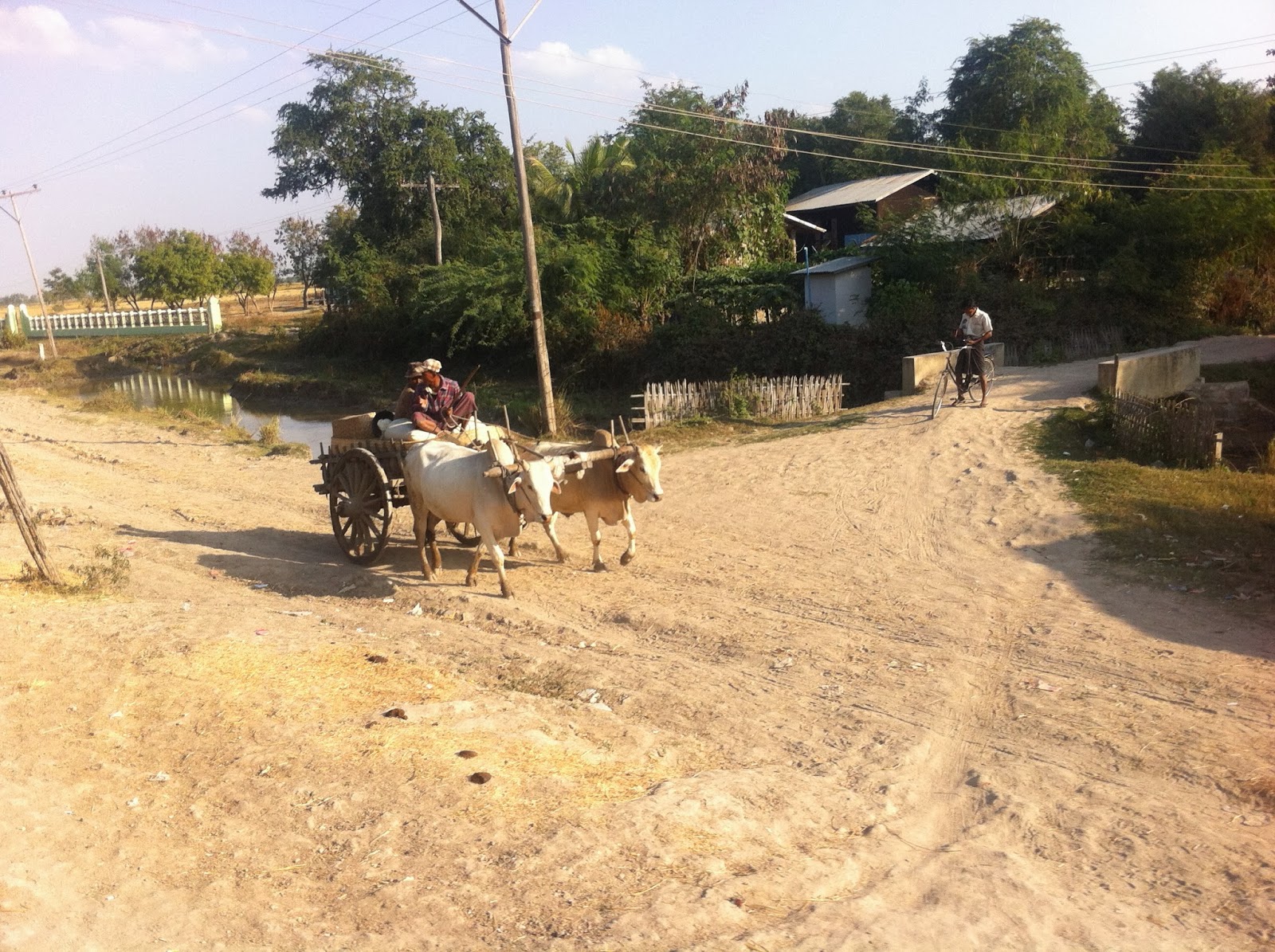
| A typical rural Burmese scene |
Pilgrimage #2
Day 1: Yangon
Day 2: Pyaw Bwe Gyi
Day 3: Yangon and Hmawbi
Day 4: Hmawbi
Day 5: The Road to Mandalay
Day 6: Mandalay
Day 7: Kyaukse and Mandalay
Day 8: Mandalay and Monywa
Day 9: Monywa
Day 10: Monywa, Sain Pyin Gyi, and Ingyinbin
Day 11: Ingyinbin
Day 12: Ingyinbin
Day 13: Ingyinbin, Shwebo, and Sagaing Hills
Day 14: Sagaing Hills Nunneries
Day 15: Within the Sagaing Hills
Day 16: Sagaing Hills One Day Sitting
Day 17: Mingun
Day 18: Sagaing Hills and Yangon
Day 19: Yangon
Day 20: Yangon
| Pilgrims travel back from Mingun to Sagaing |
...one may ask, what is so special to have to come across the world to Burma anyway, when the practice is basically inside already? Harold Fielding, a British administrator, provided an answer to this question in 1898 in "Soul of a People":
"To hear of the Buddha from living lips in this country, which is full of his influence, where the spire of his monastery marks every village, and where every man has at one time or another been his monk, is quite a different thing to reading of him in far countries, under other skies and swayed by other thoughts. To sit in the monastery garden in the dusk, in just such a tropic dusk as he taught in so many years ago, and hear the yellow-robed monk tell of that life, and repeat his teaching of love, and charity, and compassion—eternal love, perfect charity, endless compassion—until the stars come out in the purple sky, and the silver-voiced gongs ring for evening prayers, is a thing never to be forgotten. As you watch the starlight die and the far-off hills fade into the night, as the sounds about you still, and the calm silence of the summer night falls over the whole earth, you know and understand the teacher of the Great Peace as no words can tell you. A sympathy comes to you from the circle of believers, and you believe, too. An influence and an understanding breathes from the nature about you—the same nature that the teacher saw—from the whispering fig-trees and the scented champaks, and the dimly seen statues in the shadows of the shrines, that you can never gain elsewhere. And as the monks tell you the story of that great life, they bring it home to you with reflection and comment, with application to your everyday existence."
Labels:
"Soul of a People",
Hmawbi,
Htut Kaung Sayadaw,
Ingyinbin,
Kory Goldberg,
Kyaukse,
Mandalay,
Mingun,
Monywa,
Muditā Works,
Pariyatti yatra,
Pyaw Bwe Gyi,
Sagaing,
Shwebo,
Sitagu Academy,
Yangon
Burma Pilgrimage #2, Day 20: "Deep Gratitude also Arises"
You can also consider joining a later pilgrimage in Burma.
"It's hard to see the full breadth of what's taken place these past three weeks.
Twenty pilgrims from multiple countries, came together and learned about the fabric from which the cloth (which we all find so invaluable) was cut.
One take away is appreciation of the breadth and depth of the practice. The richness of Dhamma in Burma, manifesting in both physical forms, and actions. The integration of monastics into national psyche, and the integration of off the cushion 'practice' in daily life. The seeing of what is possible - that, like Mingun Sayadaw, one can penetrate deeply into pariyatti into patipatti and beyond (and vice versa). That, regardless of gender, it's still possible to reach advanced stages with rigorous practice (and that there are still those carrying this torch). All of this inspires one to keep on walking, and renews faith that the path will remain for generations to come.
Deep gratitude also arises... Gratitude to the the 'Knower of Great Peace' for the teachings, and to the Sangha for preserving them for centuries. Gratitude to Goenkaji for illuminating a path in the forest - providing a nonsectarian technique that extracts the essence. Gratitude to Snow, Joah, the Bhante, who believed, and generously gave of themselves. Gratitude to all who helped shepard us through safely...
It will take time to fully understand the impact of this journey, but one thing is for sure - we go back changed, and with little bits of our hearts left behind, in Burma..."
Friday, 28 February 2014
Burma Pilgrimage #2, Day 19: "Quite a Lovely Experience"
The following excerpt was written by an American yogi about the pilgrimage in Burma. The first pilgrimage has ended, and the second one has just begun! To read about two days prior as they explored Mingun, go here. To read about the first yatra from Day 1, and read the journal entry in order, start here.
"The last (full) day started with a group sit at Kaba Aye monastery. This houses relics of the Buddha, Sariputta, and Moggallana.
![]() |
| Kaba Aye Pagoda Trustees hold the sacred relics above the heads of pilgrims, giving each a chance to meditate underneath |
As we started to trickle into the small chamber, a few ochre robed bhikkus and many white-clad Cambodian pilgrims swarmed up to the front, and started chantings and paying their respects. (A co-pilgrim wryly noted later that it's a chanting country - if it's not chanting via loudspeaker, then it's background chanting; if not that, then it's someone right next to you...)
After some initial confusion, in gentle Burmese fashion, the pagoda trustees and Snow patiently waited for the Cambodian group to finish before our group started. There was some jostling from our Cambodian brothers and sisters at the beginning - was great to be able to use this as part of the practice. After all, it's not much different than been jostled on a bumpy 'bus' ride... it's all just matter bumping back and forth, and it settled down with time.
An unexpected benefit from waiting was that the pagoda trustees allowed us to sit for a while with the unlocked relics - quite a lovely experience..."
To read about the final day of the second pilgrimage, go here!
Thursday, 27 February 2014
Burma Pilgrimage #2, Day 17: "Here, change is in your face."
![]() |
| The model plan for the new ambitious Sitagu Vipassana Center. The group sat here in the morning |
![]() |
| The upper most paogoda at the Sitagu Vipassana Center. Last month's yatra was the first group to ever meditate there, and this group was the second |
The following excerpt was written by an American yogi about the pilgrimage in Burma. The first pilgrimage has ended, and the second one has just begun! To read about the previous day sitting the self course in the Sagaing Hills, go here. To read about the first pilgrimage group's experience as they explored Mingun, see here.
You can also consider joining a later pilgrimage in Burma.
| A view of the Mingun Jetty before boarding the boat back to Sagaing |
"The highlight today was an Ayeyarwaddy river boat trip.
On boarding the boat consisted of walking down a sandy bank, onto a 'bridge/plank' brought into being by the alignment of a slab of wood to walk on, and a single bamboo 'railing' held by two men. Arising and passing away is never far away in this land...
The craft was remarkably low set in the water with open windows covered only with adjustable tarp. Rain started during our time on the vessel, with a drop in temperature that few of us were prepared for.
Going down the Ayeyarwaddy was the last leg of Goenkaji's ashes. As we traced his path, we passed tugboats hauling wood cargo, small wooden boats with old motors attached, some puffing out black smoke in their journeys.
All share passage in the muddy waters, in a place where change is a reality of life. The sandy banks actively evolve, with large chunks falling to join the river. Men testing water depths stand guard at the bow, guiding vessels away from swirling eddys and sand bars. The landscape is foggy, with rolling hills framing flat lands interspersed with an occasional thatched hut and flame tree.
One of the things in the West, is that we've created such comfortable (and artificial) environments that we forget that all things change. Here, change is in your face, whether it is in the dimming of the bathroom light because the electric shower head just turned on, or floating down the Ayeyarwaddy in an exposed wooden boat.
Anicca, anatta, dukkha...
![]() |
| A gold statue of Mingun Sayadaw |
**************
![]() |
| This Mingun Pagoda is built on seven layers to resemble the seven layers of waves when approaching Mt. Meru |
The mood is somber, as we pass near where Goenkaji's ashes were scattered.
The rain picked up, and by the time we got on the bus, we were a wet bunch. And in the moment, huddled together on the exposed bus for warmth, Goenkaji's doha chantings arise, led by a couple of CCTs... a sweet ending to a memorable Ayeyarwaddy trip..."
Subscribe to:
Posts (Atom)