Showing posts with label David Lambert. Show all posts

Thursday, 27 August 2015

An Unlikely Place to Start a Revoluion


Travel 85 miles west of Mandalay to a merchant town of nearly 200,000 people, and the pilgrim is welcomed by a humble yet honest sign announcing: “Capital of the Northwest, Monywa Must do Better than Other Towns.” For the yogi willing to look past its inhospitable terrain and hot climate, he travels back in time to a land where an unlikely confluence of events came together that would ultimately transform the monkhood and the faith— for this pilgrim, Monywa certainly does “do better!” In his essay, “Chindwin,” David Lambert captures the unusual opposing dynamics that characterize Monwya, writing that “beyond the conventional radar, this is the heart of yogi tourism, where foreign meditators, carrying tourist cash dollars, come to explore the heartland of their spiritual souls. For some, this is the area ‘where it all began.’ ”

Whether lay or monastic, a certain resilience was always needed to survive here. It has long been a very hot and dry region, something that even the later colonial irrigation projects did little to alleviate. Monks first came out here nearly a millennium ago during the Bagan Era, when the region was full of thickly wooded forests, and functioned as a kind of forest refuge for paṭipatti-minded monastics who wished to put some distance between themselves and the royal capital. As Michael Charney notes, the “harshness of the Chindwin environment and its relatively low population base may have dissuaded all but the hardiest monks.” More monks began to stream in the mid-18th century, when the region was spared the wars then taking place elsewhere in the country. As greater civilization came to settle in this area, the competition between city and forest monks (gamavasi and aranyavasi) eventually became so fierce that at least once even spilled over into violence.

And yet, still prior to the British arrival, Monywa was little more than a village. The town’s rise to worldly prominence can be traced to when the British named the town the Headquarters of the Lower Chindwin District in 1886. 
The British had originally chosen nearby Ahlone, but had to move following local unrest. Recently, Monywa was named the capital of the Sagaing Division. 

This happened to be around the same time that a young monk named U Nyanadhaja would venture into the Ledi Forest, to continue his scholarly work and meditation practice in the quiet that the vast wilderness provided. He would remain there for the following thirteen years, and would forever be known afterwards as the Ledi Sayadaw. 

Sunday, 11 January 2015

Intersection of Dhamma Travel and Tourist Travel in Myanmar


 As Myanmar continues to open up, more and more Dhamma pilgrims can come to experience the richness of its Buddhist sites. Unfortunately, more and more tourists can also come to tramp around these very same Buddhist sites. Such a fact comes out in an article written by Douglas Long in My Magical Myanmar. He describes his visit to Monywa. This was the place recognized as the home of the great Ledi Sayadaw, which meditator David Lambert celebrated in his essay Chindwin by writing that “beyond the conventional radar, this is the heart of yogi tourism, where foreign meditators... come to explore the heartland of their spiritual souls. For some, this is the area ‘where it all began.’”

Now, however, as Long's essay shows, it is no longer "beyond the conventional radar," as for him, it is a place to be "sheltered in our air-conditioned room and [wait] until late afternoon for a walk around town."

Long goes on to write that "we... enjoyed the long, casual amble that took us past a statue of national hero Aung San on horseback, the town’s central clock tower, a buzzing street market and the Shwezigon Pagoda. At the riverside, we enjoyed fresh-squeezed sugarcane juice as we watched the sun descend toward the horizon." Shwezigon, of course, is the pagoda where Ledi Sayadaw lived, mediated, wrote, and taught after a great fire in Mandalay destroyed nearly all of his books and he retreated the then-capital city.

The next stop is Bodhi Ta Htaung, where Long writes: "Myanmar’s tourism boosters are fond of declaring that this statue is one of the tallest such images in the world, but given the Buddha’s teachings on humility and impermanence, these trifling boasts seem somewhat contrary to the spirit of the religion." Not known or mentioned by the casual tourist, however, is that the great Bodhi Ta Htaung Sayadaw, originally known as U Narada, practiced meditation across Upper Burma, although his work was hindered by bouts of tuberculosis. Even after becoming Sayadaw, he regularly planned extended self-courses to pursue his own meditation practice, going to such sites at West Prekhemma Monastery in Sagaing, Kyuakse Hill, Kaunghmudaw Pagoda, among others. Between 1988 and 2004, he also travelled extensively throughout Asia and the West. His last known words, said while in the hospital were: “He who always cultivates mindfulness, attains Nibbana. He who does not cultivate mindfulness, is born and dies endlessly. Lord Buddha delivered a discourse time and again, mindfulness should be cultivated at all times.”

The road to Bodhi Ta Htaung Monastery

Long's next stop is Thanboddhay Monastery, which he notes as a "beautifully painted in a riot of bright colours and decorated with thousands of small Buddha images." Much more importantly, however is the former Mohynin Sayadaw who oversaw this site. He was one of Ledi Sayadaw's most renowned students, and followed Ledi's advice by coming here to meditate ten years in seclusion without talking to another soul. When World War II struck Burma, this became a refuge for thousands of lay Buddhists, with many learning meditation for the first time. It was a thriving meditation center after the war, with unique meditation cells constructed along the walls of the inner compound that still exist today. 

Thanboddhay Monastery

Long also mentions passing by Letpadaung mine, and he notes that "Myanmar riot police had used unnecessarily heavy-handed tactics while confronting monks and villagers protesting against the environmental and communal impact of the mine." However, he seems to miss that it was not just environmental concerns that people had. Even more importantly, this was where Ledi Sayadaw resided for over one year, living remotely in a cave while practicing meditation, and the local Buddhist community did not want his cave damaged or access to the site prevented to future pilgrims.

Finally, Long visits Hpo Win Daung caves, about which he says this: "We wandered around the main hill, saw a few Buddhist monks looking into the alcoves, and ran into a group of local kids who asked for packets of shampoo." Much more important to the Dhamma pilgrim, however, is that this is the site where Saya Thet Gyi was instructed by Ledi Sayadaw to practice his own teachings, and where he made his earliest advancements in meditation practice.

One wonders if these sites will become open further and further to conventional tourists who do not know-- and are not interested-- about the rich and important dhammic past of these sites, or if they may also be visited by those who recognize the sacred importance of these sites within the great tradition of Burmese Buddhist practice.

Maha Ledi Monastery in Monywa, where Ledi Sayadaw resided

Sunday, 29 June 2014

Sain Pyin Gyi: Where It All Began


This precious stupa and Buddha statue is hundreds of years old, and on the site where Ledi Sayadaw ordained as a young boy

"…beyond the conventional radar, this is the heart of yogi tourism, where foreign meditators, carrying tourist cash dollars, come to explore the heartland of their spiritual souls. For some this is the area ‘where it all began." Chindwin, David Lambert

Located in Dipayin township, Sain Pyin Gyi is the village where Ledi Sayadaw was born (1846) as well as where he first ordained as a full monk (1866). Saing Pyin Gyi can be translated to mean “many scattered bison,” suggesting the vast wilderness that must have existed here some time ago. Indeed, Sayadaw U Nyanissara lists the other wild animals that roamed here during the mid nineteenth century: barking deer, antelope, reindeer, hyena, wildebeest, and goat. Now, however, it is a community of over one thousand homes.

Here a major project is being undertaken to save for all posterity all remaining works by Ledi Sayadaw that have not yet been inscribed by stone. Once finished, serious meditators from around the world can come and pay their respects to the great monk.

Prior to his birth in the Katoe Quarter, a great rainbow appeared from a tamarind tree growing on his parents’ land, which then swooped into his family’s home and went back out again, bathing the sky in a brilliant radiance. In words chiseled in stone at the very site and rendered from a Monywa talk, Ledi Ashin Kelarsa Agga Maha Pandia has described this as a “miraculous, nay, auspicious event.” The event was later accorded its own name, referred to as “Indra’s Bows,” among other names. U Candima acknowledges that “from a modern perspective, this rainbow display is hard to believe. There were, however, many witnesses.” 

U Candima goes on to share that news of this rainbow quickly spread throughout the village, and “learned people predicted that the child would take delight in the Buddha’s Sasana when he came of age. They added that the child would master the Tipitaka and would devote his life to selfless service in missionary work.”

Following the great rainbow, the boy was given the name Maung Tat Khaung, which can be translated as “one who will climb up to the very top”. Maung Tat Khaung’s parents were simple rice farmers in a typical small village that revolved around agriculture. In pre-colonial Burma it was also standard for monasteries to look after the basic educational needs of the community’s young men. 

This is the very tamarind tree that a rainbow passed through on the night of Ledi's birth, an omen that many interpreted to mean that great things would come to the boy. Today, only serious meditators are allowed to meditate around it.

After turning ten, he entered Kyaung Ma Monastery as a novice and was given the name Shin Nyanadhaja, and here he began his study of Pāḷi and the scriptures under Sayadaw U Nanda. Maung Tat Khaung continued his studies in nearby Ye Thwet Village and received full ordination when he was twenty, having read all of the books held in the two towns near his home (and including a brief period in which he disrobed for eight months to help on the family plot). 

He studied not only from the scriptures, but also astrology and poetry, and in his later years would return to this field by composing poems based on the Abhidhamma. In fact, these poems came to be learned by the young and old alike throughout the country; people would often greet him to their town when he visited, and discuss and parse the meaning of these poems long after he left. Soon after turning twenty-one, it was said that he walked to Mandalay with his nephew to continue his formal studies at the royal capital. 
 
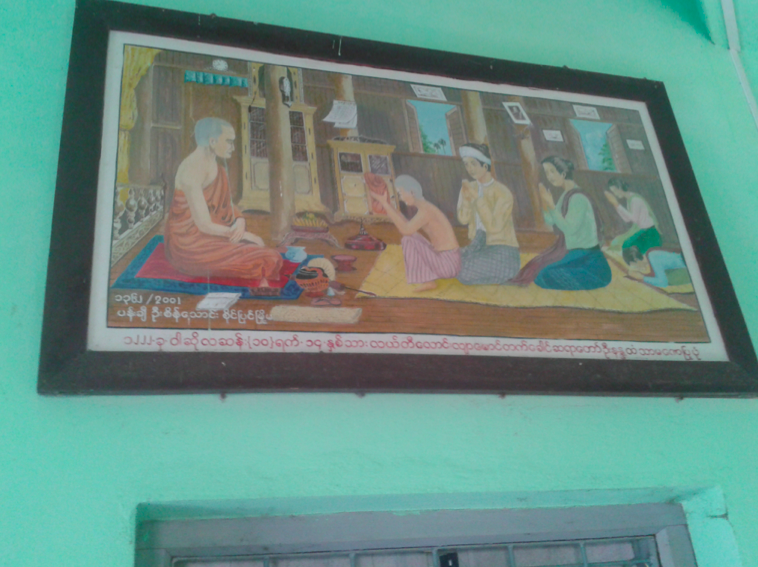
A painting in the very Sima Hall where Ledi Sayadaw was ordained as a boy depicts the event as it happens


This is the very Sima Hall where Ledi Sayadaw ordained as a young boy