Showing posts with label Branden Macie. Show all posts

Thursday, 4 September 2014

Meal at Metta Shin


On the first day of the 2014 year, pilgrims from a dozen countries came together to share breakfast at Thoke Da Metta Shin Monastery in Hmawbi. This was part of a three week pilgrimage throughout Burma that visited important sites where the Dhamma has been preserved and is still practiced. One may also attend pilgrimages this year, and one full scholarship will be offered.


Pilgrims meditate inside mosquito nets in the Sima Hall at Thoke Da Monastery in Hmawbi

The Metta Shin Sayadaw is highly regarded throughout Myanmar as he coordinates a vast amount of humanitarian projects, ranging from health to education to sustainable development. He was very happy to host this pilgrimage group, who came with noble intentions to practice meditation in the Golden Land. Metta Shin Sayadaw has written over 20 books, and two were translated in English, and he regularly speaks to audiences in the thousands. He leads an annual New Year's course in which over 4,000 yogis attend! Interestingly, and somewhat surprisingly, he has just disrobed last month to become married, a rare occurrence for Burmese senior monks and Sayadaws.

Three American yogis from the following pilgrimage outside their room. One ordained at IMC in the 1970s, and another ordained the following month at Shwekyin Monastery

Tuesday, 25 March 2014

A Burma Pilgrimage: "The Benefits should not be Overlooked"

Mårten Berg standing outside Sayagyi U Ba Khin's IMC
Mårten Berg, a Swedish meditator, participated on the February 2014 pilgrimage in Burma. Following he writes some reflections on his trip, now that he has returned to his home country. He hopes to return to the Golden Land next year for continued practice. To read about current pilgrimage offerings, see here.


"To those training in morality and with devotion making efforts towards development in the Dhamma, going to Burma for a pilgrimage is very auspicious. Burma, the golden land, is a unique place, strong in purity. The benefits of going there as a part of ones practice should not be underestimated nor overlooked. The merits gained on such a journey will last throughout ones life and future lives. It will give a strong push of urgency to keep developing in Dhamma and dismay towards worldly things. It will bring out whatever purity one has and multiply it. Whatever negativities there may be will subside, if they arise they will not be so strong and the good atmosphere all around will settle the mind quite effortlessly. It is important that the pilgrim receives support to overcome cultural, language and religious barriers. It is easy with a western mind, to discard the many ways in which Dhamma expresses itself. Being a country of about 60 million people, Burma has its good and bad qualities as any other country. But as one decides to go on a pilgrimage and ones mind attunes towards Dhamma, it gets connected to all the good vibrations of the golden land. There is a wide spectrum of practitioners all the way from just practicing devotion to being fully liberated. If one really makes efforts to understand and go beyond preconceived views one can fully connect to the gift which Burma is to the people of the world. The actual barriers are nothing but the five enemies, namely; craving, aversion, physical sloth/ mental torpor, agitation/ worry and doubt.

Mårten with Snow, her mother, and Branden (now U Ariyavamsa), preparing for monks' alms rounds

I am so full of gratitude as the pilgrimage hosted by Pariyatti, Joah, Snow, Bhante Agga and many others generated a wonderful environment for Dhamma to flourish. Much like a course there were requirements, rules, guidelines and expectations. We had daily meditation sessions, times for eating and resting, scheduled activities and endless opportunities for doing good deeds. We visited places related to revered Goenkaji and the lineage of teachers, and also other sites related to Dhamma in general. The pilgrims were allowed to submerge in the inner experience of the pilgrimage as the management was discretely taken care of behind the scenes. We also received support from our guides' deep intuitive understanding of the golden land and how Dhamma is expressed there. So much so that we also gained intuition and were inspired to visit monasteries on our own. It has been like from swimming in a fish bowl back home to be let out in the ocean of Dhamma to swim on your own. Burma has enriched my life so deeply. To visit the centers of our Dhamma grandfather and great grandfather and so on, to learn about their struggles and attainments, is so satisfying. To know that there is a serious Sangha, that monks and nuns are practicing very diligently, gives so much faith to the heart. To just be near such noble ones, to benefit from their radiating purity is enough to dispel so much of the negativities. And to meet a people so dedicated to following the Buddhas teaching of generosity and morality certainly inspires one to become a better person. I experienced a clarity of mind greater than ever before. Each day kept building on the previous one. We kept saying to each other, 'how can it get any better than this?', and those who knew better would say 'just wait until tomorrow' or 'just wait until we get to such and such a place' or 'until we meet so and so'. Indeed, the good atmosphere kept building throughout the journey. It is difficult to put into words, it is something to be experienced. The Dhamma-sprout planted several years ago in the depths of Vipassana under the protection of Goenkaji, that then needed so much tending, now had grown and was in bloom. With all the sunshine, water and good nutrition, this tree of Dhamma, tree of happiness, gave fruit. Something marvelous culminated in Burma. The negativities became so feeble, an exhilarating sense of freedom emerged. 

Pilgrims explore Saya Thet Gyi's center in Pyaw Bwe Gyi

I read that the Buddha compered his feelings of relief and happiness to those of a man who has just discharged a debt, or recovered from a painful illness, or been freed from prison, or released from slavery, or who has safely crossed a dangerous wilderness. Such was the experience. I am so happy to let you know, this experience wasn't mundane, not another high to come down from. It was transformative. It is something I have brought with me home, the fruits keep on coming every day. It seems this is a new chapter. Dhamma has taken root within. Not that there are no more negativities. But it certainly has helped me get past so many obstacles that would have taken so much longer otherwise. So much misery has been dispelled. My wish of deep sympathetic joy (mudita) and 'come and see for yourself' (ehipassiko) is that all serious practitioners of Dhamma will make a pilgrimage to the golden land, to benefit from its good vibrations and spread this happiness of Dhamma throughout the world.

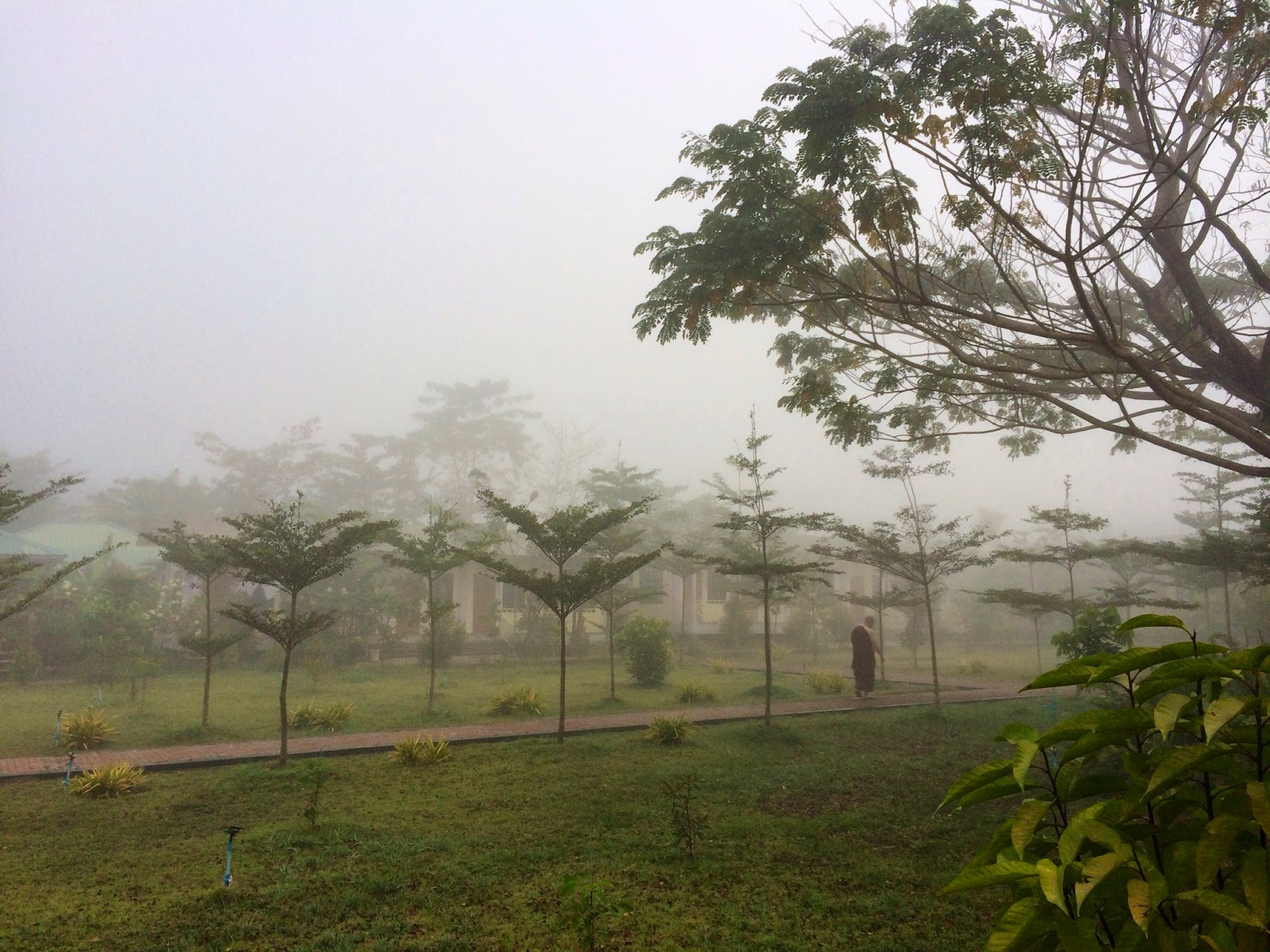
A Burmese Monastery in the early morning hours

As the great emperor Ashoka inscribed on pillar edicts over two thousand years ago: 'Happiness in this world and the next is difficult to obtain without much love for the Dhamma, much self-examination, much respect, much fear (of evil), and much enthusiasm.'"

Mårten with a monk met during the pilgrimage

Monday, 10 March 2014

"The Beauty of Burmese Life is Hard to Qualify."

Pilgrims listen to a dhamma talk by monks in Sain Pyin Gyi, the small village where Ledi Sayadaw was born.

The following essay was written by Branden Macie, an American pilgrim who attended the recent Pariyatti pilgrimage in Burma (and is at present moment sitting a Satipattana course at Dhamma Joti!). The original piece can be found on the Living Vipassana website. To read more about the pilgrimages, see here. To learn about current pilgrimage offerings, see here.

"From January 2012 to March 2012 a nickel of wisdom arose in me while serving long-term at Dhamma Patapa in Jesup, Georgia, U.S.A. I was there to strengthen my individual walk in Dhamma and to share my merits with others who came for meditation alongside other meditators who wanted to apply the technique in daily life-like scenarios. At the time of my stay, I jumped into study (pariyatti) to gain a view of the context of Vipassana being taught there at the Center. Zipping through books with the lightning evaluation capacity which comes with strong concentration episodes, the texts chronicling the lineage of the Vipassana tradition appealed to me most.

One particular book which wedged a great impression in me was the Sayagyi U Ba Khin Journal where details unrelated to the teaching of the typical 10-day courses tested and touched my faithful side, enlivening my understanding of this Path. Leaving the center and maintaining the practice for years following that service period, heavy dreams of pilgrimaging within Burma made their eruption into my conscious stream over and over. Then, Burmese folks I’d meet would lift up those dreams further by inviting me to Dhamma related outings, studies unrelated to the language and practice Goenkaji’s teaching.

For the a long while a needle of uncertainty was lodged into my mind about living Dhamma through different techniques and actions than were known to me through the 10-day retreat center’s presentation. I held on so closely, so personally. The conditioning I’d developed was strong and a barrier to outside Dhamma works, events, and representations of ‘Dhamma’ began to form — I felt a bit off the mark even knowing the Buddha’s Liberation Teachings were specific to each individual. The attachment had to be let go of.

Navigating those walls, the concepts, the emotions they arose became easier with continued acceptance that Buddha’s Dhamma can’t only fit one categorization of language and practice. More important the Real Time at each individual’s mental level, efforts, and energies is where Dhamma exists and that’s gladdening.

Therefore, seeing Burma and the way the society has structured itself while noticing my own inner pilgrimage along the way helped me realize the vastness of walking toward liberation — all the efforts one CAN make for others (regardless of tradition). When one’s mind is settled into the heart of Right Intention much can be shared.

The beauty of Burmese life is hard to qualify. Learning of enlightened Arahats, even ones so recently passed away who revealed their attainments through body relics, were Great teachers of the Dhamma in their own special ways for the Burmese locals. The amount of devotion and merit gaining on a daily level in Burma is astoundingly high. One can go from Alms round serving monks to Pagodas for paying respects to Sayadaws and end the evening with a Dhamma talk on the Abidhamma or any of the hundreds of Suttas contained in the Tipitaka.


Pilgrims arrive at Thanboddhay Monastery, established by Mohnyin Sayadaw, a disciple of Ledi Sayadaw. Thousands of Burmese were sheltered here during World War II and learned meditation during this time. When the pilgrims arrived, dozens of Burmese college students were there for meditation and devotion.
The fruit to seeing the wider context of Buddha’s Dhamma is so sweet, so virtuous, so needed and for anyone interested in investigating Burma Dhamma, I would willingly be a contact point once one enters the country.

Here’s a quote by Harold Fielding from Soul of a People to end on:

“To hear of the Buddha from living lips in this country [Burma], which is full of his influence, where the spire of his monastery marks every village, and where every man has at one time or another been his monk, is quite a different thing to reading of him in far countries, under other skies and swayed by other thoughts. To sit in the monastery garden in the dusk, in just such a tropic dusk as He taught in so many years ago, and hearing the yellow-robed monk tell of that life, and repeat His teaching of love, charity, and compassion — eternal love, perfect charity, endless compassion — until the stars come out in the purple sky, and the silver-voiced gongs ring for evening prayers, is a thing never to be forgotten. As you watch the starlight die and the far-off hills fade into the night, as the sounds about you still, and the calm silence of the summer night falls over the whole earth, you know and understand the teacher of the Great Peace as no words can tell you. A sympathy comes to you from the circle of believers, and you believe, too. An influence and an understanding breathes from the nature about you — the same nature that the teacher saw — from the whispering fig-trees and the scented champaks, and the dimly seen statues in the shadows of the shrines, that you can never gain elsewhere. And as the monks tell you the story of that great life, they bring it home to you with reflection and comment that has application to your everyday existence.”


Two pilgrims relax at the base of a pagoda stupa

Sunday, 2 February 2014

Thoughts about Pilgrimage Visits to IMC and Pyaw Bwe Gyi

The following excerpt was written by Branden Macie about the pilgrimage in Burma, and describes scenes from Day #2 and Day #3. Another American yogi also wrote briefly about the second day. For current pilgrimage offerings, see here.

"Paying respects to and meditating at Sayagyi U Ba Khin's IMC personal cell for a few minutes, a cool dissolution of metta engulfed me, the entirety of U Ba Khin's life and Dhamma efforts washed over me and the vivid words of Goenkaji about U Ba Khin's metta instantly were realized. At once, my mind was fashionable and I cast it in the purest direction knowable, toward the limitless merits of this life and this journey with the whole of conditioned existence with formed/conditioned phenomena, from fine forms to solidified, bound forms. Truly it was easy to pray through the dissolved rupa and nama which that single place affirmed. 


I bowed deeply taking refuge in the Buddhas, Dhammas, and Sanghas of past, present and future. Truly, I pray the streams lightness-- of metta, reach all beings in that location, be known to all, and fill this arupa, rupa, and kama lokas of samsara. The streams of light metta atoms known to my mind was easily fixable, directable. And I cast it in a direction which, surely, Sayagyi would encourage-- towards sharing the merits.

A feather floated lightly through the wind at Saya Thet Gyi Center. It landed on the hard solidified concrete ground. My mind was directed towards subtle/soft realities and to gross/impermeable realities. Then, naturally the awareness of the space enabling soft and hard realities to exist arose in me. Such were the vibrations of our Anagami great grandfather's center: light, heavy, and containing."