Showing posts with label "Soul of a People". Show all posts

Tuesday, 2 December 2014

"They do not sleep or eat or walk as do other men.”


“The reverence in which a monk—ay, even the monk to-day who was but an ordinary man yesterday—is held by the people is very great. All those who address him do so kneeling. Even the king himself was lower than a monk, took a lower seat than a monk in the palace. He is addressed as 'Lord,' and those who address him are his disciples. Poor as he is, living on daily charity, without any power or authority of any kind, the greatest in the land would dismount and yield the road that he should pass. Such is the people's reverence for a holy life. Never was such voluntary homage yielded to any as to these monks. There is a special language for them, the ordinary language of life being too common to be applied to their actions. They do not sleep or eat or walk as do other men.” Harold Fielding, Soul of a People

Wednesday, 24 September 2014

Morning recitation at Burmese monastic school


“The education in their religion is very good, very thorough, not only in precept, but in practice; for in the monastery you must live a holy life, as the monks live, even if you are but a schoolboy.” Harold Fielding, Soul of a People

Students at a monastic school recite suttas from the Buddhist scriptures to start their day. One may see how the nuns are in the front of the classroom, thus an early respect for those in robes in established from a young age. Behind them are school children wearing the formal white and emerald green uniforms. Filling up the rest of the room are orphans and local village children. Lessons will commence after the recitation is completed.

Friday, 22 August 2014

A Haircut in the Sagaing Hills


“A Burman's ideas of this world are dominated by his religion. His religion says to him, 'Consider your own soul, that is the main thing.' His religion says to him, 'The aim of every man should be happiness.' These are the fundamental parts of his belief; these he learns from his childhood: they are born in him. He looks at all the world by their light. Later on, when he grows older, his religion says to him, 'And happiness is only to be found by renouncing the whole world.' This is a hard teaching. This comes to him slowly, or all Buddhists would be monks.” Harold Fielding, Soul of a People

Monday, 10 March 2014

"The Beauty of Burmese Life is Hard to Qualify."

Pilgrims listen to a dhamma talk by monks in Sain Pyin Gyi, the small village where Ledi Sayadaw was born.

The following essay was written by Branden Macie, an American pilgrim who attended the recent Pariyatti pilgrimage in Burma (and is at present moment sitting a Satipattana course at Dhamma Joti!). The original piece can be found on the Living Vipassana website. To read more about the pilgrimages, see here. To learn about current pilgrimage offerings, see here.

"From January 2012 to March 2012 a nickel of wisdom arose in me while serving long-term at Dhamma Patapa in Jesup, Georgia, U.S.A. I was there to strengthen my individual walk in Dhamma and to share my merits with others who came for meditation alongside other meditators who wanted to apply the technique in daily life-like scenarios. At the time of my stay, I jumped into study (pariyatti) to gain a view of the context of Vipassana being taught there at the Center. Zipping through books with the lightning evaluation capacity which comes with strong concentration episodes, the texts chronicling the lineage of the Vipassana tradition appealed to me most.

One particular book which wedged a great impression in me was the Sayagyi U Ba Khin Journal where details unrelated to the teaching of the typical 10-day courses tested and touched my faithful side, enlivening my understanding of this Path. Leaving the center and maintaining the practice for years following that service period, heavy dreams of pilgrimaging within Burma made their eruption into my conscious stream over and over. Then, Burmese folks I’d meet would lift up those dreams further by inviting me to Dhamma related outings, studies unrelated to the language and practice Goenkaji’s teaching.

For the a long while a needle of uncertainty was lodged into my mind about living Dhamma through different techniques and actions than were known to me through the 10-day retreat center’s presentation. I held on so closely, so personally. The conditioning I’d developed was strong and a barrier to outside Dhamma works, events, and representations of ‘Dhamma’ began to form — I felt a bit off the mark even knowing the Buddha’s Liberation Teachings were specific to each individual. The attachment had to be let go of.

Navigating those walls, the concepts, the emotions they arose became easier with continued acceptance that Buddha’s Dhamma can’t only fit one categorization of language and practice. More important the Real Time at each individual’s mental level, efforts, and energies is where Dhamma exists and that’s gladdening.

Therefore, seeing Burma and the way the society has structured itself while noticing my own inner pilgrimage along the way helped me realize the vastness of walking toward liberation — all the efforts one CAN make for others (regardless of tradition). When one’s mind is settled into the heart of Right Intention much can be shared.

The beauty of Burmese life is hard to qualify. Learning of enlightened Arahats, even ones so recently passed away who revealed their attainments through body relics, were Great teachers of the Dhamma in their own special ways for the Burmese locals. The amount of devotion and merit gaining on a daily level in Burma is astoundingly high. One can go from Alms round serving monks to Pagodas for paying respects to Sayadaws and end the evening with a Dhamma talk on the Abidhamma or any of the hundreds of Suttas contained in the Tipitaka.


Pilgrims arrive at Thanboddhay Monastery, established by Mohnyin Sayadaw, a disciple of Ledi Sayadaw. Thousands of Burmese were sheltered here during World War II and learned meditation during this time. When the pilgrims arrived, dozens of Burmese college students were there for meditation and devotion.
The fruit to seeing the wider context of Buddha’s Dhamma is so sweet, so virtuous, so needed and for anyone interested in investigating Burma Dhamma, I would willingly be a contact point once one enters the country.

Here’s a quote by Harold Fielding from Soul of a People to end on:

“To hear of the Buddha from living lips in this country [Burma], which is full of his influence, where the spire of his monastery marks every village, and where every man has at one time or another been his monk, is quite a different thing to reading of him in far countries, under other skies and swayed by other thoughts. To sit in the monastery garden in the dusk, in just such a tropic dusk as He taught in so many years ago, and hearing the yellow-robed monk tell of that life, and repeat His teaching of love, charity, and compassion — eternal love, perfect charity, endless compassion — until the stars come out in the purple sky, and the silver-voiced gongs ring for evening prayers, is a thing never to be forgotten. As you watch the starlight die and the far-off hills fade into the night, as the sounds about you still, and the calm silence of the summer night falls over the whole earth, you know and understand the teacher of the Great Peace as no words can tell you. A sympathy comes to you from the circle of believers, and you believe, too. An influence and an understanding breathes from the nature about you — the same nature that the teacher saw — from the whispering fig-trees and the scented champaks, and the dimly seen statues in the shadows of the shrines, that you can never gain elsewhere. And as the monks tell you the story of that great life, they bring it home to you with reflection and comment that has application to your everyday existence.”


Two pilgrims relax at the base of a pagoda stupa

Saturday, 8 March 2014

A Bhikkhu's Single Meal: Alms Rounds In Burma

This beautiful Burmese documentary from several decades ago has now been added English subtitles, allowing yogis all over the world to benefit from watching it. It shares the role that food, and the offering of food, plays in the life of a bhikkhu.


“The gifts are never acknowledged. The cover of the bowl is removed, and when the offering has been put in, it is replaced, and the monk moves on. And when they have made their accustomed round, they return, as they went, slowly to the monastery, their bowls full of food… It is a good thing to give alms—good for yourself, I mean. So that this daily procession does good in two ways: it is good for the monk because he learns humility; it is good for the people because they have thereby offered them a chance of giving a little alms. Even the poorest may be able to give his spoonful of rice. All is accepted. Think not a great gift is more acceptable than a little one. You must
judge by the giver's heart.”

--Harold Fielding, Soul of a People

“The first alms round was a magical experience with devout donors and plenty of gratitude both from them and from us. The life of an alms mendicant is interesting, the householders are respectful and grateful to have someone representing Buddha to them, when they give us food they feel joyful and thus earn merits. We monks are equally grateful, with their donation we can live this wonderful life another day without difficulty. It is a mutual symbiotic relationship of joy with neither side accumulating a sense of debt to the other.”

--Canadian monk

Sunday, 2 March 2014

A Diary of Pilgrimages

Three young Burmese boys join a group siting at a pagoda with the pilgrims

42 days of pilgrimages have now been completed, and two groups of devoted yogis have now seen the best that Burma has to offer, with many lives transformed in the process. Some pilgrims ordained and are still in robes, with others coming in the next few weeks, months, or even years with a similar intention in mind. Others have grasped the dhamma in more profound ways than was possible in one's home country, and have returned to their local community to share their wealth of experience, understanding, and inspiration.

The following guide shows the diary entries recorded for the two yatras. The majority of the first diary entries were made by Kory Goldberg, a Canadian yogi and author of Along the Path. The majority of the second yartra entries were made by an anonymous American pilgrim.

While no yatras have as yet been confirmed for the following winter of 2015, there are upcoming opportunities for those interested to join part on such excursions in the near future. U Kumara at Sitagu Academy has indicated an interest in hosting Abhidhamma workshops in English for any interested foreigners in the Sagaing Hills in June, and brief ten-day dhamma trips will be organized both before and after these courses for those wishing to attend. Finally, one may also contact Muditā Works  (the agency which arranged for the entire following two pilgrimages) at any time to arrange such a dhamma trip according to the wishes of one's group.


The ruins of Htut Kaung Monastery in the Sagaing Hills. This was one of the world's first meditation-oriented monastery 

Pilgrimage #1
Day 1: Yangon
Day 2: Pyaw Bwe Gyi
Day 3: Yangon and Hmawbi
Day 4: Hmawbi
Day 5: The Road to Mandalay
Day 6: Mandalay
Day 7: Kyaukse and Mandalay
Day 8: Mandalay and Monywa
Day 9: Monywa
Day 10: Monywa, Sain Pyin Gyi, and Ingyinbin
Day 11: Ingyinbin
Day 12: Ingyinbin
Day 13: Ingyinbin
Day 14: Ingyinbin, Shwebo, and Sagaing Hills
Day 15 and 16: Sagaing Hills
Day 17: Mingun
Day 18: Sagaing Hills and Yangon
Day 19: Yangon
Day 20: Yangon

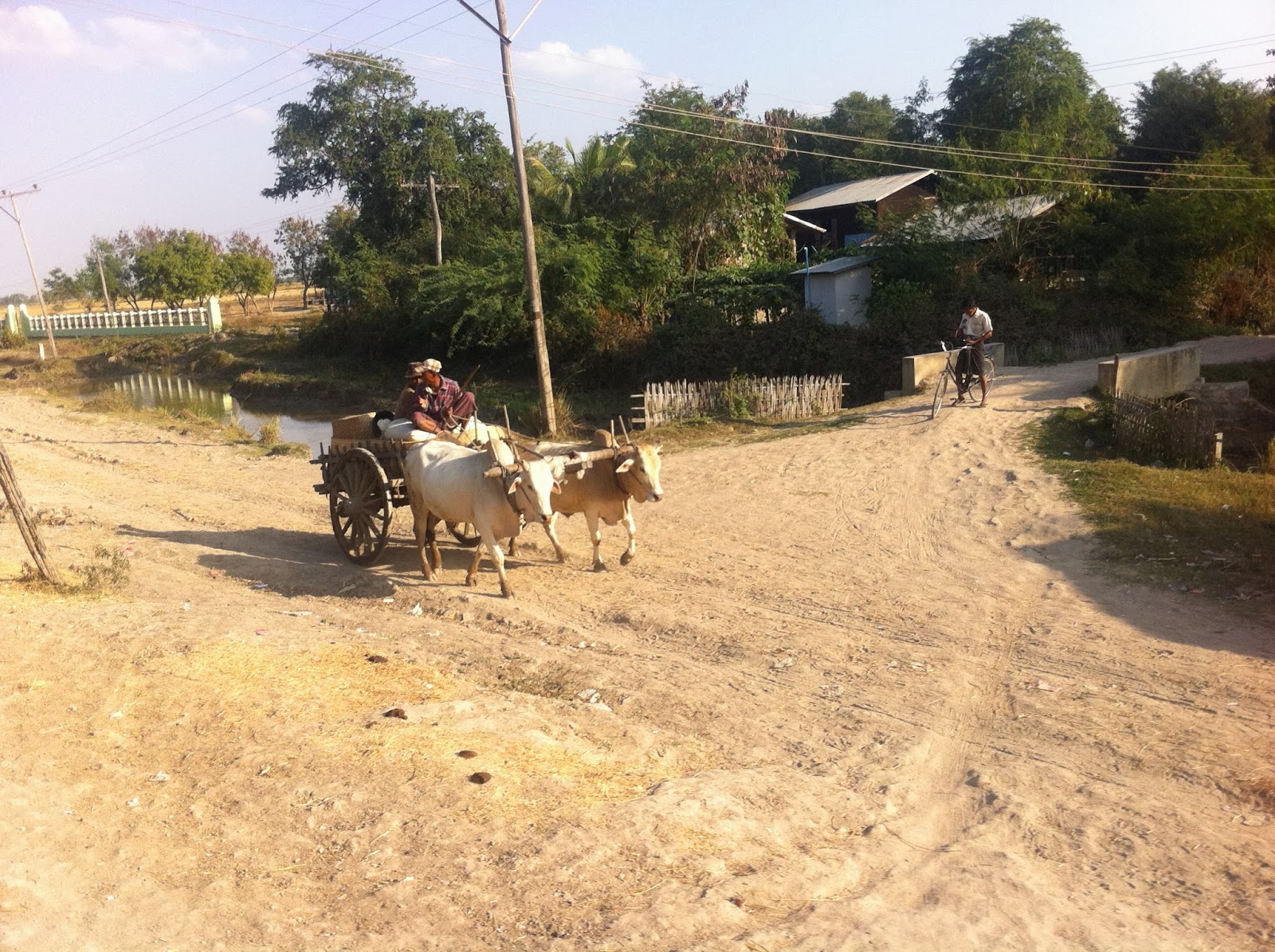
A typical rural Burmese scene

Pilgrimage #2
Day 1: Yangon
Day 2: Pyaw Bwe Gyi
Day 3: Yangon and Hmawbi
Day 4: Hmawbi
Day 5: The Road to Mandalay
Day 6: Mandalay
Day 7: Kyaukse and Mandalay
Day 8: Mandalay and Monywa
Day 9: Monywa
Day 10: Monywa, Sain Pyin Gyi, and Ingyinbin
Day 11: Ingyinbin
Day 12: Ingyinbin
Day 13: Ingyinbin, Shwebo, and Sagaing Hills
Day 14: Sagaing Hills Nunneries
Day 15: Within the Sagaing Hills
Day 16: Sagaing Hills One Day Sitting
Day 17: Mingun
Day 18: Sagaing Hills and Yangon
Day 19: Yangon
Day 20: Yangon

Pilgrims travel back from Mingun to Sagaing

...one may ask, what is so special to have to come across the world to Burma anyway, when the practice is basically inside already? Harold Fielding, a British administrator, provided an answer to this question in 1898 in "Soul of a People":

"To hear of the Buddha from living lips in this country, which is full of his influence, where the spire of his monastery marks every village, and where every man has at one time or another been his monk, is quite a different thing to reading of him in far countries, under other skies and swayed by other thoughts. To sit in the monastery garden in the dusk, in just such a tropic dusk as he taught in so many years ago, and hear the yellow-robed monk tell of that life, and repeat his teaching of love, and charity, and compassion—eternal love, perfect charity, endless compassion—until the stars come out in the purple sky, and the silver-voiced gongs ring for evening prayers, is a thing never to be forgotten. As you watch the starlight die and the far-off hills fade into the night, as the sounds about you still, and the calm silence of the summer night falls over the whole earth, you know and understand the teacher of the Great Peace as no words can tell you. A sympathy comes to you from the circle of believers, and you believe, too. An influence and an understanding breathes from the nature about you—the same nature that the teacher saw—from the whispering fig-trees and the scented champaks, and the dimly seen statues in the shadows of the shrines, that you can never gain elsewhere. And as the monks tell you the story of that great life, they bring it home to you with reflection and comment, with application to your everyday existence."


School children gather before a backdrop of rural stupas

Sunday, 2 February 2014

Burma Yatra #2, Day 1

The following excerpt was written by an American yogi about the pilgrimage in Burma. The first pilgrimage has ended, and the second one has just begun! (To see and compare Day #2 of the first yatra, see here, and to another account of the IMC and Saya Thet Gyi visits, see hereYou can also consider joining a later pilgrimage in Burma yourself.

Shwedagon Pagoda as seen from the pilgrims' Yuzana Hotel


"I wasn't planning on writing unless inspiration struck. Based on how things unfolded today, it may strike more often than not...

Pardon any inaccuracies...

There's a corner of Shwedagon where depending on which tile you step on, the diamond on top of the main pagoda shimmers a different color. At the right place, at the right time, the unexpected materializes... So it was with day one of the yatra.

The morning found us barefoot walking from the motorcoach into Shwedagon. For those of us unaccustomed to walking on gravel (stained with local flavors, nonetheless), it was a great opportunity to practice with changing unpleasant sensations. It was especially sweet to remember that this is how (as Harold Fielding put it) the 'Knower of Great Peace' walked, and all the line of monastics after him...

After a brief tour of Shwedagon, we headed to IMC. There was a course ongoing, but Snow and Joah had gotten permission for us to do a one hour group sit on the platform outside the pagoda cells. After a strong sit, Sayagi U Ba Khin's (normally locked) cell was unexpectedly opened for viewing. We each sat briefly in the outer portion of the cell, just long enough to feel the coolness emanating from within and to pay respects.


The view of the inner pagoda area where Sayagyi U Ba Khin would sit, and where Webu Sayadaw meditated when he visited IMC, was specially and unexpectedly opened for pilgrims

A sample of the books by and about U Ba Khin that are available in the IMC bookstore
There was tremendous gratitude welling up from this visit - how special to be able to sit where it all (more recently) began. The radiating out of dhamma from this place has rippled through many lives across the world. May it continue for generations to come.


The powerful impression of the Shwedagon at night
And then... another unexpected surprise was in store - Sayagi U Ba Khin's son and his wife would be joining us for lunch... We were able to hear some stories from him, including how he took his first course. He recently wrote a book on his father - currently only in Burmese, but English translation is underway.

The post lunch afternoon flowed toward more mundane matters - a quick trip to Bogyoke market to pick up necessary items and/or gifts. And the evening wraped up with a group sit at Shwedagon. As it was Saturday night, the ring of candles at the base were amply lit. Dancing flames flickering in the breeze accompanied a walk through Shwedagon's Saturday crowds.

And so ends a day of unexpected surprises - what a start to a grand adventure!"

See here for Day 2 at Saya Thet Gyi's!

Tuesday, 5 November 2013

Burmese Dogs: A Bark Worse Than Its Bite

A typical wild dog as found in Burma (Myanmar)


Haun lun thay kwe, lu ma lay: “A dog barking all the time will not bite.”

It is helpful to be attuned to canine behavior in Myanmar, especially as dogs usually know when someone unfamiliar enters their territory. If you happen upon a dog sniffing the ground, cowering its head or wagging its tail, these are all good signs that the animal does not pose any threat. However, a stiffened tail, frozen body posture, and alert eyes and head are all signs of possible aggression, though these are often nothing more than a prelude to a threatening bark. Most dogs in Myanmar don’t want to fight, but feel a need to defend their territory. 


If a dog looks like it might be trouble, you have some options of how to respond. Some yogis will menacingly raise their hand as if they are about to throw something—whether you have an object or not doesn’t matter, as many dogs know from experience what this gesture means. Others will walk on in a steady pace ignoring the dog entirely, making a loud clicking noise with the tongue that many Burmese dogs have been conditioned to understand that this is warning them to back off. Others may simply try for mettā. Whatever you do, it is unwise to show fear or uncertainty. If you are staying somewhere for a while, most often the nearby residents will eventually call the dog back, and after several days the dog will realize you are not an unwelcome intruder, and let you be.


However, many of the dogs in Myanmar are happy enough with their monastery leftovers and not looking for any trouble. Harold Fielding noted this more than one hundred years ago in Soul of a People, when he wrote: “Coming from half-starved, over-driven India, it is a revelation to see the animals in Burma. The village ponies and cattle and dogs in India are enough to make the heart bleed for their sordid misery, but in Burma they are a delight to the eye. They are all fat, every one of them— fat and comfortable and impertinent; even the ownerless dogs are well fed.”

While one may have little fear against actual dog bites, avoiding their bark is a much harder task, as one Burmese proverb illustrates. One says Sin paw ga lu kwe haun, meaning “the dog barks at the man on the elephant,” and refers to exerting effort towards something which is not going to be all that effective.

Friday, 1 November 2013

Burmese Monasteries

One of the pieces of original artworks that was completed by a meditator and will appear in Shwe Lan


“They are most beautiful, many of these monasteries—great buildings of dark-brown teak, weather-stained, with two or three roofs one above the other, and at one end a spire tapering up until it ends in a gilded 'tee.' Many of the monasteries are covered with carving along the façades and up the spires, scroll upon scroll of daintiest design, quaint groups of figures here and there, and on the gateways moulded dragons.” Harold Fielding, Soul of a People 


Monasteries come in all kinds of different shapes and sizes, from giant concrete complexes with hundreds of monks in attendance to teak kutis built deep in the forests that house only a single occupant. Those monasteries that receive more dana or regularly welcome foreigners are often known to have slightly improved amenities.


Monasteries are not guesthouses. When looking at hotels, it is reasonable to ask about the room, the shower, the bed, and other such living conditions, and to even ask to inspect them before choosing to stay. Monasteries are a place for yogis to develop their nekhemma parami, meaning renunciation and acceptance. By definition, monasteries are places of simple living but where most basic necessities are met, and above this one need not request.

If you have a medical condition or special request, it is appropriate to communicate this to the Sayadaw and politely inquire if the monastery can meet this need. An example would be having a bad back and needing a certain amount of padding when sleeping, or feeling under the weather and needing a quiet place to rest. However, be careful not to stretch the meaning of “special needs.” Needing almond-flavor soymilk instead of 2% or asking the kitchen to prepare separate dishes with fewer chilies may pass at Western meditation centers, but you’ll have to make due here, and anything that does come from a request should be reimbursed to either the office or kitchen staff. In fact, one of the main reasons many Sayadaws hesitate to accept Westerners is they know ahead of time about their propensity to have such “special needs”, and they worry that their basic monastery will not be able to meet their standard of living. For this reason, it is important that the foreign yogi adapt to local conditions as much as possible (while not compromising health), and to show monks that you are satisfied with what has been given and do not require more. Your behavior will impact not only the relations you have with the monastery, but will have consequences for many more yogis who may wish to practice there in the future—if your stay causes any difficulties or complexities then they may hesitate to offer such an opportunity the next time someone comes to request.

On this point, it may be relevant to hear the words of one Dutch monk who has been living in Myanmar for several years: “What I think cannot be stressed enough is that all facilities, food, teachings etc are all gifts, they are coming from the generosity of others. You're a guest in somebody else’s place, [so] you can't demand things as you wouldn't if you are visiting friends. Here at [my monastery], too many times I've seen foreigners forgetting that everything is a gift. They make demands, complain about the food, require things, don't follow rules or don't show gratitude… I find it painful to see this ignorance, and feel bad for donors who see them.”

Saturday, 19 October 2013

Various views on the practice of "Pindabat", or the alms rounds of monks

The Meditator Guidebook to Myanmar is in its final stages. As the guide gets closer to publication, we will begin to share excerpts of what yogis and meditators may expect... some sneak previews of what is to come. Here is an excerpt from the section on Monastic Life, and discusses the monks' alms rounds. We have included three quotations that were placed towards the end of this section:
--


“The gifts are never acknowledged. The cover of the bowl is removed, and when the offering has been put in, it is replaced, and the monk moves on. And when they have made their accustomed round, they return, as they went, slowly to the monastery, their bowls full of food… It is a good thing to give alms—good for yourself, I mean. So that this daily procession does good in two ways: it is good for the monk because he learns humility; it is good for the people because they have thereby offered them a chance of giving a little alms. Even the poorest may be able to give his spoonful of rice. All is accepted. Think not a great gift is more acceptable than a little one. You must judge by the giver's heart.” Harold Fielding, Soul of a People

“Offering alms to monk on their daily rounds is considered of even greater merit than sending an elaborate meal to the monastery or inviting monks to one’s home to partake of food: it is spontaneous and lacking in show or ostentation and there is also a spirit of impersonal and impartial good will.” Khin Myo Chit, Colorful Myanmar

“The first alms round was a magical experience with devout donors and plenty of gratitude both from them and from us. The life of an alms mendicant is interesting, the householders are respectful and grateful to have someone representing Buddha to them, when they give us food they feel joyful and thus earn merits. We monks are equally grateful, with their donation we can live this wonderful life another day without difficulty. It is a mutual symbiotic relationship of joy with neither side accumulating a sense of debt to the other.” Canadian monk


A foreign monk accepts rice from a young villager outside of Shwe Oo Min Monastery in Northern Yangon

Sunday, 8 September 2013

Shwe Lan Excerpt: The Monkhood

“The more you study the monkhood, the more you see that this community is the outcome of the very heart of the people. It is a part of the people, not cut off from them, but of them; it is recruited in great numbers from all sorts and conditions of men. In every village and town—nearly every man has been a monk at one time or another—it is honoured alike by all; it is kept in the straight way, not only from the inherent righteousness of its teaching, but from the determination of the people to allow no stain to rest upon what they consider as their 'great glory.' This whole monkhood is founded on freedom. It is held together not by a strong organization, but by general consent. There is no mystery about it, there are no dark places here where the sunlight of inquiry may not come. The whole business is so simple that the very children can and do understand it. I shall have expressed myself very badly if I have not made it understood how absolutely voluntary this monkhood is, held together by no everlasting vows, restrained by no rigid discipline. It is simply the free outcome of the free beliefs of the people, as much a part of them as the fruit is of the tree. You could no more imagine grapes without a vine than a Buddhist monkhood that did not spring directly from, and depend entirely on, the people. It is the higher expression of their life.” Harold Fielding, Soul of a People

A student pays respects to monks after finishing her alms donation

Friday, 23 August 2013

Shwe Lan Excerpt: Planning Your Trip

The Meditator Guidebook to Burma is in its final stages! As the guide gets closer to publication, we will begin to share excerpts of what yogis may expect... some sneak previews of what is to come. Here is an excerpt from the introduction of our section on "Planning Your Trip":
---


"Burma, I declare! One does not hear much of that part of the world; it's always connected in my mind with rice and rain.” --B.M. Croker, The Road to Mandalay (1917)

The words spoken above are given to a British fictional character after learning that her friend has decided to leave London for Rangoon. Though written almost one hundred years ago, travelers to the Golden Land today often face a similar reaction from their friends and family upon learning of their intended destination (that is, assuming it is not confused with Burundi or Bhutan). However, since the time that the venerable Ledi Sayadaw began a written correspondence with some of the top Western thinkers about Buddhist theory and British chemist Allan Bennet became the first foreigner to take robes in the country, a steady trickle of foreigners have continued to keep Burma on the mind, and certainly in the heart.

From the British occupation to World War II strategic planning to the Cold War Era to very recent history, the country has for the most part been overlooked by the greater world. Neighboring countries always seemed to have bigger crises, greater global relevance, and perhaps a more accessible understanding. But this is now all quickly changing, a factor that has immediate and long-term implications for yogis now using this book to making their own preparations for travel. A country once forgotten in time for all but a select group is now receiving regular visits by top world diplomats, celebrities, billionaires, and investors. Its transition and gradual opening are being watched with awe and commentary as one phase continues to the next. And its tourist numbers are off the charts, changing landscapes overnight. As one author recently noted, “the numbers are still climbing. In the Lonely Planet based economy, places are changing.”

Indeed, “places are changing,” this much is indisputable. But what kind of change? For the generation of yogis, meditators, dhamma students, and Buddhists who are the living beneficiaries of Ledi Sayadaw’s works, and to those who wish to follow the example set by Allan Bennet in his ordination, what will these new changes look like? In other words, for that audience for whom the book is meant, how will these changes alter plans and extended stays? And how will the country’s greater openness and access to opportunity affect its age-old traditions and customs?

The way forward is not yet clear (as this following Planning Your Trip chapter will certainly illustrate), although perhaps we can turn to a pundit who was present during a preceding period of transition. Following their taking of Upper Burma in 1885, England deposed the Burmese king and sent him to exile, moved the capital 693 miles south, opened new ports to bring both international trade as well as entire new immigrant populations, revitalized new industries, developed infrastructure that still stands today, instituted a new educational and administrative system, and brought overwhelming changes into a previously closed country in the fields of technology, food, weaponry, and transportation, among others. A little more than a decade after such drastic transformations were underway, Harold Fielding pondered this very same question, and questioned aloud how the local traditions and religion might be able to withstand the modern pull.

Here is his answer: “But a community that has lived through twenty-four centuries of change, and is now of the strength and vitality that the Buddhist monkhood is, can have nothing to fear from any such change…. the pattern and ensample of purity and righteousness will always remain.”

While the early 21st century experiment has yet to be played out, we can see how the late 19th century experience ended up. What may be different now as opposed to then are the many fertile seeds of dhamma practice that have been sprouting in many diverse corners of the world. As meditators and Buddhists begin to stream into Myanmar in higher numbers to take a retreat or pursue a life of inner calm, outside interest in the practice will continue to increase, and respect for the traditions may give way to greater sustainability. And perhaps in ten years time a contemporary writer can comment on how Burma is holding up her traditions then, which a guidebook 120 years from now can pick up and quote from, and our future reader can evaluate how the Buddhist practice of the people has continued to adjust and adapt to an ever-changing world. For now, in this chapter, we do our best to advise you on the ever-changing current conditions, and how to best prepare for them prior to arrival.


Monks on an Alms Round in a small Burmese town

Thursday, 15 August 2013

Shwe Lan Excerpt: Introduction

The Meditator Guidebook to Burma is in its final stages! As the guide gets closer to publication, we will begin to share excerpts of what yogis may expect... some sneak previews of what is to come. In this post, we present you the complete first page from the Introduction:
---
In the past couple of decades, Buddhist practice has begun to reach regions of the globe that have scarcely been impacted in the 2500 years since the teachings passed from the mouth of Siddhartha Gautama himself. The American Religious Identification Survey estimated that the number of self-indentified Buddhists in the US increased by 170% between 1990 and 2000, while an Australian government bureau showed a 300% increase between 1991 and 2001, making it their nation’s fastest growing spiritual tradition or religion. The numbers jump out even in places where you least expect them, such the eightfold rise in Buddhist converts in British jails (where it also has the “fastest-growing” moniker), to Brazil, which boasts the third-largest Buddhist population of the Americas and has 150 temples spread across the country, and where one state government even began a mandatory meditation program for its military police.
As these teachings spread and are further established in local communities around the world, native sanghas begin to grow and take root in their own right. In so doing, the Buddhist practice finds a way to fit the needs and values of local communities. For example, the Buddhism brought in the 19th century to various African countries by Indian, Sri Lankan, and Burmese communities who arrived with the British would later catch on among liberal whites, who would go on to organize multi-racial meditation courses (which government agents promptly infiltrated). Buddhism in Africa now has followers among all segments of society and new meditation centers and monastic orders coming up, with a Burmese ordination in 1997 in South Africa and Tanzanian elephants re-trained to carry a pinnacle for a new pagoda inauguration. Similarly, there are also unprecedented stories of group meditation sittings and instruction taking place within organizations and communities that have no such prior history. While it may be not terribly surprising to hear that some progressive Catholic churches and Jewish synagogues have started meditation programs, a Midwestern congressman organizing a mindfulness group in the U.S. Capitol and General Mills equipping every building on its corporate campus with a meditation room would have been unimaginable only 10 years ago. Meditation has now gained official legitimacy from neurologists to psychologists to executives to scholars, and a 2007 National Institute of Health survey found that a full 10% of Americans meditate in some form on a regular basis. While meditation-only groups would likely seem quite foreign to traditional Buddhist communities and certainly outside of their own definition of sangha, spirituality and religion have always migrated in those ways that the people find them to be most useful and needed, and Buddhist meditation has been no exception.
As Theravada Buddhist teachers, sanghas, and traditions become established and strengthened throughout the world, the need to travel to a specific region or meet a particular abbot or teacher seems to be less vital than it was in years past. Indeed, there is the story of an American renunciate in the 1970s who decided to ordain in Sri Lanka, knowing little of other options available to him. After some time there, he happened to come across an Ajahn Chah book describing the Thai forest tradition for the first time, and was so moved that he changed course and immediately re-ordained in Thailand. He is now one of the senior foreign Ajahns there, a circumstance that came about only by a chance encounter with a single book, and one that took him many years to eventually come across.
For better or worse, the modern yogi need no longer worry about a scarcity of such resources. Today, one can never leave the confines of one’s own home and still access a nearly unlimited (and free) amount of Buddhist material. This may range from podcasts to electronic books to documentaries, and may cover everything from Abdhidhamma theory to meditation instructions to personal narratives. And for the yogi who wishes to find quality teachers, practice environments, and a greater spiritual community, it is similarly getting easier and easier to simply do it all locally— an option that just a few decades ago would have been extremely rare, if not impossible. This is all the more true if one happened lived away from certain communities known for their progressive and eclectic nature— such as small enclaves in northern California, western Massachusetts, Byron Bay, Glastonbury, and Christiania— where a mix-mash of various Eastern-inspired teachings were beginning to find followers.
While such greater accessibility provides more opportunities for one to find the Noble Eightfold Path, it also lessens the urgency of having to actually travel to a foreign land, and by extension having to face a foreign culture, language, practice, climate, food, and a host of other logistical issues that comes with any global movement. In other words, there is no need to go to the practice, since the practice can come to you.
Additionally, for many who come upon the path of Dhamma after years of searching, one of the first profound realizations that one makes is that practice is essentially an internal affair. This may sound obvious, but for many who have been engaged in external pursuits and searches in the physical world, it is quite a revelation to realize that true peace comes only from looking within.
The question then comes that if the answer lies inside, and if the resources to navigate these inner routes have become more available, what is the need for going half way across the world anymore? In other words, if the practice is only one of “going inside”, then why make such an effort for “going outside?”
This is a good question, and there may be no greater response than the one Harold Fielding provided in 1898, referencing his many years spent as an Englishman in Burma:

"To hear of the Buddha from living lips in this country, which is full of his influence, where the spire of his monastery marks every village, and where every man has at one time or another been his monk, is quite a different thing to reading of him in far countries, under other skies and swayed by other thoughts. To sit in the monastery garden in the dusk, in just such a tropic dusk as he taught in so many years ago, and hear the yellow-robed monk tell of that life, and repeat his teaching of love, and charity, and compassion—eternal love, perfect charity, endless compassion—until the stars come out in the purple sky, and the silver-voiced gongs ring for evening prayers, is a thing never to be forgotten. As you watch the starlight die and the far-off hills fade into the night, as the sounds about you still, and the calm silence of the summer night falls over the whole earth, you know and understand the teacher of the Great Peace as no words can tell you. A sympathy comes to you from the circle of believers, and you believe, too. An influence and an understanding breathes from the nature about you—the same nature that the teacher saw—from the whispering fig-trees and the scented champaks, and the dimly seen statues in the shadows of the shrines, that you can never gain elsewhere. And as the monks tell you the story of that great life, they bring it home to you with reflection and comment, with application to your everyday existence."

Yogis who have been to Burma in this current century can attest to similar impressions. Even several years after a visit, many can describe in vivid detail how their time in the Golden Land provided an invaluable gift to their practice and to their life.

The guide that follows was made by those who have tasted the joys of living and practicing in Burma, even for a short time, and wanted to find a way to share these treasures with a wider audience. This includes native Burmese who sincerely wish to welcome and support foreign yogis planning a visit to their country, as well as non-Burmese who have spent time here and wish to share their experience.
... [Introduction continues]....

A monk walks over an old stone walkway in the Sagaing Hills