Showing posts with label Maha Bodhi Monastery. Show all posts

Monday, 26 June 2017

The White Scarf and Burmese Meditation


Marie Byles records that at exactly 1:00 p.m. on Christmas Eve, something curious happened at the Maha Bodhi meditation center in Mandalay. “U Thein placed a white scarf over my shoulders, saying that I was now a Yogi and should always wear the scarf when meditating.” Her description almost seems to imply that the presentation and donning of the white scarf was symbolic of a formal, spiritual transformation, not dissimilar to a monk’s taking of saffron robes during an ordination ceremony.

Looking through the lens of Buddhist history, U Sarana notes that references to white garb are found frequently throughout the Pāḷi scriptures, occurring in all five nikayas of the Sutta Pitaka (including thirty-nine times alone in the Majjhima Nikaya). In the scriptures, white is associated with purity in general, and specifically can mean that one is following eight or ten precepts. Interestingly, Saya U Than recalls how Ledi Sayadaw had instructed Saya Thet Gyi to wear a white scarf once he began teaching meditation. Sayadaw U Vajirapani, one of the most senior students of the famous Tipiṭakadhara Yaw Sayadaw, noted that Ledi was adhering to the scriptural reference of seta paribajaka, or “white recluse,” (Also written as setavattha paribbājaka. More information is available in the Khuddakavatthukkhandhakaṃ, from the Vinaya Pitaka.) as well as odata vasana gihi, meaning “person clothed in white.” U Vajirapani suggests that Ledi reduced the practice of wearing entire white garments down to a plain white scarf, asking lay yogis to wear it when they came to the forest to learn Dhamma from him, and then the custom was carried over when meditation-oriented monasteries came to be established in later years. Photos of white scarves from the early 20th century show them as being much larger than merely covering the neck or acting as a kind of sash, as it is worn today, suggesting that it has since been reduced further in size.


 Then, U Ko Lay describes that when U Ba Khin was learning under Saya Thet Gyi, Saya Thet became pleased with his student’s meditation progress, and advised him “to sit in mental culture for seven days, and to wear a white cloth around his shoulders.” Later, when Webu Sayadaw encouraged U Ba Khin to spread the Dhamma, he is reported to have said, “Give [the lay practitioners] a method. Give him the teaching as a layman after having changed to wearing a white cloth.” Later on, many yogis at the International Meditation Center took up the practice of wearing a white shawl. The practice of the white scarf is not very common in meditation centers and monasteries in Myanmar today. However, in other Buddhist countries (such as Sri Lanka and Thailand), some monasteries continue to require a fully white garb for meditation courses and other ceremonies, as do some organized pilgrimages.


Friday, 2 June 2017

Saya Thet Gyi's Method, in Mandalay


This 31-acre site got its name from the sapling of a Bodhi tree that was brought from Bodhgaya in the 19th century. The whole area, in fact, has been known as Bodhigone, or literally “Bodhi table.” This refers to the physical base on which a Bodhi tree is placed or from which it grows, and can also be used metaphorically. Even though the original tree is no longer here, the name remains.

Today Secretary U Win Maung is one of Maha Bodhi’s primary lay supporters. He recalled coming here regularly as a young man and learning under Saya U Thein directly. Upon returning from an extended stay in Singapore to find parts of the center left unattended, he made it his life’s mission to oversee much-needed renovations here. Bhaddanta Karunika Bivantha is the primary meditation instructor here. He spent thirty years learning under Saya U Than, another of Saya Thet Gyi’s important disciples, and today teaches in the tradition of his guru.

The daily meditation regimen consists of eight one-hour sittings, with a 30-minute break between. The sayadaw joins the meditators for three sittings daily. Anāpāna is taught according to the four stages of the First Tetrad as described by Ledi Sayadaw (in brief, these are: (1) establishing mindfulness, (2) knowing if the breath is long or short, (3) feeling the whole breath, and (4) becoming peaceful within calm observance.), and Bhaddanta Karunika Bivantha teaches that the student must pass through all four stages before moving to vipassanā. Practically speaking, yogis often follow anāpāna for the first four days of a 7-day course and switch to vipassanā during the final three days. Concerning the kind of vipassanā practiced here, Bhaddanta Karunika Bivantha instructs yogis to become distinctly aware of vedanā and how it is constantly changing. Once the yogi understands that vedanā is anicca, he says, then one can move on to observing the four elements.


Monday, 8 August 2016

Why did Saya Thet Gyi Give White Scarves to Meditators?


Marie Byles, Australian author of Journey Into Burmese Silence, visited Maha Bodhi Meditation Center in 1957, and was taught for several months by Saya U Thein, one of the main disciples of Saya Thet Gyi. 

Byles recalls that on at “1 p.m. on Christmas Eve… U Thein placed a white scarf over my shoulders, saying that I was now a Yogi and should always wear the scarf when meditating.” Byles’ description almost seems to imply that the white scarf encouraged a formal spiritual transformation, not dissimilar to a monk’s ordination. 

Interestingly, Saya U Than wrote about how Ledi Sayadaw had instructed Saya Thet Gyi to wear a white scarf once he became a meditation teacher. Then, later on, many yogis at the International Meditation Center took up the practice of wearing a white shawl when studying under Sayagyi U Ba Khin. Although it is not clear where the garment originates from or its underlying meaning, it may relate to the brown shawl, or yawbut tin thi, that Burmese pilgrims and meditators wear today and that indicates their spiritual intent. However, U Sarana is doubtful about this, for he notes that “the brown scarf for ladies was an attempt to ‘label’ them with a ‘recluse mark,’ thus to differentiate them from the monastery workers and non-yogis.”

Buddhist history may also shed some light on this wearing of white. Dating back at least to the 3rd century B.C.E., the Sri Lankan laity would dress entirely in white to indicate their adherence to following eight or ten precepts. Some monastic traditions request that samaneras dress entirely in white before their ordination, and still in Sri Lanka today, lay yogis routinely dress entirely in white when visiting monasteries for uposatha, during meditation retreats, or on pilgrimages. It is uncertain if Ledi’s preference of a white scarf was contextual to his time, historical, or a unique innovation that he encouraged himself.

Note that the photograph above depicts a statue of Saya Thet Gyi at his meditation center in Pyaw Bwe Gyi, and the painting below shows him wearing the white scarf in a painting at the same site.  In the latter painting he is shown holding beads, suggesting that he may have used this in his meditation practice, as his teacher Ledi Sayadaw was also photographed with beads. 


Tuesday, 3 February 2015

Sayagyi U Goenka Pilgrimage: Dhamma Mandapa in Mandalay


The 2015 Sayagyi U Goenka Pilgrimage is now underway! Pilgrims descended from such countries as Israel, England, India, the US, and China, and are being led around the sacred sites in the U Goenka tradition.


On this day, pilgrims visited the Dhamma Mandapa U Goenka Vipassana center in Mandalay.

Meaning “Pavilion of Dhamma” and located where the royal gardens once stood, this center affiliated with the Sayagyi U Goenka tradition is actually located within the compound of Bamaw Monastery. In the spirit of mutual respect and honor that characterizes many Dhamma practitioners in Burma, several years ago the present Bamaw Sayadaw offered part of his compound to be used for this U Goenka center, the first to appear in the Mandalay region. As one enters the compound, one sees the bright white spire of the Maha Bodhi monastery, a site in the Saya Thet Gyi tradition, looming up beyond the monastery grounds. In the compound itself, to the right, is a newer Bamar Monastery, and set against a backdrop of palms to the left is the architectural highlight of the compound, the older Bamar Monastery.

To read about last year's visit to Dhamma Mandapa, see here. Also, please note that while the 2013-4 pilgrimages were sponsored by Pariyatti, the 2014-5 pilgrimages going on now are being run independently by Compassionate Travels Myanmar. For upcoming pilgrimages, see Muditā Works.

Friday, 17 January 2014

Maha Bodhi Monastery in Mandalay


Maha Bodhi Monastery was founded in 1950 by Saya Thein, who was a disciple of Saya Thet Gyi and a contemporary of Sayagyi U Ba Khin. U Thein was born in 1898 and from Yahkaing Chaung Village (near the hometown of Saya Thet Gyi in Pyaw Bwe Gyi). He came to Mandalay after marrying a local girl and began to work as a trader. For most of his life U Thein taught meditation as a lay person, and towards the end of his life he took on robes and was given the name U Pyinnya Tharmi.

Monks and lay disciples came to this center, including U Own Maung and the younger U Myint Sein, who also trained under Mohnyin Sayadaw. U Myint Sein became a teacher spread Saya Thet Gyi’s teachings throughout Mandalay for many years until his death in 2005 at the age of eighty-two.

Bhaddanta Karunika Bivantha, the current Sayadaw, spoke about meditation courses offered at Maha Bodhi in January 2014. He said that there are no formal beginning and ending dates, and lay practitioners as well as monks may request to come at any time. The recommended meditation regimen is eight times per day for an hour each, with a 30-minute break in between. The Sayadaw meditates three times per day with meditators, and the rest on his own. When asked how he taught, he recited the very famous Ledi Sayadaw poem about the four stages of anapana. His view is that a student must pass through all four stages before going to vipassana: knowing if the breath is long or short, then feeling the whole breath, and finally becoming peaceful within calm observance. The teaching of anapana here is according to what many Burmese know as “ti, thi,” which means “touch, then know.” At Maha Bodhi, anapana is usually the first four days of a 7-day course, with vipassana being the final 3 days. When asked how he teaches Vipassana, he said that one should try to know what is happening with vedana and how it is changing. If the yogi understands that vedana is anicca, then one can move on to understanding the four elements. As with the Dhamma practice at Maha Bodhi, it is interesting to note that the four elements also have a central place in the practice in Ledi Sayadaw, Saya Thet Gyi, and U Ba Khin.


This information is from Day 7 of the Pariyatti Yatra. For more information on this day, see here. For more about current pilgrimage options, see here.

Sunday, 5 January 2014

Burma Day 6: A Day in Mandalay

As foreign yogis meditate at Maha Muni Pagoda, a monk silently records them with his video camera

For Day 5, see here! Kory Goldberg continues his Burma pilgrimage journal for the full day experience in Mandalay, writing about the Pariyatti yatra. You can also consider joining a later pilgrimage in Burma yourself.

"Group yoga on a rooftop as the sun rises is a wonderful way to begin a day. Our morning meditation at the sacred Maha Myat Muni Pagoda was a real blessing. The living Buddha, or the Buddha surrounded by life, inspires millions of pilgrims to lead a life dedicated and devoted to Dhamma. As always, the local Burmese were delighted to see our group engaging with their culture in a meaningful way. Our time at the pagoda was an engagement both sacred and profane as we practiced mindfulness while sitting, standing, listening to the Venerable Snowadaw explain the site and answer our questions, and shopping for gongs. We came across a pre-ordination ceremony with young children dressed as royal princes. The ages of the children varied, some around twelve or thirteen, others around three or four, forcing some of us to question the intelligence and motivation for ordaining a child still not weened from mother's milk. The land of infinite wisdom doesn't exist in isolation from ignorance and greed.


So happy were the Burmese to see the yatra group that they politely requested a photo with this Swedish pilgrim and German nun
A German dasa sila (Buddhist nun) joined our group for the day, inspiring many, especially those in our group who flirt with the idea of living a monastic life. For those seriously donning the noble robe, practice is continuous and holistic. once again energies shifted as our next stops, although brief, were visits to factories and emporiums. while interesting to see the country's finest handicrafts, the visits were a bit of an energy drain and a distraction from the meditative attitude that we are/were in the process of cultivating.


At a handicrafts store of traditional Burmese wares


Ma Khaing, a long-time friend to many Western Vipassana yogis the last dozen years or so, displayed typical Burmese hospitality by cooking us a sumptuous homecooked pure vegetarian meal. the food was infused with love and the group unanimously agreed that it was the best meal so far, although we seem to hear these superlatives on a daily basis. at the end of the meal a few of us expressed our gratitude and appreciation for Ma Khaing's generosity, and one of us offered her a maple leaf shaped bottle of Canadian maple syrup. She was delighted, less so for receiving a nice gift and a series of compliments and more so from the joy that arises from giving yourself over to others. A common Burmese spirit unsurpassed by any other culture in the world.


Four foreign pilgrims take time out for a photo outside of Dhamma Mandapa

Bamaw Monastery, which allowed the U Goenka organization to establish a center on its monastic compound, the first in the Mandalay region. The architecture of this old monastery is only found in Upper Burma, and one of the few teakwood buildings to survive the bombings and fires of World War II

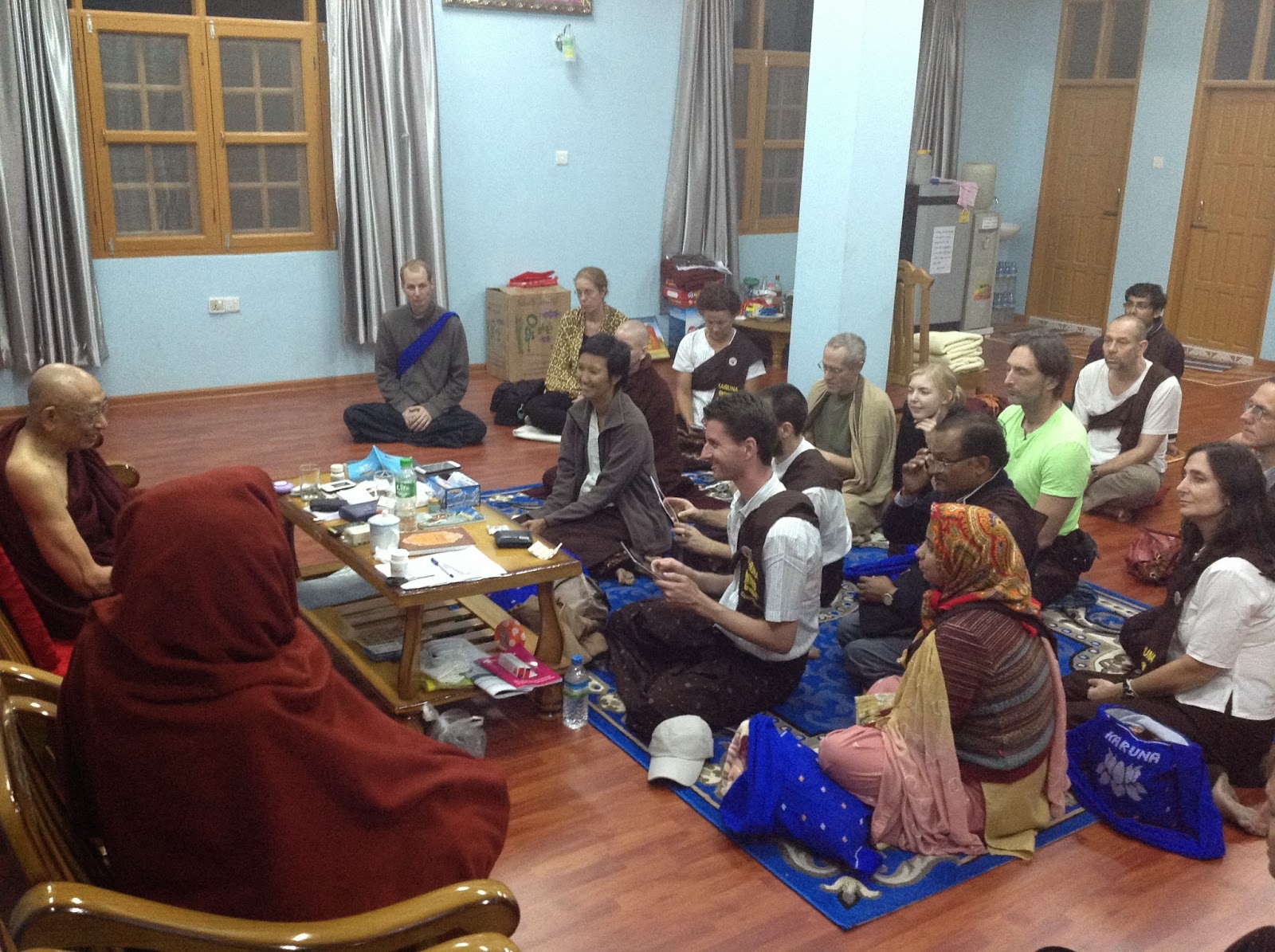
After lunch we briefly walked off our lunch at the Bamaw Monastery, whose rustic building is constructed from teak and carved with elaborate floral patterns and Buddhist imagery. The generous Bamaw Sayadaw allowed Goenkaji's Mandalay students to construct a centre on his land. Even though the Sayadaw's tradition has no connection to Goenkaji's lineage, the selfless monk shared his property simply out of appreciation for Goenkaji's ability to teach people from all walks of life. meditating at Dhamma Mandapa and again next door at the Mahabodhi Vipassana Yogi Meditation Centre founded by Saya Theingyi (a student of Saya Thetgyi) wad restful and nourishing, allowing many to reorient themselves in Burma's extensive and complicated Buddhist matrix. ven. Karunika Bivantha, the Sayadaw now in charge of the Mahabodhi centre, is not only a master meditator but a great scholar who has authored several books on the Abhidhamma. Like many of the Sayadaws we have met so far, this wiry and radiant scholar-monk emphasized the importance of paying attention to the four elements as an object of meditation. However, unlike the the others, he connected this contemplation to the awareness of the arising and passing away of vedana, demonstrating a profound and intimate personal experience of the meditative life, as well his relationship to Ledi Sayadaw and Saya Thetgyi. (For a short excerpt of the Sayadaw's talk on the Four Elements, see here)


The Sayadaw at Maha Bodhi Monastery smiles during a Question and Answer with foreign yogis
A Russian pilgrim stands in reverence before the Maha Bodhi temple at the center established by Saya Thet Gyi's student, Saya Thein

While the day was certainly filled with great moments, I also felt that the wounds from the inner battles were also revealing themselves for a number of people in the group. Most of us were tired and wanted to go back to the hotel. However there was one last stop of the day (actually many but it was getting dark and we needed to cancel a few stops on the itinerary). The Shwegyin Monastery is renowned for its monks who strictly adhere to the vinaya. As the monks chanted their evening prayers in their magnificent teak temple, we sat outside on the large veranda. After some time, One of the elder monks approached Snow, wondering who this curious bunch of foreigners were. Finding out that we were students of Goenkaji, he ushered us into another building where there sat one of the most illuminated old monks any of us had ever seen before. We were pleasantly surprised to discover that this old bhikkhu exuding love and light was a senior teacher under Goenkaji. Dr. Khin Maung Aye, the 82-year old bhikkhu, was a living example of what we all strove to be in one way or another. Not necessarily a monk in robes (although he did suggest that we all give it a try sometime, even for just a few days, since the spiritual benefits of doing so are immeasurable), but a stress-less, caring, bundle of joy. the constant giggles of this Dalai Lama/yoda-like figure was concrete proof of what this path can do and provided us all a brief moment that will be cherished for the rest of our lives."


For Day 7, go here!

Dr. Khin Maung Aye, a senior AT in the Goenka tradition, spoke to the pilgrims during a visit to Shwe Kyin Monastery 

U Thuttivara, seated to the left and the presiding Sayadaw at Shwe Kyin Monastery, provided an inspiring end to an already full dhammic day

Pilgrims are all smiles when listening to the deep wisdom of these two great monks at Shwe Kyin Monastery