Showing posts with label Shwebo. Show all posts

Friday, 26 May 2017

Webu Sayadaw's "Ground of Victory"


Spiritual striving and worldly gain often appear on opposite sides of the spectrum, but this is certainly not the case at Aung Myay Monastery in Shwebo. 

The monastery's name means “ground of victory” and refers to an episode connected to King Alaungpaya. (Ground of victory in Burmese is aung myay. Bate Mann refers to a religious building or holy place. Throughout history, other kings have proclaimed their own “ground of victory,” but this one associated with King Alaungpaya is one of the more famous in the country. In contemporary Myanmar, Burmese may declare their own “ground of victory” to motivate themselves in accomplishing a difficult task.) Long before ascending the throne, Alaungpaya passed this spot as a simple village hunter, afterwards claiming that he saw a frog eating a snake and deer chasing away a tiger there. Modern monastery artwork depicts this scene. Ashin Sarana suspects that whatever King Alaungpaya actually saw was repackaged to evoke Jātaka Tale 77, in which King Kosala saw this identical scene as one of sixteen symbolic dreams. The Buddha interpreted this as illustrating the perverse character of distant future times, when the less skillful would rule. In later years, during the colonial period, some Burmese would interpret British rule and the country’s attendant social breakdown as fulfilling that prophesy. The Burmese typically learn about King Kosala’s dreams as children, so this land, the pre-colonial Burmese past and this particular Jātaka Tale are culturally linked together in a powerful, symbolic resonance. Many years later, when he was preparing for war against a stronger foe, he chose this auspicious spot as his “victory spot” because he had twice witnessed a weaker animal conquering a stronger one.

When the British annexed the country, they recognized the symbolism of this patch of ground, and that it represented past Bamar military might and nationalism. So they tried to deliberately render the grounds inauspicious, first by hanging prisoners there and then by converting the entire area into a British cemetery.

This British posturing evidently did little to dissuade Webu Sayadaw, however, as he decided to establish his third monastery here in 1940, eventually spending his Rains Retreats here after the invitation from a female doctor from Rakhine State who was concerned about his poor health. The compound spans thirty-two acres, with an inner perimeter track that is a nice way to get a feel for the grounds. These dirt paths run parallel to an ancient wall and pass by some neighboring communities living just outside the monastery.


Wednesday, 1 March 2017

Shwebo: A Place of Resistance and Dhamma


Some of the royal forces’ best fighting men hailed from the Mu Valley, particularly the old districts of Hladau, Tabayin, Tazfe, and Ye-O. Soldiers from this region were distinguished by a special vermillion tattoo on the small of their back. Given this history, it was not surprising that some of the last skirmishes between colonial troops and the Burmese resistance took place in the Shwebo area after the Burmese king was deposed in 1885.

One Shwebo-born rebel was the infamous long-haired U Yit, who had served the king and then fought the British after annexation. Seeing that further resistance was futile, he fled to Tadahgalay Village with his Shan wife. The area was at that time a dense jungle that they had to clear in order to farm (and which by now has morphed into Insein, an urbanized suburb of Yangon). So many Shwebo rebels settled here that for a time the area was called Shwebosu. U Yit lived to be over 100 years old, ultimately becoming better known the beloved grandfather and role model of the future Sayadaw U Pandita, the famous Mahasi disciple, than for his resistance exploits.

In the years that followed the king’s removal, dacoit gangs roamed the land, prompting the colonial government to engage in extensive “pacification” campaigns here. While the old British Gymkhana Club in Shwebo is no more, there is a small British War Cemetery honoring soldiers killed in these battles.

Spiritual striving and worldly gain often appear on opposite sides of the spectrum, but this is certainly not the case at Aung Myay Monastery. Its name translated means “Ground of Victory,” and refers to an episode connected to King Alaungpaya. (This is aung myay. Bate Mann refers to a religious building or holy place. Throughout history, other kings have proclaimed their own “Ground of Victory,” but this one associated with King Alaungpaya is one of the more famous in the country. In contemporary Myanmar, Burmese may declare their own “Ground of Victory” to motivate themselves in accomplishing a difficult task.) 

Long before ascending the throne, he passed this spot as a simple village hunter, afterwards claiming that he saw a frog eating a snake and deer chasing away a tiger there. Modern monastery artwork depicts this scene. U Sarana suspects that whatever King Alaungpaya actually saw was repackaged to evoke Jātaka Tale 77, in which King Kosala saw this identical scene as one of 16 symbolic dreams. The Buddha interpreted this as illustrating the perverse character of distant future times, when the less skillful would rule. In later years during the colonial period, some Burmese would interpret British rule and the country’s attendant social breakdown as fulfilling that prophesy. The Burmese typically learn about King Kosala’s dreams as children, so this land, the pre-colonial Burmese past, and this particular Jātaka Tale are culurally linked together in a powerful, symbolic resonance. Many years later when he was preparing for war against a stronger foe, he chose this auspicious spot as his “Victory Spot” because he had twice witnessed a weaker animal conquering a stronger one.

When the British annexed the country, they recognized the symbolism of this patch of ground, and that it represented past Bamar military might and nationalism. So they tried to deliberately render the grounds inauspicious, first by hanging prisoners there and then by converting the entire area into a British cemetery.

This British posturing evidently did little to dissuade Webu Sayadaw, however, as he decided to establish his third monastery here in 1940, eventually spending his Rains Retreats here after the invitation from a female doctor from Rakhine State who was concerned about his poor health. The compound spans thirty-two acres, with an inner, perimeter track that is a nice way to get a feel for the grounds. These dirt paths run parallel to an ancient wall and pass by some neighboring communities living just outside the monastery.

The photo shows the Victory Spot of Webu Sayadaw today.

Tuesday, 12 July 2016

Webu Sayadaw's Meditation Cave


Before U Kumara (the future Webu Sayadaw) popped up in Kyaukse out of the blue on March 12, 1924, no one was quite sure where he had been spending time. All that was known was that he was in the midst of years of intensive, solitary practice; even his modern biographers and closest disciples have been unable to reconstruct those early years in any detail. And while U Kumara continued his secluded practice here, Kyaukse was also where the next phase of his life began, and from where word about the achievements of the noble monk would spread to the rest of the country. 


The first site of note at Webu Sayadaw Monastery in Kyaukse is Dhat Ma Shaw Well, situated on the right side of the road, between the inner and outer monastery gates. After leaving his formal studies behind at the Masoyein Monastery in Mandalay in his mid-twenties, U Kumara spent some time living in remote caves and forests; perhaps given these hardships, he was frequently afflicted with stomach illnesses. 

One story goes that he was once travelling by train from Shwebo when someone advised him about a well near the Webula Hills that was known for its medicinal qualities. (In one version this was a holy man or pilgrim clad entirely in white. In another, it was a woman who met him before the train, and when U Kumara suggested that he may go home to Ingyinbin seeking a cure, she diverted him instead to Kyaukse) Soon after, he had a dream in which a being directed him to come here and search for a well of clear, bluish water. When he found the well, it is said that the same supernatural being appeared to personally offer him the water, and after drinking it, the monk’s stomach pains ceased. U Mya Thaung wrote that following this event, Webu Sayadaw never again laid down, had a cold, or spit. Those who wish may drink from this well, but note: pilgrims do so at their own risk.

Dhat ma shaw carries a couple of different meanings. Translated literally, it means “the knife falls down,” a reference from the 12th century when King Alaung Sithu is believed to have passed through here, back when the village was known as Paung. At that time, one of the royal attendants accidentally dropped his knife in this well. But when “knife falls down” is said quickly in Burmese, it can be heard as “the diarrhea has stopped,” a reference to the curative effect the well water had on Webu Sayadaw.

The words “ye phyu ye pya,” (or “white water, blue water”) came to be associated with the famous Kyaukse well that healed Webu Sayadaw. The white color refers to the water found naturally throughout these hills, while the curative water in Webu’s story was blue. Located around Webu and Weba Hills, this gave rise to the clever ditty, “Ye phyu ye pya, webu weba,” which references the geography, water quality, and famous monk all at once.

Beside the well is a stone tablet with a Burmese inscription, telling the Phaung Daw Oo story of the magical royal barge that carried King Alaung Sithu by air around the country. The king constructed a pagoda wherever he stopped, and so today many pagodas carry the name Phaung Daw Oo, meaning “the prow of the royal barge.”

Today, only serious meditators are allowed to enter and meditate in this cave, which is still standing today. Below is a photo of an inscription on this cave, with the translation below:


"Follow the tip of the nose - align with mindfulness,
To other object - (mind) should not be let go.
Contact and mindfulness - should be known continuously,
(thus) the difference between body and mind - will be known without fail."
The benefactor Venerable Webu Sayadaw
Champion 1998"


Monday, 6 June 2016

Ingyinbin Journal: Pottery Making and Vipassana Practice


John, a meditator from New Zealand, spends extended periods in Ingyinbin each year, the home of the revered Webu Sayadaw and with his friend Ashin Mandala. This winter, he has decided to keep a journal, which he has kindly offered to share with us. His journal alternates between observation and poetry, between meditation practice and commentary about Burmese Buddhist society, from his learnings and his questions. The full collection of his musings can be found here.

1 February 

"
Day trip to the pot-making factory Kyaukmyaung, near the Irrawaddy, west of Shwebo: 
Kyaukmyaung pottery: orange mounds of stone
crushed to fine dust, doused
& struck on the wheel: Vipassana.
Soon on to the Hanlin Museum commemorating the Pyu people’s civilisation, but before that the group is shown various artefacts and scrolls assembled in the upper monastery room occupied by the visiting Russian academic, researching nineteenth century Buddhist Sangha texts - co-incidentally the same person we met a couple of visits back in an ancient cave in the Sagayan hills where he was painstakingly taking photographs of images in the cave and appeared equally distracted. But Kyaukmyaung: a tiny aperture low at the rear of one of the five or six large brick kilns (each some 20 meters in length) allows us to view the fire capering over the pots, a wafting and deadly light. A worker feeds different grades of pre-cut firewood into another of the several kilns: one day to build the fire, having it burn for three, letting it cool a further three. The young woman who carries a few bricks at a time from a large pile of bricks wears cloth mittens, her clothes thick with dust. Children in the adjacent field containing piles of uncut logs carry and drop bits and pieces. In a bamboo chair, a worker, enjoying Uposata, watches a Burmese soap on the old tube television housed in a dusty box of wood. Women in yet another shed produce more than 50 small elegant clay pots each day: one shapes, taking only a few minutes per individual pot, while her companion spins the wheel in a regular motion by swinging her own leg to and fro with a push with each swing, reminding me of the boatmen on Inle Lake. The larger pots made elsewhere are transported using a 6 inch diameter length of bamboo pole, the pot suspended between two Burmen doing the carrying. Jamie can’t resist, and as carrier he does a fair job, just as he did swinging his leg and spinning the pottery wheel."

Wednesday, 13 April 2016

Ingyinbin Journal: Ordinariness in Everything


John, a meditator from New Zealand, spends extended periods in Ingyinbin each year, the home of the revered Webu Sayadaw and with his friend Ashin Mandala. This winter, he has decided to keep a journal, which he has kindly offered to share with us. His journal alternates between observation and poetry, between meditation practice and commentary about Burmese Buddhist society, from his learnings and his questions. The full collection of his musings can be found here.

16 January

Back from Shwebo following a muddle over the pickup arrangements, and Karen with a heavy cold, the prominent gold pagoda spire seen at a distance of some kilometres foreshortens the distance. Return with evening-time.

Under the wispy moon in the still-blue sky
lines of white birds sweeping into the tamarinds.
Silent, graceful, landing as new leaves.
The following morning I walk with Kwau Soe to the patipatti compound, where shortly after Yan Aung Shwe joins us, wearing treble sweaters. We examine the U Ba Khin building, which Aung Shwe has recently upgraded adding new facilities and paint. He wants the small corner room with generous windows on three sides where U Ba Khin spent a week ordained to be reserved for serious mediation only. Beyond this building stands another, rather dilapidated one, used during Webu’s time by his donor, a former Burmese Railways Minister.

From a nearby tree Kwau Soe plucks from a tree vine several tiny orange berries each with a black spot at one end which he holds out in his open palm. He explains that in his childhood they used to thread these berries onto a thread of cotton to make necklaces:

Kauw Soe gathers the tiny orange berries
they once threaded onto necklaces:
the devas on their elevated platform are benign.
He also stops to pick up from a narrow ledge at the arahant’s pool a small tortoise, white on the underside and less than half the size of his palm, with two small legs occasionally emerging and flailing, while the head remains firmly ensconced within the body - until the creature is returned to the water, where its head and legs re-emerge and after a brief flurry it disappears beneath the surface of the stagnant water. Shortly after, we visit the deva platform, a place where Webu is said to have been sometimes found meditating; and to my surprise beneath the expansive banyan tree nearby there are a couple of gnat altars decorated by devotees with fresh cut sprigs placed in jars; then over we head to the monks’ quarters, where just today the aged blue Plymouth car donated to Webu some sixty years ago has been towed back from Kin-U, a mere shell but impressive still.

We enter Webu’s rooms, where Aung Shwe recounts for me the last hours of the Sayadaw’s life: a final visit to the toilet in the adjoining room followed by collapse on his return, immediately lifted and carried by his assistants to the dais where shortly he passes away, cradled in arms including those of the current Sayadaw on the pariyati side. Several events of the final days are captured in the photographs that hang on the walls and I look long at them.

Karen and I return to the hut after lunch and sit through the afternoon, re-entering it late but still bright and welcoming.


Leaving the hut, the warm sun,
the wavy leaved tree displays perfumed white flowers
which we saw yesterday cupped in the old woman’s hands.
Perhaps this is a reasonable juncture at which to digress and recount an event of a few days later concerning the now 81 year old Sayadaw and the 83 year old Indian nuclear physicist and physician recently arrived to take robes and meditate. On the morning of his ordination the Indian gentleman is sat down on a small wooden stool beside the concrete trough used for washing by the monks and a young monk proceeds to shave the remaining ring of grey hair from the elderly fellow’s head in quick straight bursts of the razor. From there Bhante leads him to the dining room, where he becomes a novice prior to receiving full ordination. Pali phrases are said and repeated, robes passed as dana to the preceptor are returned and donned with the help of a couple of attending novices. Next a large young monk directs us to the Sima Hall, where an animated preceptor Sayadaw proceeds gleefully to compare the ripened age of each the novice, he himself, and the Buddha; once again he points to the upper lip and repeats Webu’s injunction to hold the attention right there uninterrupted on the breathe 24 hours in the day. The village musicians start up prematurely, thinking the foreign guests (six of us at this time) who now vacate the hall include the entire ordination party. It’s another 30 minutes before their cymbals and drums sound again in urgent unison as the monks reappear and we have the chance to give to tach of them a modest dana.

Late in the afternoon the guests enter the Sayadaw’s quarters in the ramshackle old teak hall, rows of empty Red Bull cans lining the inner entrance. Sayadaw sidles onto the floor with us and the priceless Buddha relics are brought out. A new glass dome has replaced the old one which has been roughly glued together following an earlier mishap. It is topped with a small black carved pagoda and the same wood serves as a pedestal, studded with lips of ivory. It is an ivory lotus that houses the tiny container which contains the dozen or so ‘mustard seed’ sized bone relics, wrapped in a small piece of purple cloth. Each petal has been individually carved, so that one that is near the relics curves up from the rest of the holder almost perpendicularly. Each of us in turn has a white cloth placed on our head while another holds the relic holder over the head for a couple of minutes. This has happened for me before, and at least this time the mind remains composed even though there is a strange and unsatisfied sense that there should be a ‘special’ experience or sensation to report. Ordinariness can feel like a major disappointment! Finally, it is Snow’s turn; as I rest the relics on her head a sudden buzzing sound is immediately followed by an itchy sensation and I realise a mosquito has just landed and bitten me on the cheek.

Sayadaw scrambles after almost spilling
a ‘mustard seed’ bone relic.
Cats, medicines, newspapers, plus one freshly ordained monk.
 

Cats race the roof as the black wooden bowl
housing the Buddha relics gets held in turn
above each head. Still within the mind kicks.
 

I hold the relic holder above Snow’s head
two minutes; knees pretty unsteady; hands
occupied, a mosquito stationed on my cheek.

As if I hadn’t appreciated the ordinariness in everything, later bhanti-ji, quite hard of hearing, explains that he had heard little or nothing, and asks why the grains of rice had been treated so reverently and whether it was these that had been referred to as ‘mustard seeds’.

The Sayadaw himself, surprisingly impish and bright-faced, each day perambulates the compound with his walking poles, using them to indicate this or that or else to admonish recalcitrant novices:

81, more a jaunty 18, soiled
robes and hugely calloused feet, this
Sayadaw held Webu when he passed.

Wednesday, 5 March 2014

San Kyaung Building at Webu Sayadaw Monastery in Ingyinbin


This short clip shows a German meditator in very early morning in the San Kyaung building at Webu Monastery in Ingyinbin village, located in Upper Burma. In January 2014, a group of 25 foreign meditators visited here, and they sat a one day course in this building.

This building is highly significant because it was here that the venerable Webu Sayadaw, widely believed to be an arahant, resided during each hot season (he spent the rainy and hot seasons in Kyaukse and Shwebo, but always came to his native village for hot seasons). He meditated in this two story building and received visitors here as well. It was also in here where the great monk entered passed away and entered parinibbana. More about him can be learned from the documentary "Webu Sayadaw: Anthology of a Noble One."

The building is usually kept under lock and key, but the pilgrims received extraordinary permission to meditate in this building as they wished during their stay. The main altar is shown in the video, and where precious relics are kept, along with other items from Webu Sayadaw's day.

A more comprehensive and informative map of Ingyinbin and its history is coming soon.

For more information on current pilgrimage, see here.

Sunday, 2 March 2014

A Diary of Pilgrimages

Three young Burmese boys join a group siting at a pagoda with the pilgrims

42 days of pilgrimages have now been completed, and two groups of devoted yogis have now seen the best that Burma has to offer, with many lives transformed in the process. Some pilgrims ordained and are still in robes, with others coming in the next few weeks, months, or even years with a similar intention in mind. Others have grasped the dhamma in more profound ways than was possible in one's home country, and have returned to their local community to share their wealth of experience, understanding, and inspiration.

The following guide shows the diary entries recorded for the two yatras. The majority of the first diary entries were made by Kory Goldberg, a Canadian yogi and author of Along the Path. The majority of the second yartra entries were made by an anonymous American pilgrim.

While no yatras have as yet been confirmed for the following winter of 2015, there are upcoming opportunities for those interested to join part on such excursions in the near future. U Kumara at Sitagu Academy has indicated an interest in hosting Abhidhamma workshops in English for any interested foreigners in the Sagaing Hills in June, and brief ten-day dhamma trips will be organized both before and after these courses for those wishing to attend. Finally, one may also contact Muditā Works  (the agency which arranged for the entire following two pilgrimages) at any time to arrange such a dhamma trip according to the wishes of one's group.


The ruins of Htut Kaung Monastery in the Sagaing Hills. This was one of the world's first meditation-oriented monastery 

Pilgrimage #1
Day 1: Yangon
Day 2: Pyaw Bwe Gyi
Day 3: Yangon and Hmawbi
Day 4: Hmawbi
Day 5: The Road to Mandalay
Day 6: Mandalay
Day 7: Kyaukse and Mandalay
Day 8: Mandalay and Monywa
Day 9: Monywa
Day 10: Monywa, Sain Pyin Gyi, and Ingyinbin
Day 11: Ingyinbin
Day 12: Ingyinbin
Day 13: Ingyinbin
Day 14: Ingyinbin, Shwebo, and Sagaing Hills
Day 15 and 16: Sagaing Hills
Day 17: Mingun
Day 18: Sagaing Hills and Yangon
Day 19: Yangon
Day 20: Yangon

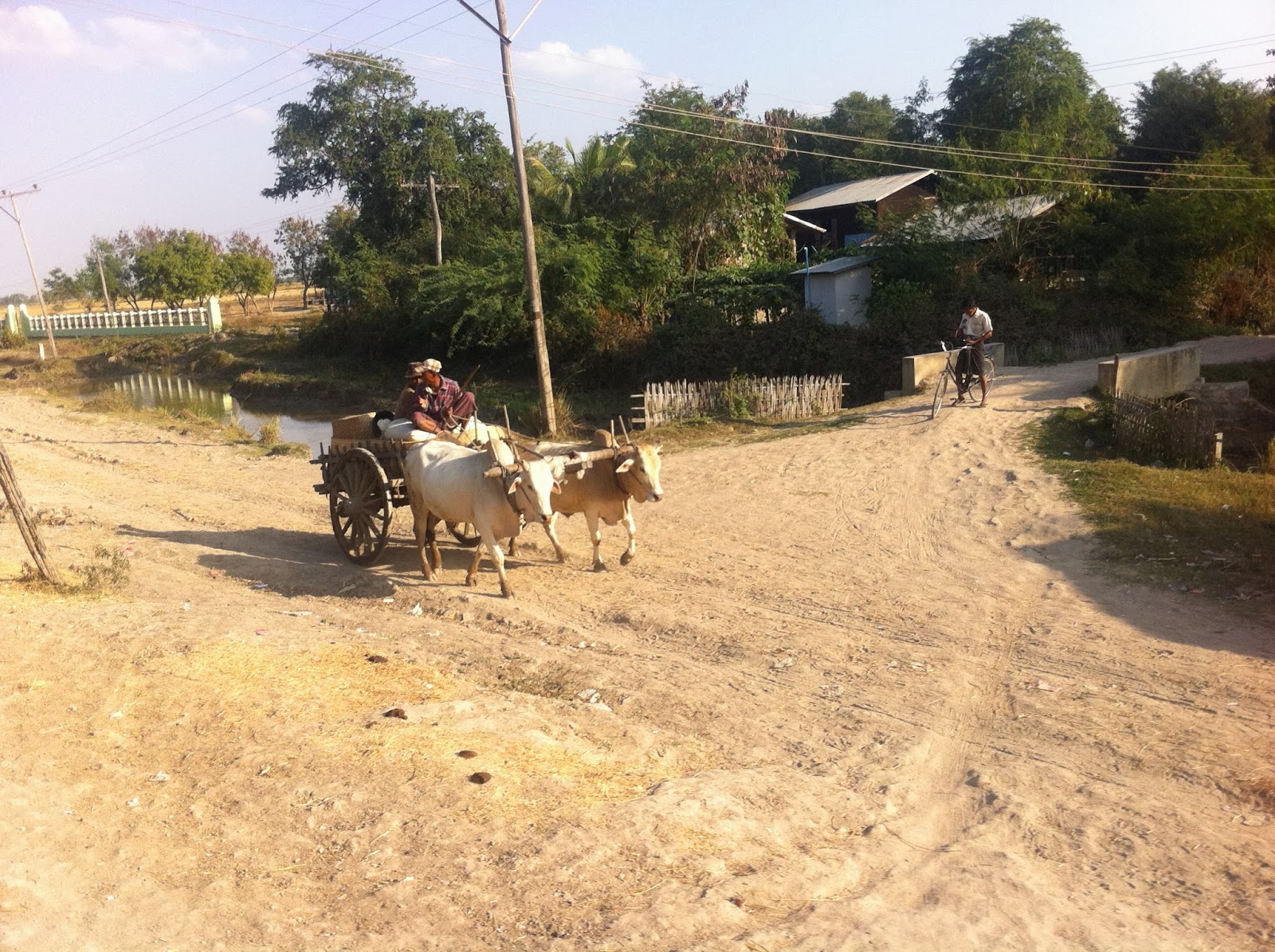
A typical rural Burmese scene

Pilgrimage #2
Day 1: Yangon
Day 2: Pyaw Bwe Gyi
Day 3: Yangon and Hmawbi
Day 4: Hmawbi
Day 5: The Road to Mandalay
Day 6: Mandalay
Day 7: Kyaukse and Mandalay
Day 8: Mandalay and Monywa
Day 9: Monywa
Day 10: Monywa, Sain Pyin Gyi, and Ingyinbin
Day 11: Ingyinbin
Day 12: Ingyinbin
Day 13: Ingyinbin, Shwebo, and Sagaing Hills
Day 14: Sagaing Hills Nunneries
Day 15: Within the Sagaing Hills
Day 16: Sagaing Hills One Day Sitting
Day 17: Mingun
Day 18: Sagaing Hills and Yangon
Day 19: Yangon
Day 20: Yangon

Pilgrims travel back from Mingun to Sagaing

...one may ask, what is so special to have to come across the world to Burma anyway, when the practice is basically inside already? Harold Fielding, a British administrator, provided an answer to this question in 1898 in "Soul of a People":

"To hear of the Buddha from living lips in this country, which is full of his influence, where the spire of his monastery marks every village, and where every man has at one time or another been his monk, is quite a different thing to reading of him in far countries, under other skies and swayed by other thoughts. To sit in the monastery garden in the dusk, in just such a tropic dusk as he taught in so many years ago, and hear the yellow-robed monk tell of that life, and repeat his teaching of love, and charity, and compassion—eternal love, perfect charity, endless compassion—until the stars come out in the purple sky, and the silver-voiced gongs ring for evening prayers, is a thing never to be forgotten. As you watch the starlight die and the far-off hills fade into the night, as the sounds about you still, and the calm silence of the summer night falls over the whole earth, you know and understand the teacher of the Great Peace as no words can tell you. A sympathy comes to you from the circle of believers, and you believe, too. An influence and an understanding breathes from the nature about you—the same nature that the teacher saw—from the whispering fig-trees and the scented champaks, and the dimly seen statues in the shadows of the shrines, that you can never gain elsewhere. And as the monks tell you the story of that great life, they bring it home to you with reflection and comment, with application to your everyday existence."


School children gather before a backdrop of rural stupas

Wednesday, 26 February 2014

Burma Pilgrimage #2, Day 13: "Vibrant Days"

The following excerpt was written by an American yogi about the pilgrimage in Burma. The first pilgrimage has ended, and the second one has just begun! To read about the previous day, go here. To read about the first pilgrimage group's experience as they traveled from Ingyinbin to Sagaing, see here.

You can also consider joining a later pilgrimage in Burma yourself.

"We had a travel day to Sagaing hills.

The main stop was Webu Sayadaw's third monastery, where he spent more than thirty rains retreats. While still a working monastery, it sounds like it's become more of a patipatti place. The walking meditation area looked as if it had seen more vibrant days. 


The original bed where Webu Sayadaw took rest

A shrine room in the three story Shwebo building where Webu Sayadaw taught and practiced walking meditation

Snow describes the history of the former King's residence to pilgrims, where the later Webu Sayadaw Monastery was constructed

We arrived at Sitagu Academy in the evening. Mattresses and hot showers were highlights of the evening. Compared to Ingyinbin's raw strength, Sagaing has a much gentler feel.

Just in time, as some pilgrims are starting to fall ill..."


For the first full day's description of life in Sagaing, Day 14, when the group visits the famous nunneries of Sagaing, see here. 

Click on any of the following images to enlarge them.

A view of the pilgrims at Sitagu soon after arriving

Another view of the pilgrims at Sitagu soon after arriving
U Agga reads about the life of a nun in Burma, to the request of many pilgrims who were curious about the life of a female renunciate. 
The group takes a rest at Kaunghmudaw Pagoda just outside of Sagaing.

Monday, 24 February 2014

Webu Sayadaw: Anthology of a Noble One

Thanks to new YouTube features, we are now able to share the entire one hour documentary on the life of the renowned Burmese monk Webu Sayadaw.


Thursday, 16 January 2014

Burma Day 14: Entering the Hills


For Day 13, see here. The following excerpt was written by Kory Goldberg in his personal journal about the current pilgrimage now underway in Burma. You can also consider joining a later pilgrimage in Burma yourself.


"When Russell took robes the other day, many of us felt we were there right with him in solidarity, and lived the higher order vicariously through him. Today we not only left Ingyinbin, we left behind a travel companion. All attachments, the Buddha taught,  lead to dissatisfaction. Russell and U Sasana, the profane and the sacred, are mere forms, mere concepts, which must be let go of in order to realize freedom from the shackles bound by psychological fear, insecurity and delusion.

From Webu Sayadaw’s hot season centre to the place where he spent 37 rainy seasons, we had the chance to offer food to the monks of Shwebo and meditate in the Venerable’s room where he spend his days—every moment—in contemplation. Our session concluded with a discussion led by U Agga and the various types of ascetic practices such as not lying down that the Liberated One had endured. Doing so would certainly be an extreme way of living for any of us, but for him, such an engagement constituted a middle path approach to self-understanding essential for Awakening. We then walked around the Shwebo monastery’s grounds laden with tropical trees and gazebos for quiet sitting and Dhamma discussions. Some of us played games and shared snacks with some of the local kids, most of them looking quite dirty and unhealthy. Mixing seriousness with silliness gladdens the human heart.


Arriving in the hills of Sagaing was quite magical. We made a brief pit stop at Kaunghhmudaw, unreverentially referred to by the early British colonialists as “tit pagoda.” Upon hearing this it has been nearly impossible to see this massive Sanchi-like stupa and not think of this term. How our minds are plagued by a lack of control! While at the pagoda, Joah gave the group a brief introduction to the mystical landscape of Sagaing, preparing us for the unconventional hermitage monasteries that we would be visiting as a group and on our own. As we pulled into the town overshadowed by the small hills dotted with great pagodas, monasteries and nunneries, all of us were in awe and felt waves of good fortune pass through us. Our first experience in Sagaing, other than the celestial-like landscape, was the pick-up truck driving in front of us with a cab filled with boisterous spirit (nat) mediums erotically dancing to loud Burmese pop music. They were happy to bless us with their gyrating hips and we enjoyed the cultural experience, once again demonstrating the lack of rigid boundaries between what constitutes spirit and what is merely mundane. The Dhamma freely flows through every aspect of life and nowhere is fact of nature more evident and understood than in this Golden Land."    

To see what happens to the group in the Sagaing Hills, click here. 

Saturday, 14 September 2013

Thanaka

In this excerpt from the book, we pick up an entry from our "Burmese Days" chapter. Following is a short excerpt from the section on "thanaka":
---

Original artwork sketched by one of Shwe Lan's artist contributors shows a typical thanaka design on a young Burmese girl
“May May Gyi first put three blots of thanaka on my face, one on the forehead, and the others on each cheek and spread them all over the face. It was a sweet cooling sensation and May May Gyi told me the importance of putting thanaka on my face every morning if I wanted to be a beauty when I grew up.” Khin Myo Chit, Colorful Myanamr

After just a few hours in the country, the first question many visitors want to ask is “what is that yellow paste that people wear on their faces?” The answer is thanaka, a bark that has a similar smell to sandalwood and comes from the thanaka tree (murraya thanaka). It is used both as a skin moisturizer, sun block, whitening cream, and anti-acne cream, and many praise its virtues for keeping the face cool throughout the day. It is also said to tighten the pores and above all else, it smells good. To prepare it for wearing, thanaka is ground on a stone slab (in Burmese, kyauk pyin) and then mixed with pure water, resulting in a creamy paste that comes out a narrow channel surrounding the rim. Some kyauk pyin become treasured family heirlooms, and even become historical items, as in the case of the slab that Queen Raza Datu Kalaya of Taungoo used in the 17th century, which is today on display at Shwe Maw Daw Pagoda Museum in Bago.

Many children like to make swirling and elaborate patterns when applying it on their cheeks in the morning, and many of these designs are actually given names and date back hundreds of years. Burmese sellers in the marketplace will be more than happy to apply a dosage if you’d like to try, and if you do, you’ll be guaranteed a day full of smiles from the Burmese that you meet!

Historically, the earliest reference comes from a 14th century Mon poem, although it is believed that women have used it for over 2000 years. Different kinds of trees are used, and locals have their own preference as to which kind of tree and location they like best, with some buying huge quantities when they are in a place famous for a quality wood. Of note include Sagaing town, Shwebo, and parts of Shan state and Magwe division. There has also been a long-running rivalry between those produced in Shwebo and those in Shinmadaung, with both sides claiming the better quality. When Burmese find themselves in these places, they “then bring back enough logs to build a cabin,” as one Burmese writer quipped. Some fake logs of thanaka do exist, and the way to ensure its authenticity is to take a small taste of it on your tongue: real thanaka should be bitter. Or, for those who just don’t have the time to bother, there are also small containers of the paste pre-prepared.

“[Thanaka is] used by both queen and commoner. It is a thousand year old tradition. The stone implement used to grind thanaka is cut from smooth stone into a circular slab, with a trough along the rim for the paste to flow into. This stone slab rests on four short legs, which in the old days were decorated with classical motifs and scenes carved into the stone in high relief. A short length of the thanaka log is ground, bark side, in a circular motion, with drops of water poured on the stone from time to time.” Ma Thanegi, The Native Tourist