Showing posts with label U Goenka remains. Show all posts

Tuesday, 11 November 2014

A California Sangha Dana in Honor of S.N. Goenka: More Photos


As noted in an earlier post, one year following the passing of the great lay meditation teacher Sayagyi U Goenka, a Sangha Dana was organized in his honor in Azusa, California, at the Dhammakaya International Meditation Center. U Goenka had visited here in 2002 on the Meditation Now tour. This time, over one thousand guests attended, including many bhikkhus and nuns. There to photograph it was Mitchell Walker, and he has kindly allowed his images to be shared on this blog. Many of these photographs will be included a book that will come out in the following months.


A caterer prepares the offering
Meditators and Buddhists from many Asian countries came to the Southern Californian monastery


Western meditators also attended, although in smaller numbers

Buddhist suttas are chanted by the monks 


Wednesday, 29 October 2014

A California Sangha Dana in Honor of S.N. Goenka


One year following the passing of the great lay meditation teacher Sayagyi U Goenka, a Sangha Dana was organized in his honor in Azusa, California, at the Dhammakaya International Meditation Center. U Goenka had visited here in 2002 on the Meditation Now tour. This time, over one thousand guests attended, including many bhikkhus and nuns. There to photograph it was Mitchell Walker, and he has kindly allowed his images to be shared on this blog. Many of these photographs will be included a book that will come out in the following months.


These placards indicate the diversity of Sanghas represented at the event

The Vietnamese table

One regional group from Southeast Asia poses for a photo

Sangha Dana is served before noon

Monday, 27 October 2014

Jack Kornfield honors S.N. Goenka

Monks stand before a photo of S.N. Goenka, with his final remains in a glass case, at the Vipassana center in Mandalay

On his website, American author Jack Kornfield has offered these words on the passing of S.N. Goenka:


"In every generation, there are a few visionary and profound masters who hold high the lamp of the Dharma to illuminate the world. Like the Dalai Lama and Thich Nhat Hanh, Ven. S.N. Goenka, was one of the great world masters of our time. Brilliant and charismatic, tireless advocate for the transformative power of meditation practice, supporter of retreats encouraging hundreds of thousands to have a direct experience of wisdom, founder of 172 meditation centers worldwide, and man of virtue, samadhi and understanding, Goenka has passed away at age 90.

He always taught meditation as an inner exploration, urging students to simply 'Come and see for yourself.' Born and trained in Burma, Goenka was an inspiration and teacher for Joseph Goldstein and Sharon Salzberg, Ram Dass, Daniel Goleman, and many other western spiritual leaders.

His style of Vipassana practice, awareness of the breath and mindful awareness of the vibrations and energy field of the body brings deep understandings of impermanence, inner purification and freedom. This practice has been used in health care, prisons, schools businesses and meditation centers across the globe.

From Spirit Rock and the whole movement of the Dharma in the west we offer bows of gratitude and respect for all he has offered, prayers of blessings for him and continuing appreciation for all who follow his example in Dharma practice and selfless service."

Wednesday, 17 September 2014

Scattering of Goenkaji's ashes on the Ayeyarwady River


Nearly one year ago, the great lay meditation teacher S.N. Goenka passed away, as various posts in this blog shared at the time. Although Sayagyi U Goenka passed away in India, it was his final wish that his remains be returned to the land of his birth, Burma. The above video shows how his ashes were prepared in Dhamma Joti, the main U Goenka center in Myanmar. Excerpts from Dhamma speeches made at the center are partially translated, and the journey from the airport to the center and then the precious Ayeyarwaddy River are also shown in this video. 

Many local meditators and monks gathered for this occasions, as many will do around the world in the coming months when the one year anniversary of his death approaches, and people will meditate and give Sangha Dana in his memory.

Thursday, 31 July 2014

"S.N. Goenka: His Life His Dhamma" Complete

This float carried the final remains of S.N. Goenka from the Yangon airport to Dhamma Joti

U Min Chit Thu spent the better part of a decade completing his oeuvre on the life of the great lay meditation teacher S.N. Goenka. Although it has not yet been released outside of Myanmar, he personally has given this blog permission to share his work with the greater world, for all to better appreciate the life of Goenkaji. U Min Chit Thu also decided to share as he has made the documentary not for personal fame or profit, but to inspire a generation of meditators. Currently a project is underway to provide English subtitles. Until then, according to U Min Chit Thu's generous permission, we share the complete four parts here:


A close up of the vessel containing the final remains of S.N. Goenka. It was later scattered among three places along the Ayeyarwaddy River

Thursday, 27 February 2014

Burma Pilgrimage #2, Day 17: "Here, change is in your face."

The model plan for the new ambitious Sitagu Vipassana Center. The group sat here in the morning

The upper most paogoda at the Sitagu Vipassana Center. Last month's yatra was the first group to ever meditate there, and this group was the second 

The following excerpt was written by an American yogi about the pilgrimage in Burma. The first pilgrimage has ended, and the second one has just begun! To read about the previous day sitting the self course in the Sagaing Hills, go here. To read about the first pilgrimage group's experience as they explored Mingun, see here.


You can also consider joining a later pilgrimage in Burma.


A view of the Mingun Jetty before boarding the boat back to Sagaing

"The highlight today was an Ayeyarwaddy river boat trip.

On boarding the boat consisted of walking down a sandy bank, onto a 'bridge/plank' brought into being by the alignment of a slab of wood to walk on, and a single bamboo 'railing' held by two men. Arising and passing away is never far away in this land...

The craft was remarkably low set in the water with open windows covered only with adjustable tarp. Rain started during our time on the vessel, with a drop in temperature that few of us were prepared for.

Going down the Ayeyarwaddy was the last leg of Goenkaji's ashes. As we traced his path, we passed tugboats hauling wood cargo, small wooden boats with old motors attached, some puffing out black smoke in their journeys.

All share passage in the muddy waters, in a place where change is a reality of life. The sandy banks actively evolve, with large chunks falling to join the river. Men testing water depths stand guard at the bow, guiding vessels away from swirling eddys and sand bars. The landscape is foggy, with rolling hills framing flat lands interspersed with an occasional thatched hut and flame tree.

One of the things in the West, is that we've created such comfortable (and artificial) environments that we forget that all things change. Here, change is in your face, whether it is in the dimming of the bathroom light because the electric shower head just turned on, or floating down the Ayeyarwaddy in an exposed wooden boat.

Anicca, anatta, dukkha...


A gold statue of Mingun Sayadaw

**************

This Mingun Pagoda is built on seven layers to resemble the seven layers of waves when approaching Mt. Meru

The mood is somber, as we pass near where Goenkaji's ashes were scattered.

The rain picked up, and by the time we got on the bus, we were a wet bunch. And in the moment, huddled together on the exposed bus for warmth, Goenkaji's doha chantings arise, led by a couple of CCTs... a sweet ending to a memorable Ayeyarwaddy trip..."


To read about the pilgrims' final day in Yangon, see here.

The Sitagu Academy Rector gave generously of his time, as pilgrims took advantage of his English fluency to ask him a number of question pertaining to the Dhamma

Thursday, 16 January 2014

Burma Day 17: A Day in Mingun

One can read about the previous days in the Sagaing Hills here, and to see how the following yatra group enjoyed Mingun, see here. You can also consider joining a later pilgrimage in Burma yourself. Kory Goldberg continues to record in his personal journal about the current pilgrimage now underway in Burma:

Pilgrims pause at the very well where the "floating knife" and the Vow of Truth took place in the life of Taung Phi Lar Sayadaw

"After a quick morning meal of congee and beans we were off to visit the sites in and around Mingun. We all piled into a pick-up truck-cum-mini-bus for the pleasant, yet bumpy country drive. On the way we stopped for our morning meditation session in a cave that once belonged to the 18th century monk Htut Khaung Sayadaw, the renegade monk who freed himself from monastic convention to pursue an unfettered and disciplined yogic life in the forest. The Sayadaw became famous not only for his dismissal of traditional obligation, but for his respect for nuns and willingness to teach them and provide a space for ascetic practice. This cave, where Venerable Htut Khaung resided for much of his life, still teems with energy as a handful of bhikkhus continue to practice here regularly. It’s incredible how fast an hour flies by at such locations.


One of the pilgrims pays respect to a monk at the original site of Htut Khaung Sayadaw's 18th century monastery
Our Sangha Dana today was at the monastery founded by the late Mingun Sayadaw, the first Tipitika-dhara in modern history. Mingun Sayadaw was made famous in the 1950s on a global scale for his ability to memorize the entire Buddhist canon, approximately 18,000 pages long. He was even admitted into the Guiness Book of World Records for this incredible feat. Today, nine of his students have achieved the same textual mastery, keeping the words of the Buddha close to their hearts and minds. At first glace, spending up to 10 hours a day for years on end to memorize each and every word that the Buddha taught may seem like a waste of one’s life. However, upon deeper reflection, we see that doing so leaves very little space in one’s mind for the mundane and the useless, and serves as a form of meditation practice that purifies the mind, making space for such unique activity to take place (although he did say that he does quiet the mind every morning upon rising and every evening before retiring). The Mingun monk we met today did seem a little robotic in his mannerism, yet he also seemed quite calm and other-worldly, not bothered by the day-to-day inane issues that plague the average person’s mind. Although he did admit that despite his super-human ability to commit the Buddha’s words to memory, he still does misplace his glasses from time to time!  


The group poses for a group photo at Mingun Monastery

After the visit we struck the Mingun Bell (the second largest in the world), visited a touristy pagoda, shopped and drank coconut water. To return to Sagaing we took a pleasant 90-minute boat along the Ayerwaddy River, seeing where Goekaji’s ashes were released and merged back to nature. The boat ride was very peaceful, affording everyone a moment to relax and recuperate from all the intense inner and outer journeying. Before retiring at the Sitagu Academy, we mediated at a nunnery overseen by a 50-something year-old saint named Daw Nu Kati who has been in robes since she was nine. She welcomed this strange group of travelers into her compound, smiling wide, yet unsurprised by this unlikely event. After meditating, she patiently and gladly answered some of our questions about the life of not only a nun, but of a renowned meditation master, a rarity for a woman in Buddhist Asia. She served us snacks, engaging all the tastes: salty crackers, sour amla, sweet bananas, bitter tea. Her presence was soothing and inspiring; totally present, yet not there at all. Once again, a rare and precious moment not to be forgotten! As one pilgrim put it, “it’s like Christmas every day!” Every day while on pilgrimage in such a holy land is certainly a gift. But alas, these daily miracles will soon come to an end, or rather, they will be replaced by other, less evident daily miracles. The challenge is to see these subtle blessings with appreciation and gratitude in whatever form they may take. Doing so will reveal how much we have really learned on this journey through the Golden Land. Let’s see…"


Pilgrims embark the boat in Mingun that will take them along the Ayeyarwaddy towards Sagaing, and over the place where Sayagyi U Goenka's ashes were scattered just months before
To read about the final days, go here.


After a long day, five smiling Burmese girls wait on the pilgrims at Sitagu Academy to offer an evening fruit plate

Sunday, 5 January 2014

The Last Journey of S.N. Goenka

The Radiant Journey of a Most Compassionate, Most Revered Dhamma Being Global Pagoda Dhamma Service

The following is text of article ' The Radiant Journey of Padma Bhushan Global Vipassana Acharya Shri Satya Narayan Goenka'

Vipassana Research Institute newsletter, English edition, October 18, 2013:

Original article in Hindi Vipassana Patrika


"The Most Venerable Teacher Shri Goenkaji passed away peacefully at the age of 90 at his residence in Mumbai on 29th September 2013 at 10:40 PM. He remained active, aware and peaceful till his last moment. Even on the last day of his life, his daily routine remained the same without any difficulty.

Many people came to meet Venerable Goenkaji during the month and interacted with him on the Dhamma. Apart from prominent students, Deputy Minister of Religion and Culture in Myanmar, Mr. U Soe Win, paid a visit to Goenkaji at his residence along with four Burmese Monks. A meeting of “Global Vipassana Foundation Trust” was held in the presence of Venerable Goenkaji. Mr. Surinder Kumar Singh (IPS), DG of Home Guards and also Dr. Sukhdeo Soni, a student of Vipassana from America came to meet Venerable Goenkaji.

He cleared many of his important writing works. He guided selection of 500 couplets each in Hindi and Rajasthani written in his diaries and notebooks. He made necessary corrections and instructed to append them in the future editions of the books on couplets.

From the last ten days, every day until the morning of 29th September, Sangha Dana was being organized by daughter-in-law Naina at the residence of Venerable Goenkaji where Mataji herself was giving dana to the Sangha. During these days, Venerable Goenkaji also met the monks on several occasions and gave his Metta to the student monks.

At breakfast time on 29th September, Venerable Goenkaji enquired from Shriprakash about the working of the Pagoda. In response, he replied that that day being Sunday, he would be going to the Pagoda and on return he would report everything.

On 29th September while taking lunch, Venerable Goenkaji mentioned to Ven. Mataji, Sons Shyambihari and Shriprakash, sitting nearby, “Today I have given leave to the Doctors.” At that time the statement did not sound solemn to any of them. But since morning itself, it seemed as if he had decided to leave the body on that day. Therefore, most of the time, he remained confined to himself. In the night when his corporeal body became free from all medication, the meaning of his above statement was perceived by all as a form of the early indication.

In the evening after taking tea, he went through the important headlines of the newspapers. Afterwards he meditated while sitting on the chair in the room. He came to the table for dinner after 9:00 PM. Usually, after dinner, Venerable Goenkaji would ask Sriprakash about the day’s news and discuss with him the issues pertaining to Vipassana and the Centers. But today he did not talk and went straight to his room.

He remained seated in the room for some time. Then he sought help to lie down on the bed. Immediately after lying down the process of leaving the body began to take place. The breathing became faster for some time. On seeing this, Venerable Mataji called the Son, Shriprakash, and Daughter-in-law, Naina. As soon as they reached, they summoned the Doctors. The Doctor, who was residing in the same building, called for the ambulance and also requested necessary preparation in the hospital. But before the family Doctor could arrive, the situation had become critical. He indicated that the ambulance services would be of no use then. By the time the ambulance comes, we will not be in a position to shift him there. And, indeed, in a short while, after the check up, he informed that the heart had stopped beating. But there was no sign of pain or stress on the face of Venerable Goenkaji. As he has instructed the people throughout his life to learn the art of living and dying, on those very same lines, he left his body like an ideal saintly lay person.

The atmosphere was filled with a serene calmness. Nobody was able to believe that he had left this world forever. No sound of crying or grief was uttered by anybody. Prior to this, whenever he was in great pain, often tears rolled down the face of Venerable Mataji. But now the state of mind of Mataji was so inspiringly equanimous and peaceful that it was hard to believe. By observing her, one could see the greatness of Dhamma and how it helps in difficult times.

When the news was given to the few, it spread in the city of Mumbai, and thereafter the news spread like fire in the whole world. From that instant in the night, the telephone bells started ringing and the people started pouring. Many of the family members were in foreign countries. It was natural that they would take more than 24 hours’ time to reach here. Therefore, a decision was taken that his body would be kept at the residence itself in a glass case with auto-freezer and the funeral rites would be completed by afternoon on 1st October. Throughout the day people kept pouring (in thousands) to express their condolence and giving way to others.

At 10:00 PM in the night itself, about five hundred people were standing on the road in a queue outside the building. Some of those who came from far away distances stayed in a tent for the whole night. The rest were requested to come in the morning. Again in the morning from 7:00 AM onwards on 1st October, people started thronging the place. There were long queues of visitors till 10:15 AM. At 10:15 AM, his corporeal body was brought down and people formed a queue and paid their respects till 11:30 AM.

The Government of Maharashtra declared to bid farewell to Venerable Goenkaji with full State honors.Accordingly, an armed police squad in a special turnout was sent. The corporeal body of Venerable Goenkaji was wrapped in a National Flag. As the band played, the squad paid tribute by raising their rifles in unison and firing shots. The police squad accompanied the funeral procession of Venerable Goenkaji up to the cremation ground and after the funeral rites were over once again fired shorts in tribute to the departed. The government had made extensive police arrangements. Some voluntary organizations helped in clearing the 5-6 km long path leading to the cremation ground. The procession was led by some monks while people in thousands followed the procession peacefully in queues to pay their last respects up to the Electric Funeral Ground near Oshivara, Jogeshwari (West). The National Flag brought for paying State Honor was handed over by the Police Squad to the family members to keep alive the memories of Venerable Goenkaji forever.

The Urn containing his Relics reached “Global Vipassana Pagoda” in the evening on 1st October. At the moment when the vehicle stopped at the main gate, the rains started pouring. It was as if the Parjanyadev (the Rain God) and other Samyak dev (Righteous deities) were waiting in eagerness to welcome him in advance.

On 2nd October, a meeting of acquaintances and relatives was organized at Jalaram Hall, Juhu Scheme in the evening from 4 to 7:00 PM. Here also people in hundreds paid their last respects. It was published in the newspapers on 2nd October that on 6th October, the students would pay homage through the group sitting in the main meditation hall of the Pagoda.

On 6th October people came from far off places to participate in this. As usual Venerable Mataji sat in the centre of the hall and the Urn containing the Relics was placed nearby in front of a photograph of Venerable Goenkaji. About five thousand students along with thousands of meditators paid their respects. Thereafter the Relics were carried to Myanmar.

Venerable Goenkaji desired that his remains should be carried to the land of his birth, Myanmar and there consigned in the waters of Irrawaddy River. Therefore, the five Sons of Venerable Goenkaji Mr. Banwarilal, Mr. Murarilal, Mr. Shyambihari, Mr. Shriprakash, Mr. Jaiprakash and three Grandsons along with some other family members set off to Myanmar on 6th October carrying the Relics. The eldest Son Mr. Girdhalalji could not go to Myanmar owing to his ill health. However, he was present in all the programmes held in Mumbai. The flight from Mumbai to Bangkok took off at about 01:30 am on 7th October towards Myanmar. The next flight to Yangon (Myanmar) was to take off from the Bangkok airport after a gap of two and a half hours’ time.

The number of Vipassana students in Thailand is quite large as there are nine Vipassana Centers. They booked two rooms in the lounge itself with the help of the Government and the Airport authorities and made arrangements for paying homage. About 20 people walked up to the door of the airplane with the permission of the officers and gave a warm welcome to the people carrying the Relics.They wanted to take VISA, but the Officers gave them permission to reach the Lounge outside the Airport after keeping passport in their custody. The Urn containing the Relics was placed on the podium with a large photograph of Venerable Goenkaji and decorated with white lotus flowers. In spite of the incessant rains pouring throughout the night, hundreds of students assembled there. For one hour, every one of them, as per his or her turn, paid homage to Shri Goenkaji and expressed gratitude. An exceptional thing happened when the airplane touched the land: the rains which had poured incessantly throughout the night had stopped, thereby providing relief to the people.

A grand welcome was given to the arrival of the Relics at Yangon Airport in the morning of 7th October. The Urn containing the Relics was carried to the Dhamma- Joti (the first Vipassana Centre) in a special vehicle. There are twenty Vipassana Centers in Myanmar along with a great number of meditators. Everyone had been eagerly waiting for the Relics. The Urn was placed on the already decorated podium and the students paid their respects in a queue.

In the night on 7th October, tremors of an earthquake (rector 3.1) were felt at 02:27 AM. This was considered as an indication of his final welcome by nature in the Birth Place of Venerable Goenkaji. In June 1969 when Venerable Goenkaji arrived in India from Burma, at that moment also tremors of light intensity were felt in India.

In the morning at 9:00 AM on 8th October, Sanghadana was performed at the Goenka-Residence in Myanmar and 90 monks were given donations. Thereafter at 11:00 AM, the Asthi-Kalash (the Urn containing the ashes) was carried from Dhamma-Joti to Botataung Jetti. There, the Sons and Grandsons of Venerable Goenkaji reached the middle of the Yangon River (Irrawaddy) on a special motor-boat and consigned some part of the Relics. Coincidentally, 56 prisoners were released at the same time by the Burmese Government. The Ashti-Kalash was brought back and placed at the Dhamma-joti.

On the same day in the evening, a meeting was organized at the Ball-room of Hotel Royal Park from 3:00 to 5:00 PM where the relatives, acquaintances and Vipassana meditators living in Myanmar paid their homage and expressed their gratitude.

On 9th October the Ashti-Kalash was carried from Dhamma-Joti. The Relics were taken to Myitkyina on a plane from Yangon. After getting down from the plane, a part of the ashes was consigned at the Irrawaddy River in Myitkyina (the starting point of the River). As per the routine, the same flight was to return after half an hour period of stay. The people accompanying the Ashthi- Kalash were required to return to Mandalay on the same day. However, there was no other flight available. So, the same airplane waited for them for about two and half hours (instead of returning after half an hour). Thus they could return to Mandalay the same day, and the Ashti- Kalash was placed at the Vipassana Center, Dhamma Mandala so that the people could pay their respects.

In the evening, the reputed Monk of Myanmar, Venerable U Nyanissara (Thidagu Sayadaw). chalked out the next day’s program and explained it to everyone. The Chief Minister of Mandalay, the Minister of Religion and Culture in the Burmese Government, and the Police Commissioner of Mandalay reached there the same evening. They checked the whole program and approved it. They instructed their officers to work as per the wishes of Venerable Bhanteji.

A Programme of Sanghadana (Donation to the Sangha) was held in the morning of 10th October at 9:00 AM. Venerable U Nyanissara ji gave a long discourse in Burmese language about Rev. Goenkaji after the initial chanting. (It will be published in future after its translation is completed.) Then food was served to the visitors assembled in large numbers. Thereafter, prior to the start of the journey, Venerable U Nyanissara ji instructed all the Monks to recite the following Pali verse continuously from the beginning of the journey to the end, the meaning of which is also given below:

Anicca vata sankhara, uppada vaya dhammino;
uppajjitva nirujjhanti, tesam upasamo sukho.
– Dighanikayo 2.221, Mahaparinibbanasuttam

Truly all conditioned things are impermanent. All the conditioned, things, individuals which arise are impermanent. Arising and passing away is their inherent nature (dhamma), their inherent characteristic. When this phenomena of constant arising and passing away is extinguished completely by the practice of the Vipassana meditation – the cycle of repeated arising stops, this is known as the ultimate happiness, the ultimate bliss of Nibbana.
In this way, with the royal paraphernalia and honor the procession began in the late afternoon. The Asthi- Kalash was placed on a special vehicle prepared in the shape of golden colored swan. This was followed by the vehicles of the Goenka family. Thereafter, followed the Monks and Nuns and the Vipassana Teachers. Then the Media and at the end were the vehicles of all other people. At the time of the program finalization, the number of vehicles present was only 69, but when the journey commenced, there were 300 vehicles.

The procession took around 1.5 to 2 hours to reach the banks of Ayeyarwady River at the Panmadee Jetti. Five specially decorated large motor-boats were arranged at the bank. The family members along with the Asthi-Kalash and the Vipassana Teachers boarded the first boat, Monks boarded the second, Nuns the third, the media people occupied the fourth, and the students and others boarded the fifth boat. The fleet of boats went to the middle of the River to consign the ashes. At the time of the immersion, darkness began to set in. The Government had banned entry of other boats and ships in that area from 12:00 Noon to 7:00 PM.

The fleet of boats circling the water made a round shape and all in consonance floated one thousand lamps with lighted candles in the River. This magnificent sight became more majestic when these lamps enwrapped in colored covers began to float over the waves while moving and dispersing all over the River. It looked as if the deities of the higher abodes were swinging with happiness. Various types of fireworks were displayed creating an extraordinary sight in the water, over the and in the sky.

At the conclusion, Venerable U Nyanissaraji said that neither such a magnificent welcome was ever organized for anyone nor is there any chance of bidding such a farewell to anyone in the times to come. Venerable U Nyanissaraji also said that the flow of Dhamma which was carried by U Goenka from the banks of Irrawaddy to India in 1969 has come back in 2013 as the Asthi- Kalash to get merged with the River. However, the work of spreading the dhamma all around the world will continue. Everyone stayed in Mandalay in the night.

On the morning of 11th October, the members of the Goenka family returned to Rangoon from Mandalay in an airplane and on the same day boarded a flight via Bangkok in the evening and reached their residence in Mumbai at about 2:00 AM in the night. The Monks were invited on the morning of 12th October and Sanghadana (donation to the Sangha) was performed. Entire family members and relatives were present on this occasion. Everyone was extremely happy to join in the Sanghadana ceremony. Sanghadana was also organized on the 13th. Thus, farewell was given to the lay saint who showed the world the way to experience the pure dhamma through Vipassana meditation.

Venerable Goenkaji may have gone away from us as far as his physical body is concerned, but his body of Dhamma, his voice, his heritage filled with wisdom will forever remain with us. Now it is our duty to make this invaluable technique part of our life and help more and more people to gain benefit from it. By living the life of Dhamma, mutual cordiality will prevail and we will become helpful in the welfare of others also. When we all come together to achieve the aim of our beloved Venerable Goenkaji, of spreading the Dhamma, only then will it be a true tribute to him. This will lead to our own true welfare and the Dhamma will truly benefit us.

Bhavatu Sabba Mangalam!

May all beings be happy!"


(To read about a Sangha Dana that took place in California one year following Sayagyi U Goenka's passing, see here).

Monday, 2 December 2013

Preparing for U Goenka's ashes upon Yangon River

This video shows scenes from Dhamma Joti in Yangon, on the night before U Goenka's ashes were scattered by special barge upon Yangon River, November 8th. One can see the care and respect given by many local meditators in honoring the great meditation teacher. One can also view the video here.

Monday, 25 November 2013

Arrival of U Goenka's final remains to Myanmar

The following procession formally brought the final remains of S.N. Goenka from the Mingaladon Airport to Dhamma Joti.

A close up of the urn in which the final remains were placed

The vehicle which transported the final remains

Saturday, 23 November 2013

Scattering of Ashes of S.N. Goenka in the Ayeyarwaddy River

The final remains of S.N. Goenka were brought back to his birthland of Burma in October, to be scattered in three places along the Ayeyarwaddy: Yangon, Mandalay, and Myitkyina. Photos of the Yangon and Mandalay ceremonies are shown below.

October 8: the boat that scattered the ashes of S.N. Goenka in the Ayeyarwaddy River just outside of Yangon

Yogis meditate on the Mandalay barge along the Ayeyarwaddy before the final remains of U Goenka, prior to their scattering

A close-up of the final remains

Friday, 22 November 2013

Arrival of S.N. Goenka's Remains in Mandalay

On October 10, U Goenka's remains were ceremoniously brought to Mandalay. They were then driven in a procession to Dhamma Mandapa, located in the downtown area. Following are photographs that show this event.

 The vehicle that carried the ashes is gilded to look like a golden duck, shown arriving at the center
A photograph of the women's side of the Dhamma Hall. Burmese nuns meditate in the front row, while lay yogis (wearing the brown and white thawbet) meditate behind them.

Men sit meditating in the front of the Dhamma Hall

A senior assistant teacher from the center speaks to local news crews

S.N. Goenka's good friend Sitagu Sayadaw was charged with the scattering of the ashes.

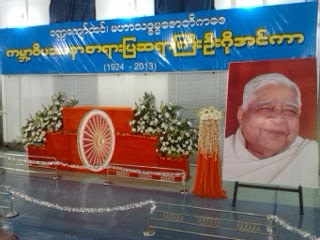
Monks gather before a a large photo of S.N. Goenka covered in garlands. The photo was taken by Snow Aye in Mumbai.

The ashes of S.N. Goenka comes to Dhamma Joti

On October 7, 2013, the ashes of S.N. Goenka were ceremoniously brought from Mumbai to Yangon, and a portion were brought to Dhamma Joti for awaiting pilgrims. Below are photos of the event.

Yogis before the ashes, enshrined in a glass case

The Dhamma Hall at Dhamma Joti

Female pilgrims work on the garlands for the event.

Flowers are prepared for the arrival of Goenkaji's ashes

Saturday, 12 October 2013

Scattering of Goenkaji Ashes takes place

This Myanmar Times article describes U Goenka's final homecoming back to the country of his origin. After arriving on October 7th with a formal procession, his ashes were floated at Yangon River after an offering at Park Royal Hotel in downtown Yangon. Students at Dhamma Mandala in Mandalay scattered more on the center ground on October 9th, and U Nyanissara scattered ashes in the Ayeyarwaddy near the Goenka ancestral home.

On October 13th at 8.15 am Myanmar time, a group sitting will take place at Dhamma Joti. This also happens to be the 20th anniversary of the center's founding.

Thursday, 10 October 2013

Scattering of Ashes of U Goenka in Mandalay

More than five hundred monks will converge in Mandalay as the Sitagu Sayadaw from Sagaing will disperse U Goenka's ashes. Large boats will carry the monks and tens of thousands of lay followers are expected. The progression will be headed by seven large floating barges that will spell out the words, with one letter each: S  N  G  O  E  N  K  A. The barges of fire will flow together with his ashes. 

Wednesday, 9 October 2013

Los Angeles Times reports on U Goenka's passing from Yangon

This L.A. Times article discusses the life and teachings of S.N. Goenka, as well as the arrangements being made for his ashes this week in Yangon. The article also quotes Shwe Lan Ga Lay's contributor Ma Phyu Wint Yee, who has been involved in Dhamma Joti preparations this week. Ma Phyu Wint Yee has taken a major role in assisting with the meditator book project for the last six months.

Monday, 7 October 2013

A message from Goenkaji

A message from Goenkaji:

Dear Travellers on the path of Dhamma;

Be happy
Keep the torch of Dhamma alight.
Let it shine brightly in your daily life.

Always remember, Dhamma is not an escape.
It is an art of living: living in peace and harmony with oneself
And also with all others.
Hence, try to live a Dhamma life.
Don’t miss your daily sitting each morning and evening.
Whenever possible, attend weekly joint sittings with other Vipassana meditators.
Do a ten day course as an annual retreat.
This is essential to keep you going strong.
With all confidence, face the spikes around you bravely and smilingly.
Renounce hatred and aversion, ill will and animosity.
Generate love and compassion, especially for those who do not
understand Dhamma and are living an unhappy life.
May your Dhamma behavior show them the path of peace and harmony.
May the glow of Dhamma on your faces attract more and more suffering
people to this path of real happiness.
May all beings be happy, peaceful , liberated.
With all my metta,
S.N. Goenka


Carrying the final remains of S.N. Goenka to his birth country of Burma

The Beginning of the "Last Journey"

In what they are calling "The Last Journey" in Yangon, this morning many pilgrims came to Dhamma Joti to pay respects. They will sit again together from 6 to 7 pm Myanmar time and invite all meditators around the world to join in this meritorious deed by sitting at the same time at your own location.

The ashes being ceremoniously brought to the center by the Goenka family

Members of U Goenka's family, led by his son U Shwe, carry the ashes to the center

U Goenka's ashes on display

Pilgrims gather to pay their respects

The remains of Padmabhushan Global Vipassanacharya Sri S.N. Goenka

A local TV news crew at the event

Sunday, 6 October 2013

Arrival of Ashes to Yangon and Dhamma Joti

The ashes of S.N. Goenka as they arrive in Yangon:


Change of Plans for Goenkaji's Ashes

The plans for the ceremonies have changed and are now as follows. The ashes will be scattered:
  • October 8 in Yangon
  • October 9 in Myitkyina
  • October 10 in Mandalay
As one local Burmese meditator comments, "one very remarkable thing is at other funerals many people are sad and some may cry, but we all are delighted to celebrate and give our last respect toward our respected Puja Guruji Goenka. According to reports, Mataji will come and participate in this trip."

There is thus still time for foreign yogis to take part in these events.