Showing posts with label Thabarwa. Show all posts

Saturday, 1 February 2020

Insight Myanmar Podcast #1: Thabarwa Sayadaw


Subscribe the "Insight Myanmar" podcast on your preferred podcast app! Otherwise, listen right off the web here.

This inaugural talk with Thabarwa Sayadaw focuses on the teacher’s biography and the origins of his monastery. With the Thabarwa mission starting as a local phenomenon and now becoming an international one, this is an important discussion in illuminating where it all came from. 

Despite being born in Myanmar, Sayadaw did not have full rights of citizenship because of his family’s Chinese ancestry. This prevented him from pursuing his dream of higher education, so he instead embarked on a business career by opening a convenience store franchise. Although he became quite successful—and at a time when entrepreneurs were extremely rare in Myanmar, no less—the stress led to a series of mental breakdowns that ultimately brought him to meditation (27:30). After initial experiences in the Mogok and Thae Ingu traditions, it was the vipassana courses he took at the Dhamma Joti Vipassanā Center, in the tradition of S.N. Goenka, which propelled him to seek full ordination and become a monk. 

Thabarwa Sayadwa’s initial meditation center occupied just half of a residential apartment building in downtown Yangon (58:20), before he eventually moved to some undeveloped land that had been offered to him in Than Lyin, across Yangon River. He was followed by a small number of disciples, who under Sayadaw’s leadership had begun caring for a growing number of refugees as well as others living on the margins of society. This group would eventually number in the thousands and became wholly reliant on the care provided by Thabarwa volunteers. This non-conventional approach on the part of a Burmese abbot, coupled with the development of a non-prototypical Buddhist monastery, ultimately resulted in a tense stand-off between him and senior members of the Saṅgha, along with government authorities who wanted them evicted (1:29:00). Ultimately it was the opening of the country and especially the freedom of the press that ended Thabarwa’s existential fears and opened a new chapter in their development. 

At the end of the podcast, Zach Hessler, a former forest monk in Myanmar, joins Joah to reflect on the Thabarwa story (1:40:00). They note how the Sayadaw’s critical nature sets him apart in a culture where conformity and mimicry is often the standard. Joah compares Sayadaw’s hunger for wisdom with that of a 19th century Burmese monastic, Ledi Sayadaw, and Zach comments on the deep faith that Sayadaw holds about the power of good deeds. 

If you find the Dhamma interviews we are sharing of value and would like to support our mission, we welcome your contribution. You may give monthly donations on Patreon, or one time donations on PayPal. If you are in Myanmar and would like to give a cash donation, please feel free to get in touch with us.

Friday, 17 January 2020

A late night interview podcast with Thabarwa Sayadaw


What a talk! Thabarwa Sayadaw made a surprise stop by our recording studio at midnight and we talked till almost 4 a.m. Still, there was so much to discuss that we only reached halfway through our topics, so we hope to continue our talk later this month.

The majority of our conversation focussed on the origin story of Sayadaw himself as well as the development of the Thabarwa center and mission. He discussed his difficulties in being from a family of Chinese immigrants in Yangon and his early interest in education and business. While wildly successful in a time in Myanmar when almost no entrepreneurial activity was taking place, it led to a severely imbalanced mind that became dominated by greed and anger, causing him to make several key poor business decisions. Concerned about his deteriorating mental state, this led to an interest in meditation, and he spent several years studying intensively at such centers as Mogok, Thae Inngu, Goenka, U Ba Khin, and Mahasi.

He became a proper teacher in his own right at the time that massive societal and political transformations were underway in Myanmar, and he discusses openly how the the upheaval of his country put his entire center and mission in an existential crisis, not knowing if they were going to be shut down from one month to the next. Ultimately, the advent of a free press by 2014 finally allowed independent journalists to share more widely what his unique meditation center was trying to accomplish, and the resulting stability led to steady growth and today, international renown.

Thank you to Thabarwa Sayadaw and so many close to him that helped make time in his busy schedule. Sayadaw had just flown from the UK on December 31st, and had spent the prior several days driving from one event to the other throughout Yangon, as well as side trips to Hpa An and Mandalay, and is leaving today to Vietnam. So we were really privileged to have access to so much of his time.

Saturday, 21 April 2018

Cetana Village


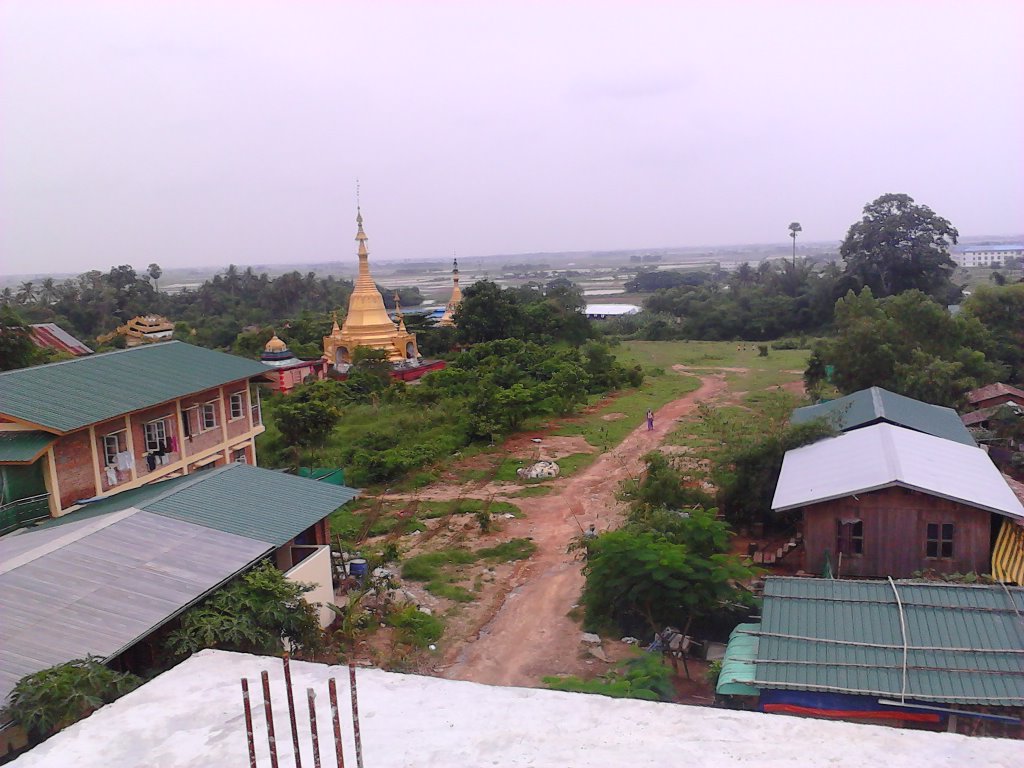
In 2012 Sayadaw U Uttamasāra established Cetana Village ( Saytanar, the Burmese pronunciation of this Pāli word, is more commonly used at Thabarwa Center.

In Pāli, cetanā means “intention” or “mental volition,” but in Burmese the term largely carries a wholly positive meaning, and when referring to the neutral or negative implications of cetanā, other terms are used instead. Therefore Saytanar village is commonly translated to English as Goodwill or Mercy Village.) on about sixty acres of land, about fifteen minutes’ walk from the monastery. The story behind it is a bittersweet tale that eventually comes full circle through the power of the Dhamma. The indigent village residents petitioned the sayadaw to purchase their village land; with that money, they planned to make a go of it elsewhere. But many of them found that the cost of land and rent was prohibitive wherever they looked, and so, unable to move, they ended up requesting to stay on in the village that they had only recently sold. In response, the sayadaw created 225-square-foot (15 x 15) parcels, which he gave out free to those families, and continues to offer to others in need. To qualify, no proof of indigency is required. Applicants must simply pledge to fulfil one, unmonitored condition: to meditate for seven continuous days at the monastery. About 15,000 people from 3,000 families now live in Cetana Village, and there’s now a meditation hall, schools serving 800 children with a volunteer staff, a market, public toilets and several hand-pump water wells.