Showing posts with label Htut Kaung Sayadaw. Show all posts

Friday, 5 February 2016

Advice from Htut Khaung Sayadaw


Bhikkhu Obhasa shares the following:
"After lunch my teacher Sayadaw U Tejaniya and I were talking about how often Dhamma and especially Vinaya are argued about. He said his teacher Shwe Oo Min Sayadaw used to share a poem by Htut Khaung Sayadaw with some healthy guidelines for discussing Dhamma: (paraphrased)
On discussing Dhamma:
If someone speaks of Dhamma - Listen
If asked - Speak
If you agree (with anything) - Accept
If you disagree - Silence
-advice shared by my teacher shared by his teacher from a poem of Htut Khaung Sayadaw"

Sunday, 2 March 2014

A Diary of Pilgrimages

Three young Burmese boys join a group siting at a pagoda with the pilgrims

42 days of pilgrimages have now been completed, and two groups of devoted yogis have now seen the best that Burma has to offer, with many lives transformed in the process. Some pilgrims ordained and are still in robes, with others coming in the next few weeks, months, or even years with a similar intention in mind. Others have grasped the dhamma in more profound ways than was possible in one's home country, and have returned to their local community to share their wealth of experience, understanding, and inspiration.

The following guide shows the diary entries recorded for the two yatras. The majority of the first diary entries were made by Kory Goldberg, a Canadian yogi and author of Along the Path. The majority of the second yartra entries were made by an anonymous American pilgrim.

While no yatras have as yet been confirmed for the following winter of 2015, there are upcoming opportunities for those interested to join part on such excursions in the near future. U Kumara at Sitagu Academy has indicated an interest in hosting Abhidhamma workshops in English for any interested foreigners in the Sagaing Hills in June, and brief ten-day dhamma trips will be organized both before and after these courses for those wishing to attend. Finally, one may also contact Muditā Works  (the agency which arranged for the entire following two pilgrimages) at any time to arrange such a dhamma trip according to the wishes of one's group.


The ruins of Htut Kaung Monastery in the Sagaing Hills. This was one of the world's first meditation-oriented monastery 

Pilgrimage #1
Day 1: Yangon
Day 2: Pyaw Bwe Gyi
Day 3: Yangon and Hmawbi
Day 4: Hmawbi
Day 5: The Road to Mandalay
Day 6: Mandalay
Day 7: Kyaukse and Mandalay
Day 8: Mandalay and Monywa
Day 9: Monywa
Day 10: Monywa, Sain Pyin Gyi, and Ingyinbin
Day 11: Ingyinbin
Day 12: Ingyinbin
Day 13: Ingyinbin
Day 14: Ingyinbin, Shwebo, and Sagaing Hills
Day 15 and 16: Sagaing Hills
Day 17: Mingun
Day 18: Sagaing Hills and Yangon
Day 19: Yangon
Day 20: Yangon
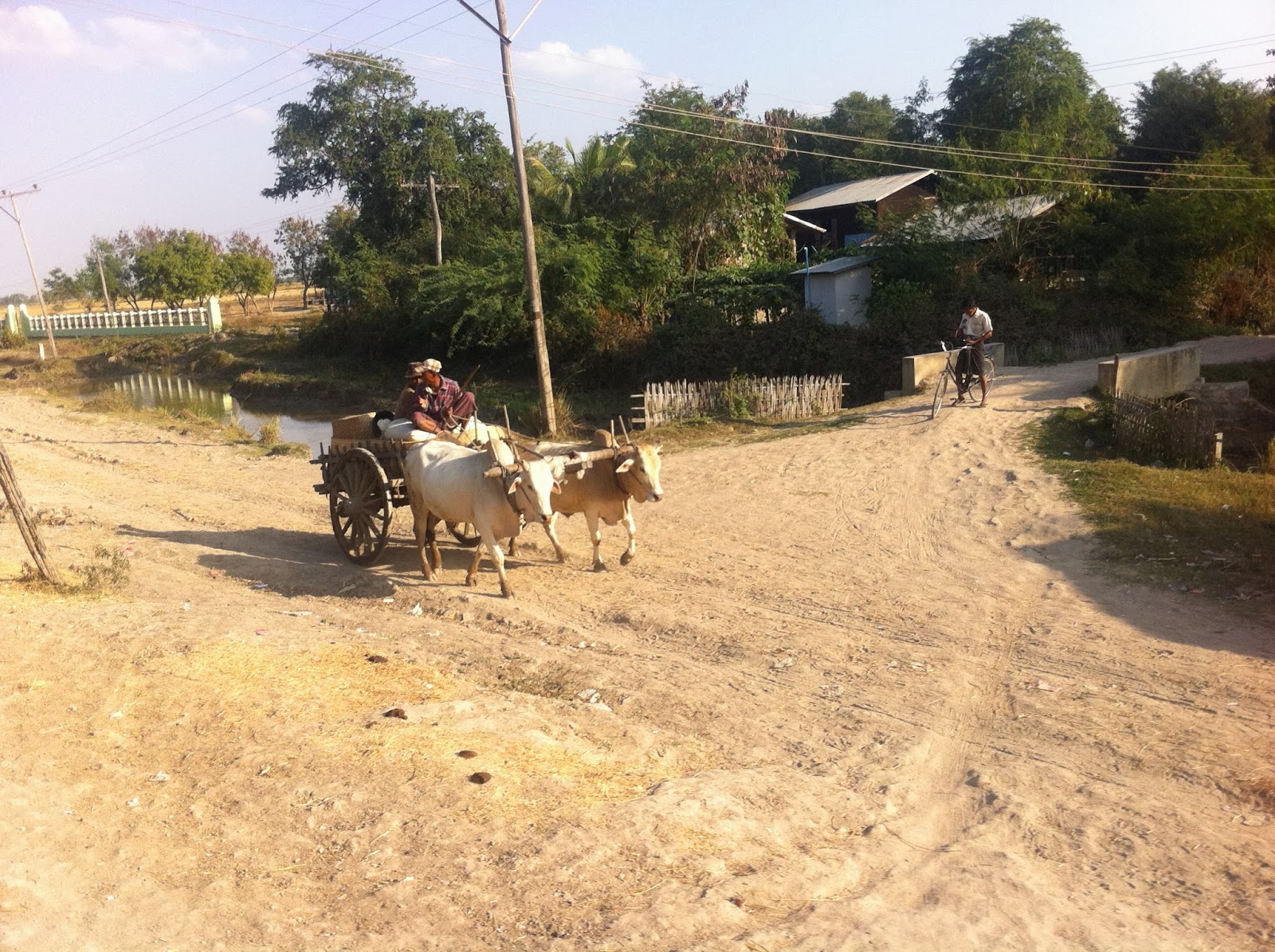
A typical rural Burmese scene

Pilgrimage #2
Day 1: Yangon
Day 2: Pyaw Bwe Gyi
Day 3: Yangon and Hmawbi
Day 4: Hmawbi
Day 5: The Road to Mandalay
Day 6: Mandalay
Day 7: Kyaukse and Mandalay
Day 8: Mandalay and Monywa
Day 9: Monywa
Day 10: Monywa, Sain Pyin Gyi, and Ingyinbin
Day 11: Ingyinbin
Day 12: Ingyinbin
Day 13: Ingyinbin, Shwebo, and Sagaing Hills
Day 14: Sagaing Hills Nunneries
Day 15: Within the Sagaing Hills
Day 16: Sagaing Hills One Day Sitting
Day 17: Mingun
Day 18: Sagaing Hills and Yangon
Day 19: Yangon
Day 20: Yangon

Pilgrims travel back from Mingun to Sagaing

...one may ask, what is so special to have to come across the world to Burma anyway, when the practice is basically inside already? Harold Fielding, a British administrator, provided an answer to this question in 1898 in "Soul of a People":

"To hear of the Buddha from living lips in this country, which is full of his influence, where the spire of his monastery marks every village, and where every man has at one time or another been his monk, is quite a different thing to reading of him in far countries, under other skies and swayed by other thoughts. To sit in the monastery garden in the dusk, in just such a tropic dusk as he taught in so many years ago, and hear the yellow-robed monk tell of that life, and repeat his teaching of love, and charity, and compassion—eternal love, perfect charity, endless compassion—until the stars come out in the purple sky, and the silver-voiced gongs ring for evening prayers, is a thing never to be forgotten. As you watch the starlight die and the far-off hills fade into the night, as the sounds about you still, and the calm silence of the summer night falls over the whole earth, you know and understand the teacher of the Great Peace as no words can tell you. A sympathy comes to you from the circle of believers, and you believe, too. An influence and an understanding breathes from the nature about you—the same nature that the teacher saw—from the whispering fig-trees and the scented champaks, and the dimly seen statues in the shadows of the shrines, that you can never gain elsewhere. And as the monks tell you the story of that great life, they bring it home to you with reflection and comment, with application to your everyday existence."


School children gather before a backdrop of rural stupas

Thursday, 16 January 2014

Burma Day 17: A Day in Mingun

One can read about the previous days in the Sagaing Hills here, and to see how the following yatra group enjoyed Mingun, see here. You can also consider joining a later pilgrimage in Burma yourself. Kory Goldberg continues to record in his personal journal about the current pilgrimage now underway in Burma:

Pilgrims pause at the very well where the "floating knife" and the Vow of Truth took place in the life of Taung Phi Lar Sayadaw

"After a quick morning meal of congee and beans we were off to visit the sites in and around Mingun. We all piled into a pick-up truck-cum-mini-bus for the pleasant, yet bumpy country drive. On the way we stopped for our morning meditation session in a cave that once belonged to the 18th century monk Htut Khaung Sayadaw, the renegade monk who freed himself from monastic convention to pursue an unfettered and disciplined yogic life in the forest. The Sayadaw became famous not only for his dismissal of traditional obligation, but for his respect for nuns and willingness to teach them and provide a space for ascetic practice. This cave, where Venerable Htut Khaung resided for much of his life, still teems with energy as a handful of bhikkhus continue to practice here regularly. It’s incredible how fast an hour flies by at such locations.


One of the pilgrims pays respect to a monk at the original site of Htut Khaung Sayadaw's 18th century monastery
Our Sangha Dana today was at the monastery founded by the late Mingun Sayadaw, the first Tipitika-dhara in modern history. Mingun Sayadaw was made famous in the 1950s on a global scale for his ability to memorize the entire Buddhist canon, approximately 18,000 pages long. He was even admitted into the Guiness Book of World Records for this incredible feat. Today, nine of his students have achieved the same textual mastery, keeping the words of the Buddha close to their hearts and minds. At first glace, spending up to 10 hours a day for years on end to memorize each and every word that the Buddha taught may seem like a waste of one’s life. However, upon deeper reflection, we see that doing so leaves very little space in one’s mind for the mundane and the useless, and serves as a form of meditation practice that purifies the mind, making space for such unique activity to take place (although he did say that he does quiet the mind every morning upon rising and every evening before retiring). The Mingun monk we met today did seem a little robotic in his mannerism, yet he also seemed quite calm and other-worldly, not bothered by the day-to-day inane issues that plague the average person’s mind. Although he did admit that despite his super-human ability to commit the Buddha’s words to memory, he still does misplace his glasses from time to time!  


The group poses for a group photo at Mingun Monastery

After the visit we struck the Mingun Bell (the second largest in the world), visited a touristy pagoda, shopped and drank coconut water. To return to Sagaing we took a pleasant 90-minute boat along the Ayerwaddy River, seeing where Goekaji’s ashes were released and merged back to nature. The boat ride was very peaceful, affording everyone a moment to relax and recuperate from all the intense inner and outer journeying. Before retiring at the Sitagu Academy, we mediated at a nunnery overseen by a 50-something year-old saint named Daw Nu Kati who has been in robes since she was nine. She welcomed this strange group of travelers into her compound, smiling wide, yet unsurprised by this unlikely event. After meditating, she patiently and gladly answered some of our questions about the life of not only a nun, but of a renowned meditation master, a rarity for a woman in Buddhist Asia. She served us snacks, engaging all the tastes: salty crackers, sour amla, sweet bananas, bitter tea. Her presence was soothing and inspiring; totally present, yet not there at all. Once again, a rare and precious moment not to be forgotten! As one pilgrim put it, “it’s like Christmas every day!” Every day while on pilgrimage in such a holy land is certainly a gift. But alas, these daily miracles will soon come to an end, or rather, they will be replaced by other, less evident daily miracles. The challenge is to see these subtle blessings with appreciation and gratitude in whatever form they may take. Doing so will reveal how much we have really learned on this journey through the Golden Land. Let’s see…"


Pilgrims embark the boat in Mingun that will take them along the Ayeyarwaddy towards Sagaing, and over the place where Sayagyi U Goenka's ashes were scattered just months before
To read about the final days, go here.


After a long day, five smiling Burmese girls wait on the pilgrims at Sitagu Academy to offer an evening fruit plate