Showing posts with label Sagaing. Show all posts

Wednesday, 5 February 2020

An incredible dhamma story out of the Sagaing Hills


The Sagaing Hills are full of wondrous and amazing stories to inspire any Dhamma practitioner, but few can hold a candle to the tales told about the 18th-century monastic Taung Pyi Lar Sayadaw.

Like many great Burmese monastics of the past 1,000 years, he choose the Sagaing Hills as a preferred place of practice to get away from the rigid orthodoxy (and laxness) of the central capital, instead enjoying the peace and quiet of living alone in nature.

The Burmese king wished to test his fortitude to ensure he was truly a monk worthy of respect. So he devised a plan in which a half-naked woman came running through the forest, and finding the monk, begged him to be permitted to stay at his monastery, fearfully claiming that a horde of rapists and murderers were hot on her tail. The monk refused, saying that it was against vinaya, but as the woman insisted, the monk relented, allowing her to stay in his kuti as he slept outside in the forest.

However, at night Taung Pyi Lar Sayadaw was so racked by lust, and having such a beautiful and nubile young woman close at hand after so many years of celibacy, that he was unable to concentrate on any of his meditation objects. So he took a nearby knife, and began to slice at his palms, with the gross pain finally allowing him to feel bodily sensations. The lust not subsiding, he sliced the other palm, and then both soles of his feet, and finally his thigh.

The next day, the king showed up with his royal entourage, and he found himself accused of impropriety. The monk argued he had done nothing wrong, but the king exclaimed, "How can you be believed with a half-naked woman walking out of your kuti?"

The monk responded by taking a Vow of Truth, and dropping the knife in a nearby pond. "Let the knife tell the truth then! If I am lying, it will sink. If I tell the truth, let it float across the water to the other side."

The knife did not sink in the end, and the monk became one of the most revered in the kingdom after this.

Sunday, 29 September 2019

Another wondrous Dhamma tale from the Sagaing Hills


The Sagaing Hills are full of wondrous and amazing stories to inspire any Dhamma practitioner, but few can hold a candle to the tales told about the 18th-century monastic Taung Pyi Lar Sayadaw.

Like many great Burmese monastics of the past 1,000 years, he choose the Sagaing Hills as a preferred place of practice to get away from the rigid orthodoxy (and laxness) of the central capital, instead enjoying the peace and quiet of living alone in nature.

The Burmese king wished to test his fortitude to ensure he was truly a monk worthy of respect. So he devised a plan in which a half-naked woman came running through the forest, and finding the monk, begged him to be permitted to stay at his monastery, fearfully claiming that a horde of rapists and murderers were hot on her tail. The monk refused, saying that it was against vinaya, but as the woman insisted, the monk relented, allowing her to stay in his kuti as he slept outside in the forest.

However, at night Taung Pyi Lar Sayadaw was so racked by lust, and having such a beautiful and nubile young woman close at hand after so many years of celibacy, that he was unable to concentrate on any of his meditation objects. So he took a nearby knife, and began to slice at his palms, with the gross pain finally allowing him to feel bodily sensations. The lust not subsiding, he sliced the other palm, and then both soles of his feet, and finally his thigh.

The next day, the king showed up with his royal entourage, and he found himself accused of impropriety. The monk argued he had done nothing wrong, but the king exclaimed, "How can you be believed with a half-naked woman walking out of your kuti?"

The monk responded by taking a Vow of Truth, and dropping the knife in a nearby pond. "Let the knife tell the truth then! If I am lying, it will sink. If I tell the truth, let it float across the water to the other side."

The knife did not sink in the end, and the monk became one of the most revered in the kingdom after this.

Friday, 22 September 2017

The Sagaing Hills: A Perfect Antidote to Civilization and Privilege

The Meditator's Guide to Burma, Part 2, is due out soon! Nearly four times as big as Part 1 and the result of nearly five years of intensive work by a team of volunteers, it will function as a kind of Lonely Planet's guide to the Golden Land... but specifically for those spiritual practitioners who wish to develop in Dhamma. Following is a draft from the Sagaing Hills chapter, which would be included in a potential Part 3-- but unfortunately, no work is happening currently as there is not sufficient financial support to sustain the project. This section introduces the Sagaing Hills before describing some specific site history. 

"The monks of 150-200 years ago were especially attracted to the ravines and hilltops of this remote region of the Sagging Hills, in sharp contrast to the congested, flat lowlands around Mandalay Hill they were leaving behind. Some took to criticizing some Mandalay monastics for their laziness or laxness in adherence to Vinaya, and saw in the promise of a simple life in the Hills the perfect antidote to the adverse pull of modern civilization, and privilege.

Given the wild nature of Sagaing in those days, forest monks were left to their own devices in finding a place to reside and practice. Caves were the shelter of choice for many. However, because there are few natural cave systems in the Sagaing Hills, forest monks had to hew many hundreds of make-shift enclosures out of hillsides or cliffs. Enough fresh water to sustain them was available either from collecting rainwater or a walk to the river, depending on how far away the monastic decided to set up camp.

Ironically, civilization followed these seekers of solitude. Over time, small settlements of lay communities slowly grew around these pioneering monks, which themselves turned into villages. Monks intent on complete solitude could, of course, venture deeper into the hills, where the dense forest and hilly terrain made it possible to live in near-total seclusion even in fairly close proximity to lay supporters. Indeed, the many winding, narrow hill paths throughout the Sagaing Hills have likely been used by countless monks on alms round."

Saturday, 19 August 2017

Sagaing: the Hidden Treasure of the Golden Land


“After the return to Australia I found out that for a Buddhist to go to the Sagaing Hills is something like a Moslem going to Mecca, and when I casually mentioned to an Australian Buddhist who had been in Burma that I had stayed there, I could almost feel the halo growing round my head.” Marie Byles, Journey Into Burmese Silence

It’s difficult to overstate the majesty and wonder of the Sagaing Hills (The name “Sagaing” actually denotes three different things: the largest division in the country extending from Mandalay to the northwest; the town of Sagaing; and the Sagaing Hills. This chapter is concerned with the latter two.). And for the yogi intent on Burmese Buddhist practice, there are few—if any—places that compare. For yogis who have never been to Burma but have heard about the country from the lips of Dhamma friends or books by Burmese Sayadaws from another era, Sagaing may come the closest to approximating the image one had formed. More than one meditator has been known to remark, “Ah… this is Burma!” after spending time in the Sagaing Hills.

From almost the moment one leaves the dusty lanes of the downtown Sagaing for the rarefied air of the Hills, one enters the stillness and quiet of winding forest paths, past countless caves, kutis, monasteries, pagodas, shrines, Dhamma halls, monuments, and water stands. It brings a sense of calm to the heart. And like with Shwedagon Pagoda, even if a person is just passing at a distance, he/she often bows in veneration towards the pagoda-covered hills.

In Colorful Myanmar, Khin Myo Chit writes, “Of the first things I learned about pagodas, nothing had to do with the intellectual side of Buddhism, but all was full of colour and romance. Once, while we were crossing the river from Mandalay to Sagaing in a small flat-bottomed boat, we headed towards the long dark range of thickly wooded hills, crested with shining pagodas, and the tinkling bells from their htis chimed welcome to us. Colonnaded stairways zig-zagged through the flowering foliages. They looked so inviting that I could hardly wait to run up the steps and reach the pagodas there.”

Wednesday, 25 February 2015

Asaygan Fort


By 1850, King Mindon began to build fortifications along the Ayeyarwaddy River to prepare for the expected skirmishes to come with British troops. In 1885, three forts were built in a triangle in attempt to trap oncoming British soldiers, and were considered the last line of defense before the royal capital of Mandalay. Asaygan was one of these three, designed in the shape of a semi-circle, with walls nine feet high with holes for rifle fire (except for the south-facing wall). In the end, however, the forts were never used because the King and Parliament ordered its troops not to resist when the British did eventually come; indeed, when the advancing Colonel White arrived to disarm the populace, he was given a dinner by the newly surrendered Burmese commander. Sir Herbert White writes in A Civil Servant in Burma, “The fall of Mandalay had been so sudden that it had not yet been realized in rural places, and the forces of opposition had not yet been organized. Very soon the turmoil began. It was then long before officers were able to travel without escort in Upper Burma.”

The inexorable march of tropical greenery has invaded even the innermost fortifications, but amidst this one can find some old cannons and the original walls. On the Sagaing side there are tombstones of British soldiers who died in some minor skirmishes in 1885 in spite of the overall peaceful surrender of Burmese forces.

Obviously, this fort is not really related to Buddhist practice in any way. So unless one is a history buff, it may not be worth the detour, and there are certainly no conducive sites for a sitting. But if one does go, the crows can be quite bad here during the cool season, so a laser is recommended. Admission to the fort is free.


Thursday, 19 February 2015

Burmese Buddhism: Vast, Brutal, Gentle, and Sticky


 By Miles Bukiet 

"Much of the Buddhist world has been crushed over the last century. The wake of devastation stretches across the Asian continent, a result of the Communists in Mongolia, Vietnam and Laos, the Cultural Revolution in China, and the ongoing ruthless occupation in Tibet. Even the countries spared violent political suppression have been assaulted by modernization and development. In Thailand, for example, economic growth has led to the wholesale destruction of the forests that once served as the ground of the Forest Tradition. Is there anywhere dharma is still at the root of things, where the people have been steeped in it for millennia, where the built environment reflects the devotion of a nation, where the spirit of the society is infused with the wisdom of the Triple Gem? 

Welcome to Myanmar. 

Many know of Myanmar as an incubator for the modern Vipassana movement, the home of Mahasi Sayadaw and the birthplace of S.N Goenka. Others know it as the base of the fabled Pa Auk monastery. These strands of teaching and practice lured me to Myanmar with their promise of fourteen hours of meditation a day, the strictness of their demands, and the fullness of their support. Wake up before dawn, keep your mouth shut, and sit through pain in exchange for a bed and a free lunch. This was the brutal no nonsense approach I sought. If this is what you seek, Myanmar won’t let you down. 


My own journey began last winter at Panditarama, a sprawling 100-acre campus still presided over by the indomitable Sayadaw U Pandita, a man who has been in robes for more then 80 years. Here the task is an unremitting focus on the moment-to-moment arising of phenomena. From 4:30am until at least 9:00pm you alternate sitting and walking meditation in one-hour blocks. There’s a ferocity to the approach here. It’s not about feeling good; it’s about relentless application of the technique, and hopefully over time a breakthrough to liberating insight.

Pa Auk has a similarly driven attitude although the focus is, at least in the early stages, narrowed to the breath and sitting meditation is prioritized. Its 500-acre campus inhabits a forested hillside with kutis spreading up steep pathways and extending deep into the jungle, making the scale almost impossible to grasp. These kutis house the monks, whose numbers sometimes swell to over 1000. Go to either Pa Auk or Panditarama and you will be assured a clean and comfortable lodging, abundant food twice daily and the expectation of rigorous practice.

I most likely would have stuck to this limited itinerary if it weren’t for a chance encounter with a man named Joah that would radically alter my trajectory. Neat, trim, fit, he carries a quiet calm matched by a fierce intensity of purpose. Two years ago a small group of foreign yogis at the Shwe Oo Min center north of Yangon met to exchange tips about where to study. Seeing that most of these yogis were new to the country and understood very little about the ins and outs of Burmese Buddhism and culture, Joah began gathering and collating information in order to deepen and enrich the experience of foreigners living and practicing in Myanmar. The project has since snowballed into an exhaustive and long overdue guide to Burmese Buddhism. This guide will become an immediate classic of indispensable value to anyone looking to experience the dharma first hand in Myanmar as well as for those with a more armchair style curiosity. But the book is about more then just satiating idle curiosity and facilitating the experience of foreign yogis. It’s a treasure trove of history and a chronicling of one of the richest extant cultural realms on this planet. It arrives at a time of radical change and will help to redefine what development and progress can mean, not only in Myanmar, but in Southeast Asia and the world at large.


The book is called Shwe Lan Ga Lay (Shwe Lan for short), which translates as The Golden Path. It contains a thumbnail sketch of hundreds of monasteries, practice centers, monuments, pagodas, shrines, and stupas across the country. It profiles dozens of Sayadaws, both contemporary and historical, and it contains information from interviews with Sayadaws, scholars, lay devotes, and seasoned foreign yogis. Much of this content has never before appeared in English, and some of it has never before been written down in any language whatsoever. The book has a section on Burmese culture and the ways to be respectful, focusing on common guffaws and cultural differences. It notes the practicalities of travel with information on transportation, health, food, and visas. It will even teach you how to ordain as a monk.

With dozens of artists donating original pieces, both professional and amateur photographers contributing photographs, and professional designers working to create a dynamic layout, it promises to pack a strong visual punch to match the hefty written portion. When Shwe Lan is completed Pariyatti, a non-profit devoted to disseminating the teachings of the Buddha, will publish it in a way that insures as broad a distribution as possible including freely available e-versions.

More impressive still, the entire document has been created exclusively by volunteers and a scanty few thousand dollars of dana (donations) to cover various costs. I was floored and struck with a powerful urge to lend a hand. Joah emailed me and another young American, Sam Hanft, a list of 25 places to scout in Yangon. For each place we were instructed to report back on the conditions, the food, the sleeping arrangements, the style of teaching, and the vibe. We were asked to iron out directions, cull anecdotes, interview Sayadaws, record relevant history, and take pictures.

The scale of the task begins to crush me as even finding the monasteries proves to be a maddening undertaking and a herculean test of patience. Hurled into Yangon, the pulsing hub of the emerging nation, I spend a sweaty confused week lost and stuck in traffic. Busted sidewalks, with potholes big enough to fall into, heave with swarms of people hawking cheap Chinese merchandise and local fruits. Several stories above the mayhem, trees grow through the cracks of the function over style concrete flats that dominate the downtown. A rooster sits on the top of a glass counter full of the latest model knock off smart-phones. This is the angsty epicenter of the nation set to set to become the newest democracy in Southeast Asia, set to increase its GDP ten fold in the next decade.

But despite all the hustle, and bustle, despite the promise of modernity, despite the smog, and despite the traffic, there is the palpable sense of a collective, expectant pause. On a balmy evening, wandering the streets of Yangon, a Burmese friend and a poet, quips to me “it’s like Godot around here, everyone’s waiting, but they don’t know what they’re waiting for.” Myanmar is poised to transform, but in the interim you’re still hard pressed to find internet or an ATM and you can still see an older, gentler way of life and practice of dharma. This poisedness lends a poignancy to all that I see, a sense that the world that’s unfolding in front of me, the world that Joah is eager to share, is open, but only for a moment. 


Even within the crowded downtown, each monastery is a universe unto itself. Aletawya Monastery is lost in time with decaying colonial relics interspersed with lush green foliage and hidden pagodas. Orange robes hang on lines as elderly monks move quietly about their business and cats bask in the sun. Dhamma Theidhi Kya Ung center is full of the charged youthful energy of hundreds of novices showering and running about. Smart new concrete school buildings stand proudly above the well-marked sports fields. The Mogok Headquarters occupies the sprawling former tax building. In the 1950’s this was a crucial center for the massive post war meditation boom, when tens of thousands took up the practice for the first time. Drenched in history it’s a Blade Runneresque maze of corridors and rooms, some filled with huge dusty machinery. Everywhere wires and pipes run this way and that. Dhamidaow Daya Dhukhidarma is an orderly and serene nunnery housing hundreds of well fed young women dressed in the classical hot pink robes. Some monasteries ooze a turgid energy with pudgy monks lazily lounging, chewing betel nut, the fast acting narcotic of choice in Myanmar, as packs of mangy dogs roam the grounds.

The continual refrain from the monasteries is: come stay, come practice, come learn. Everyone is ready to roll out another mat to sleep on, ready to set up another mosquito net to meditate under, ready to make room on the floor around one of the round tables laden with food. Whatever your style, whether it’s learning Burmese and studying Pali; practicing one of the many different types of meditation; or helping the young novices there’s somewhere to suit you. Shwe Lan will highlight this diversity of options opening dharma doors both within and beyond the formal practice of meditation. 


Something of both the relative and absolute scale of it all can be grasped by noting that Myanmar is a country with 53 million people and a whopping monastic population of over 500,000. Those 500,000 live off donations alone. Myanmar is one of the poorest nations in the world, and yet the society somehow manages, through extraordinary generosity, to unfailingly support its bulging monastic population. Much of this generosity comes in the form of a single spoonful of rice given daily. Indeed this generosity, and the faith and understanding that inspires it, is legendary. This spirit of giving has created a softening effect on the country, such that despite the poverty, and despite the political oppression there is an air of friendliness and safety. The people possess an unusual uprightness both physically and psychologically, and they have a remarkable brightness and warmth. Some of the money that flows into the monastic world is squandered on flat screens for the Sayadaws, vain building projects, and sluggish monks, but much of it is funneled towards education and authentic practice whose fruits radiate through the entire society.


Watching a long line of monks marching through the streets at dawn, large metal bowls held out expectantly, people bowing and filling them with all types of food, I wonder how long such generosity can last as Myanmar hurtles into the 21st century. Shwe Lan reminds us that change is not new to Myanmar, recounting the mighty kingdoms that have come and gone, the rise and fall of colonial rule, the passing of the World Wars, and the five decade long grip of a corrupt military regime. Somehow through it all the dharma has remained strong and relevant, often reinventing itself to do so. But the juggernaut of consumerist culture that is already descending on the land is something unprecedented. How the society galvanizes to protect what’s worthwhile in the culture, while also working towards valid development goals concerning health, sanitation, infrastructure, access to education, ending hunger, the alleviation of poverty, and protection of minority rights, will have effects far beyond the boundaries of the nation.

Although originally tasked with investigating particular monasteries, it seems Myanmar is so saturated with Buddhism that I can’t help but trip and fall over it everywhere I go. Riding on one of the busy highways I see a massive Buddha, perhaps dozens of stories high, rearing up from the flat lands visible through the haze like a mirage. “What’s that?” I ask the cab driver excitedly. He dishes back a deadpan shrug as though such things are so commonplace as to be forgettable. Trundling through the streets on one of the 1950’s wood floor buses, I look up and notice that above the driver the bus has its own shrine, with flowers, pictures, and a small statue. I soon discover this is nearly universally the case.

Stumbling upon the former residence of Aung San, the much-loved father of modern Myanmar, I learn that despite being both a general and a communist, he was also a devoted Buddhist. In a turret of his house I pause for a moment of meditation in front of the gold, oddly squat Buddha statue where the general sat quietly each morning in the last few years of his life. My spine tingles and, chills course up and down my body. There’s a palpable charge to this turret. It’s not only here. Almost daily I find places that provoke this peculiar energetic reaction. 


At night Shwedagon Pagoda, beaming over Yangon, beckons me to retreat north of the downtown. As the heat recedes and the crowds dissipate, I walk barefoot on the still warm marble, head craning up to see the 344ft golden spire stretching towards the heavens. The profound allure of gold, its austere and relentless beauty against a dark sky, captivates the eye. Listen carefully and you’ll hear the singing of the small brass wind chimes placed high on the monument. Lovers walk hand in hand and families picnic idly.

In Myanmar the romantic rarely comes without a reminder of the real as the nation grows up. A youth anxiously spins his smart phone in his hand as he talks in a jittery manner with his girlfriend. LEDs have been affixed behind many of the bronze Buddhas nestled at the foot of the pagoda and cheesy looking plaster statues have been added around the base. The true devotees don’t seem to mind, kneeling silently by the Buddhas in the various reliefs, the altars full of offerings, fruits, flowers, dried goods, incense. A time for prayer. A time to tune into something beyond time.

I’ve become lost in this strange timeless momentum and have taken a young Sayadaw named U Asabha, at his word to come and stay. On the outskirts of Yangon is a vast sprawling neighborhood known as South Dagon. Flat, dry, hot, poor, and dusty, its massive blocks stretch for miles, lined with rickety wooden houses packed close to one another. Small makeshift footbridges cross the open sewers that run alongside the bumpy dirt streets. Sayadaw U Asabha speaks impeccable English, and teaches in the Mogok style, a style that is barely known in the West, but with more then 700 major centers, represents the most practiced tradition in Myanmar today. He presides over Shwe War Win monastery on a small plot at the corner of one of the blocks.

He takes me with him everywhere. Day after day we wind through the neighborhoods in his Toyota 4Runner, his infatigueable driver spitting betel nut out the window, honking his way through pedestrian-choked streets. We’re off to lunches and breakfasts, Sayadaw U Asabha blesses the homes, the babies, the marriages, and gives dharma talks everywhere he goes. Each home, no matter how modest the family, provides an immaculate spread, of fruits, rice, tealeaf salad, fish, curries, tea, sweets, on and on. Rolling out low wooden tables to sit around, they take great joy in offering food to the monks and me.

At night we’re often driven to this or that neighborhood of Yangon for large public talks where many hundreds of people cram into a temple or onto the streets that have been closed off for the occasion. The Sayadaw’s normally cool temperament is here augmented by a ferocity that sweeps the crowds on a roller coaster from excitement to hushed silence and on into the rollicking laughter so typical of the Burmese people. When he leaves the organizers present him with piles of cash gathered from the attendees, shoeboxes or plus sized envelopes stuffed with kyat. As per monastic code he doesn’t touch any of it. Instead one of his lay supporters carries it faithfully back to the car. This will go towards the construction of his monastery and towards feeding and educating the monks and young novices under his care. Somehow in his spare time he manages to instruct me on the Theory of Dependent Origination, the central teaching of the Mogok tradition. He’s adamant that the link between vedana (feelings) and tanha (craving) is the crucial link that must be severed in the karmic cycle.

He takes me south with him to the bottom of Mon state for a retreat. We clunk along in the 4Runner for twelve hours on poor roads with four people to a three-person seat. The retreat is an assault on my senses as Burmese continuously blares through loud speakers across the monastery. But the dharma is between the cracks out here. A young man noting the awkward position I’ve ended up in takes me on his motor-bike on an impromptu tour around the state to see massive religious monuments and enormous forested monasteries supported miraculously by local farming communities. I get a glimpse of the vastness of the monastic network and gain a new respect for the power of a spoonful of rice. In the small “kitchen” a handful of middle-aged women with large smiles, a few immense woks, and a small pile of wood, crank out enough food to feed hundreds. They consistently come by and ask me “alright?”, “happy?”, “enough?”. I assure them “kaun deh,” Burmese for “it’s / I’m great.” 


Golden Rock Pagoda in Mon State

When it’s time to part ways with Sayadaw U Asabha a young man offers to take me to the bus stop and once there he buys me a ticket before I know what he’s doing. It’s only 5000 kyat, a few dollars, but for him it’s likely a week’s pay. To refuse would be obscene so I accept as graciously as I can. “Call me when you get to Pa Auk, it’s good place, it’s good thing you do, good luck.” He leaves me with these words and I leave with a heart bursting with the absurdity and the profundity of such a gesture. There’s a saying that when it comes to Theravada Buddhism: if you want the universities go to Sri Lanka, if you want to learn the Viniya go to Thailand, but if you want to practice, go to Myanmar. Everyone is relentlessly ready to help and is determined to support you in any way they can.

Before I leave Myanmar I head north to the Sagaing Hills, a place I had never heard of, but for a few words from Joah and the battered pages of printed notes from an advance copy of Shwe Lan. “It’s difficult to overstate the majesty and wonder of the Sagaing Hills. And for the yogi intent on Burmese Buddhist practice, there are few—if any—places that compare... with an estimated 1,000 monasteries and 200 nunneries—many of them consisting of just little more than a scant collection of buildings on a quiet hillside— and well over 15,000 in robes, it is a living, breathing Buddhist community almost unparalleled in the modern world.”

Further along in the Shwe Lan section is a quote from V. C. Scott O’Conner in Mandalay and Other Cities of the Past in Burma that seems as true today as it was one hundred plus years ago when he wrote it. “By far the most interesting part of Sagaing lies in the hilly country above it, where austere monks live; and every peak bears testimony to the piety of bygone kings and people…. The effect of the spectacle is enhanced, and lifted up to something strangely majestic, by the atmosphere, dry, prismatic, mystical— glorious with all the effulgence of Sagaing… One does not come upon sights like this out of Burma. There is some unconscious undercurrent of great qualities in the Burman personality that alone makes them possible.”

At a quiet monastery, tucked into a valley in the Hills, I stumble upon an old friend and a small gaggle of foreigners. I tell them a bit about the project and they nod. “Ohhh, just don’t tell them about these Hills” they giggle to themselves, wanting to keep Sagaing a secret. For a moment I falter. Perhaps they’re right. Maybe sharing these places will just spoil them, leave them overrun the same way the Lonely Planet often destroys the very places it highlights. Joah has already considered this, opting to craft the Sagaing section not as a traditional guide, but as a monument to the unknown and untold history of Sagaing and an open invitation to make your own path there… still I wonder.

But as I wander for days up and over and around the hills I begin to see just how embattled this ancient bastion is. Only a generation ago wild tigers roamed these Hills, today the towns on the edges steadily encroach on the habitat once reserved for these magnificent animals and the seekers brave enough to live alongside them. In the Hills once quiet forest paths have been paved and tractors blare as workers illegally mine rocks that will be crushed and made into cement. The historic Dat Ma Ku Kan Pond has been reduced to a puddle by a strangely dry year. On the peaks you can hear the speakers of the nearby towns blasting pop tunes. Myanmar is surrounded by nations eager to plunder it. It’s filled with people enthralled by the promises of material wealth and its climate, like that of the rest of the world, is becoming strangely unpredictable. It’s these forces that will radically reshape the monasteries and transform the character of the nation and not a few earnest seekers. It’s these changes that also lend an urgency to the completion of Shwe Lan and to the explorations it will engender.

I leave on a direct Air Asia flight from Mandalay to Bangkok, one of many such new connections that are facilitating Myanmar’s rapid transformation into just another cog in an increasingly monolithic global capitalist culture. The plush red and black pleather seats contrast sharply with the brown earthy hews of the Myanmar landscape fading beneath me. The tight-fitting uniforms, fake smiles, and menus where everything is for sale likewise contrast sharply with the modesty, authenticity, and generosity fading beneath me. As I sink back into the seat I begin to reflect that perhaps Myanmar doesn’t fade from you quite so quick as that. Maybe its got more of a sticky hard to rinse off quality.

I went to Myanmar hungry for a certain almost violent approach to practice, but in experiencing such practice delivered in impeccable form I began to navigate towards something else. Of course there can be enormous value in hardcore practice environments, but the dharma is not one size fits all and even an individual will need different things as he or she evolves over time. Myanmar seemed to effortlessly accommodate, perhaps even instigate, my own shifting orientation and turned out to be more diverse, gentle, and nuanced then I’d ever imagined. It swept me along in its current, delivering teachings on its own time and its own terms.

Like a pebble emerging from a river I feel a little smoother and softer around the edges. I fear that upon returning home I’ll effortlessly regain all my old prickly hardness, but this is far from fated. Despite what the dominant culture may encourage, culture is not a one-way street. Individuals create culture just as culture shapes individuals. At one point the dharma was new to Myanmar, carried slowly by pilgrims, seekers, and wise men from the Indian subcontinent. I’ll be taking home a burgeoning understanding of how these initial seeds of dharma can root and flower and grow into something of tremendous scale and multifaceted value. Tempering this awesome possibility, I’ve also seen how even mighty trees can be threatened by storms and disease. And alongside these grandiose conceptions of how radical large-scale social transformation emerges and declines, I’ll carry something on a much more intimate, and visceral level, a quiet twang in my chest reminding me of the deep worth and infectious quality of human kindness.


Hopefully the majesty, the grandeur, the mystery, the improbable scale of it all can be a reminder that the world still holds pockets of wonder and goodness. As we consider the people who make all this wonder possible, as we reflect on the relentless drive of Joah McGee, the welcoming embrace of Sayadaw U Asabha, the patient persistent contributions of peasants offering their daily spoonful of rice, and the monks and yogis battling to transform their minds we can settle back in these reminders of uprightness and benevolence, finding solace and warmth in their glow. We can also use these reminders as an edge to inspire us to dig deeper in summoning our own relentless drive, in conjuring our own warm embrace, in finding an arena for our own consistent contribution, and in waging our own inner battle."


To read Shwe Lan Ga Lay Part 1, go here.


About the author: Miles Bukiet has followed a consuming passion for yoga, bodywork, and meditation to India, Malaysia, China, Myanmar, Laos, and Thailand.

Miles Bukiet

Tuesday, 14 October 2014

"The Nuns' Alms Round: A Good Time to Practice Equanimity"


The following is a beautiful reflection from a Chinese meditator who practiced in the tradition of S.N. Goenka before coming to Burma. After taking just one ten-day course in Malaysia, she found herself with the overwhelming desire to seek a life of purity, even if only temporarily, where she could devote herself to spiritual practice. She left her job in finance in China, and made her way to Burma after taking a second course at the Chinese Vipassana center. After staying at Shwe Oo Min monastery briefly in Yangon, she took robes as a nun at the highly esteemed That Kya nunnery. In the stunning narrative that follows, she describes how her mindful practice has informed the alms rounds taken as a Buddhist nun. Her description offers yet another example of the profound Dhamma experience that await those foreign yogis who come to the Golden Land for serious practice. 

A photo of the ordination of the Chinese meditator/nun at That Kya Nunnery, which took place in October 2014

"I learnt from Venerable Goenkaji's discourse that when the monks or nuns go alms rounds, it is good time to practice equanimity. Whatever they get, they need to keep equanimous.

Suddenly I got chance to go alms rounds. Oh I felt excited not because I intended to practice equanimity but to experience a totally new thing. Not many can do it in this life.

My friend Ma Rupasiri borrowed nun's umbrella and alms bowl for me. I borrowed Ma Devamani's longyi which was made in Vietnam with the upper end tied by an elastic rope. This was very helpful for a new longyi dresser. After breakfast, we started in queen well-armed. :)

Just when we got out of the gate, Ma Rupasiri following behind me murmured to me Ma Khemartheri don't make friction sound between the slippers and the ground. Oh actually I could not move fast wearing longyi. The longyi was too long and tight to make a big step. But I got to be careful not to make that sound and tried my best catch up the queue.

It seemed we walked for a long distance till we got our first alms offerings. I saw monks holding their bowls walking on the road. Most of them are very slim. Some monks went alms round in group. Some others did it alone. I felt respect for them from the bottom of my heart. Every time we received givings, Sayalays chanted paritta to send merits to the giver for Dana. Most of the offerings were raw rice. Sometimes people offer cash, candies, cakes or other requisites, such as soaps. I kept high enthusiasm along all the way and observed my mind to some high extent. Well I have to say that I recognized myself as a new person with some evil wills and shameful prejudice. There is a big 'self' related to every thought flow. Especially during the first time, I judged all the way. The mind was like a naughty baby. It is swift and conditioned in many negative ways. I am lucky in that I started to learn mindful meditation. No matter what happens, just observe it. If I took all the ridiculous thoughts as 'my', I guess I would not want to go alms round again!

I paid attention to how much rice people offered and labeled with' less' or 'more'. Also when people donated cash, I noticed the denomination or sometimes when donator gave every nun cash, I thought this man is so generous! Sometimes we waited at the gate and the householder just sit in the yard, she did not move. Oh in my mind' she does not move'! ....When we came back to the nunnery the first day, I was told that all donations except for rice and money belong to you now. Oh that was a big surprise. I thought we were supposed to hand in all donations. So the second day when going alms round, I was thinking 'why no people offer cakes today'. But I found I did not care about the rice and cash as much as the first day. And the cake relevant thought came to my mind once or twice. Then I did not pay much attention to the donations. It seems I began to feel grateful for their Dana. At my third time, when we got full bowl, I was thinking oh this is enough for one week. It was no easy to carry the donations with nuns special dress under big sun walking for hours. Sometimes I felt drowsy just following the queen moving without thinking too much. Or probably I did think a lot. Just the mind is too swift and subtle to see.

There were not only negative feelings or thoughts. Sometimes compassion arised when seeing poor families. Or I felt quite happy for little children who did Dana with the help go their parents. They are brought up at such a religious environment worth of veneration. I sincerely wished that they have a happy and peaceful life.

We stopped for twice or three times to unload the donations and gained some energy by enjoying the householder's traditional Desserts (juice in the afternoon). The golden hearted nuns took care of me as their baby. And they said so: I was like their daughter. :) 

There is no lacking of happiness and smiles here. We are happy nuns.
At this very moment, I feel gratitude to all givers. As Buddha's teaching shows we should recollect on the donations both when receiving it and using it. I hope I can be a better one. 

May all beings be happy. :)"

Tuesday, 7 October 2014

Thadingyut at Sektha Dittha nunnery


That Kya is one of the more famous nunneries in Myanmar. It is also known as Sektha Dittha. Sektha refers to the clan name of Gautama Buddha, and dittha is daughter, so the nunnery may be known as “Daughters of the Buddha.” The story of its founding is inspiring. One daughter greatly wished to become a nun, and three days after she did, both her parents did, followed by her brother sixteen days later. Except for her brother, the rest of the family has stayed in robes. In 1998, she, her mother, and her close friend wished to create a high quality nunnery. They connected with Dr. Hiroko Kawanami from Japan, who purchased land for the monastic site, and the renowned Sayadaw U Thiloka became their mentor, helping them to get the nunnery established. A beautiful photo of the three Burmese nuns hangs today in the room where visitors are received. Past visitors have remarked the degree of cleanliness found here, seen in the most careful of details such as how the sandals are perfectly arranged outside a hall.


The holiday seen in these photos is called Thadingyut, which marks the end of Buddhist Lent. Thadin refers to an observance, in this case, the observance of 8-10 precepts sīla; gyut means to be completed for finished. Thus, Thadingyut refers to the fact that the stricter following of 8-10 precepts during Buddhist Lent is over, and people begin to observe 5 precepts again. During this holiday new robes are again offered as they are at Waso, because by this time the intense rains have likely worn many of the old ones out.

Held on a full moon day that typically falls on September or October, it celebrates the time when Buddha descended from the heavenly realms to preach Abhidhamma. He had been teaching Celestial Beings—among them his own mother—in Tāvatiṃsa (the Abode of the Gods) for the duration of Lent, and as he ascended back to the world, the devas created three staircases made of gold, silver, and precious gems that spanned the sky stretching to earth, and lit up the entire universe. For this reason, the three-day holiday is today marked by illuminating the entire country with candles. Families will go to shrines, monasteries, caves, and pagodas and place candles on every surface, hence its name as Festival of Lights. In general, lights are thought to bring about a greater intellectual prowess, and during exam times in March many pagodas also become full of candles.

Saturday, 27 September 2014

A full day on a pilgrimage!

Day 15

This white board shows the schedule of Day 15 of a three week Burma pilgrimage. On this particular day, the meditators visited important nunneries in Sagaing, learning about inspiring women in contemporary Myanmar, and asking questions about Burmese nuns in society.

For those wishing to have a similar experience themselves, see Muditā Works.

Tuesday, 1 July 2014

A Shwedagon Replica in the Sagaing Hills

On the Pya Phone Ridge in the Sagaing Hills, one is treated to a spectacular view of the Ayeyarwaddy River to one side, and the many stupas and pagodas of the Sagaing Hills to the other. It is here where a great project is currently underway to build an exact replica of the wondrous Shwedagon Pagoda in Yangon.


Tuesday, 1 April 2014

"Through the Looking Glass"


Bhikkhu Cintita, on alms rounds in Burma


Californian John Dinsmore led a full lay life for fifty years: he worked as a noted linguist, computer programmer, carpenter, and business entrepreneur in Eastern Europe just after the Soviet Union collapsed; he fathered three children and had several marriages and long-term relationships; and had several degrees in higher education and himself taught as a professor in various universities. However, despite all this, he still felt unfulfilled and in search of greater meaning. He ended up leaving most of his possessions and the trappings of lay life to devote himself entirely to Zen Buddhist practice in California and Texas, eventually becoming an integral member of the burgeoning Austin Zen Center. In time, he himself was appointed a Zen teacher and priest here. Still, the depth of renunciation for which he was searching could not be found in Zen, and so he accepted an invitation to travel to Burma on a pilgrimage. Arriving in full Zen clothing, he later ordained as a Theravadin Bhikkhu on a full moon day in Sagaing. In fact, his ordination took place at Sitagu Academy, on the very birthday of Sitagu Sayadaw. He spent the following 13 months between the Sitagu campuses in Yangon and Sagaing. Having recently turned 60 and now known as Bhikkhu Cintita, he has now written a memoir on the events leading to his life in robes. The entire book can be found here, while the monk's main blog is here.

Following is an excerpt, describing the time immediately after his ordination:

“My initial reply to the Burmese monks who had asked what felt different to me after ordination, ‘I know what I am!’ did not quite get to the heart of it. What was different after ordination was that now, for the first time, more than a few others, in fact an entire culture, an entire nation, recognized the shape of my life. It’s not so much that I know what I am — I had chosen to be it years before at the beginning of the good thinking that had earned me my name — but that others now also know who I am, and not only that, but through their respect for the robes show that they fully endorse and share my faith in this way of life. My gratitude for being held by this kind of support was and is to this very day boundless.”

A view of the Sitagu Academy campus in the Sagaing Hills

Sunday, 30 March 2014

The Sagaing Hills: "A Fairyland of Pagodas"

A view of the magical Sagaing Hills, resting on the Ayeyarwaddy, across from Mandalay.

New Zealander yogis Bruce and Marion Forbes brought their two children to Myanmar in 2012. In the following passage, they share about their deep connection with the Sagaing Hills:

"We had heard about Sagaing from one of our meditator friends, Karen. She had described it as 'Fairyland' because of the numerous golden-spired pagodas in the hills. She had spent a very special time there, meditating in a cave. We knew that it was home to 6000 monks and was believed to be the place where Vipassana Meditation was kept alive over the centuries. My husband had also visited Sagaing 5 years earlier and had made friends with an trishaw driver, Maung Htay and a monk called Panna Sami, so we were all eager to visit. We spent a few days in Sagaing visiting friends, walking in the hills, taking in the sights, visiting monasteries and meeting the monks and nuns. After a few days, we visited Pyin Oo Lwin, a cool hill station which had been the summer capital of British Burma in a bygone era. Though picturesque, we found that we were missing Sagaing, so we returned for a few more days. Our days in Sagaing flowed so well. We had many wonderful experiences and our family felt so welcome, especially at the monasteries. Staying in Sagaing was the highlight of our trip in both Myanmar and India."

Two novices sit at the base of a stupa in the Sagaing Hills

Sunday, 16 March 2014

Dhamma Found in a Burmese Teashop

A young child awaits a fresh cup of tea

Sam Hanft, an American yogi, spent several months in Burma in the winter of 2013/2014. He relates some of his more special experiences that he had in the Sagaing Hills:

"I arrived in Sagaing in the evening, having taken the bus from Mandalay, and decided I would get a hotel and start my search for a monastery the next morning. I was approached by a motorcyle taxi as I got off the bus, and within minutes was at a newly built hotel several dusty lanes away. After settling in, I asked the owner where I could get a bite to eat, and he suggested a place just down the road.

In retrospect, I'm sure he was talking about one of several beer stations on the corner. But I was new to Sagaing, and I walked into the first place I saw: a teahouse.

My arrival caused some commotion. The owners, a couple in their 50s, greeted me with smiles and ushered me to a plastic chair in the center of the shop. There were shouts behind the counter. Soon after, their youngest daughter emerged with a bashful smile. 'Myanmar food?' she asked. 'Yes, please.' All around, wide eyes diverted their gaze from the Myanmar movie blaring on the TV and settled on me.

Within minutes, I had a soup, two bowls of curry, and a plate of steaming rice in front of me. I didn't know at the time, but this was from the family's dinner; normally, they only serve noodle dishes to customers. The rest of the teashop's patrons looked on with envy as I dug in. When the owner saw that I had finished my soup, she generously gave me her own as she was sitting down to eat. Another bowl of curry arrived soon after. As I ate, I took in the scene. Customers laughed along with the film, chatted among themselves, or quietly sipped a cup of tea. The owner's three children bustled about taking orders, while two grandchildren ran under and between tables, tossing a ball back and forth. Satisfied, I asked to pay and was charged only for the tea. I was stunned.


Sam with the family that offered him breakfast each morning

I spent the next day hunting for a monastery with no success. I was looking for a place with an English-speaking Sayadaw where I could go on solitary retreat. At lunchtime, I headed back to the teahouse, where I was met with more smiles and food. Despite my best efforts, the family once again refused payment.

U Pinnisami, the Sayadaw at the monastery where Sam stayed
That evening, as I was preparing to go back to the hotel empty-handed, a taxi driver shouted at me from across the street--'Hey! Would you like to stay at a monastery?' It seemed like a dream come true. He took me to the hotel to collect my bags, and I settled into the monastery that evening. Now in a different part of town, I couldn't head back to the tea shop to eat or say goodbye. Little did I know, they had prepared a special curry and were awaiting my arrival.

The next day I heard from a friend who invited me to join him for the tail end of a pilgrimage. He was leading a group of foreign meditators around Myanmar to visit sites of interest to the lineage of U Goenka. Six days and many monasteries later, I was back in Mandalay planning the next leg of my trip. After my experience on the pilgrimage, I felt like sitting a Goenka meditation course. I also had an urge to head east and see the Shan plateau. But the tea shop family had been so generous to me, I felt I couldn't continue on without thanking them. So I bought some toys for the grandchildren and headed back to the monastery in Sagaing, thinking I'd stay a night or two.

I went to the shop the next day for lunch. Still new to the norms of giving in Burma, I was nervous about how my gifts would go over. My entry met with familiar smiles. I offered my gifts, which were received as if my gesture was the most natural in the world. Soon I was sitting next to the mother, sipping tea and snacking on boiled radishes. I spent all day at the shop. Before leaving, War War, the youngest daughter (and only English I speaking member of the family), offered to take me to Mingun the next morning. I hadn't planned on staying in the area long, but I couldn't say no.

War War and her mother prepare the tea

I spent the next day with War War and her friend Soe Min Htet, touring Mingun and Kaung Hmu Daw pagoda and getting lunch at their favorite restaurant in town. Again and again, I was caught off guard by their generosity. War War saw that my bag was torn and bought me a new one without saying a word. They paid for all the gas and food--I was never quick enough to beat them to the bill. Having little prior experience with Burmese hospitality, I felt anxious and wondered how I would repay them.

I spent the evening at the teashop, and at the end of the night War War offered to take me somewhere else if I came back the next day. Of course, I agreed.

The tea making area at the cafe

I ended up spending six weeks in Sagaing. I slept at the monastery, where I maintained my daily meditation and practiced English with the friendly Sayadaw. Every morning, I was offered breakfast by a family down the street who sold me water. With not a word of English spoken in the household, it promised an interesting start to each day. After that, I headed to the tea shop. War War and I would go to the market to buy the day's supply of food and drink, then sit together while she made tea and served customers. We practiced English and Burmese. Slowly, I learned how to make tea and was eventually allowed to take orders for the shop's regulars, who got a kick out of my serving them. I ate lunch and dinner with the family. I tried to help out wherever I could--washing dishes, cracking peanuts, sweeping--but the family did their best to ensure I didn't do any work. Mostly, I sat around and drank tea.

I met friends and friends of friends and made contacts through the monastery. I was invited to visit local sites, like Inwa, Amarapura, and the pagodas of the Sagaing Hills, as well as nearby villages, which my hosts told me had never before seen foreign visitors. I witnessed several novitiation ceremonies, whose glittering ox-carts and fanciful costumes were unlike anything I'd ever seen. More than once I was invited to stay overnight. The more time I spent in the area, the more I let go of my inhibitions and opened to the local way of living. Soon, I was eating with my hands, sporting jade jewelry and fuzzy flip flops, and smiling more than I ever had before. Everywhere I went, the hospitality was overflowing--food, lodging, smiles--and no one would ever accept a single kyat.


The novitation ceremony that Sam witnessed

One such occasion left a particular impression on me. Five young men my age, English students of my monastery's head monk, took me to their village. After a day of eating, swimming in the river, and singing and playing guitar, I was ready to go back to the monastery. I was offered an overnight stay but declined. Feeling a little guilty, I wondered who would take me back. It was dark, the drive was thirty minutes each way, and the windy dirt road was littered with bumps and holes. There was a festival in the village that night to boot. To my surprise, without exchanging a single word, all five of my hosts jumped on two motorbikes and accompanied me back to the monastery, singing and joking the whole way. All I could think of was all the times my friends back home and I had argued over who would give who a ride home. When we got to the monastery, we parted with earnest handshakes and warm goodbyes.

Sam with his new Burmese friends

I did my best to give back by teaching English and computer skills to anyone who was interested, which was almost everyone. I bought year-long memberships to the British Council in Mandalay for several friends who were sincere in their effort to study. I also had many long talks with War War, who secretly desired to leave the tea shop to seek professional work but, as the youngest daughter, was too scared to tell her parents (or anyone, for that matter) about her ambitions. Before leaving, I signed her up for an accounting course and facilitated a conversation with her mother, who happily agreed to hire a new worker to allow War War to pursue her dreams. Today, I got an email for War War telling me that she has an interview in Monywa for a hotel reception job.

I finally left Sagaing with plans to attend a Goenka meditation course in Mandalay, spend a couple days in Bagan, and then take a flight from Yangon to Bangkok, and from there back to the States. To my surprise, on the morning of the last day of the course, War War and Soe Min Htet showed up to drive me to the bus station to catch my ride to Bagan. As soon as I arrived in Bagan, I felt like I'd made a mistake. So I made a quick tour of the temples and booked a ticket back to Sagaing, where I spent my last three days before heading to Yangon and leaving the country.

My stay in Sagaing has left me with a lot to think about. I witnessed and received kindness, generosity, and consideration such as I had never known. Just as impressive, I saw people act with a straightforwardness and sincerity I assumed were relics of a bygone era. I also glimpsed some of the darker sides of such traditional life, particularly with respect to the treatment of women. Above all, my experience constantly challenged my ideas about how and why life should be lived, which is the greatest gift I could ask for."


Thazin Khin, the sister of War War, with her child

Saturday, 8 March 2014

Information about Abhidhamma Course at Sitagu Academy in the Sagaing Hills

As a recent post indicated, the Sitagu Academy Rector in the Sagaing Hills has generously offered to teach an Abhidhamma course to foreigners during the months of June and July 2014. The opportunity is open to 20 fortunate meditators, and more details can be found below.

You can also download and share the following information by going here. To download the PDF version, simply click on "Download: Abhidhamma Course at Sitagu Academy.pdf" as it appears on the top of the page.


Thursday, 6 March 2014

Abhidhamma Course for International Meditators


Most foreigners initially become attracted to the Buddha's teachings through a desire to learn formal meditation, as this is a practice which gives wonderful (and often immediate) results. Indeed, such an experience allows for direct insights that are often far more powerful than mere intellectual discussion or contemplation.

However, as one advances further in the practice, greater complexities are to be found in the inner world of the mind. This is where the Abhidhamma comes in, for the text is historically considered to be one of the most important and sacred by many Burmese Buddhists. The Abhidhamma carefully maps mind-body relationships and organizes components according to many specific classifications. Developing a greater understanding into what the Buddha actually taught regarding these factors can greatly advance one's overall understanding of the Dhamma, and provide wonderful support to one's meditation practice on the cushion.

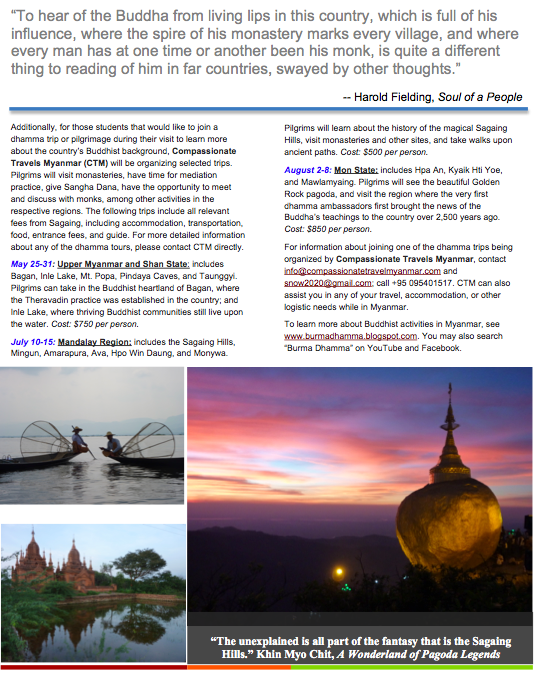
This June and July, Sitagu Academy Rector Dr. U Kumara has announced his intention to offer a two month Abhidhamma course to foreigners in Sagaing. The course will be given entirely freely, and those accepted will be provided a meditation visa to attend. Finally, Compassionate Travels Myanmar will be offering three one-week dhamma tours around the country to coincide with the Abhidhamma course dates, allowing students/pilgrims to explore more of the country's Buddhist background while in this part of the world. Especially recommended, however, is Muditā Works.

To learn more about the requirements for applying to this Abdhidhamma course, please see this blog post. You can also directly download the PDF version here.

Many foreigners may already be familiar with the Sitagu name, as they have a branch monastery in Austin, Texas and the head Sayadaw, U Nyanissara, is one of the most respected in all of Burma today. U Nyanissara was also very close friends with U Goenka. The great lay meditation teacher regularly visited here when visiting the country and stopped at the Academy several times while leading several hundred foreign meditators on pilgrimage in the early 2000s.