Showing posts with label Kyaukse. Show all posts

Tuesday, 12 July 2016

Webu Sayadaw's Meditation Cave


Before U Kumara (the future Webu Sayadaw) popped up in Kyaukse out of the blue on March 12, 1924, no one was quite sure where he had been spending time. All that was known was that he was in the midst of years of intensive, solitary practice; even his modern biographers and closest disciples have been unable to reconstruct those early years in any detail. And while U Kumara continued his secluded practice here, Kyaukse was also where the next phase of his life began, and from where word about the achievements of the noble monk would spread to the rest of the country. 


The first site of note at Webu Sayadaw Monastery in Kyaukse is Dhat Ma Shaw Well, situated on the right side of the road, between the inner and outer monastery gates. After leaving his formal studies behind at the Masoyein Monastery in Mandalay in his mid-twenties, U Kumara spent some time living in remote caves and forests; perhaps given these hardships, he was frequently afflicted with stomach illnesses. 

One story goes that he was once travelling by train from Shwebo when someone advised him about a well near the Webula Hills that was known for its medicinal qualities. (In one version this was a holy man or pilgrim clad entirely in white. In another, it was a woman who met him before the train, and when U Kumara suggested that he may go home to Ingyinbin seeking a cure, she diverted him instead to Kyaukse) Soon after, he had a dream in which a being directed him to come here and search for a well of clear, bluish water. When he found the well, it is said that the same supernatural being appeared to personally offer him the water, and after drinking it, the monk’s stomach pains ceased. U Mya Thaung wrote that following this event, Webu Sayadaw never again laid down, had a cold, or spit. Those who wish may drink from this well, but note: pilgrims do so at their own risk.

Dhat ma shaw carries a couple of different meanings. Translated literally, it means “the knife falls down,” a reference from the 12th century when King Alaung Sithu is believed to have passed through here, back when the village was known as Paung. At that time, one of the royal attendants accidentally dropped his knife in this well. But when “knife falls down” is said quickly in Burmese, it can be heard as “the diarrhea has stopped,” a reference to the curative effect the well water had on Webu Sayadaw.

The words “ye phyu ye pya,” (or “white water, blue water”) came to be associated with the famous Kyaukse well that healed Webu Sayadaw. The white color refers to the water found naturally throughout these hills, while the curative water in Webu’s story was blue. Located around Webu and Weba Hills, this gave rise to the clever ditty, “Ye phyu ye pya, webu weba,” which references the geography, water quality, and famous monk all at once.

Beside the well is a stone tablet with a Burmese inscription, telling the Phaung Daw Oo story of the magical royal barge that carried King Alaung Sithu by air around the country. The king constructed a pagoda wherever he stopped, and so today many pagodas carry the name Phaung Daw Oo, meaning “the prow of the royal barge.”

Today, only serious meditators are allowed to enter and meditate in this cave, which is still standing today. Below is a photo of an inscription on this cave, with the translation below:


"Follow the tip of the nose - align with mindfulness,
To other object - (mind) should not be let go.
Contact and mindfulness - should be known continuously,
(thus) the difference between body and mind - will be known without fail."
The benefactor Venerable Webu Sayadaw
Champion 1998"


Sunday, 6 September 2015

Pyat Kha Shwe Taung Pagoda


Burmese kings first arrived here between the eleventh to the thirteenth centuries to build dams throughout the region. They rode on royal processions preceded by a retinue of white elephants— there was a well established tradition in Burma linking these animals to the faith, for 33 white elephants were said to have carried the Tipiṭaka into the country from Mon state and there is believed to be a telepathic connection between the beast and the king.

King Anawrahta was the first of these kings to arrive in the area. After receiving a replica of the Buddha Tooth Relic from Sri Lanka in the 11th century, he set out with his favorite white elephant, proclaiming that it be allowed to wander freely, and wherever it stopped he would build a pagoda which would enshrine the Relic. This was not an uncommon practice at the time, and at least four pagodas in Bagan were constructed this way. The elephant paused as he reached Shwe Thar Hlaung Hill, the site that would become famous from the historic meeting of Sayagyi U Ba Khin and Webu Sayadaw. However, it was somehow divined that the great animal did not designate this to be the chosen spot for a pagoda, and so he was allowed to continue, and when on until he reached Pyat Khar Shwe Hill. Even as the king chose to have the pagoda built at the latter site, he authorized another pagoda to be constructed at the first hill as well. After the pagodas were completed, great festivals were held at both sites. Later, after laying an advanced system of canals in the Kyaukse region, the King suggested that Thadingyut be celebrated in the region by paying respects to and sharing merit with the white elephant. A competing theory for the founding of this pagoda is that it honored the patron Nat of elephants, Uttay Na, who is believed to have power over all elephants and oozies (trainers). Uttay Na shrines have been placed at elephant camps for many centuries.

Today, the pagoda’s annual festivals includes the exhibition of large, hollow, paper maché elephants inhabited and brought to life by two people within. The craft of making these very life-like costumes has remained a secret for generations, passed down only within family lineages. Prizes are given each year for the best costume and dance, with families and communities competing against one another, and routines include dainty steps and acrobatic twists and turns to the music of a traditional orchestra. Choreography may be practiced an entire year prior, and the winning teams from the respective age groups perform at the pagoda on the ensuing full moon day, as well as at novitation ceremonies and other religious functions in town. After the competition, village residents and visiting pilgrims ascend to the pagoda to present offerings to elephant figurines.

Friday, 12 June 2015

A Tree in Ingyinbin


John from New Zealand took this photo at Kan Oo Monastery in Ingyinbin, the site most associated with Webu Sayadaw. This is a tree from the "Pariyatti Monastery" in the village, and one that John especially resonated with. It also has some history-- as a young novice, Shin Kumara (who would later be known as Webu Sayadaw, after the Webula Hills in Kyaukse) used to water this tree every day. Before this, when still a lay boy, his father had also given him the task of throwing pebbles to shoo away birds landing on the rice paddy, but he ultimately refused to do this task as it disturbed the birds, showing his compassion at even a young age.

This March, there will be a ten day silent meditation retreat in the tradition of Sayagyi U Goenka held at Ingyinbin, the 8th overall that has taken place there. This will be a very unique and precious opportunity for meditators to sit at the very site where Webu Sayadaw instructed thousands in meditation.

Wednesday, 4 February 2015

Sayagyi U Goenka Pilgrimage: A Day in Kyaukse


On this day, pilgrims descended on the important town of Kyaukse, near the Mandalay airport and just south of the city of Mandalay. This is a place of vast importance in the biography of Webu Sayadaw. For many years, this monk's whereabout were totally and entirely unknown, and even present-day biographers have been unable to construct any narrative of where the great monk was for nearly a decade. Likely he was practicing intensive Vipassana meditation in wild forest regions, and had little to no contact with other people at this time. However, Kyaukse marks the site where Ashin Kumara, as he was then known at the time, resurfaced after so many years away. Suffering from chronic stomach problems, he had a dream in which a supernatural being directed him to a special well in Kyaukse that contained celestial water. "Drink some of this," the being promised, "and you shall suffer no more." U Kumara followed the advice, and true to his word, his stomach pains did indeed ease. 

As he recuperated, he found a cave just up a hill where he could meditate intensively, later followed by a black stone on which he would sit for many hours in the open air. Located on Webu Hill, U Kumara ultimately because known as "the Sayadaw on Webu Hill," or just "Webu Sayadaw" for short.

Eventually-- to speed the story up many years in the space of a sentence-- a vast monastery was built around the great monk, which is what a young government minister found in 1943 when he had a brief layover en route to Yangon. The Minister's name was U Ba Khin, and upon meeting Webu Sayadaw for the first time here and describing his meditation practice, he was instructed in no uncertain terms to begin teaching immediately! Just a few hours later, he taught his first student: a train worker at the Kyaukse station. Later, with Webu Sayadaw's blessing, U Ba Khin would open IMC, where a young Indian named S.N. Goenka would learn under him, and eventually spread this wonderful Burmese Dhamma around the world...


An Indian pilgrim takes photos of the very cave where Webu Sayadaw began his practice in Kyaukse

The very kuti where Webu Sayadaw was meditating when U Ba Khin came to the site as a young government minister

Saturday, 28 June 2014

A Visit to Webu Monastery in Kyaukse

A life size statue of Webu Sayadaw depicts the venerable monk in a palanquin that was actually used during his lifetime. This is set next to a large Dhamma Hall where Webu would preach, before which, he always played his own recording of him chanting the Maha Sumaya Sutta, which is an invitation to devas and other celestial beings.


Kyaukse has a very important place in the story of the Venerable Webu Sayadaw. It was in Kyaukse that the venerable monk reemerged after several years of intense meditation practice, the details of which even his biographers are not clear about and which may never be satisfactorily unearthed. Webu Sayadaw would go on to reside in this area for much of the rest of his life, although when the Webu Monasteries at Ingyinbin and Shwebo were established he would stay here only for the Rains Retreat. It is also believed he attained the third stage of liberation in Kyaukse, and later gained full liberation back in his native village of Ingyinbin. U Ba Khin met Webu for the first time here, and soon after he taught his first student, the train station attendant, upon Webu Sayadaw's advice.

As Webu began to get more known throughout the country, many lay supporters sought him out and monks came here hoping to learn under him, causing this center to slowly grow into its present size, a 200-acre monastery compound. U Ko Lay ordained twice at this Kyaukse center, once in 1960 and once several years later. While the old sites of significance from Webu Sayadaw’s life are still standing on the grounds, much of the original construction has been abandoned in favor of a newer monastery where monks, nuns, and lay people currently reside. Today the monastery grounds are also home to over fifty pagodas.


This is the stone stairwell leading to the San Kyaung building, where many artifacts from the First and Second Webu Sayadaw are kept. Included here are relics, paintings, original alms bowls, and other such items. 
Foreign yogis mediate inside the very cave where Webu Sayadaw spent many of his days-- and nights-- when he first came to the Kyaukse area.

A Canadian yogi ascends the stairs to San Kyaung. Above his head one can see placards hanging. One of these was sponsored by Sayagyi U Ba Khin, and his name and family and address are listed as well.


Wednesday, 5 March 2014

San Kyaung Building at Webu Sayadaw Monastery in Ingyinbin


This short clip shows a German meditator in very early morning in the San Kyaung building at Webu Monastery in Ingyinbin village, located in Upper Burma. In January 2014, a group of 25 foreign meditators visited here, and they sat a one day course in this building.

This building is highly significant because it was here that the venerable Webu Sayadaw, widely believed to be an arahant, resided during each hot season (he spent the rainy and hot seasons in Kyaukse and Shwebo, but always came to his native village for hot seasons). He meditated in this two story building and received visitors here as well. It was also in here where the great monk entered passed away and entered parinibbana. More about him can be learned from the documentary "Webu Sayadaw: Anthology of a Noble One."

The building is usually kept under lock and key, but the pilgrims received extraordinary permission to meditate in this building as they wished during their stay. The main altar is shown in the video, and where precious relics are kept, along with other items from Webu Sayadaw's day.

A more comprehensive and informative map of Ingyinbin and its history is coming soon.

For more information on current pilgrimage, see here.

Sunday, 2 March 2014

A Diary of Pilgrimages

Three young Burmese boys join a group siting at a pagoda with the pilgrims

42 days of pilgrimages have now been completed, and two groups of devoted yogis have now seen the best that Burma has to offer, with many lives transformed in the process. Some pilgrims ordained and are still in robes, with others coming in the next few weeks, months, or even years with a similar intention in mind. Others have grasped the dhamma in more profound ways than was possible in one's home country, and have returned to their local community to share their wealth of experience, understanding, and inspiration.

The following guide shows the diary entries recorded for the two yatras. The majority of the first diary entries were made by Kory Goldberg, a Canadian yogi and author of Along the Path. The majority of the second yartra entries were made by an anonymous American pilgrim.

While no yatras have as yet been confirmed for the following winter of 2015, there are upcoming opportunities for those interested to join part on such excursions in the near future. U Kumara at Sitagu Academy has indicated an interest in hosting Abhidhamma workshops in English for any interested foreigners in the Sagaing Hills in June, and brief ten-day dhamma trips will be organized both before and after these courses for those wishing to attend. Finally, one may also contact Muditā Works  (the agency which arranged for the entire following two pilgrimages) at any time to arrange such a dhamma trip according to the wishes of one's group.


The ruins of Htut Kaung Monastery in the Sagaing Hills. This was one of the world's first meditation-oriented monastery 

Pilgrimage #1
Day 1: Yangon
Day 2: Pyaw Bwe Gyi
Day 3: Yangon and Hmawbi
Day 4: Hmawbi
Day 5: The Road to Mandalay
Day 6: Mandalay
Day 7: Kyaukse and Mandalay
Day 8: Mandalay and Monywa
Day 9: Monywa
Day 10: Monywa, Sain Pyin Gyi, and Ingyinbin
Day 11: Ingyinbin
Day 12: Ingyinbin
Day 13: Ingyinbin
Day 14: Ingyinbin, Shwebo, and Sagaing Hills
Day 15 and 16: Sagaing Hills
Day 17: Mingun
Day 18: Sagaing Hills and Yangon
Day 19: Yangon
Day 20: Yangon

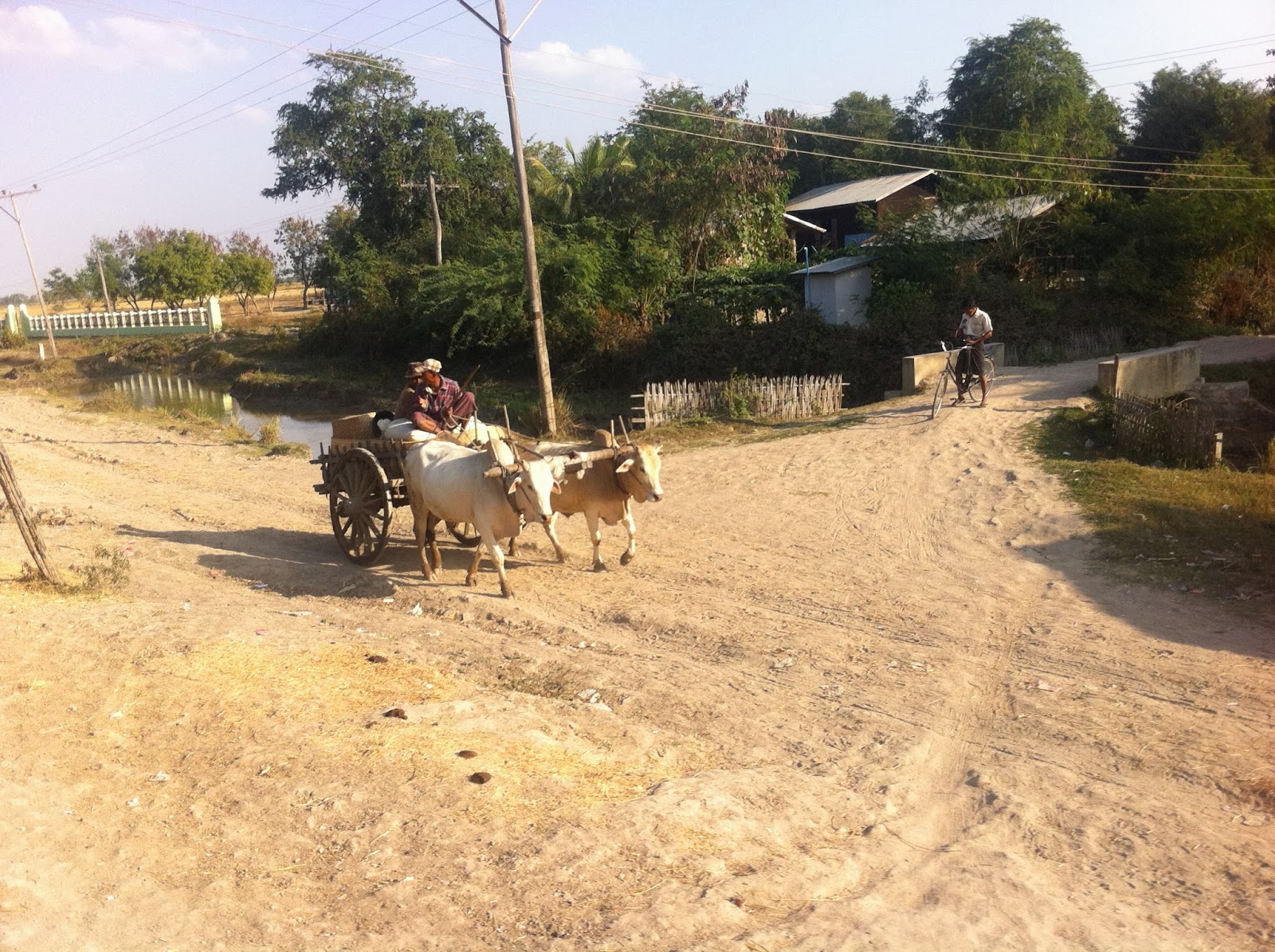
A typical rural Burmese scene

Pilgrimage #2
Day 1: Yangon
Day 2: Pyaw Bwe Gyi
Day 3: Yangon and Hmawbi
Day 4: Hmawbi
Day 5: The Road to Mandalay
Day 6: Mandalay
Day 7: Kyaukse and Mandalay
Day 8: Mandalay and Monywa
Day 9: Monywa
Day 10: Monywa, Sain Pyin Gyi, and Ingyinbin
Day 11: Ingyinbin
Day 12: Ingyinbin
Day 13: Ingyinbin, Shwebo, and Sagaing Hills
Day 14: Sagaing Hills Nunneries
Day 15: Within the Sagaing Hills
Day 16: Sagaing Hills One Day Sitting
Day 17: Mingun
Day 18: Sagaing Hills and Yangon
Day 19: Yangon
Day 20: Yangon

Pilgrims travel back from Mingun to Sagaing

...one may ask, what is so special to have to come across the world to Burma anyway, when the practice is basically inside already? Harold Fielding, a British administrator, provided an answer to this question in 1898 in "Soul of a People":

"To hear of the Buddha from living lips in this country, which is full of his influence, where the spire of his monastery marks every village, and where every man has at one time or another been his monk, is quite a different thing to reading of him in far countries, under other skies and swayed by other thoughts. To sit in the monastery garden in the dusk, in just such a tropic dusk as he taught in so many years ago, and hear the yellow-robed monk tell of that life, and repeat his teaching of love, and charity, and compassion—eternal love, perfect charity, endless compassion—until the stars come out in the purple sky, and the silver-voiced gongs ring for evening prayers, is a thing never to be forgotten. As you watch the starlight die and the far-off hills fade into the night, as the sounds about you still, and the calm silence of the summer night falls over the whole earth, you know and understand the teacher of the Great Peace as no words can tell you. A sympathy comes to you from the circle of believers, and you believe, too. An influence and an understanding breathes from the nature about you—the same nature that the teacher saw—from the whispering fig-trees and the scented champaks, and the dimly seen statues in the shadows of the shrines, that you can never gain elsewhere. And as the monks tell you the story of that great life, they bring it home to you with reflection and comment, with application to your everyday existence."


School children gather before a backdrop of rural stupas

Monday, 24 February 2014

Webu Sayadaw: Anthology of a Noble One

Thanks to new YouTube features, we are now able to share the entire one hour documentary on the life of the renowned Burmese monk Webu Sayadaw.


Sunday, 9 February 2014

Burma Pilgrimage #2, Day 7: Webu Sayadaw Monastery in Kyaukse

A lifesize replica of Webu Sayadaw shown sitting in his palanquin, placed next to the Dhamma Hall where he used to preach

The following excerpt was written by an American yogi about the pilgrimage in Burma. The first pilgrimage has ended, and the second one has just begun! To read about the previous day, go here. To read about the first pilgrimage group's experience on their own Day 7 at Kyaukse, go here.

You can also consider joining a later pilgrimage in Burma yourself.


"Today we visited several sites related to Webu Sayadaw.


We stopped at a well where Webu Sayadaw is said to have consumed some water that cured his digestive troubles. While the water in the well looked a little suspect (green and a little cloudy looking), it was actually quite clear after ladling it out. With the help of a monk's water filter and lid (as a makeshift drinking vessel), several of us tried the water. Tasted
pretty good, and we're still upright, about 12 hours later...


The well that Webu Sayadaw found in Kyaukse
The morning group sit took place in a small wood hut next to Webu Sayadaw's kuti (where Sayagi U Ba Khin first met the great monk and initially paid his respects). Post sit, we were able to spend a few minutes in said kuti (really nice...), and paid respects to an 'Arahant ordination hall.' Apparently in order for a man to become a monk, a proper ordination hall is needed. Story has it that the ordination hall near Webu Sayadaw's kuti was created by Webu Sayadaw and
two other arahants (Sun Lun Sayadaw and Nyaung Long Sayadaw). One can only imagine the quality of monks to come from such a place!


The Sima Hall established by three arahants

The Building where U Ba Khin met Webu Sayadaw for the first time

After lunch at Webu monastery, we were able to sit briefly in the cave where it is said that Webu Sayadaw reached arahantship. The feel of the place, even with the low, slanted ceiling, was amazing. One could easily spent a day and a night (or a lifetime?) there...

There were plans to see relics from an arahant named Monle Sayadaw who passed away in 2010, but we ran out of time. There's good & bad about traveling as a group. It's been very helpful to not have to worry about logistics, and we've likely gotten to do things as a 'group of international meditators' that a single meditator might not have been able to do.


This large painting shows Gautama Buddha following very severe ascetic practices, and is hung in the Dhamma Hall where Webu Sayadaw would teach dhamma.

On the other hand, everything takes that much longer in a larger group, and the energy level varies amongst the group members. The schedule is also less flexible... More reason for a future second yatra to Burma...)"


For Day 8, keep reading!


A close up of a Webu Sayadaw statue

Thursday, 16 January 2014

Burma Day 13: Settling In Before Heading Out

The day before can be seen here! The following excerpt was written by Kory Goldberg about the pilgrimage in Burma. You can also consider joining a later pilgrimage in Burma yourself.


Pilgrims take a group photo with the Sayadaw at the Patipatti side of Webu Monastery

"Today was atypical as people had the opportunity to really follow their own rhythm. Following meditation and breakfast, most of us chose to take the village and Pariyatti Monastery tour, but some decided to simply take it easy and meditate on their own. Some even followed bhikkhus U Sasana and U Agga on their alms round through the village, getting a glimpse into the 2600 year old tradition in a location that probably does not look like too much has changed since then. For those of us on the tour walking through the village with U Mandala and the visiting monk U Yassa was quite special. Ingynbin's people are renown for their devotion to the Sangha and walking along with these English speaking venerable monks afforded us an opportunity to interact with villagers in a way that seemed impossible the day before when a small group of us went out on our own. The previous day, we certainly got a few brilliant smiles and mingalabas, but with the monks people actually came out to meet us after they had finished bowing in reverence to the monks. 


The group gathers for a photo in front of the magnificent Dhamma Hall on the Pariyatti side of Webu Monastery
When we arrived in the village centre, we came across a large float built to hold a coffin. Venerable Yassa's aunt had recently died and he was back in Ingynbin from Mandalay to participate in the funeral procession and practice the Asubha contemplation. One of the pilgrims asked the monk of 25 rainy seasons how he felt. He admitted that he felt sad, but he did not cry since he had so much Buddhist practice under his belt. He said he felt happy also at this moment, for he had helped to teach dhamma to his aunt and he knew that she had lived a pure and virtuous life. Sharmaji, with full compassion, held the monk's hand, for he too is a human being. 

U Yassa then translated the conversation to the crowd of villagers who stood close by (in a respectful and non-imposing manner, unlike in India when locals are not shy to surround a foreigner and gawk at him as if he were an animal in a zoo). The villagers were all smiling, including Yassa's uncle, understanding that death is just another part of the cycle of life. Yassa continued that his aunt was a dedicated Buddhist whose morality was stainless and her meditation strong, so he was confident that she was bound for rebirth in a celestial plane. He then invited us to attend the funeral and practice the Asubha, a reflection on the fragility of human life and the repulsiveness of the human body. To his surprise, we all accepted with gratitude and excitement to watch a corpse burn to ashes.

Since the ceremony was not for another 90 minutes we returned to the monastery for an audience with the Buddha relics. As I was at Chowse, I was quite skeptical regrading their authenticity, despite knowing that they had been donated to Webu Sayadaw by the Prime Minster of Sri Lanka (Webu Sayadaw had visited Sri Lanka only on the condition that he was given some Buddha relics to bring back to Myanmar). However, as soon as I entered the Sayadaw's darkened room where they were kept I immediately felt that distinct strong activation of the awareness of the anicca along with a coolness flowing through my body, a very unique movement of sensation that I feel only when in the presence of the Tathagata's remains. The 82-year old Sayadaw sat there flanked by some younger monks, and in front of him was an open relic casket. Right there lay before me mustard seed sized pieces of bone in the centre of an ivory lotus flower. Snow had been in the room for some time already, and she called each one of us up to the relics and then placed them on our heads for a direct blessing. Once everyone had had a turn, Yassa translated the Sayadaw's Webu-inspired teaching on practising continuously in order to awaken in this very lifetime. None of us wanted to leave, but this moment too had to come to the end of its life as the funeral ceremony was to soon begin.

The procession itself was neither solemn nor sad, but rather festive with lots of joking and laughter as people banged on the side of the float shouting out the Burmese equivalent to "Grandma, Grandma, come on Grandma." The float was then disassembled, the body removed from the coffin and placed on to the pyre. We then all moved to a nearby site where we were all given lychee juice while taking refuge in the Triple Gem and 5 precepts, followed by an Asubha-based discourse, which fortunately Yassa translated for us. 

Initially, I felt bad that we were given the seats of honour at a funeral of person we did know and that the translations stretched out the event for our sake, but when realizing that all the locals were so pleased to have us there, all such thoughts vanished. As the chanting and discourse commenced, the smell of burning flesh wafted through the air. When the discourse was over, we met Yassa's cousin, also a monk, and uncle who we met earlier. This time, however, the elderly farmer was no longer grinning from ear to ear as the direct realization of what was happening began to sink in. His son, the monk, looked devastated, despite wearing the armour of a bhikkhu. We then walked over to watch the corpse burn and reflect on the vulnerability of life and inevitability of death. To our surprise, most of the funeral attendees skipped out on what seemed to me one of the most important parts of the ceremony. Those in attendance, besides the freaky foreigners eager to see a dead body, were a bunch of young novices with their fingers stuck up their noses, a few teenagers, the calm Yassa, and those responsible for burning the body. Every now and again these guys would use a long piece of bamboo to scrape the flesh and poke at the bones to make sure that every part got consumed by the fire.

Later that afternoon as most people rested, a couple of us completely changed gears as we dove into the mud with the Thai women and a group of novices to work on constructing the mud bricks for the adobe house. We worked out our muscles by mixing the clay, water and rice husks and then carrying heaps of these mixtures over to the frame for shaping the bricks. It was a lot of fun and gave us an opportunity to interact with locals in a completely new and engaging way. Translating words into English, Thai and Burmese while building something useful is a great way to establish communication amidst linguistic and cultural obstacles. After we were done and bathed at the natural hot spring, we came across some young, local farmers playing their end-of-day ritual of chinlone-volleyball. At first we hesitated to join because these guys were amazing, but their skill and positive energy magically raised our bar and we fit in not too badly.

After our evening meditation the relaxation for most continued until bed while some of us went back to meet with Thais to learn more about adobe building and their projects back home. What an incredibly diverse and spontaneous day! The constant surprises and blessings on a pilgrimage can only manifest when their is a willingness to remain flexible and open to change, comfort with not knowing what will pop out around the next corner, and honest about one's needs and limitations. The next step is integrate these pilgrimage lessons back home where every day, every moment is its own little journey."


The next day's entry, when the group goes on to the mystical Sagaing Hills, can be found here...

Sunday, 5 January 2014

Burma Day 7: Webu Sayadaw

(To see Day 6, go here!) The following excerpt was written by Kory Goldberg, describing the Buddhist pilgrimage in Burma as it reaches it half-way point. You can also consider joining a later pilgrimage in Burma yourself.

"The day began again with a morning yoga session on the hotel's roof, even though we were all quite tired from a lack of sleep caused by the very loud Burmese independence day celebrations that began around 9pm the night before and continued until around 7am this morning (and now that it is night time again the music has recommenced. The ear sense door senses the sound object--some moments the mind accepts sound is merely sound; other moments the mind is pulled towards aversion of the unpleasant sound object). A few members from our group were too tired to join the group and opted to stay back and rest at our luxurious hotel.


We spent most of the day at Webu Sayadaw's first monastery in Kyaukse (pronounced Chowse, so I have no clue why the English spelling is the way it is--this is quite common and none of the old Burma hands can adequately explain the disconnect between the way it is spoken and written). When we arrived the bhikkhus were out on alms round so we immediately headed towards Webu Sayadaw's first kuti (where Sayagyi U Ba Khin first met the venerable one) and meditated there for an hour while playing a rare recording of Webu Sayadaw and 
Sayagyi U Ba Khin chanting together. The powerful contemplative atmosphere, not only here but the entire compound, made concentrating on the in-coming and out-going breath easier than usual. After our session we made our way to the dining hall where we met Webu Sayadaw III, whose role as abbot, I imagine, is not only an honour but a challenge to fit into the gigantic shoes (or rather, bare feet) of the previous two Webus who were not only strict dhutanga practitioners but also purported to be Arahants. After a brief question and answer period that focussed primarily on the original Webu Sayadaw's interpretation of Anapana and the practice of eating one meal a day in one sitting from one bowl, we offered the Sangha robes and the day's meal. While the nuns ate their meal we took a walk up the mountain to Webu Sayadaw's second and bigger kuti which also served as a dhamma hall for instruction. While meditating at this site we were in the presence of what are believed to be the Buddha's relics (given to Webu Sayadaw by the president of Sri Lanka). The relics are in Webu's bowl that is wrapped in a white cloth, and we were able to have the bowl placed on ours heads as we meditated. To be honest, I am a little skeptical about this claim given that the bowl is just displayed there out in the open without any sort of protection whatsoever, so anyone cold steal them if they so desired. however, given that we are in such a strong dhamma atmosphere where the people are really concerned about there ethical integrity, it seems highly unlikely that anyone would imagine committing such a crime (and the long-term kammic consequences of doing so would be so much worse than any punishment dished in this lifetime). Also, I cannot truthfully say that I felt anything really special, as I have on other occasions while in the presence of the Bhagawan's relics; although this might also be because the whole atmosphere is really charged, making it difficult for a gross oaf such as myself to detect such subtle nuance. After our lunch, we walked up and along another trail leading to the cave that Webu Sayadaw used to live in for several years before his lay disciples built him a kuti so that he would be more accessible to reach for dhamma instruction. Since the cave only holds about half a dozen meditators at a time, we took turns sitting in there while the rest sat on the small verandah just outside the cave. Sitting quietly was a real pleasure as the tranquil and quiet atmosphere and the gentle breeze cooled our hearts and minds, releasing travel- related stresses, strains and fatigue. After we all had a turn in the cave, we slowly made our way back down the hill to the bus, stopping briefly at the water well whose healing waters were said to have cured Webu Sayadaw's long time dysentery. Some of us followed the Sayadaw's lead and drank some of the musky water. My tummy had been slightly upset, so I decided to take a risk and make a dedication of truth and take a swig of water, thinking that at best it would either relieve my discomfort and increase my faith in the mystical or worsen my digestive woe. Eight hours later and so far so good.


On our way back to Mandalay we stopped in at Dhamma Mandala for a tour of the centre and a group sitting. Once again our Burmese yogi kin were delighted to see us and showered us with their Burmese hospitality, even though it was Day 0 of a 20-day course. Unlike in the West where centre management tends to be stiff and rule-oriented, the Burmese are way more relaxed, nourishing visiting meditators and even allowing them to meditate in the pagoda between courses. Our final stop before a light dinner at Ma Khain's was at the late Monle Sayadaw's meditation centre where his bone, brain and heart relics were on display for public viewing. The body of this inspiring arahant who passed away in 2010 was left out in the open for 7 days so that devotees from around the country could pay their last respects to the great master. Whereas corpses generally stiffen quite quickly and begin to smell rotten after 2-3 days, Monle Sayadaw's body remained limp and odorless for the entire week leading up to the cremation. We had the good fortune to be blessed by the Sayadaw's robe that had wrapped his corpse. the rare robe, which had been woven by lotus fibres, had not been washed after being on the corpse and it remained clean and fresh. This great master of meditation and Abhidhamma lived a humble and simple life, and served as example of freedom in the truest sense of the word."


The journey continues through to Day 8!