Showing posts with label arahant. Show all posts

Tuesday, 25 February 2014

Burma Pilgrimage #2, Day 12: "But perhaps, there's more than that..."

A view of the fields and trees around Ingyinbin

The following excerpt was written by an American yogi about the pilgrimage in Burma. The first pilgrimage has ended, and the second one has just begun! To read about the previous day, go here. To read about the first pilgrimage group's experience on their own time in Ingyinbin, see here.

You can also consider joining a later pilgrimage in Burma yourself.

"Today a one day course was held at Ingyinbin, in the hall where Webu Sayadaw passed into parinibbana.

As the group organizers and remaining manager looked quite tired, they had the day off to sit or do as they pleased.

It seemed like a good course for all. Some of us had the chance to sit in Webu Sayadaw's kuti - quite an incredible place.


A view of the male sleeping quarters, upstairs in the Bago building towards the southeast of the Patipatti compound.
*********
A male yogi's bed

There's something remarkable about Ingyinbin.

An arahant's birthplace, where his meditation kuti, parinibbana site, and cremation grounds are with walking distance to each other. Add to this mix both Buddha and arahant relics... the strength in this small strip of land is palpable.

But perhaps, there's more than that. After all, it was the place an anagami came for final liberation. And a place where a reputed Bodhisattva's hair clippings rest, at the foot of an arahant planted bodhi tree.

What strength lay here before Webu Sayadaw? What role will Ingyinbin play in the future? Only time will tell..."


For the Vibrant Days on Day 13 towards Shwebo and Sagaing, see here!


Villagers in Ingyinbin


One of the modern caretakers at the Webu Monastery in Ingyinbin

Friday, 31 January 2014

Sayagyi U Goenka venerates Shwe Oo Min Sayadaw

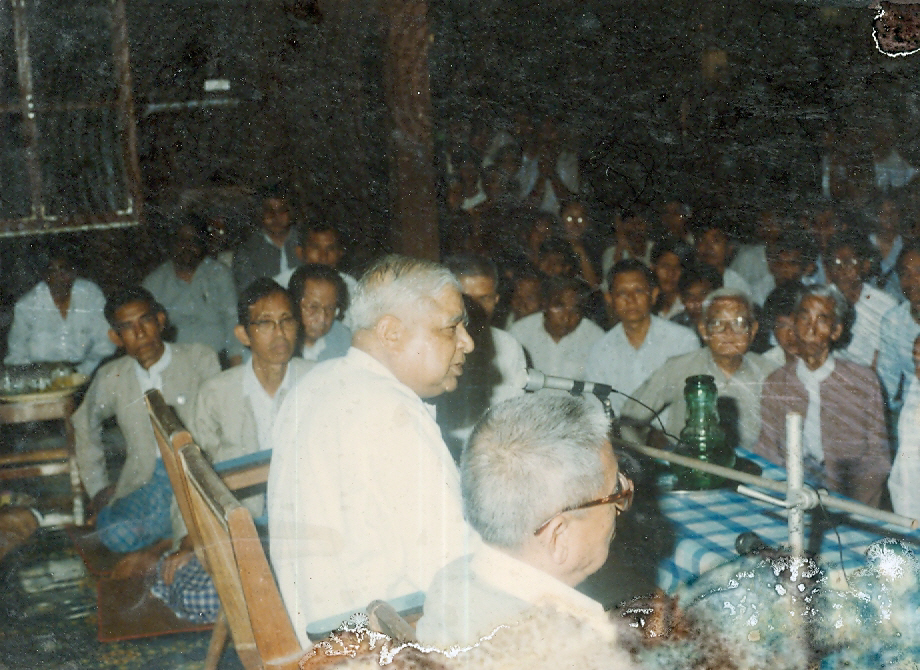
In the Shwe Oo Min Sayadaw commemorative book, one page is dedicated to Goenkaji's visits. The first shows him paying respects to the venerable monk, the second visiting his North Okkalapa monastery, and the third addressing a gathered crowd to discuss dhamma

From a photobook commemorating Shwe Oo Min Sayadaw's life are these three photos of Goenkaji. It was largely because of Shwe Oo Min Sayadaw, deeply revered in Burma and believed by many to be an arahant, that Goenkaji was given permission by the State Sangha to be able to run his courses from 1993. Goenkaji was therefore always deeply grateful to Shwe Oo Min Sayadawgyi, and during his visits back to Burma often made sure to visit him and pay his respects. Many of his early pilgrimages made a point to stop here, and Goenkaji would give a brief dhamma talk after paying his respects (on one such trip an American assistant teacher himself ordained at the Shwe Oo Min monastery!). Shwe Oo Min Sayadaw also strongly supported the children course initiative that the Goenka centers undertook, and they worked together with the Shwe Oo Min monasteries across Burma to be able to reach many thousands of children. Still today, it is not uncommon for serious meditators to visit the Shwe Oo Min Monastery, and there is a hut where one can pay respects to the memory of the former Sayadaw, and some will stay on here for some time.

Sunday, 5 January 2014

Burma Day 7: Webu Sayadaw

(To see Day 6, go here!) The following excerpt was written by Kory Goldberg, describing the Buddhist pilgrimage in Burma as it reaches it half-way point. You can also consider joining a later pilgrimage in Burma yourself.

"The day began again with a morning yoga session on the hotel's roof, even though we were all quite tired from a lack of sleep caused by the very loud Burmese independence day celebrations that began around 9pm the night before and continued until around 7am this morning (and now that it is night time again the music has recommenced. The ear sense door senses the sound object--some moments the mind accepts sound is merely sound; other moments the mind is pulled towards aversion of the unpleasant sound object). A few members from our group were too tired to join the group and opted to stay back and rest at our luxurious hotel.


We spent most of the day at Webu Sayadaw's first monastery in Kyaukse (pronounced Chowse, so I have no clue why the English spelling is the way it is--this is quite common and none of the old Burma hands can adequately explain the disconnect between the way it is spoken and written). When we arrived the bhikkhus were out on alms round so we immediately headed towards Webu Sayadaw's first kuti (where Sayagyi U Ba Khin first met the venerable one) and meditated there for an hour while playing a rare recording of Webu Sayadaw and 
Sayagyi U Ba Khin chanting together. The powerful contemplative atmosphere, not only here but the entire compound, made concentrating on the in-coming and out-going breath easier than usual. After our session we made our way to the dining hall where we met Webu Sayadaw III, whose role as abbot, I imagine, is not only an honour but a challenge to fit into the gigantic shoes (or rather, bare feet) of the previous two Webus who were not only strict dhutanga practitioners but also purported to be Arahants. After a brief question and answer period that focussed primarily on the original Webu Sayadaw's interpretation of Anapana and the practice of eating one meal a day in one sitting from one bowl, we offered the Sangha robes and the day's meal. While the nuns ate their meal we took a walk up the mountain to Webu Sayadaw's second and bigger kuti which also served as a dhamma hall for instruction. While meditating at this site we were in the presence of what are believed to be the Buddha's relics (given to Webu Sayadaw by the president of Sri Lanka). The relics are in Webu's bowl that is wrapped in a white cloth, and we were able to have the bowl placed on ours heads as we meditated. To be honest, I am a little skeptical about this claim given that the bowl is just displayed there out in the open without any sort of protection whatsoever, so anyone cold steal them if they so desired. however, given that we are in such a strong dhamma atmosphere where the people are really concerned about there ethical integrity, it seems highly unlikely that anyone would imagine committing such a crime (and the long-term kammic consequences of doing so would be so much worse than any punishment dished in this lifetime). Also, I cannot truthfully say that I felt anything really special, as I have on other occasions while in the presence of the Bhagawan's relics; although this might also be because the whole atmosphere is really charged, making it difficult for a gross oaf such as myself to detect such subtle nuance. After our lunch, we walked up and along another trail leading to the cave that Webu Sayadaw used to live in for several years before his lay disciples built him a kuti so that he would be more accessible to reach for dhamma instruction. Since the cave only holds about half a dozen meditators at a time, we took turns sitting in there while the rest sat on the small verandah just outside the cave. Sitting quietly was a real pleasure as the tranquil and quiet atmosphere and the gentle breeze cooled our hearts and minds, releasing travel- related stresses, strains and fatigue. After we all had a turn in the cave, we slowly made our way back down the hill to the bus, stopping briefly at the water well whose healing waters were said to have cured Webu Sayadaw's long time dysentery. Some of us followed the Sayadaw's lead and drank some of the musky water. My tummy had been slightly upset, so I decided to take a risk and make a dedication of truth and take a swig of water, thinking that at best it would either relieve my discomfort and increase my faith in the mystical or worsen my digestive woe. Eight hours later and so far so good.


On our way back to Mandalay we stopped in at Dhamma Mandala for a tour of the centre and a group sitting. Once again our Burmese yogi kin were delighted to see us and showered us with their Burmese hospitality, even though it was Day 0 of a 20-day course. Unlike in the West where centre management tends to be stiff and rule-oriented, the Burmese are way more relaxed, nourishing visiting meditators and even allowing them to meditate in the pagoda between courses. Our final stop before a light dinner at Ma Khain's was at the late Monle Sayadaw's meditation centre where his bone, brain and heart relics were on display for public viewing. The body of this inspiring arahant who passed away in 2010 was left out in the open for 7 days so that devotees from around the country could pay their last respects to the great master. Whereas corpses generally stiffen quite quickly and begin to smell rotten after 2-3 days, Monle Sayadaw's body remained limp and odorless for the entire week leading up to the cremation. We had the good fortune to be blessed by the Sayadaw's robe that had wrapped his corpse. the rare robe, which had been woven by lotus fibres, had not been washed after being on the corpse and it remained clean and fresh. This great master of meditation and Abhidhamma lived a humble and simple life, and served as example of freedom in the truest sense of the word."


The journey continues through to Day 8!

Thursday, 28 March 2013

Auspicious Results of a Blood Test

This is a large poster hanging in an Upper Burma nunnery that shows the result of a recent blood test that an aged monk had at a hospital. Upon examining the blood and particles closely, the nurses were astounded to find certain crystalized properties within the venerable monk's blood that suggested this monk had attained enlightenment. His achievement of such a stage was not known or guessed previously to this very auspicious blood test.


Monday, 18 March 2013

SN Goenka pays respects to Shwe Oo Min Sayadaw

The following photographs are from what is believed to be the year 2000, and feature SN Goenka visiting the Shwe Oo Min monastery to pay his respects to the Sayadaw in Yangon, Myanmar. The Shwe Oo Min Sayadaw was considered by many to be an arahant, e.g. a fully enlightened being. It is also reported that at the time, U Goenka told those of his meditation students wishing to ordain as monks that Shwe Oo Min was a conducive place for continuing their practice. In a commemorative book after the Sayadaw passed, one page also honored the special relationship that Goenkaji enjoyed with him.

As a note, the original Shwe Oo Min Sayadaw (featured in the photos below) passed away in 2003 and the monastery is now presided over by Sayadaw U Tejaniya.


SN Goenka visits the Shwe Oo Min Monastery 
SN Goenka visits the Shwe Oo Min Monastery

SN Goenka pays respect to Shwe Oo Min Saydaw

SN Goenka pays respect to Shwe Oo Min Sayadaw

SN Goenka speaks to assembled guests at Shwe Oo Min monastery in Yangon, Myanmar