The Maha Myat Muni Buddha image! In this single object, now heavily coated in gold, can be seen the intersection between myth and documented history, between ancient India and modern Myanmar, between political power and the quest for liberation, and between external devotion and internal faith. Meditators from lands without a strong Dhamma history may not understand how— or even be aware that— centuries of devoted Buddhist practice manifest through material objects, especially Buddha images. One of the clearest examples of this is the Maha Myat Muni Buddha statue. As British colonial writer George Bird wrote over a century ago, “[S]o highly venerated was this image, that from the earliest times pious pilgrims from most distant Buddhist countries have been in the habit of coming to the shrine to pay their devotions.” The tradition and reverence continues to this day.
Showing posts with label Maha Myat Muni Pagoda. Show all posts
Sunday, 10 April 2016
Maha Myat Muni Pagoda: A Single Dhammic Object
The Maha Myat Muni Buddha image! In this single object, now heavily coated in gold, can be seen the intersection between myth and documented history, between ancient India and modern Myanmar, between political power and the quest for liberation, and between external devotion and internal faith. Meditators from lands without a strong Dhamma history may not understand how— or even be aware that— centuries of devoted Buddhist practice manifest through material objects, especially Buddha images. One of the clearest examples of this is the Maha Myat Muni Buddha statue. As British colonial writer George Bird wrote over a century ago, “[S]o highly venerated was this image, that from the earliest times pious pilgrims from most distant Buddhist countries have been in the habit of coming to the shrine to pay their devotions.” The tradition and reverence continues to this day.
Thursday, 31 March 2016
Ingyinbin Journal: Returning to Each Breath
4 January
Pigeon hoots in Mahamuni hall - dogs wanting to be petted - one bullock cart, bamboo mat floor & slats with a rail made by hand - a child with its mother and infant brother, his eyes peering examining us from under the sibling’s arm - the mother at intervals with a switch in her right hand slapping the white bullock pair - a final hard pull on the reigns brings the lumbering beasts to a standstill - staggering we disembark - passing villagers on their motorcycles laugh and wave or are slightly dumbfounded.
Returning to each breath
Itself a harvest,
a hundred byways.
Saturday, 3 October 2015
A Monastery more about the Buddha than Cats...
In his book Curious Encounters of the Human Kind, Paul Sochaczewski describes visiting Nga Hpe Chaung Monastery. Founded in 1843, the monastery is south-facing and contains 654 pillars, topped by a 3-tiered roof. The Dhamma Hall contains several large Buddha statues representing different regional styles. A local historian shared that many come from the former Shan principalities and royal palaces, and were transferred here for safekeeping. Many had been the centerpiece of their respective shrine rooms in the royal courts or important monasteries of the district’s saopha. The ceiling here is red lacquer with some gold leaf, and the north wall has an impressive painting depicting some Jataka Tales. Fine gold leaf engravings are also found on the base of the daises, which portray a variety of scenes, from taking the Five Precepts to the transfer of the Maha Muni Buddha to Mandalay. It is a space where one can appreciate the inspiration and faith these statues have provided countless Shan Buddhists over the many centuries.
Sochaczewski describes this interesting exchange during his visit:
“Then tell people the monastery is more than cats. It’s Buddha.”
Paul Sochaczewski has kindly allowed Shwe Lan Ga Lay to include this excerpt in its upcoming Part 2 release, which will feature an extensive section on Shan State, including Inle Lake. For more information on Paul Sochaczewski's book, see here.
“Come on Brochette, jump through this hoop. Arnold Schwarzenegger can do it -- it can’t be that hard.”
Our ginger cat in Geneva was doing what cats everywhere do – exactly what she felt like. Which at this moment was not jumping through a hoop.
I was trying to accomplish a similar coup de persévérance to that which some monks in Burma have achieved. Teaching cats parlor tricks. But Brochette wasn’t buying it. What did the monks have that I didn’t?
Lots of patience and an abundant supply of Friskies, as it turned out.
I was introduced to the famous Burmese jumping cats at the Nga Phe Kyaung monastery, on Inle Lake.
The “jumping cat monastery” is a key stop for the trickle of tourists who visit Burma. There I met Venerable U Nanda, 25, one of a dozen resident monks.
“It’s easy to train cats,” he said, somewhat reluctantly putting down his Burmese comic book. With a large dose of ennui he explained that you simply start when they’re kittens, scratch them under the chin, say kon, and reward them with kitty treats.
Obviously, it works. Every 30 minutes or so, when a group of visitors would accumulate, San Win, an assistant in the monastery, would put the cats through their paces.
“What’s that one called?” I asked, pointing to a black and white tabby.
World-weary U Nanda explained “That’s Leonardo di Caprio.”
“And this one?”
“Demi Moore.”
“Can I try?”
I held the wire hoop in front of Arnold Schwarzenegger,” paradoxically one of the skinnier cats in the temple. I gave him a little nudge, ordered him to kon, and after he jumped I rewarded him with a biscuit.
Meanwhile Tina Turner was curled up on my backpack, asleep. “Don’t leave your things on the floor,” U Nanda lectured. “She pisses everywhere.”
After a while U Nanda started to open up. Perhaps he saw that since I wasn’t going to go away he might as well have a discussion. I was interested in Buddhist history, he was interested in conjugating English verbs.
Throughout our conversation, the abbot, Sayadaw Kite Ti, 68, kept his distance and read a book. I don’t read Burmese, but from the pictures of cowboys and horses I was pretty sure that it wasn’t a religious text. He didn’t glance up as visitors stuffed tattered kyat notes and a few dollar bills into the offering box.
I left Inle Lake to travel around Shan state, and returned a few weeks later and sought out U Nanda. I felt I had unfinished business with the young monk, a feeling that there was more to him than a saffron-robed feline-inclined impresario.
“You again,” he said when I walked in. He wasn’t hostile, but he wasn’t overly welcoming.
I deliberately avoided the handful of curious visitors watching Brad Pitt and Michael Jackson leaping about on the linoleum. “Tell me about the temple,” I asked. And he did. He showed me around the 160-year-old monastery, the oldest on Inle Lake. Proudly, he turned on lights so that I could better see the six two-meter tall Buddha images made out of lacquerware, and the gilt-encrusted wooden statues and carved pillars. He took me into the abbot’s room to show me old, sacred Buddha images. In half an hour of looking through different eyes, the monastery for me had evolved from a tourist site into a combination art museum and place of worship
“What do you do?” he eventually asked me.
“I’m a journalist.”
Our ginger cat in Geneva was doing what cats everywhere do – exactly what she felt like. Which at this moment was not jumping through a hoop.
I was trying to accomplish a similar coup de persévérance to that which some monks in Burma have achieved. Teaching cats parlor tricks. But Brochette wasn’t buying it. What did the monks have that I didn’t?
Lots of patience and an abundant supply of Friskies, as it turned out.
I was introduced to the famous Burmese jumping cats at the Nga Phe Kyaung monastery, on Inle Lake.
The “jumping cat monastery” is a key stop for the trickle of tourists who visit Burma. There I met Venerable U Nanda, 25, one of a dozen resident monks.
“It’s easy to train cats,” he said, somewhat reluctantly putting down his Burmese comic book. With a large dose of ennui he explained that you simply start when they’re kittens, scratch them under the chin, say kon, and reward them with kitty treats.
Obviously, it works. Every 30 minutes or so, when a group of visitors would accumulate, San Win, an assistant in the monastery, would put the cats through their paces.
“What’s that one called?” I asked, pointing to a black and white tabby.
World-weary U Nanda explained “That’s Leonardo di Caprio.”
“And this one?”
“Demi Moore.”
“Can I try?”
I held the wire hoop in front of Arnold Schwarzenegger,” paradoxically one of the skinnier cats in the temple. I gave him a little nudge, ordered him to kon, and after he jumped I rewarded him with a biscuit.
Meanwhile Tina Turner was curled up on my backpack, asleep. “Don’t leave your things on the floor,” U Nanda lectured. “She pisses everywhere.”
After a while U Nanda started to open up. Perhaps he saw that since I wasn’t going to go away he might as well have a discussion. I was interested in Buddhist history, he was interested in conjugating English verbs.
Throughout our conversation, the abbot, Sayadaw Kite Ti, 68, kept his distance and read a book. I don’t read Burmese, but from the pictures of cowboys and horses I was pretty sure that it wasn’t a religious text. He didn’t glance up as visitors stuffed tattered kyat notes and a few dollar bills into the offering box.
I left Inle Lake to travel around Shan state, and returned a few weeks later and sought out U Nanda. I felt I had unfinished business with the young monk, a feeling that there was more to him than a saffron-robed feline-inclined impresario.
“You again,” he said when I walked in. He wasn’t hostile, but he wasn’t overly welcoming.
I deliberately avoided the handful of curious visitors watching Brad Pitt and Michael Jackson leaping about on the linoleum. “Tell me about the temple,” I asked. And he did. He showed me around the 160-year-old monastery, the oldest on Inle Lake. Proudly, he turned on lights so that I could better see the six two-meter tall Buddha images made out of lacquerware, and the gilt-encrusted wooden statues and carved pillars. He took me into the abbot’s room to show me old, sacred Buddha images. In half an hour of looking through different eyes, the monastery for me had evolved from a tourist site into a combination art museum and place of worship
“What do you do?” he eventually asked me.
“I’m a journalist.”
“Then tell people the monastery is more than cats. It’s Buddha.”
Paul Sochaczewski has kindly allowed Shwe Lan Ga Lay to include this excerpt in its upcoming Part 2 release, which will feature an extensive section on Shan State, including Inle Lake. For more information on Paul Sochaczewski's book, see here.
Saturday, 21 June 2014
S.N. Goenka at Maha Myat Muni Pagoda in Mandalay
Following is an image of the Burmese pilgrimage leader showing pilgrims the most revered Buddha image in all of Burma, at Maha Myat Muni Pagoda. This pagoda has significant importance for the pilgrims, who practiced in the tradition of S.N. Goenka, for the great meditation teacher's earliest Buddhist experiences were at this temple.
Sayagyi U Goenka has frequently shared his memories of going to Maha Myat Muni pagoda as a young child of eight with his grandfather. He admitted that his primary motivation in going at the start was the electric tram he got to ride to the pagoda, and once there he wanted to play in the open courtyard. But his grandfather would instead instruct him to walk around the temple three times before they sat quietly together for half an hour. Incidentally, there is nothing wrong with such playfulness at a pagoda; Khin Myo Chit writes that the young boy “is allowed to roam freely, playing or munching his snacks. Very little restraint is put on him—so long as he keeps away from the older folk doing their contemplation.”
In any case, the young Goenka relates being bored for the first five to seven minutes, but soon after noticing that “the entire environment was very peaceful.” Having been born in Mandalay, U Goenka has referenced this early life experience as one of his first encounters with dhamma practice. He would later say that “the pure vibrations in the tranquil air of the ancient Maha Myat Muni Buddha Temple caused a thrilling sensation throughout the body and filled the mind with rapture. It was extremely enchanting and pleasing.” He notes, “I continued to visit the temple even after my grandfather’s death… The peace and cleanliness of Buddha’s temples attracted me. I knew nothing about meditation then, but whenever I visited Maha Muni temple I felt very calm.”
When U Goenka sat his first course under Sayagyi U Ba Khin, “these childhood memories of peace and tranquility were awakened” and he recalled how it was here that the seed was initially sown in his mind. His grandfather’s example would continue to be a positive influence on his life in the years to come, as he would attribute his ethical business dealings and future itinerant life of traveling for the spread of dhamma to lessons he learned from childhood.
Tuesday, 4 March 2014
The Burma Pilgrimage: "A Great Pool of Contentment and Silence"
| January 2014 pilgrims meditate for one hour at Maha Myat Muni Pagoda in Mandalay, the pagoda where SN Goenka first came in contact with dhamma, when he used to visit here with his grandfather. |
-- Gaurishanker Sharma, India
Sunday, 9 February 2014
Burma Pilgrimage #2, Day 6: Something Special About Mandalay
| The pilgrimage group was greeted to Myanmar's second biggest city, and its most important Buddhist one |
You can also consider joining a later pilgrimage in Burma yourself.
"There's something special about Mandalay. Perhaps it was the ride in, past verdant green fields. Or the stupas dotting the cityscape. Or the increased Sangha density. Whatever it is, it's pretty special.
We started the day with a group sit at the Mahamuni temple. It happens to be a time during which the monks live chant the Patthana Sutta - this takes place 24 hrs a day for seven days, and was the background against which we sat.
Dhamma Mandapa is a sweet center tucked within a peaceful monastery in Mandalay city. The Dhamma hall and the dorms are built of wood, and surround a small lily pond. It serves as a daily group sit place, and apparently during the April water festival, the quaint center can house 170 students!
Shwe Kyin monastery was the next stop. This place is known for the strict sila/vinaya of the monks. The area teacher for Burma currently resides here for his temporary ordination, as does a member of the last pilgrimage.
After witnessing the monks file in and begin their evening gathering, we reconvene for a Question and Answer session with the Acharya. In the midst of the time with this happy bhante, we get an audience with the Sayadaw. He's got a presence that is lovely to behold, and reminds all of us of the importance of sila.
He also offered to assist with any of us, men or women, with a monastic bent - music to some of our ears..."
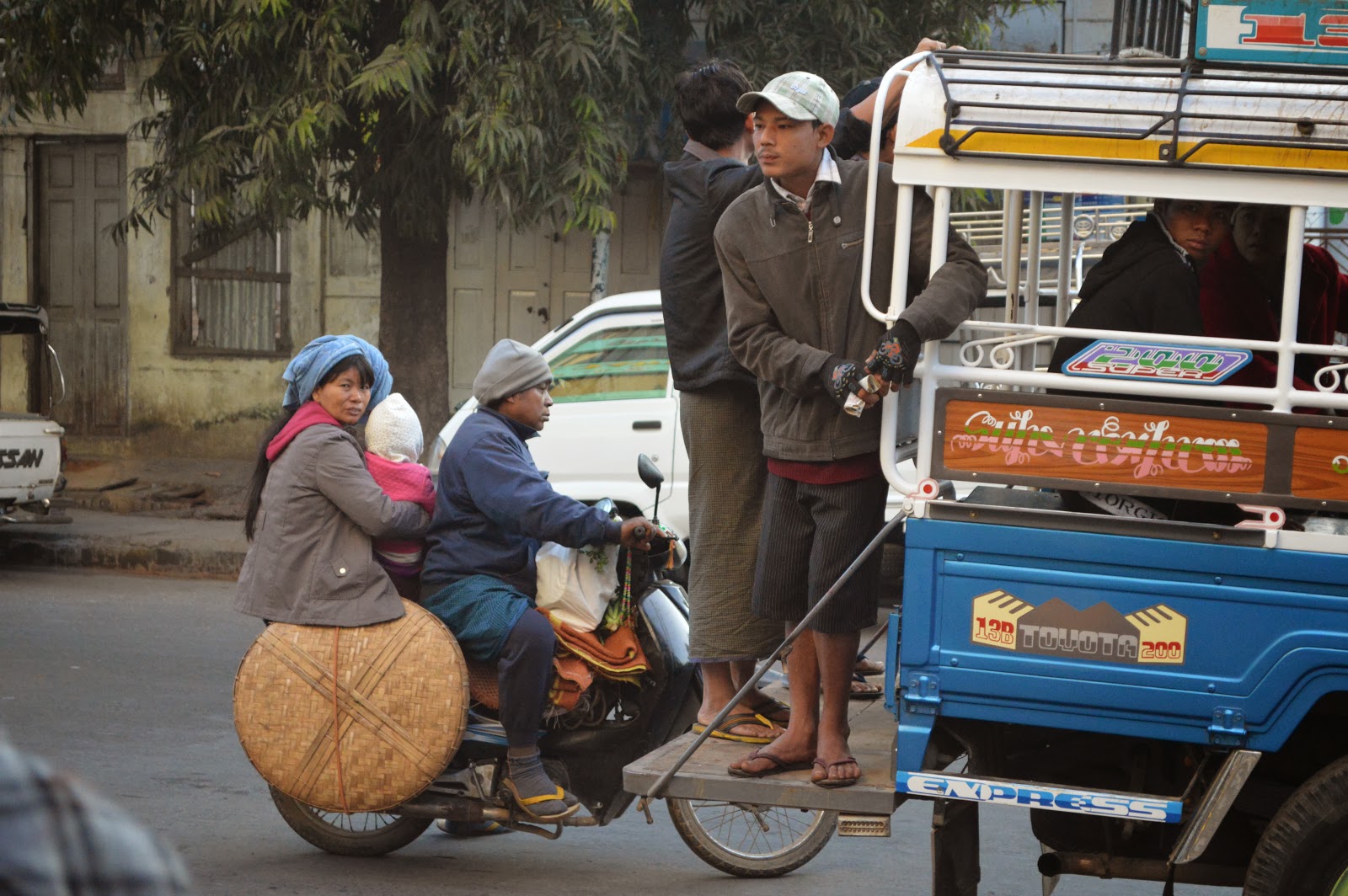
| A teashop next to the group's hotel |
Dhamma Mandapa is a sweet center tucked within a peaceful monastery in Mandalay city. The Dhamma hall and the dorms are built of wood, and surround a small lily pond. It serves as a daily group sit place, and apparently during the April water festival, the quaint center can house 170 students!
Shwe Kyin monastery was the next stop. This place is known for the strict sila/vinaya of the monks. The area teacher for Burma currently resides here for his temporary ordination, as does a member of the last pilgrimage.
After witnessing the monks file in and begin their evening gathering, we reconvene for a Question and Answer session with the Acharya. In the midst of the time with this happy bhante, we get an audience with the Sayadaw. He's got a presence that is lovely to behold, and reminds all of us of the importance of sila.
He also offered to assist with any of us, men or women, with a monastic bent - music to some of our ears..."
To learn about Day 7 at Webu Monastery in Kyaukse, go here!
Sunday, 2 February 2014
A Kiwi Monk at Webu Monastery in Ingyinbin
During the recently completed Burma pilgrimage, New Zealander Russell Quinn made the decision to ordain for 10 days at Webu Monastery in Ingyinbin, ordaining in the very Sima Hall as Webu himself once did, and becoming only the second foreigner to ever ordain there. An initial seed for this decision was planted after watching the documentary, "Webu Sayadaw: Anthology of a Noble One" and seeing the welcoming presence of U Mandala. After Russell was given the Pali name U Sassana, his shaven hair was then put under the very same Bodhi tree where Webu Sayadaw placed Sayagyi U Ba Khin's hairs when he ordained in 1965. Now back in New Zealand, Russell has shared his experiences with the yatra group, and gave permission to post his words to provide inspiration with the wider world. A series of journal entries from this yatra are also available, most having been written by Kory Goldberg, and excerpts from the second yatra (currently in progress) begin here. Kory also wrote about the experience of Russell's own ordination and his own impressions at the time that it happened in January 2014.
For current pilgrimage offerings, see here.
Just arrived back in New Zealand from the Dhamma Land: here is a short summary of my time as U Sassana and the remainder of the trip.
Once your bus had left, I felt very fortunate and joyful with the realization that I now had this wonderful opportunity to meditate in such an environment as a monk for 10 days. Amazing! How did this happen?
Once I locked into the 10 Day course routine it really didn't feel that different living as a monk than it does when one renounces for a course. Had I ordained for a longer period or even for life this no doubt would have been different. Although being in noble silence, with eyes downcast and with the attention focused inside, I did observe to some degree the community of monks at Ingynbin, to see just how they acted and lived. It seems as though they had individual practices and routines. I am very grateful for the introduction that U Agga gave me but felt a little frustrated by my lack of knowledge. In hindsight some prior inquiry would have been wise.
I sat with Sayadaw U Ku Tah La each morning for breakfast at Patipatti and he was obviously very keen to talk, but with our lack of a common language, conversation didn't go past learning the Burmese names for the different dishes. I would have liked to have talked to him about the vinaya and what the monks practice, if the discourses that often played where by Webu Saydaw and what it was that some monks were chanting etc.
The one outstanding difference I felt was that of increased mindfulness and that more worldly thoughts subsided. After disrobing I felt less protected from the influences of mara. While being whisked out of Mandalay in the air conditioned shuttle to the airport, with thoughts surfacing about heading back to New Zealand, I saw a monk on alms round and that seemed to be clearly the more wise choice. The seed has been planted now: who knows if it will be given water in the future.
On day 7 I got sick. Uh-oh! This is what I didn't want to happen. I was resting, observing the sensation of nausea, when two novices who had been serving me very attentively at lunch time at Pariyatti, appeared to check on me - as I hadn't gone to lunch. They came back that evening with some "Buddha medicine" (two types of honey, one very dark strong one and a light clear one), energy drink and bottled water. The next day there was an improvement so I went for lunch and they had prepared some more "Buddha medicine". This time it was a soup - chicken I think - and some bread and other more plain food. That evening they arrived again at the kuti with more of the honey and drinks. I was very touched by their concern and care. Truly heeding the Buddha's teaching about caring for the sanga.
One of the novice's, Nimon who is 17, is going to be sponsored by one of the Thai women next year to attend a special university for Buddhist studies in Chaing Mai. As Alex said "I think he will be quite an exceptional monk".
Ingynbin is certainly a strong place to meditate and I felt very much at home there, however, thanks to the advent of the megaphone, at times it was a case of meditating on the arising and passing of sounds. At one time there were three at once from three sides and not always carrying Dhamma messages. We tend to get used to our usually quiet meditation centres........ annica. The Dhamma hall was looking pretty good with it's new paint and there were a few well to do visitors, so perhaps the support for the monastery is on the rise. I have just heard that two NZ friends were there last year too.
The mud building at Pariyatti was finished up to roof level with lovely 3D sculptural images of flowers and Burmese lettering on the walls. It will be a great little guest room when finished. U Mandala escorted myself and the Thai group to Mandalay where he spent the day showing them some sites with U Vassa, while I went to Sagiang, thanks to the help from Ma Khaing and for the recommendation from U Agga, to a very beautiful and tranquil monastery for 3 1/2 days. The Sayadaw is a very kind and gentle person and although I was once again frustrated with the lack of a common language, he kindly showed me some of the special sites nearby, including the monastery where the yatra group stayed and the one where you did your one day sitting. I occasionally have the pang of regret at not staying with the group but do think that my solo experience was what was required for my journey.
Back in Mandalay I meditated for some time again at Maha Muni, which being a Sunday was thriving with people and there was even a group of students enthusiastically cleaning floors, walls and everything. On one side of me there was a monk reciting and on the other side someone else chanting and there were of course pigeons and other noises galore but in spite all of these potential distractions, the Dhamma vibration was strongest, which in a way sums up my overall impression of Burma. Two feelings that were almost constantly there throughout this journey and are there now are gratitude and compassion.
Deep gratitude to all those past and present who have continued the teaching and spread of Buddha Dhamma.
May all those who helped to make this and future pilgrimages to Dhamma lands possible gain plentiful merits.
With much metta,
Russell"
Sunday, 5 January 2014
Burma Day 6: A Day in Mandalay
![]() |
| As foreign yogis meditate at Maha Muni Pagoda, a monk silently records them with his video camera |
For Day 5, see here! Kory Goldberg continues his Burma pilgrimage journal for the full day experience in Mandalay, writing about the Pariyatti yatra. You can also consider joining a later pilgrimage in Burma yourself.
"Group yoga on a rooftop as the sun rises is a wonderful way to begin a day. Our morning meditation at the sacred Maha Myat Muni Pagoda was a real blessing. The living Buddha, or the Buddha surrounded by life, inspires millions of pilgrims to lead a life dedicated and devoted to Dhamma. As always, the local Burmese were delighted to see our group engaging with their culture in a meaningful way. Our time at the pagoda was an engagement both sacred and profane as we practiced mindfulness while sitting, standing, listening to the Venerable Snowadaw explain the site and answer our questions, and shopping for gongs. We came across a pre-ordination ceremony with young children dressed as royal princes. The ages of the children varied, some around twelve or thirteen, others around three or four, forcing some of us to question the intelligence and motivation for ordaining a child still not weened from mother's milk. The land of infinite wisdom doesn't exist in isolation from ignorance and greed.
![]() |
| So happy were the Burmese to see the yatra group that they politely requested a photo with this Swedish pilgrim and German nun |
| At a handicrafts store of traditional Burmese wares |
Ma Khaing, a long-time friend to many Western Vipassana yogis the last dozen years or so, displayed typical Burmese hospitality by cooking us a sumptuous homecooked pure vegetarian meal. the food was infused with love and the group unanimously agreed that it was the best meal so far, although we seem to hear these superlatives on a daily basis. at the end of the meal a few of us expressed our gratitude and appreciation for Ma Khaing's generosity, and one of us offered her a maple leaf shaped bottle of Canadian maple syrup. She was delighted, less so for receiving a nice gift and a series of compliments and more so from the joy that arises from giving yourself over to others. A common Burmese spirit unsurpassed by any other culture in the world.
| Four foreign pilgrims take time out for a photo outside of Dhamma Mandapa |
After lunch we briefly walked off our lunch at the Bamaw Monastery, whose rustic building is constructed from teak and carved with elaborate floral patterns and Buddhist imagery. The generous Bamaw Sayadaw allowed Goenkaji's Mandalay students to construct a centre on his land. Even though the Sayadaw's tradition has no connection to Goenkaji's lineage, the selfless monk shared his property simply out of appreciation for Goenkaji's ability to teach people from all walks of life. meditating at Dhamma Mandapa and again next door at the Mahabodhi Vipassana Yogi Meditation Centre founded by Saya Theingyi (a student of Saya Thetgyi) wad restful and nourishing, allowing many to reorient themselves in Burma's extensive and complicated Buddhist matrix. ven. Karunika Bivantha, the Sayadaw now in charge of the Mahabodhi centre, is not only a master meditator but a great scholar who has authored several books on the Abhidhamma. Like many of the Sayadaws we have met so far, this wiry and radiant scholar-monk emphasized the importance of paying attention to the four elements as an object of meditation. However, unlike the the others, he connected this contemplation to the awareness of the arising and passing away of vedana, demonstrating a profound and intimate personal experience of the meditative life, as well his relationship to Ledi Sayadaw and Saya Thetgyi. (For a short excerpt of the Sayadaw's talk on the Four Elements, see here)
![]() |
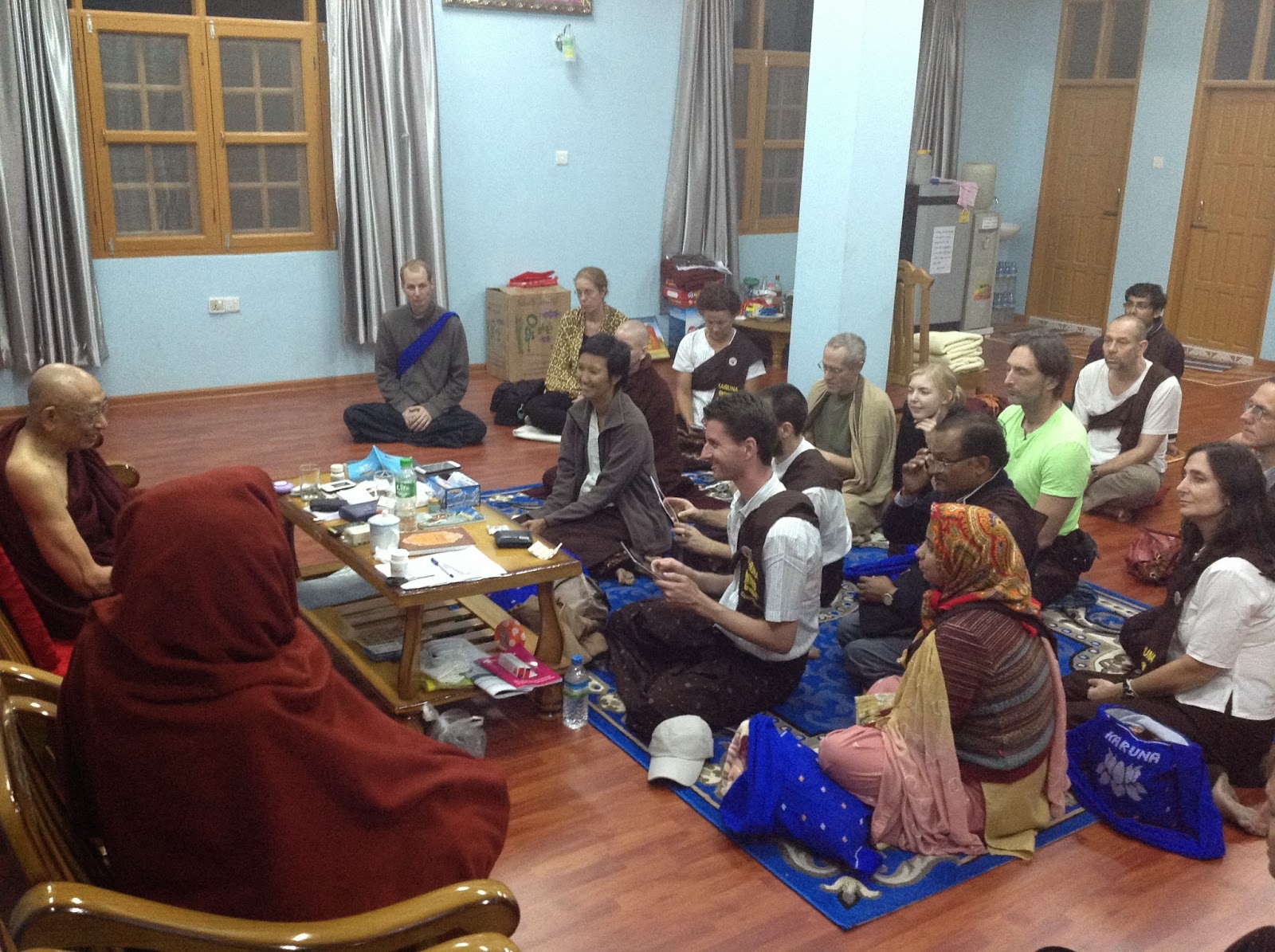
| The Sayadaw at Maha Bodhi Monastery smiles during a Question and Answer with foreign yogis |
![]() |
| A Russian pilgrim stands in reverence before the Maha Bodhi temple at the center established by Saya Thet Gyi's student, Saya Thein |
While the day was certainly filled with great moments, I also felt that the wounds from the inner battles were also revealing themselves for a number of people in the group. Most of us were tired and wanted to go back to the hotel. However there was one last stop of the day (actually many but it was getting dark and we needed to cancel a few stops on the itinerary). The Shwegyin Monastery is renowned for its monks who strictly adhere to the vinaya. As the monks chanted their evening prayers in their magnificent teak temple, we sat outside on the large veranda. After some time, One of the elder monks approached Snow, wondering who this curious bunch of foreigners were. Finding out that we were students of Goenkaji, he ushered us into another building where there sat one of the most illuminated old monks any of us had ever seen before. We were pleasantly surprised to discover that this old bhikkhu exuding love and light was a senior teacher under Goenkaji. Dr. Khin Maung Aye, the 82-year old bhikkhu, was a living example of what we all strove to be in one way or another. Not necessarily a monk in robes (although he did suggest that we all give it a try sometime, even for just a few days, since the spiritual benefits of doing so are immeasurable), but a stress-less, caring, bundle of joy. the constant giggles of this Dalai Lama/yoda-like figure was concrete proof of what this path can do and provided us all a brief moment that will be cherished for the rest of our lives."
For Day 7, go here!
| Dr. Khin Maung Aye, a senior AT in the Goenka tradition, spoke to the pilgrims during a visit to Shwe Kyin Monastery |
| U Thuttivara, seated to the left and the presiding Sayadaw at Shwe Kyin Monastery, provided an inspiring end to an already full dhammic day |
| Pilgrims are all smiles when listening to the deep wisdom of these two great monks at Shwe Kyin Monastery |
Subscribe to:
Posts (Atom)