Showing posts with label Yangon. Show all posts

Monday, 25 July 2016

Mogok Vipassana... in English!


Bhikkhu Obhasa shares his experience practicing Mogok Vipassana for the first time. The above photo shows the American monk's secluded dwelling for the Rains in 2016 in Kalaw, Shan State. For more information Mogok in English, see here.

"Last year I had the chance to attend an eight-day Mogok Vipassana course on the outskirts of Yangon. It has always been sort of an enigma as it's by far the largest and most widespread Vipassana technique in Myanmar with its famous Paticca Samuppada wheel seen everywhere, yet it has remained almost entirely off the radar to foreign meditators.

After understanding the general Myanmar teaching/learning style, it is clear why the technique has such appeal to the laity as it's laid out in a simple system that easily lends itelf to being delivered and learned in a way locals are familiar with.

That being said, although such a delivery would appeal far less to Westerners, both the practice and theory I think have incredible potential. My background in Vipassana has been mostly in the U Ba Khin tradition as taught by Goenka and the Shwe Oo Min tradition under Sayadaw U Tejaniya. I'd actually place these two traditions at opposite ends of a spectrum, the Goenka technique being prescriptive and focused, the other being more open and natural. In the Goenka method, the object, body sensations, is chosen for you whereas the U Tejaniya method, the object is whichever objects of the 6 senses naturally arises in the mind with more attention given to the mind. In the Goenka method, a clear cut technique is specifically laid out and its connection to theory is systematically explained whereas U Tejaniya lays out some basics and then explains more theory as it naturally arises in Q&A's from yogis individual practice. 

The reason I present these two as a spectrum is because some people may be familiar with one or both and it so happens that the Mogok method fits right in between the two. On the one hand, it shares the more choiceless open awareness via any and all of the 6 sense doors as U Tejaniya teaches. On the other hand, the technique is more systematically laid out like Goenka's and the practice is clearly and extensively connected to theory via the famous Mogok Wheel. All three I think have their appeal to different people at different times. I think the Mogok technique then, fills a gap in this spectrum nicely. It seems it would appeal to those that do well with more open awareness yet also enjoy a more explicit structure and clearly explained grounding in theory.

The issue currently is the Mogok method and facilities have yet to be properly adopted for a foreign an especially Western audience. Even though there are at least two teachers that speak English, the current Myanmar presentation style of the technique seems to me to be quite inadequate for foreigners. Also, the available texts in English are straight translations from Myanmar books which again are in a style unsuitable for foreigners and are full of culture specific examples from Myanmar. If these issues get worked out though, I think the Mogok method could fill in a gap and rise to some prominence in the Vipassana spectrum for Westerners."

Tuesday, 14 October 2014

Taw Tai Monastic School


Taw Tai Monastery in Yangon is an exquisite educational center that also offers regular meditation retreats, teaching Vipassana practice. The monastic school has about 350 novices and 100 monks. Buddhist courses are offered five days per week, with Saturday and Sunday free. Its meditation retreats are approximately ten days long, and are usually attended by about 100 people. 


The Dhamma Hall at Taw Tai where the Vipassana courses are held

Foreigners are welcome to join the meditation courses, where they can learn the traditional Burmese Buddhist meditation practice. Also, those who have the volition may serve the meditation courses of the monks and novices, or that of the Burmese lay people. Yogis can also join the classes, and even teach those such as English, where their help may be quite welcome. 

For any Dhamma practitioners who are making their way through the Golden Land, a visit to Taw Tai is surely a must-see!

The monastery sign


A tropical monastery

Saturday, 11 October 2014

Kyaikkasan Pariyatti-Patipatti Nunnery


Kyaikkasan Pariyatti-Patipatti Nunnery is in Thinganyun, and home to 150 nuns. The head abbess, Daw Dhukhavati, has amazingly been in robes for 75 of her 97 years, and has a look of deep serenity in her face. They are open to hosting foreign women with proper visas, and in the past foreign nuns have stayed here. They also host 7-10 meditation courses for their own nuns, to be taken after they have passed their examinations (the nuns study five days per week, and also have cooking and cleaning duties). There is a beautiful Dhamma Hall where one would be able to pursue one’s own practice. The grounds are kept in good condition and a large monastic school is housed in a multi-story yellow building and also double as dormitories for the nuns. Note that males are not allowed to enter this building at any time.


Wednesday, 24 September 2014

Dhingan Monastery (formerly known as Bauk-Taw Monastery)


This Sun Lun center was initially established by U Nu long ago, as he personally invited Sun Lun Sayadaw in 1950 to stay here and make radio broadcasts of his dhamma talks to Buddhists living in Rangoon. Sun Lun Sayadaw arrived here in March 1951, and the following six days delivered these requested Dhamma talks, alternating his stay between here and the main Mahasi center (where he was personally invited by Sir U Thwin). With 24 other monks, he consecrated the Sima Hall, and as the local neighborhood started to expand five additional acres were donated by local supporters, giving it the seven acres that it contains today. This was also where U Vinaya was ordained in 1953. Of all the current Sun Lun centers now in Yangon, this is the only one where the original Sayadaw actually resided.

Today, yogis may be interested to meet Dr. Sundara, a Burmese monk who has a PhD in Buddhist studies and speaks fluent English. Remarkably, he is also one of only a handful of Tipitika-dhara in contemporary times, meaning he has memorized all of the Tipitika. There is also a beautiful Dhamma hall on site, and many new buildings have been constructed since Sun Lun Sayadaw’s time. Every evening a Dhamma talk is given by a monk who has memorized all of Buddha’s teachings, and is widely attended by local devotees.

The Sun Lun center is located about three miles from the Yangon International Airport and not far away from Aung Yadana Clinic and Hospital besides Waizayantar Road and Yadana Road. There is a prominent signboard on the Yadana road and in front of Yadana Market. The Centre is situated behind the Yadana Market. The registration counter is opened from 5 am to 10 pm, and the main gate closes at 9 pm after meditation time. Address:16/2 Block Thingun Kyun Yatana Road, South Okkalapa Yangon, Tel:95-1-56562 / 95-1-564654

For more information about Sun Lun Sayadaw, one may read here, or for information about his time with Webu Sayadaw in Kyaukse, go here.

Monday, 25 August 2014

Driving Lane for the Little Tykes


Some special side streets in Yangon allow for children aged at least four and a half years old to their practice driving skills, often from 1 to 5 pm on weekday afternoons only. Cars may not be driven faster than 15 mph, and driving on major intersections are strictly prohibited. Also, an adult chaperone must be within sight on the street where the child is driving. This also allows the children to easily see friends and smaller neighborhood pagodas.

Saturday, 21 June 2014

How to Tie a Longyi

On the December 2013 pilgrimage, foreign meditators are instructed in the art of the Burmese longyi-tying at the Yuzana Hotel in Yangon, as the pilgrimage started. For those meditators who would similarly like a lesson in how to wear the Burmese garment, sessions will be scheduled this coming winter. After the longyi-tying lesson, full pilgrimages will resume. Registration is now available, see here for more details. Or, this recent post describes the coming pilgrimage opportunity in further detail.


Sunday, 2 March 2014

A Diary of Pilgrimages

Three young Burmese boys join a group siting at a pagoda with the pilgrims

42 days of pilgrimages have now been completed, and two groups of devoted yogis have now seen the best that Burma has to offer, with many lives transformed in the process. Some pilgrims ordained and are still in robes, with others coming in the next few weeks, months, or even years with a similar intention in mind. Others have grasped the dhamma in more profound ways than was possible in one's home country, and have returned to their local community to share their wealth of experience, understanding, and inspiration.

The following guide shows the diary entries recorded for the two yatras. The majority of the first diary entries were made by Kory Goldberg, a Canadian yogi and author of Along the Path. The majority of the second yartra entries were made by an anonymous American pilgrim.

While no yatras have as yet been confirmed for the following winter of 2015, there are upcoming opportunities for those interested to join part on such excursions in the near future. U Kumara at Sitagu Academy has indicated an interest in hosting Abhidhamma workshops in English for any interested foreigners in the Sagaing Hills in June, and brief ten-day dhamma trips will be organized both before and after these courses for those wishing to attend. Finally, one may also contact Muditā Works  (the agency which arranged for the entire following two pilgrimages) at any time to arrange such a dhamma trip according to the wishes of one's group.


The ruins of Htut Kaung Monastery in the Sagaing Hills. This was one of the world's first meditation-oriented monastery 

Pilgrimage #1
Day 1: Yangon
Day 2: Pyaw Bwe Gyi
Day 3: Yangon and Hmawbi
Day 4: Hmawbi
Day 5: The Road to Mandalay
Day 6: Mandalay
Day 7: Kyaukse and Mandalay
Day 8: Mandalay and Monywa
Day 9: Monywa
Day 10: Monywa, Sain Pyin Gyi, and Ingyinbin
Day 11: Ingyinbin
Day 12: Ingyinbin
Day 13: Ingyinbin
Day 14: Ingyinbin, Shwebo, and Sagaing Hills
Day 15 and 16: Sagaing Hills
Day 17: Mingun
Day 18: Sagaing Hills and Yangon
Day 19: Yangon
Day 20: Yangon

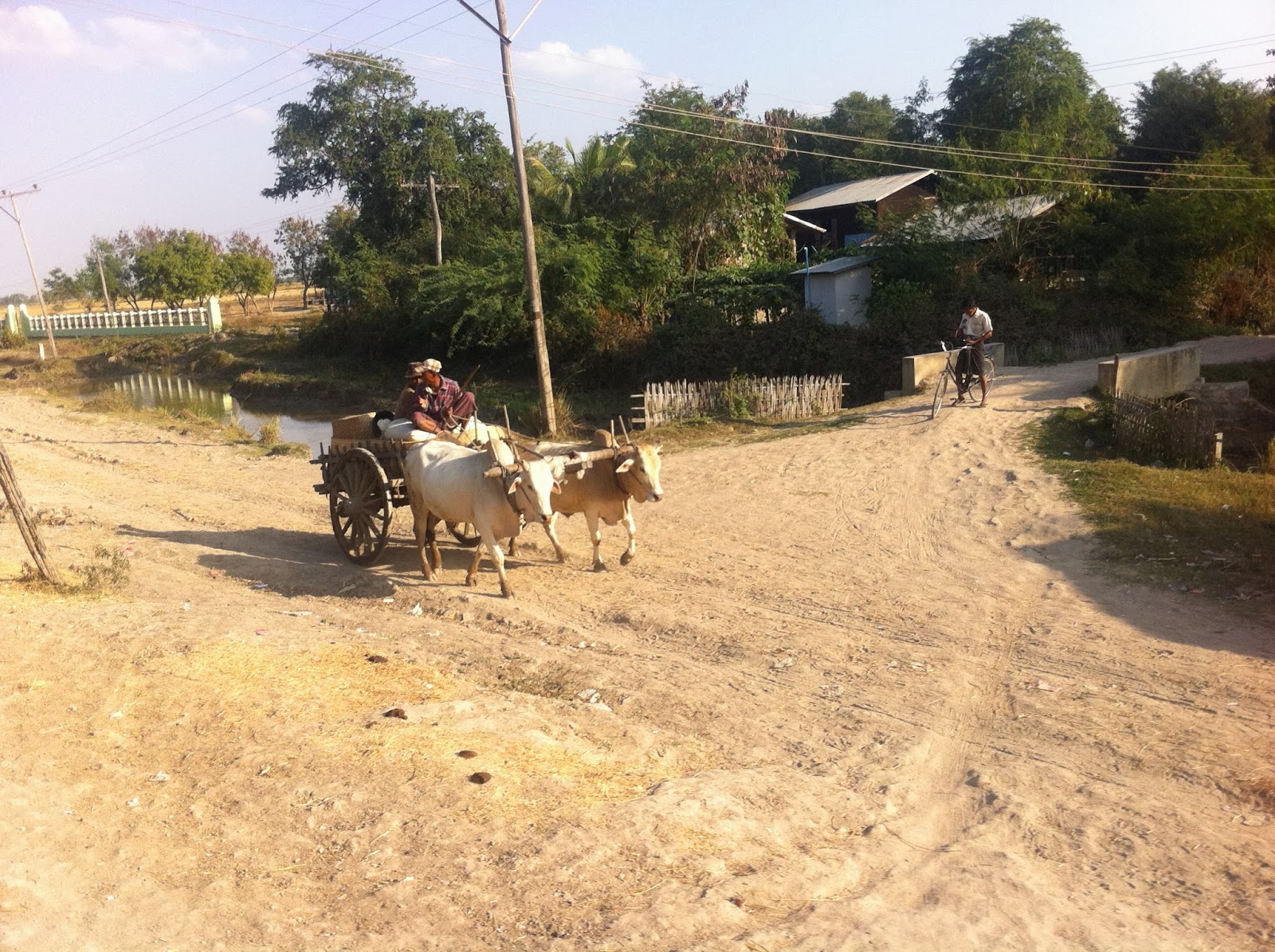
A typical rural Burmese scene

Pilgrimage #2
Day 1: Yangon
Day 2: Pyaw Bwe Gyi
Day 3: Yangon and Hmawbi
Day 4: Hmawbi
Day 5: The Road to Mandalay
Day 6: Mandalay
Day 7: Kyaukse and Mandalay
Day 8: Mandalay and Monywa
Day 9: Monywa
Day 10: Monywa, Sain Pyin Gyi, and Ingyinbin
Day 11: Ingyinbin
Day 12: Ingyinbin
Day 13: Ingyinbin, Shwebo, and Sagaing Hills
Day 14: Sagaing Hills Nunneries
Day 15: Within the Sagaing Hills
Day 16: Sagaing Hills One Day Sitting
Day 17: Mingun
Day 18: Sagaing Hills and Yangon
Day 19: Yangon
Day 20: Yangon

Pilgrims travel back from Mingun to Sagaing

...one may ask, what is so special to have to come across the world to Burma anyway, when the practice is basically inside already? Harold Fielding, a British administrator, provided an answer to this question in 1898 in "Soul of a People":

"To hear of the Buddha from living lips in this country, which is full of his influence, where the spire of his monastery marks every village, and where every man has at one time or another been his monk, is quite a different thing to reading of him in far countries, under other skies and swayed by other thoughts. To sit in the monastery garden in the dusk, in just such a tropic dusk as he taught in so many years ago, and hear the yellow-robed monk tell of that life, and repeat his teaching of love, and charity, and compassion—eternal love, perfect charity, endless compassion—until the stars come out in the purple sky, and the silver-voiced gongs ring for evening prayers, is a thing never to be forgotten. As you watch the starlight die and the far-off hills fade into the night, as the sounds about you still, and the calm silence of the summer night falls over the whole earth, you know and understand the teacher of the Great Peace as no words can tell you. A sympathy comes to you from the circle of believers, and you believe, too. An influence and an understanding breathes from the nature about you—the same nature that the teacher saw—from the whispering fig-trees and the scented champaks, and the dimly seen statues in the shadows of the shrines, that you can never gain elsewhere. And as the monks tell you the story of that great life, they bring it home to you with reflection and comment, with application to your everyday existence."


School children gather before a backdrop of rural stupas

Friday, 28 February 2014

Burma Pilgrimage #2, Day 19: "Quite a Lovely Experience"

The following excerpt was written by an American yogi about the pilgrimage in Burma. The first pilgrimage has ended, and the second one has just begun! To read about two days prior as they explored Mingun, go here. To read about the first yatra from Day 1, and read the journal entry in order, start here.

You can also consider joining a later pilgrimage in Burma.


"The last (full) day started with a group sit at Kaba Aye monastery. This houses relics of the Buddha, Sariputta, and Moggallana.


Kaba Aye Pagoda Trustees hold the sacred relics above the heads of pilgrims, giving each a chance to meditate underneath
These are usually under lock and key, so Snow had pre-arranged for an appointment for them to be unlocked for a group viewing.

As we started to trickle into the small chamber, a few ochre robed bhikkus and many white-clad Cambodian pilgrims swarmed up to the front, and started chantings and paying their respects. (A co-pilgrim wryly noted later that it's a chanting country - if it's not chanting via loudspeaker, then it's background chanting; if not that, then it's someone right next to you...)

After some initial confusion, in gentle Burmese fashion, the pagoda trustees and Snow patiently waited for the Cambodian group to finish before our group started. There was some jostling from our Cambodian brothers and sisters at the beginning - was great to be able to use this as part of the practice. After all, it's not much different than been jostled on a bumpy 'bus' ride... it's all just matter bumping back and forth, and it settled down with time.

An unexpected benefit from waiting was that the pagoda trustees allowed us to sit for a while with the unlocked relics - quite a lovely experience..."


To read about the final day of the second pilgrimage, go here!

A close up of the relics

Sunday, 23 February 2014

An Italian-Burmese Friendship Sign


"Visitors have noticed a great change to the 2500 year old Shwedagon Pagoda. Entirely from his own volition, Italian Speaking Tour Guide Ko Min Min Myat Thin has donated a helpful sign that now greets visitors at all four entrances to the great pagoda. In addition to the bilingual English and Burmese being written and translated by the Italian Speaking Tour Guide Ko Min Min Myat Thin, he also arranged for the particular photos, design, and the entire stand that allows the appartus to free-stand as it does easily, with little work needed from other pagoda caretakers.

The helpful sign begins by pointing out four of the things that foreign visitors (or any other visitor) should not do upon entering the pagoda, particularly pertaining to their style of dress. The upper most left square advises that one should not wear any kinds of socks, stockings, foot coverings, foot socks or other foot accoutrements. Going clockwise, the next picture, just to the right, clearly shows a lower garment that unacceptably goes only until the mid-thigh region, and one may not wear any mini-skirt, skirt, shorts, pants, or towels that only go this far. Next we come to the lower right, which helpfully displays a blouse that is too revealing, too short, out of style, and disproportionate to the wearer's actual body size frame. Finally, the final square, now moving to the lower left, shows two pairs of white and black sneakers, possibly cross-trainers or heavy walking shoes; although in this case one must keep in mind that any and all footwear of any kind are not allowed, and this also includes socks, stockings, foot coverings, foot socks or other foot accoutrements. 

The sign is also helpful in that it has English as well as Burmese language to remind the visitor. The upper most square reads "No Socks", then there is "No Short Pants," followed by "No Spaghetti Blouse," and finally "No Shoes."

As most visitors who come have some basic understanding in the English language, further translations into other languages (such as Hindi, Farsi, Urdu, Arabic, etc.) were not deemed needed.

Finally, the Italian Speaking Tour Guide Ko Min Min Myat Thin kindly included his own name as the donor of these signs. It reads: "Donated by Ko Min Min Myat Thin [first line]; Italian Speaking Tour Guide [second line]." It is likely that the Tour Guide Ko Min Min Myat works primarily with Italian-speaking tourists from various parts of Italy, who come to Myanmar centrally on vacation."

-- the following post was contributed by Ko Kyaw Kyaw

This is the sign in question that was produced by the Italian Speaking Tour Guide Ko Min Min Myat Thin. The helpful sign begins by pointing out four of the things that foreign visitors (or any other visitor) should not do upon entering the pagoda, particularly pertaining to their style of dress. As most visitors who come have some basic understanding in the English language, further translations into other languages (such as Hindi, Farsi, Urdu, Arabic, etc.) were not deemed needed.

Sunday, 9 February 2014

"There's Something Special About This Land..."

Pilgrims learn about the history of the Sagaing Hills at Kaunghmudaw Pagoda

"There's something special about this land. Even on a busy street in downtown Yangon, in the sweltering heat of midday, there's an ease with which sensations can be felt. Perhaps because the the practice has been maintained, perhaps because of relics, or perhaps it is the way the Dhamma is interwoven into the fabric of Burmese existence - whatever it is, it is a delightful support for those on pilgrimage."

-- American pilgrim on the Pariyatti Yatra. 

Saturday, 8 February 2014

Burma Yatra #2, Day 2: Saya Thet Gyi Day

The scenes of the rural Dalla harbor just after the group has arrived, crossing the same river as Sayagyi U Ba Khin did many years ago. The buildings of Yangon are visible from across the water.

The following excerpt was written by an American yogi about the pilgrimage in Burma. The first pilgrimage has ended, and the second one has just begun! (To see and compare Day #2 of the first yatra, see here

You can also consider joining a later pilgrimage in Burma yourself.

"Today was great grandfather day. After a morning group sit at Dhamma Joti, we headed across the river to see several sights related to Saya Thet Gyi.

Getting a group of us tickets, boarded, and disembarked is no easy feat. It says volumes about the organizers that this was all taken care of, mostly behind the scenes. Once we arrived at the other side, a small bus was arranged to continue the journey. 


The group arrives in Dalla

Once we left the ferry terminal, the landscape and feel changed dramatically. Against a mostly flat, stark landscape there were small clusters of trees, with an occasional thatched home nearby.


A typical scene that the group sees from its ride from Dalla to Pyaw Bwe Gyi. Saya Thet Gyi's family was once responsible for 1,000 acres of rice fields, and one still finds such agricultural activity in the area today.
Time seems to have forgotten this small village. Dusty roads and rice mills line the path to the salas, perhaps not dissimilar to what Sayagi U Ba Khin, and perhaps Saya Thet Gyi, might have seen in their days.

The first stop was to the Saya Thet Gyi's first meditation sala. After hearing about Saya Thet Gyi's story (especially moving when one sees the joy and pride radiating from Snow's face in the recounting of this familiar tale...), we sat for an hour in the spot where it is believed that Saya Thet Gyi reached some of his attainments. Very strong...


A dog pauses in the walkway leading to Saya Thet Gyi's center

The group then moved to the second sala. There were beautiful paintings on the walls that, as with the rest of the building, had seen some better days. The last place we went to was Anauk Monastery, a monastery where Saya Thet Gyi taught from for a brief period of time. 


The greeting party at Anauk Monastery, a site where Saya Thet Gyi taught for two years
This side of the river appears materially poorer that their city cousins. It's in such a setting that one can appreciate the physical manifestations of the people's monastic devotion. Compared to the first two places, the last (a monastic setting) appeared much better kept. Even the dogs looked healthier!


The bus parks in a field outside Anauk Monastery, the field looking similar to what one may have found even in Saya Thet Gyi's time. The lay meditation master himself preferred this site for its quiet and distance from the main town area.
As an aside - it looks remarkably challenging to lead these groups. These yatras have been compared to long courses. If so, the group leader is akin to course manager, except they have to oversee a bunch of independent minded, talking students, who wander at their own pace... The balance between letting each individual's 'course' unfold and making sure the group stays on schedule is difficult, and the effort in just getting everyone to show up and/or leave by a certain time is tremendous...

Aside #2: There's a sense of a protective bubble around us, woven by all those involved in our care. The support from them is palpable. The motocoach assistant, for example, has walked into Yangon traffic (no small feat in any Asian country!) to herd us through. How fortunate we are!"


See here for Day 3!

Sunday, 2 February 2014

Burma Yatra #2, Day 1

The following excerpt was written by an American yogi about the pilgrimage in Burma. The first pilgrimage has ended, and the second one has just begun! (To see and compare Day #2 of the first yatra, see here, and to another account of the IMC and Saya Thet Gyi visits, see hereYou can also consider joining a later pilgrimage in Burma yourself.

Shwedagon Pagoda as seen from the pilgrims' Yuzana Hotel


"I wasn't planning on writing unless inspiration struck. Based on how things unfolded today, it may strike more often than not...

Pardon any inaccuracies...

There's a corner of Shwedagon where depending on which tile you step on, the diamond on top of the main pagoda shimmers a different color. At the right place, at the right time, the unexpected materializes... So it was with day one of the yatra.

The morning found us barefoot walking from the motorcoach into Shwedagon. For those of us unaccustomed to walking on gravel (stained with local flavors, nonetheless), it was a great opportunity to practice with changing unpleasant sensations. It was especially sweet to remember that this is how (as Harold Fielding put it) the 'Knower of Great Peace' walked, and all the line of monastics after him...

After a brief tour of Shwedagon, we headed to IMC. There was a course ongoing, but Snow and Joah had gotten permission for us to do a one hour group sit on the platform outside the pagoda cells. After a strong sit, Sayagi U Ba Khin's (normally locked) cell was unexpectedly opened for viewing. We each sat briefly in the outer portion of the cell, just long enough to feel the coolness emanating from within and to pay respects.


The view of the inner pagoda area where Sayagyi U Ba Khin would sit, and where Webu Sayadaw meditated when he visited IMC, was specially and unexpectedly opened for pilgrims

A sample of the books by and about U Ba Khin that are available in the IMC bookstore
There was tremendous gratitude welling up from this visit - how special to be able to sit where it all (more recently) began. The radiating out of dhamma from this place has rippled through many lives across the world. May it continue for generations to come.


The powerful impression of the Shwedagon at night
And then... another unexpected surprise was in store - Sayagi U Ba Khin's son and his wife would be joining us for lunch... We were able to hear some stories from him, including how he took his first course. He recently wrote a book on his father - currently only in Burmese, but English translation is underway.

The post lunch afternoon flowed toward more mundane matters - a quick trip to Bogyoke market to pick up necessary items and/or gifts. And the evening wraped up with a group sit at Shwedagon. As it was Saturday night, the ring of candles at the base were amply lit. Dancing flames flickering in the breeze accompanied a walk through Shwedagon's Saturday crowds.

And so ends a day of unexpected surprises - what a start to a grand adventure!"

See here for Day 2 at Saya Thet Gyi's!

Saturday, 1 February 2014

Scenes from Shwedagon Pagoda


"To the traveller approaching from the sea the pagoda is a vision of dazzling brilliancy and is visible long before the low-lying shores and distant mountains have evolved themselves from the waste of waters. If the approach is in the early morning when the sun has not yet risen his eyes will gaze into a misty void, grey and colourless, but with the first rays of approaching light a vision as of something celestial will be sharply silhouetted against the darkness, something which has fallen from the walls of heaven, and now floats a golden glory for the delight and astonishment of man. As the light increases this brilliancy becomes almost too dazzling for mortals to gaze upon. Finally the mists grow thinner and thinner, and then sail away, leaving the structure resting upon a mound of delicate green that rolls downward and away across the valley where stands the city of Rangoon, and where the Irrawaddy forces its way to the ocean." M.M. Shoemaker, Quaint Corners Of Ancient Empires (1899)

Friday, 31 January 2014

Sayagyi U Goenka venerates Shwe Oo Min Sayadaw

In the Shwe Oo Min Sayadaw commemorative book, one page is dedicated to Goenkaji's visits. The first shows him paying respects to the venerable monk, the second visiting his North Okkalapa monastery, and the third addressing a gathered crowd to discuss dhamma

From a photobook commemorating Shwe Oo Min Sayadaw's life are these three photos of Goenkaji. It was largely because of Shwe Oo Min Sayadaw, deeply revered in Burma and believed by many to be an arahant, that Goenkaji was given permission by the State Sangha to be able to run his courses from 1993. Goenkaji was therefore always deeply grateful to Shwe Oo Min Sayadawgyi, and during his visits back to Burma often made sure to visit him and pay his respects. Many of his early pilgrimages made a point to stop here, and Goenkaji would give a brief dhamma talk after paying his respects (on one such trip an American assistant teacher himself ordained at the Shwe Oo Min monastery!). Shwe Oo Min Sayadaw also strongly supported the children course initiative that the Goenka centers undertook, and they worked together with the Shwe Oo Min monasteries across Burma to be able to reach many thousands of children. Still today, it is not uncommon for serious meditators to visit the Shwe Oo Min Monastery, and there is a hut where one can pay respects to the memory of the former Sayadaw, and some will stay on here for some time.

Thursday, 23 January 2014

"Tough Lot, Us"

“Visitors often see things in Myanmar that are totally at odds with what they have read in the international media and they want to understand what’s going on. When meeting people who no doubt have difficult lives, travelers find they are humorous, warm, proud, and dignified, spending what little they have on religious institutions. It is a conundrum, which some inhabitants of wealthy nations can’t understand. Perhaps visitors don’t see that we in Myanmar have an inner core of strength, which doesn’t veer toward aggression but is rooted in the equanimity with which they face reality. We neither give in nor give up: we have the ability, acquired through our religious beliefs, to refuse to let life get us down. Tough lot, us.

One elderly tourist asked me, in all sincerity and bewilderment, how, since the people he saw were obviously poor, could they look so happy? I tried to explain, but I doubt if he understood, the concept that anybody could be happy with such a huge lack of wealth.” 


Defiled on the Ayeyarwaddy, Ma Thanegi


Thursday, 2 January 2014

Burma Day 3: On the Road

The group poses for a photo in the Bamboo Grove at Sassana Won Saung Monastery in Hmawbi

For Day 2, see here! The following excerpt was written by Kory Goldberg, describing the ongoing Buddhist pilgrimage in BurmaYou can also consider joining a later pilgrimage in Burma yourself.

"Leaving Yangon for the unknown. Much of what we have been doing so far has been totally unprecedented, and the unfamiliar--for both us and our Burmese hosts-- would continue. After a brief halt at the Htaukkyant War Memorial with a reflection on the uncertainty and vulnerability of this precious human life, we stopped in at the Sassana Won Saung Monastery to offer food to more than 250 samaneras and bhikkhus learning and practicing the vinaya. As with all visits to a monastery, the first order of the event was to seek out the Sayadaw, pay respect to him, offer dana, and explain to him who we are and what we are doing. We were pleasantly surprised to be joined by Snow's father, who was very proud of his daughter's accomplishment of helping foreign yogis travel around their country to gain an intimacy with Burmese culture and Dhamma. Now that we have visited a few monasteries and Dhamma centres I also came to realize that not only were we curious objects of interest--and to some degree, pride, for the Burmese, but we were also in some way representatives of our teacher Sayagyi U Goenka and his teacher Sayagyi U Ba Khin. We were showing these Sayadaws what Goenkaji has accomplished by disseminating the practice of Dhamma on a global scale, and that his international students were now respectfully visiting famous and out of the way places that have helped shape the form of Burmese Buddhism over the last century and a half. 


A subtle example of the exemplary discipline found at Sassana Won Saung Monastery is evidenced by the simple way that the novices leave their shoes when entering a building

From the Sayadaw's meeting room, we made our way to the massive dining hall filled with almost hunded small tables laden with several dishes. the men of the group formally offered the food to an elder bhikkhu who in turn led the group in a chant of homage. The men, not used to the Burmese pronunciation, fumbled all the prayers, causing even a chuckle here and there by both foreign and local yogis. (a short clip of this incident can be seen here) Then as the large number of monks filed in the women in our had the opportunity to offer rice in the bowls of the monks. This moment was a first for almost all the women, and the joy and excitement they were feeling was tangible. watching the monks silently accept and consuming alms was a blessing and an inspiration for mindful eating--a practice that most westerners are not habituated to do, and probably not unrelated to the various digestive issues that so many face. 


New robes are offered and merit is made at Sassana Won Saung Monastery by foreign yogis

When the monks were done eating the men in our group offered each bhikkhu a sachet of washing powder. We all worked as a team as some of us were separating the attached packets (and making a bit of a mess spilling powder everywhere--although a pleasant sign that we contributing to the cleansing of defilements!), others handing them off to the givers, and the rest sending metta, abiding in piti, and/or taking photos of the whole event. Then it was our turn to eat. Although it would be a lie to say that we followed the monks' tranquil example, we did eat our lunch with appreciation, joy, and great Dhamma discussions. To help digest the once again delicious meal, Snow and one of the monastery's lay supporters gave us a tour of the peaceful premises dotted with jackfruit trees and a cool bamboo grove, probably not dissimilar to the venuvana of the Buddha's day. None of us really wanted to leave the shade of the bamboo, but there was still much to do before the day's end.


The immensely peaceful Bamboo Grove walkway found at Sassana Won Saung Monastery

Our next stop was Aung Zabu Tawya, a monastery that recently acquired a 301 precious Buddha statues from a Japanese devotee (whose business apparently multiplied after the donation--Dhamma works!). As soon as we arrived, we were ushered to the front of the temple to meet the Sayadaw. He was so impressed by our group that he closed off the display to other visitors so that we could visit the statues undisturbed (not a small gesture as there were hundreds of people outside waiting to enter--apparently the temple now receives approximately one million vistors per week). As we walked around the temple inspecting and honouring the images, a small group of women pilgrims clad in brown chanted Pali suttas. Their beatiful voices in unison charged the moment with a devotional intensity, bringing tears to a few of our eyes. Again, how fortunate we are.


Myittar Shin Shwe Pyi Thar Monastary in Hmawbi, about 90 minutes from Yangon, was Our next and final destination for the next couple of days. Since the Sayadaw was out of station, we went straight to our accommodation. Unlike the luxurious 3-star hotel with comfortable beds and wifi connection we stayed at in Yangon, here we were to sleep on the floor in small dorms, sharing the space with spiders, frogs, lizards. These conditions provided us with a perfect opportunity to practice nekkhama parami with grace and trust that everything would be fine as long as we maintained equanimity and appreciation. before our group meditation in monastary's ordination hall, We walked around the grounds where we came across a group of construction workers playing chinlone outside the five thousand person capacity meditation hall. While the group toured the hall, I stayed back to watch the guys play, half hoping that they would invite me into the circle. they were much better than the guys I played with in Yangon (who were about the same skill as I was), so I was also happy to just watch. They invited me in and I hopped in without hesitation, not regretting it for a moment since I was able to follow along without dropping the ball too often. Like meditating in groups, we get charged by others and everyone's capacity to go deeper increases. After our group sitting, those of us who were hungry concluded the day with tea, biscuits, and fruit over wonderful Dhamma discussions and stories. Another great ending to another great day."


The next post can be found here! (You can also compare this day with the Burma Yatra #2)


This dhamma hall is most of the time empty, but twice per year they hold Vipassana meditation courses that accommodate 4,000 sitting students at one time! (as a comparison, one Canadian Vipassana center in the tradition of Sayagyi U Goenka welcomes approximately 1,000 students per year)


Wednesday, 11 December 2013

Five Years After Cyclone Nargis: A Reminiscence

The following is from an anonymous Burmese meditator:

"Meeting after 5 and a half years, To the Door of Light to be continued………..

Today at the middle of Inle Lake, at a restaurant I met with a girl whom I served at 2008 Cyclone Nargis was storming in Myanmar. We recalled our thoughts and memories. I have to say this will be one of my unforgettable moment of my life and also hers.

When she took her first ten days course at Dhamma Joti at 2008 April-May she was only a young girl in her late teenage years. Even though she was young her dedication to meditate was so strong. At this historic and unforgettable course, I was served as a course manager for 10 days Vipassana meditation course as taught by S.N Goenka and she was a one of 108 female meditators.

The Cyclone Nargis hit Yangon on early 3rd May morning. We did our usual procedures even the strong winds is distracting and trying to fall down age old trees in our meditation center. Meditators are meditating in Dhamma Hall, I felt really worried how I have to overcome this situation. All of us have no idea of what is happening outside, how big and dangerous this storm will be and announcements from Myanmar Radio or T.V as we were totally cut off from outside news. After sitting for 2 hours at 6:30 a.m. it was the time for breakfast. I known well that the dining hall is situated at a lower level and there are no big trees around, so it can be safer than the Dhamma Hall (which itself is surrounded by big trees). Moreover, the kitchen team was ready with preparations for breakfast, I still remember they were preparing "Milk Noodles", a dish that I will never forget in my life. But trees fell down on the covered walkway. We could not use this walk way so I had a decision to make. That is to cross in open air with stormy winds of 100 miles per hour (I learned how fast they were moving only later), or to remain there. I tried to find a way out first. Before doing all these things, I dedicated my life and body for the benefit and safety of all meditators. As a Buddhist we offer our life to Buddha and I thought if I have to be die to help all these meditators, let my life be, because I know well with this strong wind, rain and falling tress and flying roofs came I can die at any moment. But I was not afraid.

I personally led the first group to run from Dhamma hall to dining hall with 5 of youngest meditators as a test run. She was the one in this group. She voluntarily came into our choice. We reached there safely. So all the meditators followed us group by group until all were safe. We took our meal and started helping the kitchen workers, standing on the floor with water came in, rain water pouring in from the windows, we just kept cutting veggies and helping meditators to feel safe and shining lasers to keep the crows away. Helped some to go to nearby toilet, water came into the entrance, creatures crawl in, crows still away. We have 8 Dhamma Servers and all of us are like sisters for many years even passed.

Cyclone stopped around 12 noon and many people would like to go back home. Some were allowed to go back because of the dire situation. Now we had to share our bed, our clothes and water. This one girl is so young, her parents are worried and asked her to come back home three times. Her decision is so strong and sharp. She told her mum “no”, I would like to finish my course at first time. But her father kept insisting her mum to bring her back. But even though she is in her 16 she says she will stay. Her mum was in difficult situation. At last we asked permission from teacher to write her father to inform him she really want to finish her course before she go outside from Myanmar to do further studies and scholarship. She is from a well-off family and well-educated young girl. She stayed at Dhamma Joti for the remaining part of the course, when there was no running water and we had to get it from well by hand and pull it with buckets, no electricity and not even any candles for some time, with one room being shared by 4 people- double the usual amount, and a center filled with fallen trees and rubbish. But main thing I will never forget is their acknowledgement. Those volunteer Dhamma servers are serving for us and are the very reason why we can meditate and try hard, and work more diligently. After the cyclone Nargis hit, we have to move to the downstairs of the dhamma hall because upper hall is impossible to use. But the momentum of the course changed. We can see and notice everybody tried hard and no one complained. Some of the Dhamma servers I met again, they told their experience with great memory. When I have a chance to meet with my old meditators of this course, they told me this is the course they will never forget. Today her mother recalled how persistant her daughter was at that time not to stop her course. I feel so happy and my heart is warmly touched to see her again, and see how she is developed and grow up. Now she become a second year student at Singapore studying Bio Chemistry Medicine, such a real scholar. But she still remember her time at Dhamma Joti and shared this website.

I didn’t expected Cyclone Nargis to change my life so strongly. But with my amazement, it also changed my life stream. Before this event, I did only donation with my own saving but after this Cyclone Nargis to help more efficiently and effectively, I founded a new service and charity organization and can helped thousands of people. Unbelievable moment."

Monday, 2 December 2013

Preparing for U Goenka's ashes upon Yangon River

This video shows scenes from Dhamma Joti in Yangon, on the night before U Goenka's ashes were scattered by special barge upon Yangon River, November 8th. One can see the care and respect given by many local meditators in honoring the great meditation teacher. One can also view the video here.

Saturday, 23 November 2013

Scattering of Ashes of S.N. Goenka in the Ayeyarwaddy River

The final remains of S.N. Goenka were brought back to his birthland of Burma in October, to be scattered in three places along the Ayeyarwaddy: Yangon, Mandalay, and Myitkyina. Photos of the Yangon and Mandalay ceremonies are shown below.

October 8: the boat that scattered the ashes of S.N. Goenka in the Ayeyarwaddy River just outside of Yangon

Yogis meditate on the Mandalay barge along the Ayeyarwaddy before the final remains of U Goenka, prior to their scattering

A close-up of the final remains

Friday, 22 November 2013

The ashes of S.N. Goenka comes to Dhamma Joti

On October 7, 2013, the ashes of S.N. Goenka were ceremoniously brought from Mumbai to Yangon, and a portion were brought to Dhamma Joti for awaiting pilgrims. Below are photos of the event.

Yogis before the ashes, enshrined in a glass case

The Dhamma Hall at Dhamma Joti

Female pilgrims work on the garlands for the event.

Flowers are prepared for the arrival of Goenkaji's ashes