Showing posts with label Sangha Dana. Show all posts

Friday, 25 March 2016

Ingyinbin Journal: Meanwhile, Sitting Continues


John, a meditator from New Zealand, spends extended periods in Ingyinbin each year, the home of the revered Webu Sayadaw and with his friend Ashin Mandala. This winter, he has decided to keep a journal, which he has kindly offered to share with us. His journal alternates between observation and poetry, between meditation practice and commentary about Burmese Buddhist society, from his learnings and his questions. The full collection of his musings can be found here.

1 January

After breakfast we are met by Aum Pyee who offers his assistance. The ibises appear to have left their roost, and the matting of weed that covers the lake allows smaller birds to land and walk about on its surface. The new pagoda is at the east side, its stainless steel and gold-finished spire still brightly lit by the display lights as well as the new rising sun, a combination that absorbs the surrounding scene with a mirrored clarity. On the farther bank the younger nuns, fresh-looking in pink and orange robes, sweep the bare earth around the kitchen and outside their own quarters with coarse bamboo brooms. The trees are drenched in dust and sunlight. Outside the green cottage that was constructed by his family, a solitary older monk, as on all other mornings, appears at first light and proceeds to sweep the ground around his accommodation, leaving here and there little piles of dust and debris.

The rising sun, disinterested,
lights the trees, the white pagoda, the near-empty compound 
where the lone monk sweeps, clothed in sparkling dust.

Meanwhile sitting continues:
Leaves, birds, dogs,
one sound, three sounds: 
I slog on in my hut!

Webu Sayadaw, the reputed arahant who trained as a novice in the paryatti (learning) monastery in which we are housed and for whom on his return to the area the extensive patipatti (meditation) monastery, including the hut where we meditate daily, was built.

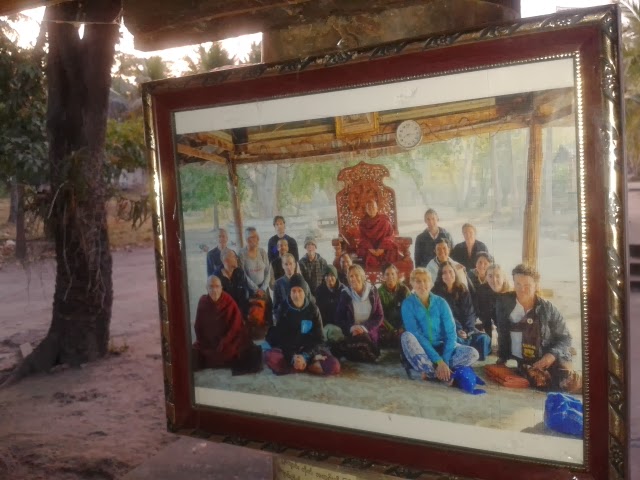
The little brown puppy with the unusable rear quarters munches on the beans and rice that Karen places before him. On Uposata day (On each eighth day of the lunar cycle layfolk dedicate this day to their Buddhist practice, taking eight precepts, undertaking of moral behavior, and spending time at their local monastery, as well as contributing the meal shared with those at the monastery) a local engineer, recently returned from America, arrives with his extended family to give dana and a shared lunch. Outside one boy makes another boy cry. An older woman smokes a cheroot as she comforts another young child beside the lake. The novices take turns sliding down the angled stack of coloured roofing iron, lifting their robes and grinning as they do so. A photo with the dana family and foreigners and they’re away! We take food with the monks; the Sayadaw and senior monks sit at the head table, others in descending order of seniority down to the most junior, who pile their plates with rice and add a morsel of vegetables. Some adults serve while others stand near us, marvelling at our plates loaded with various vegetables taken from several of the seventeen dishes that crowd the round table. The nuns, who have spent the entire night in food preparation, take a table together in the rear near the entrance door. As we leave, the men working on the pagoda approach the dining room: the straggler carries a mortar board and sings near the top of his voice. Nearby,

half the length of its tail, the squirrels
campers along the aerial cable:
earth its mirror.

In the evening we visit the family of Aum Pyee: two families and three generations share a large compound. We are sat down and offered fruits and bread and a sweet tonic drink and local tea. Everyone talks gently and convivially and with sweetness. The compound houses white bullocks and a cow with its calf, dogs, pigs, piles of cut rice stalks (harvest is near-finished and what isn’t stored indoors is sold in the nearby towns), tamarind and other fine trees, and various accommodations, the latest a tidy brick house occupied by the elder brother with his wife and their two children, aged 7 and 12 and both quite shy. We are returned by Aum Pyee to the monastery near 6pm, the distant sky golden and near dissolution as the white birds home in to the lakeside trees to chatter and groan before sleep.

Sunday, 6 September 2015

Entering the Wild Ledi Forest


The Lower Chindwin Valley monk Ashin Nyanadhaja had made a brilliant display in the royal capital of Mandalay— often as an ascendant shining star, while at other times as a transcendent lightening rod— but by the early 1880s he had seemingly given up this cosmopolitan life, choosing instead to wander alone into remote Ledi Forest in Monwya. This act gave the world Ledi Sayadaw, and gave Monywa Maha Ledi Monastery, an active pariyatti monastery on the very grounds where Ledi made his initial retreat into the wilderness.


A city has since built around it, and any trees left in the area have been intentionally planted to ease the urban landscape. Today it is the home of over two hundred monks and novices, and every year Ledi Sayadaw’s birthday is celebrated with a great Saṅgha Dāna feast and ceremony. It goes without saying that Ledi left very large shoes—or rather, sandals—to fill, and this duty currently goes to Sayadaw U Aindarwantha, also known as the Tenth Ledi Sayadaw. While foreign yogis are generally not permitted to stay overnight, one may ask permission to meditate on the compound and pay respects to the sites associated with the great founder’s life.

Tuesday, 7 April 2015

A Food-Book for Sangha Dana at Shwe Oo Min Monastery


So often in Burma, foreign yogis have a great volition to give Sangha Dana to a monastery, but because of a host of reasons-- language, culture, and protocol-- do not know how to specify exactly as they wish their dana to go. With this in mind, U Sarana (seen below giving a Dhamma talk to young Burmese during Thingyan) and a team of volunteers have done a wonderful task at Shwe Oo Min monastery of providing a photo-book of all available curries, fruits, desserts, and drinks that the kitchen can prepare for all of the monks, nuns, yogis, and workers at their monastery. With this tool, donors can simply point to the meal of their choice, and happily see that their dana has gone towards this meritorious deed. Hopefully other monasteries and meditation centers in Myanmar may follow this example in helping to allow foreign yogis to give more easily, and with more information.

For the full Shwe Oo Min Sangha Dana foodbook, see here.


Thursday, 1 January 2015

"Can I take photos when giving dana?"

One yogi recently sent us a question asking about whether one may take photos during dana ceremonies in Burma. Following is our answer. For more questions about Dhamma in Burma to be answered on this blog, shoot us an email at burmadhamma(at)gmail.

What is the protocol about taking photographs or videos of the dana, either of the actual event or posed shots?


As with all cases of photography, it is best to ask first, but by and large this will be accepted and even encouraged. It is very common for Burmese Buddhists as well to take photographs or video, as a means of remembering their good deed. Some may record the entire ceremony from start to finish, or if Sangha Dana is given at a monastery or meditation center, to record the entire line of monks and yogis in getting and eating their food. Dr. Asabha explains this Burmese tendency by noting that “they want to take these pictures to remember the event. Whenever they see them again, they remember what they donated, and they are happy all over again. It is a way to develop their meritorious mind. For this reason, many also receive a certificate after making a donation, for this also reminds them of the act and brings them more happiness back.”

Monday, 22 December 2014

Eating Vegetarian at Burmese Monasteries

Ma Khaing's home-cooked vegetarian restaurant in Mandalay

1) Is it rude to inform a monastery that I am vegetarian?

It is true that there are some countries that one can simply not travel to and reasonably expect to maintain a vegetarian diet. Fortunately, Myanmar is not one of them! Most Burmese monasteries are places where a vegetarian diet can be maintained. It is not considered rude to inform a monastery that one fully abstains from meat and fish. This should be done at the outset when one is asking for permission to stay, so that the monastery can determine if they can meet that need. While it is not appropriate to make numerous “special requests” of the kind that may be common at Western meditation centers, it is fine to make a simple request for vegetarian food. If there are even two vegetarians in an entire monastery, a special table is often arranged for them where only vegetarian dishes are served.


2) To what extent can I expect to have a balanced vegetarian diet?

The short answer is that usually one can count on at least a few purely vegetarian dishes at any meal. There are usually fresh vegetables and herbs, and good protein options such as beans, tofu, eggs, and various other soy products.

If a vegetarian guest is not expected, however, there may not be a balanced vegetarian meal on its own, so advance warning arrangements can help to ensure that the meal is more nutritious. The example of U Agga, a Dutch monk, is illustrative. While usually dwelling in the forest, he once came to Yangon for a short period, during which time he went on the morning alms round. Well-wishers gave whatever they had on hand, and at the end of the round, he found there was not enough vegetarian fare to give him proper sustenance. However, donors soon requested U Agga to tell them a day in advance when he would take an alms walk, so they could prepare something especially nutritious. (U Agga was staying with an American meditator in Yangon, so there was sufficient food here to fulfill his needs. In fact, U Agga’s main intention on taking the alms round was more to allow the local residents to make merit than to ensure his own meals.)


3) I want to sponsor a Saṅgha-Dāna for all the monks at a monastery. Can I request that only vegetarian food be served?

This depends largely on the culture of the meditation center or monastery. Some sites may already be pure vegetarian, or vegetarian-friendly, and such a request will be understood. In other places, however, the monks and yogis have come to expect meat and fish as part of their diet, and it may not be appropriate to demand which food can be served them, and which cannot. In these cases, practicing renunciation when giving the dāna may be the best policy. Another option is to offer a Saṅgha-Dāna at a neutral site and invite monks and nuns to attend. If it is announced that one is serving vegetarian fare, monastics can decide in advance whether they wish to attend.

Tuesday, 11 November 2014

A California Sangha Dana in Honor of S.N. Goenka: More Photos


As noted in an earlier post, one year following the passing of the great lay meditation teacher Sayagyi U Goenka, a Sangha Dana was organized in his honor in Azusa, California, at the Dhammakaya International Meditation Center. U Goenka had visited here in 2002 on the Meditation Now tour. This time, over one thousand guests attended, including many bhikkhus and nuns. There to photograph it was Mitchell Walker, and he has kindly allowed his images to be shared on this blog. Many of these photographs will be included a book that will come out in the following months.


A caterer prepares the offering
Meditators and Buddhists from many Asian countries came to the Southern Californian monastery


Western meditators also attended, although in smaller numbers

Buddhist suttas are chanted by the monks 


Friday, 7 November 2014

"Can I give a purely vegetarian Sangha Dana?"

The vegetarian favorite Tofu Salad


One yogi recently sent us a question asking if it was appropriate to give a purely vegetarian Sangha Dana. Following is our answer. For more questions about Dhamma in Burma to be answered on this blog, shoot us an email at burmadhamma(at)gmail.

Today, whenever and wherever Bamar food is being served, it is customary for there to be at least a few purely vegetarian dishes. Interestingly, Burma provided a “vegetarian line” during the 1954-56 Buddhist Synod held at Kaba Aye Pagoda, and it was S.N Goenka (a life-long vegetarian due to his Hindu caste) who oversaw the vegetarian food distribution during the event. In Burma, single vegetarian dishes may not be a balanced meal on their own, but with advance warning from foreign meditators residing at monasteries, arrangements can be made to prepare more options and this is usually not difficult. For example U Agga, a Dutch monk who came to Yangon for a short period found that he was given whatever vegetarian fare happened to be available on his alms rounds, with promises offered by the well-wishers that on future days they would cook something more substantial ahead of time when they knew he was coming.

A common question that comes from vegetarian yogis wishing to sponsor Sangha Dana, is whether they can stipulate that their financial dana can only go towards serving vegetarian food. This will depend largely on the meditation center or monastery. Some may already be pure vegetarian, or vegetarian-friendly, and such a request will be understood. In other sites, however, the monks and yogis have come to expect meat and fish as part of their diet, and it may not be appropriate to demand which food can be served them, and which cannot. In these cases, practicing renunciation when giving the dana may be the best practice, and one can do this by inquiring of the monastery trustees or senior monks what is possible and what would not be in line with their particular tradition.

Finally, in Burmese vegetarian dishes, there will likely be fresh vegetables and herbs, and maybe beans, tofu, or other soy products. There are three kinds of commonly-used tofu: a Chinese kind that is firm and white, a jelly-like brand from Kachin state, and yellowish tofu from Shan state made from chick peas. Sometimes a generous dose of turmeric will be mixed in, giving the tofu a yellow color. Also note that while there are more vegetarian dishes in Shan cuisine, they are often prepared in the same pots as the meat dishes, in contrast to Bamar cuisine, which though having fewer vegetarian dishes, usually prepares them entirely separately.


Hta Min War Yellow T

Wednesday, 29 October 2014

A California Sangha Dana in Honor of S.N. Goenka


One year following the passing of the great lay meditation teacher Sayagyi U Goenka, a Sangha Dana was organized in his honor in Azusa, California, at the Dhammakaya International Meditation Center. U Goenka had visited here in 2002 on the Meditation Now tour. This time, over one thousand guests attended, including many bhikkhus and nuns. There to photograph it was Mitchell Walker, and he has kindly allowed his images to be shared on this blog. Many of these photographs will be included a book that will come out in the following months.


These placards indicate the diversity of Sanghas represented at the event

The Vietnamese table

One regional group from Southeast Asia poses for a photo

Sangha Dana is served before noon

Monday, 27 October 2014

More photos from Sangha Dana at Wei Har Ree Nunnery


Ma Khaing has shared more photos of their Sangha Dana on October 16 at Wei Har Ree Nunnery in Mandalay, in honor of Ko Kyaw Ngwe. More information can be found here about the event.


Ma Khaing and family sort through offerings prior to giving them to the Sangha. Bhikkhu Agga can be seen standing on the right side

Ma Khaing stands at the head of a line of nuns as her daughters look on while smiling


Ma Khaing gives a collection of requisites to a young nun as her family looks on

Ma Khaing and her daughters prepare to offer requisite bags to nuns

Sunday, 26 October 2014

Photos of Sangha Dana at Wei Har Ree Nunnery


Ma Khaing has shared photos from the Sangha Dana that was given in memory of our dear Dhamma friend Ko Kyaw Ngwe, and as was described by Bhikkhu Agga, who attended. Following are photos from event:

Ma Khaing presents robes to Bhikkhu Agga

Ma Khaing's family follows the traditional yay sat ceremony of pouring water at the end of the monk's Dhamma discourse

Bhikkhu Agga mindfully eats the Sangha Dana that was presented to him

Ma Khaing wanders through the nuns' hall refilling their food 


Monday, 13 October 2014

Sangha Dana at a Mandalay Nunnery for Our Dhamma Friend Ko Kyaw Ngwe


In two days time, Ma Khaing and her family will donate generously at a Mandalay nunnery in honor of our dear Dhamma friend, Ko Kyaw Ngwe. He passed away on October 16, 2013 after a long battle with cancer. Ma Khaing wishes to inform meditators around the world so that they can do any of the following
  • Join the ceremony on October 16 in Mandalay 
  • Contribute to dana that will be given on this day 
  • Send metta and keep their family in your hearts and mind on this day 
  • Share stories or photos of Ko Kyaw Ngwe

May all beings be peaceful, happy, and liberated.

Wednesday, 17 September 2014

Scattering of Goenkaji's ashes on the Ayeyarwady River


Nearly one year ago, the great lay meditation teacher S.N. Goenka passed away, as various posts in this blog shared at the time. Although Sayagyi U Goenka passed away in India, it was his final wish that his remains be returned to the land of his birth, Burma. The above video shows how his ashes were prepared in Dhamma Joti, the main U Goenka center in Myanmar. Excerpts from Dhamma speeches made at the center are partially translated, and the journey from the airport to the center and then the precious Ayeyarwaddy River are also shown in this video. 

Many local meditators and monks gathered for this occasions, as many will do around the world in the coming months when the one year anniversary of his death approaches, and people will meditate and give Sangha Dana in his memory.

Saturday, 22 February 2014

Burma Pilgrimage #2, Day 11

The following excerpt was written by an American yogi about the pilgrimage in Burma. The first pilgrimage has ended, and the second one has just begun! To read about the previous day, go here. To read about the first pilgrimage group's experience on their own time in Ingyinbin, see here.

You can also consider joining a later pilgrimage in Burma yourself.

The pilgrims stayed in these two buildings. The large one on the left was given by Bago supporters, and as was Burmese custom, the men slept upstairs and the women downstairs. The one on the right was given by Mogok supporters, and this was where U Ba Khin and U Ko Lay stayed when they visited Ingyinbin. This became the pilgrims' meeting room and snack room.

It was on this six foot high platform that Webu Sayadaw was known to teach the devas and hungry ghosts in the evenings. The platform has no ladder and even today, villagers do not know conclusively how Webu Sayadaw scaled the platform. On this yatra, several pilgrims came here to meditate, and reported unusual experiences.

"How many special sites does one have the fortune of going to?

After a morning group sit in the place where Webu Sayadaw passed into parinibbana, Joah led the group on a tour of the patipatti side of the monastery. The pariyatti side had been a monastery before the arrival of Webu Sayadaw, but after his arrival the, patipatti side began and flourished.

Back in the hey day, multiple cities in Burma had given dana for the construction of buildings on the patipatti compound. Most of these are a shell of their former self. The kutis that remain, we are told, are not kept up, and the large dorm in which we are staying was covered in a thick layer of dust.


The site where Sayagyi U Ba Khin and U Ko Lay were ordained in 1965

There's a few people working on painting the old Dhamma hall, which is somewhat reassuring, until one tries to go down the steps to the cells and finds the place completely flooded with stagnant water. So is the rise and fall of all things...


The main Dhamma Hall has just been given a new coat of paint

Yet, not all is grim. There still are remarkable places on site that time and dust and disrepair cannot dull. The hall where we do our group sits. The bodhi tree where Webu Sayadaw deposited Sayagi U Ba Khin's hair after he took robes. And the kuti facing the lake of victory, where the Sayadaw broke all the fetters.


It was here, in this very Bodhi tree, where Webu Sayadaw deposited Sayagyi U Ba Khin's shaved hairs after his ordination, telling the government official that he would go on to play a major role in the Buddha Sassana. U Ba Khin gathered others of his hairs up and took them home to Yangon, placing them on his alter at IMC. Today, all IMC centers throughout the world have a small vial of these very hairs.

The mosquitoes, snakes, bats, dust, and
loudspeakers that blare all night long are no match for the strength of vibrations that still remain in this very special place. If anything, they remind of the fragility of existence.

Keep working, pilgrim, keep working...
***********


This is the new Sima Hall, a beautiful building with a cell in the center for meditation, and an upper raised platform where the ordinations could take place, with lay supporters all able to witness and celebrate down below


***********
The pariyatti side is still a busy working monastery. After partaking in Sangha dana, we had the opportunity sit and meditate with both Buddha relics and those of Webu Sayadaw. We then went on a tour of the pariyatti side. Some of the highlights of the afternoon included paying respects at the Sima halls where Webu ordained as a novice, then as a full monastic, sitting under the bodhi tree Webu Sayadaw planted, and meditating at the pagoda where, according to Burmese custom, the placenta from Webu's birth was buried. The latter, although not kept in the best shape, was quite a supportive place to sit.


A view of the monks' quarters at the Pariyatti side

Despite the neglect, there's still remarkable beauty - the flowering tree that serves as a refuge for butterflies, the lone bell on the old umbrella top that still chimes in the wind, the chanting that carries across the arid, dusty landscape, the devotion of a poor village.

The rate at which things change here is remarkable - within the span of a few minutes, one can feel nausea, malaise, dizziness, arise and completely resolve.

When you peel back the desolate and dusty facade, the strength in Ingyinbin is real and raw. Not for the faint of heart, but so incredibly instructive..."


To read on to the next day see here...

A group photo of the last pilgrimage to Ingyinbin now graces their dining hall
The dining hall has a line of paintings depicting important events in Webu Sayadaw's life. This one shows his initial emerging from the jungle to find the supernatural well water in Kyaukse.

Foreign Yogis offer Sangha Dana at Sain Pyin Gyi

After being given a royal reception and warm welcoming, foreign yogis visit the birthplace of Ledi Sayadaw. According to local villagers, this was only the third time that foreigners came here to pay respects (the first was a yogi who meant to go to Monywa but ended up here by mistake and stayed to sit a five day self-course; the second time was the previous yatra one month earlier)

This video shows the Sangha Dana as it was offered to the monks here. National media was also there to record the event. After the Sayadaw accepts the food on behalf of the Sangha, all say "Thardu" (or "Sadhu") three times to reflect upon a good deed well done and share merits with others. Note the Buddha and Ledi Sayadaw statues in the background. Following this offering, foreign yogis then went on to make more merit by serving the monks who were eating, before they took their own meal.


Thursday, 20 February 2014

Burma yatra #2, Day 10

The following excerpt was written by an American yogi about the pilgrimage in Burma. The first pilgrimage has ended, and the second one has just begun! To read about the previous day, go here. To read about the first pilgrimage group's experience on their own Day 10 towards Monywa, go here. 

You can also consider joining a later pilgrimage in Burma yourself.


Snow shares about the treasures stored in Sain Pyin Gyi

On the way to Ingyinbin today, we heard about the interwoven causes that led to the birth of this yatra. With the tugging of a single thread, the fabric pattern changes...

We stopped at Ledi Sayadaw's birthplace on the way - one of the sweetest experiences yet. Two villagers waited in the hot sun for our arrival, and once we got close, they jumped onto their motorbike to lead us. Men, women, and children were gathered for the warm welcome, complete with press (!) and Sangha 
representatives from the eight monasteries in town. 


Branden is interviewed on camera
Local camera crews

The villagers had prepared all the food for Sangha dana. After offering (already set up) tables of food, we were handed pails from which to serve the monks. It was a gathering to behold - a bunch of foreigners standing with silver pails and ladles around maroon robed monks. One of the villagers spoke fluent English, and others kindly helped guide the process. Many of them sat shyly around, but cameras were clicking both ways...


A Mexican yogi makes fast friends
Foreign Meditators preparing to serve monks living at the monastery where Ledi Sayadaw was first ordained as a novice


The offering table to monks
One of the goals of the village is to build a collection of marble slabs carved with Ledi Sayadaw's writing. With the hope to preserve these for future generations, the group was able to give enough dana for the carving of five full slabs.

After offering robes, always a touching moment, everyone present joined in the reciting of refuge and five precepts. It was lovely to be carried by the voices of all the villagers, chanting as one. Before we left, we were shown some village treasures - a beautiful silver and bronze kamawa, and sat briefly in the room where Ledi Sayadaw was ordained.


The site where Ledi Sayadaw was ordained
The site where the final Ledi Sayadaw stone inscriptions will be displayed

Ingyinbin is very special. There are small dusty roads upon which not very fast motorbikes travel. Somewhere in the distance, there's a loudspeaker that plays music, and every once in a while it sounds like a monastic is talking to the public.

We set up for the night in a couple of buildings on the Patipatti side of Webu Sayadaw's monastery. The hall where he lived and passed into nibbana is a stone's throw away, and where group sits are held. 

"The Lake of Victory," the pond that Webu Sayadaw instructed the father of the boy who asked him about his attainments to make.
The kuti where Webu Sayadaw is believed to have reached nibbana

On the way in, we heard of the kindness of Webu Sayadaw to the villagers, who have apparently not forgotten this, and take especially good care of the monastics.

To be able to walk where Webu Sayadaw lived, taught, and passed, and to sit in a place permeated with his vibrations... So very, very special."


To see Day 11, go here.

A large statue of Ledi Sayadaw graces the monastery