Showing posts with label Sain Pyin Gyi. Show all posts

Wednesday, 24 May 2017

The Birth of Ledi Sayadaw and the Birth of Insight


After over four years of continuous effort by dozens of volunteers, Part 2 of the meditator's guide to Burma is almost out! Here is a sneak preview introducing the birthplace of the great Ledi Sayadaw:

On the surface, Sain Pyin seems pretty much like any other nondescript, rural, Dry Zone village. But for Burmese followers of the Buddha’s teachings, it is anything but! This is where the future Ledi Sayadaw was born, novitiated and ordained as a full bhikkhu in the mid-1
9th century. 

U Sarana translates Sain Pyin as “plain with wild oxen.” But it was not only oxen roaming these plains in the lower Chindwin Valley, as many kinds of wild animals called this the once-vast wilderness home. While far from developed today, the land has mostly been tamed, and the much tinier village of Ledi’s time has become a modest town of around 1,000 homes.

Given the lay name of Maung Tet Khaung, a miraculous event accompanied his birth in December 1846. After turning ten, the boy was sent to study at Kyaung Ma Monastery, becoming a novice at age fifteen and being given the name Shin Nyanadhaza, or in Pāḷi, Ñāṇadhaja, this means “banner of wisdom.” He learned Pāḷi and the scriptures under Sayadaw U Nanda, as was common in pre-colonial Burma, when monasteries were charged with looking after the educational needs of the community’s young men. Shin Nyanadhaza continued his monastic studies in nearby Ye Thwet Village. By the time of his full ordination, he had read all the books to be found in the two towns near his home.

Soon after becoming a bhikkhu, Shin Nyanadhaza went to Mandalay with another monk to continue his formal studies at the royal capital. Erik Braun notes that this journey would mark “a radical change in his life, for during his time there he was exposed to the ongoing encounter with the West. Before he left the city, he would find himself an active participant in that encounter.” But Sain Pyin Gyi is where that boy became a young man before that adventure ever started.

Sunday, 6 September 2015

The Stone Library of Ledi Sayadaw


The only remnants of the lost forest refuge may be those represented in the full-scale diorama in Ledi Thein Ma Taw Gyi, or as it is known in English, the "Maha Ledi Edifice." This blue, circular building is located to the right of the arch, and also displays a number of items relating to Ledi’s life. 


Further reminders of the great monk’s work in this world are exhibited in the form of hundreds of marble slabs, in fact 806 of them to be precise. Completed in 1925, just two years after Ledi Sayadaw’s passing, most of the engraving is comprised from 89 of his dipanis. Seven additional texts are credited to his disciples Ledi Pandita and Ledi U Kavi, so marked by a giant board meticulously recording the titles, locations, and other pertinent details of each work. Most are in Burmese (Others are in Pali and Nissaya, or a word-for-word translation of Pali into Burmese), following Ledi’s innovation in making them accessible to the common person, so that any wanderer may read and contemplate the Dhamma. Some were damaged during World War II, but have since been restored. Walking freely through this garden of scholastic monuments is a living and nearly breathing testament to Ledi’s contribution within the field of pariyatti. Even these slabs, however, do not constitute the totality of Ledi’s writings. A current project is now underway in Ledi Sayadaw’s birthpace of Sain Pyin Gyi Village to complete the stone engravings of his remaining volumes, thus preserving the entirety of Ledi’s words for future generations. Or as Linda Chang, an American yogi commented, “meandering amongst these large slabs was literally 'going through' his works!” Found within these slabs and reached via a narrow walkway is the main Buddha shrine.

Sunday, 29 June 2014

Sain Pyin Gyi: Where It All Began


This precious stupa and Buddha statue is hundreds of years old, and on the site where Ledi Sayadaw ordained as a young boy

"…beyond the conventional radar, this is the heart of yogi tourism, where foreign meditators, carrying tourist cash dollars, come to explore the heartland of their spiritual souls. For some this is the area ‘where it all began." Chindwin, David Lambert

Located in Dipayin township, Sain Pyin Gyi is the village where Ledi Sayadaw was born (1846) as well as where he first ordained as a full monk (1866). Saing Pyin Gyi can be translated to mean “many scattered bison,” suggesting the vast wilderness that must have existed here some time ago. Indeed, Sayadaw U Nyanissara lists the other wild animals that roamed here during the mid nineteenth century: barking deer, antelope, reindeer, hyena, wildebeest, and goat. Now, however, it is a community of over one thousand homes.

Here a major project is being undertaken to save for all posterity all remaining works by Ledi Sayadaw that have not yet been inscribed by stone. Once finished, serious meditators from around the world can come and pay their respects to the great monk.

Prior to his birth in the Katoe Quarter, a great rainbow appeared from a tamarind tree growing on his parents’ land, which then swooped into his family’s home and went back out again, bathing the sky in a brilliant radiance. In words chiseled in stone at the very site and rendered from a Monywa talk, Ledi Ashin Kelarsa Agga Maha Pandia has described this as a “miraculous, nay, auspicious event.” The event was later accorded its own name, referred to as “Indra’s Bows,” among other names. U Candima acknowledges that “from a modern perspective, this rainbow display is hard to believe. There were, however, many witnesses.” 

U Candima goes on to share that news of this rainbow quickly spread throughout the village, and “learned people predicted that the child would take delight in the Buddha’s Sasana when he came of age. They added that the child would master the Tipitaka and would devote his life to selfless service in missionary work.”

Following the great rainbow, the boy was given the name Maung Tat Khaung, which can be translated as “one who will climb up to the very top”. Maung Tat Khaung’s parents were simple rice farmers in a typical small village that revolved around agriculture. In pre-colonial Burma it was also standard for monasteries to look after the basic educational needs of the community’s young men. 

This is the very tamarind tree that a rainbow passed through on the night of Ledi's birth, an omen that many interpreted to mean that great things would come to the boy. Today, only serious meditators are allowed to meditate around it.

After turning ten, he entered Kyaung Ma Monastery as a novice and was given the name Shin Nyanadhaja, and here he began his study of Pāḷi and the scriptures under Sayadaw U Nanda. Maung Tat Khaung continued his studies in nearby Ye Thwet Village and received full ordination when he was twenty, having read all of the books held in the two towns near his home (and including a brief period in which he disrobed for eight months to help on the family plot). 

He studied not only from the scriptures, but also astrology and poetry, and in his later years would return to this field by composing poems based on the Abhidhamma. In fact, these poems came to be learned by the young and old alike throughout the country; people would often greet him to their town when he visited, and discuss and parse the meaning of these poems long after he left. Soon after turning twenty-one, it was said that he walked to Mandalay with his nephew to continue his formal studies at the royal capital. 
 
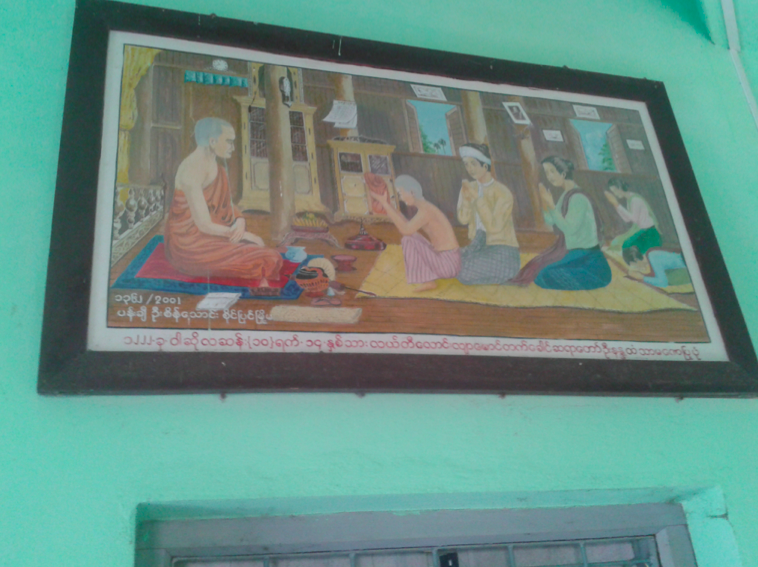
A painting in the very Sima Hall where Ledi Sayadaw was ordained as a boy depicts the event as it happens


This is the very Sima Hall where Ledi Sayadaw ordained as a young boy

Monday, 10 March 2014

"The Beauty of Burmese Life is Hard to Qualify."

Pilgrims listen to a dhamma talk by monks in Sain Pyin Gyi, the small village where Ledi Sayadaw was born.

The following essay was written by Branden Macie, an American pilgrim who attended the recent Pariyatti pilgrimage in Burma (and is at present moment sitting a Satipattana course at Dhamma Joti!). The original piece can be found on the Living Vipassana website. To read more about the pilgrimages, see here. To learn about current pilgrimage offerings, see here.

"From January 2012 to March 2012 a nickel of wisdom arose in me while serving long-term at Dhamma Patapa in Jesup, Georgia, U.S.A. I was there to strengthen my individual walk in Dhamma and to share my merits with others who came for meditation alongside other meditators who wanted to apply the technique in daily life-like scenarios. At the time of my stay, I jumped into study (pariyatti) to gain a view of the context of Vipassana being taught there at the Center. Zipping through books with the lightning evaluation capacity which comes with strong concentration episodes, the texts chronicling the lineage of the Vipassana tradition appealed to me most.

One particular book which wedged a great impression in me was the Sayagyi U Ba Khin Journal where details unrelated to the teaching of the typical 10-day courses tested and touched my faithful side, enlivening my understanding of this Path. Leaving the center and maintaining the practice for years following that service period, heavy dreams of pilgrimaging within Burma made their eruption into my conscious stream over and over. Then, Burmese folks I’d meet would lift up those dreams further by inviting me to Dhamma related outings, studies unrelated to the language and practice Goenkaji’s teaching.

For the a long while a needle of uncertainty was lodged into my mind about living Dhamma through different techniques and actions than were known to me through the 10-day retreat center’s presentation. I held on so closely, so personally. The conditioning I’d developed was strong and a barrier to outside Dhamma works, events, and representations of ‘Dhamma’ began to form — I felt a bit off the mark even knowing the Buddha’s Liberation Teachings were specific to each individual. The attachment had to be let go of.

Navigating those walls, the concepts, the emotions they arose became easier with continued acceptance that Buddha’s Dhamma can’t only fit one categorization of language and practice. More important the Real Time at each individual’s mental level, efforts, and energies is where Dhamma exists and that’s gladdening.

Therefore, seeing Burma and the way the society has structured itself while noticing my own inner pilgrimage along the way helped me realize the vastness of walking toward liberation — all the efforts one CAN make for others (regardless of tradition). When one’s mind is settled into the heart of Right Intention much can be shared.

The beauty of Burmese life is hard to qualify. Learning of enlightened Arahats, even ones so recently passed away who revealed their attainments through body relics, were Great teachers of the Dhamma in their own special ways for the Burmese locals. The amount of devotion and merit gaining on a daily level in Burma is astoundingly high. One can go from Alms round serving monks to Pagodas for paying respects to Sayadaws and end the evening with a Dhamma talk on the Abidhamma or any of the hundreds of Suttas contained in the Tipitaka.


Pilgrims arrive at Thanboddhay Monastery, established by Mohnyin Sayadaw, a disciple of Ledi Sayadaw. Thousands of Burmese were sheltered here during World War II and learned meditation during this time. When the pilgrims arrived, dozens of Burmese college students were there for meditation and devotion.
The fruit to seeing the wider context of Buddha’s Dhamma is so sweet, so virtuous, so needed and for anyone interested in investigating Burma Dhamma, I would willingly be a contact point once one enters the country.

Here’s a quote by Harold Fielding from Soul of a People to end on:

“To hear of the Buddha from living lips in this country [Burma], which is full of his influence, where the spire of his monastery marks every village, and where every man has at one time or another been his monk, is quite a different thing to reading of him in far countries, under other skies and swayed by other thoughts. To sit in the monastery garden in the dusk, in just such a tropic dusk as He taught in so many years ago, and hearing the yellow-robed monk tell of that life, and repeat His teaching of love, charity, and compassion — eternal love, perfect charity, endless compassion — until the stars come out in the purple sky, and the silver-voiced gongs ring for evening prayers, is a thing never to be forgotten. As you watch the starlight die and the far-off hills fade into the night, as the sounds about you still, and the calm silence of the summer night falls over the whole earth, you know and understand the teacher of the Great Peace as no words can tell you. A sympathy comes to you from the circle of believers, and you believe, too. An influence and an understanding breathes from the nature about you — the same nature that the teacher saw — from the whispering fig-trees and the scented champaks, and the dimly seen statues in the shadows of the shrines, that you can never gain elsewhere. And as the monks tell you the story of that great life, they bring it home to you with reflection and comment that has application to your everyday existence.”


Two pilgrims relax at the base of a pagoda stupa

Saturday, 22 February 2014

Foreign Yogis offer Sangha Dana at Sain Pyin Gyi

After being given a royal reception and warm welcoming, foreign yogis visit the birthplace of Ledi Sayadaw. According to local villagers, this was only the third time that foreigners came here to pay respects (the first was a yogi who meant to go to Monywa but ended up here by mistake and stayed to sit a five day self-course; the second time was the previous yatra one month earlier)

This video shows the Sangha Dana as it was offered to the monks here. National media was also there to record the event. After the Sayadaw accepts the food on behalf of the Sangha, all say "Thardu" (or "Sadhu") three times to reflect upon a good deed well done and share merits with others. Note the Buddha and Ledi Sayadaw statues in the background. Following this offering, foreign yogis then went on to make more merit by serving the monks who were eating, before they took their own meal.


Thursday, 20 February 2014

Foreign yogis are greeted in Sain Pyin Gyi

Foreign yogis visit the birthplace of Ledi Sayadaw. According to local villagers, this was only the third time that foreigners came here to pay respects (the first was a yogi who meant to go to Monywa but ended up here by mistake and stayed to sit a five day self-course; the second time was the previous yatra one month earlier)

This video shows the welcoming reception they received upon getting off the bus. National media was also there to record the event.


Burma yatra #2, Day 10

The following excerpt was written by an American yogi about the pilgrimage in Burma. The first pilgrimage has ended, and the second one has just begun! To read about the previous day, go here. To read about the first pilgrimage group's experience on their own Day 10 towards Monywa, go here. 

You can also consider joining a later pilgrimage in Burma yourself.


Snow shares about the treasures stored in Sain Pyin Gyi

On the way to Ingyinbin today, we heard about the interwoven causes that led to the birth of this yatra. With the tugging of a single thread, the fabric pattern changes...

We stopped at Ledi Sayadaw's birthplace on the way - one of the sweetest experiences yet. Two villagers waited in the hot sun for our arrival, and once we got close, they jumped onto their motorbike to lead us. Men, women, and children were gathered for the warm welcome, complete with press (!) and Sangha 
representatives from the eight monasteries in town. 


Branden is interviewed on camera
Local camera crews

The villagers had prepared all the food for Sangha dana. After offering (already set up) tables of food, we were handed pails from which to serve the monks. It was a gathering to behold - a bunch of foreigners standing with silver pails and ladles around maroon robed monks. One of the villagers spoke fluent English, and others kindly helped guide the process. Many of them sat shyly around, but cameras were clicking both ways...


A Mexican yogi makes fast friends
Foreign Meditators preparing to serve monks living at the monastery where Ledi Sayadaw was first ordained as a novice


The offering table to monks
One of the goals of the village is to build a collection of marble slabs carved with Ledi Sayadaw's writing. With the hope to preserve these for future generations, the group was able to give enough dana for the carving of five full slabs.

After offering robes, always a touching moment, everyone present joined in the reciting of refuge and five precepts. It was lovely to be carried by the voices of all the villagers, chanting as one. Before we left, we were shown some village treasures - a beautiful silver and bronze kamawa, and sat briefly in the room where Ledi Sayadaw was ordained.


The site where Ledi Sayadaw was ordained
The site where the final Ledi Sayadaw stone inscriptions will be displayed

Ingyinbin is very special. There are small dusty roads upon which not very fast motorbikes travel. Somewhere in the distance, there's a loudspeaker that plays music, and every once in a while it sounds like a monastic is talking to the public.

We set up for the night in a couple of buildings on the Patipatti side of Webu Sayadaw's monastery. The hall where he lived and passed into nibbana is a stone's throw away, and where group sits are held. 

"The Lake of Victory," the pond that Webu Sayadaw instructed the father of the boy who asked him about his attainments to make.
The kuti where Webu Sayadaw is believed to have reached nibbana

On the way in, we heard of the kindness of Webu Sayadaw to the villagers, who have apparently not forgotten this, and take especially good care of the monastics.

To be able to walk where Webu Sayadaw lived, taught, and passed, and to sit in a place permeated with his vibrations... So very, very special."


To see Day 11, go here.

A large statue of Ledi Sayadaw graces the monastery

Thursday, 16 January 2014

Burma Day 10: Prophecy Fulfilled

If you missed Day 9, go here. The following excerpt was written by Kory Goldberg about the pilgrimage in Burma. You can also consider joining a later pilgrimage in Burma yourself.


"Impermanent are all compounded things, and every moment on this trip is a living testament to this wise teaching of the Buddha. From cycles of health and illness, joy and misery, luxurious beds to hard wooden floors we have experienced anicca in all its forms. After two nights in a comfortable hotel, we now find ourselves sleeping on a dusty floor in a decrepit building with a freaked out barn owl wondering where all these strange humans come from. It doesn't really matter though because the despite the extremely rustic conditions that no one in our group is accustomed to we are at a very powerful sacred site that is hardly known today, either by foreigners or Burmese.

Ingyinbin Monastery, translated as Sal Tree Monastery (also known as the "Patipatti side"), is the second founded by the first (and most influential) Webu Sayadaw. Not only is this the site where he was born into this world and passed away from it, but it is also where the legendary monk fully awakened to the truth of ultimate reality. For students of Goenkaji and Mother Sayama, it is also an important, yet barely known, site as it is here where Sayagyi U Ba Khin ordained as a bhikkhu for 10 days in 1965 in order to engage deeply in meditation and as some rumours have it to teach subtle analytical points of practice to a group of celestial beings (apparently the only humans who could take on this unimaginable task are monks).

On our way to this special place we stopped in Sain Pyin Gyi, the small village where the Venerable Ledi Sayadaw was born in 1846 and ordained as an adolescent. As with Ingyinbin, we were the first group of foreigners to ever visit. The villagers were so excited for our arrival that they had even send a convoy to come meet us on the road to make sure that we didn't lose our way. Our visit began with a meeting with nine local Sayadaws (two of whom were smoking cigarettes when we arrived, a shock to some, amusing to others) and which was overseen by hundreds of villagers. The Sayadaws led us in a chant of homage to the Triple Gem and of undertaking the precepts. Once again our pilgrimage group fumbled the Burmese pronunciation and many of us had a good laugh, either outwardly or inwardly. Following our meal offering and partaking (we were served equally as well, if not better, than the monks) we were given a tour of the site by one of the monks learning English and an English teacher (and were followed around by everyone else--monks, farmers, mothers, children and everything in between). 


Legend has it that when the Sayadaw-to-be was born a rainbow formed between the birth spot and a nearby Tamarind tree, symbolizing that the baby would grow up to be a great master of knowledge. We were taken to both these spots, as well as to the place where he was ordained and the monastery he lived in. The old teak monastic building had a functioning refrigerator that was powered by kerosene, apparently one of five left in the whole world and which was donated to Ledi Sayadaw almost a hundred years ago by the Pali scholar C.F. Rhys Davids. After the tour, we were served even more food and told about their project to produce 220 marble slabs inscribed with Ledi Sayadaw's books that were absent from the Maha Ledi Monastery in Monywa. The people were so proud of their village, and having us global travellers visit their home was a highlight not only in their day but in their life. Even the party-crashing police and immigration officers suspicious of these foreigners (this village also happens to be the place where the military government attempted to assassinate Aung Sang Su Chi many years ago) fell into the good vibes and could not hold on to their negativity. The atmosphere was festive and joyous with smiles, laughter and games all around.

We left the pleasant vibe and hit the bumpy (and literally, rocky) road so that we would reach Ingyinbin before dark. Driving slowly through the country side, passing rice paddies and intricate irrigation canals, fields of sunflowers and cabbages, villages and markets, all dotted with teak, neem and palm trees was relaxing and pleasant. Farmers and road workers were all smiles as we passed them shouting "Mingalaba" out the window. The Burmese are not only happily surprised to see foreigners ( especially in these remote parts), even more so when we wear their clothing and attempt their language.


The foreign pilgrims have some fun in acting out the painting of Webu Sayadaw's prophecy (shown above them)
Shortly before Webu Sayadaw passed away he predicted that one day people from around the globe would visit this monastery in Ingyinbin. There is even a painting on the wall of a shrine room depicting Europeans, Indians, Asians among others, all dressed in their cultural attire marching through the monastery. However, once the great monk left this world, the monastery which once attracted several hundred monks, nuns and yogis gradually fell into disrepair. When we arrived, we intentionally wore our clothes from home to fulfill the prophecy and bring smiles to the faces of the local population still supporting the Sangha here. To be honest, I expected a large crowd of locals to come greet us as we had at Sain Pyin Gyi and other places along our tour. Needless to say, but I was completely wrong--in fact, no one had come to greet us all, and by the dirty state we had found our accommodations, it kind of seemed that we weren't expected, or perhaps, wanted at all. However, our brief meeting with the Inginbyin Webu Sayadaw dispelled any such thoughts by the way he later greeted us and offered English reading material as a gift. I guess there are diverse ways in which Burmese show their hospitality. In any event, the prophecy, whether made into a showy event or not, is fulfilled and the legacy of the legendary monk continues."

To keep reading on, Day 11 can be found here.