Showing posts with label Jorn Materne. Show all posts

Wednesday, 29 January 2014

Burma Day 9: Returning to our Roots

For Day 8, go here, and to read about the February pilgrims' experience on this day, go here. You can also consider joining a later pilgrimage in Burma yourself. The following excerpt was written by Kory Goldberg and Jorn Materne about the pilgrimage in Burma:

Pilgrims meditating in Shwe Taung Oo Pagoda, where Ledi Sayadaw spent two years around the turn of the 20th century

"The early morning kicked off with an offering of breakfast to about 500 monks. It seemed as if all of Monywa’s monks came out to accept our offering. It was cold and dark out, but all appreciated the unique experience. The group interacted with local lay people and we introduced ourselves with our Burmese names in the Burmese language. Che no nameh Ko Pyo Bah. Che Germany Gabah. They loved our efforts and found our jumbled attempts at communicating hilarious.

After a nice rest at the hotel and treat of real Italian coffee we headed over to the Maha Ledi Monastery to. This monastery is where Ledi Sayadaw, the root teacher of our lineage and perhaps the most important figure in modern Buddhist, spent most of his years studying, writing, teaching and meditating. The monastery houses 815 marble slabs containing 115 books of his books, about two-thirds of his work. The rest of his works will soon be engraved on to marble slabs at the monastery in Sain Pyin Gyi, the village where the great master was born and ordained as a teenager. We had the good fortune to offer robes and books to the current Ledi Sayadaw and to eight other local Sayadaws. The current Ledi Sayadaw’s jolly face impressed everyone in the group. Following in the footsteps of his predecessors, he exemplifies the fluid integration of Pariyatti and Patipatti, intellectual and experiential insight. After the participatory experience of offering food, the Sayadaws led a brief ceremony where the merits of the offerings were transferred to water. In turn, people from our group were then offered the chance to take the water and offer it to the roots of trees outside so that the merits are then transferred to the Earth (or something like that, I’m not entirely sure--editor's note, see here for more details on the origins of and rationale for this Buddhist custom). Most of us have never experienced such a ritual, and many felt a little strange, even uncomfortable as this sort of behavior seemed to be quite opposed to how the Dhamma had been taught to us. Nevertheless, some seized the moment, either out of curiosity for a new experience or to “save face,” as they say in Burma. Afterwards we took another stab at introducing ourselves in Burmese resulting in roars of laughter and good times. Both pilgrims and monks took loads of pictures of each other on their iPads and Smartphones. Who knew that Apple and Samsung would help build these cultural bridges amongst the global Dhamma community!

On the way back to the hotel for our much appreciated rest period we visited a couple of pagodas and had a great spontaneous meeting with a group of 300 college students. Unlike the stereotypical partier college students in the West, this bunch of kids was gentle and child-like and infused with Dhamma—so much so that they wanted to take refuge in the Triple Gem and recite the Five Precepts together!

The day concluded with a group meditation with Goenka’s local students at a nearby monastery. Once again, connecting with people whose social, cultural and economic lived are entirely different, yet whose spiritual lives are deeply familiar. Sitting in silence not only with practitioners of the Buddha’s teachings, but with those who are in the same lineage, yet who have been raised in a different world, is a touching experience that reveals an intimacy unknown in any other context. We have never met, yet we are brothers and sisters who have lived together forever. A spiritual family reunion!"


Click here for day 10!

Friday, 17 January 2014

Burma Day 2: Saya Thet Gyi Day

Please click here to read about Day 1. Kory Goldberg and Jorn Materne collaborate on a journal entry about the current pilgrimage now underway in Burma. You can also consider joining a later pilgrimage in Burma yourself.

The day began in the alley next to our hotel. Incidentally, the former home of U Ohn, a disciple of Saya Thetgyi, is currently on the Yuzana Hotel's property. The great meditation master resided at U Ohn's home in his last years of his life while receiving medical treatment. It's quite unfortunate that there is no indication of the site's historicity, other than a water well. Our group caught on to Joah and his enthusiasm for details and we decided then and there, if permitted, to donate a marble plaque so that the site will not be forgotten.

Our next brief stop was at the Martyr Mausoleum where Saya Thet Gyi was cremated and entombed. The cemetery itself is closed to the public, so we had to pay respect from outside the gate. In any case, STG was a living example of humility, and since he did not achieve full enlightenment he did not want anyone worshipping his remains. Across from the cemetery Sayagyi U Ba Kin built a small, unmarked pagoda in his teacher's memory, so I am unsure whether these past masters would have appreciated our visit there or not.


Pilgrims cram into the back of a lorry on the way to Pyaw Bwe Gyi Village
We took a shabby looking ferry across the Yangon River to Dallah, and from there we made our way on a dingy Japanese bus (see here!) to the village of Pyaw Bye Gyi, where Saya Thet Gyi was born, farmed, and taught Dhamma to both lay people and monks alike. Our time at Saya Thet Gyi's original meditation centre was limited because there were approximately 100 monks and 60 yogis participating on a 45-day course.We sat in the shrine room for an hour and took turns meditating in the cell where Saya Thet Gyi would sit when sending metta to his students, and meditating in front of a Buddha statue where it is believed Saya Thet Gyi reached his stage of anagami. It was a powerful moment meditating there as the group of bhikkhus were in the large hall behind us practising standing meditation (they alternate between sitting, standing, walking and lying down).

One pilgrim meditates in the cell from which Saya Thet Gyi sent metta to his students.


Some locals prepared a delicious lunch for us, after which we met with the centre manager and the Sayadaw leading the retreat. He explained to us how they practice focussing on the impermanence of the four elements, and also have a short discourse on the outward and inner cultivation while practising generosity. Snow arranged books, robes and other gifts which we offered one by one to the Sangha. Most of the group was unfamiliar with all the formalities associated with offering things to the Sangha, but the Sayadaw saw that our intentions were in the right place and he wished us to be happy and to be soon free from all suffering.

Robes are given as an offering to the Sayadaw leading the 45 day monks' course at Saya Thet Gyi's center
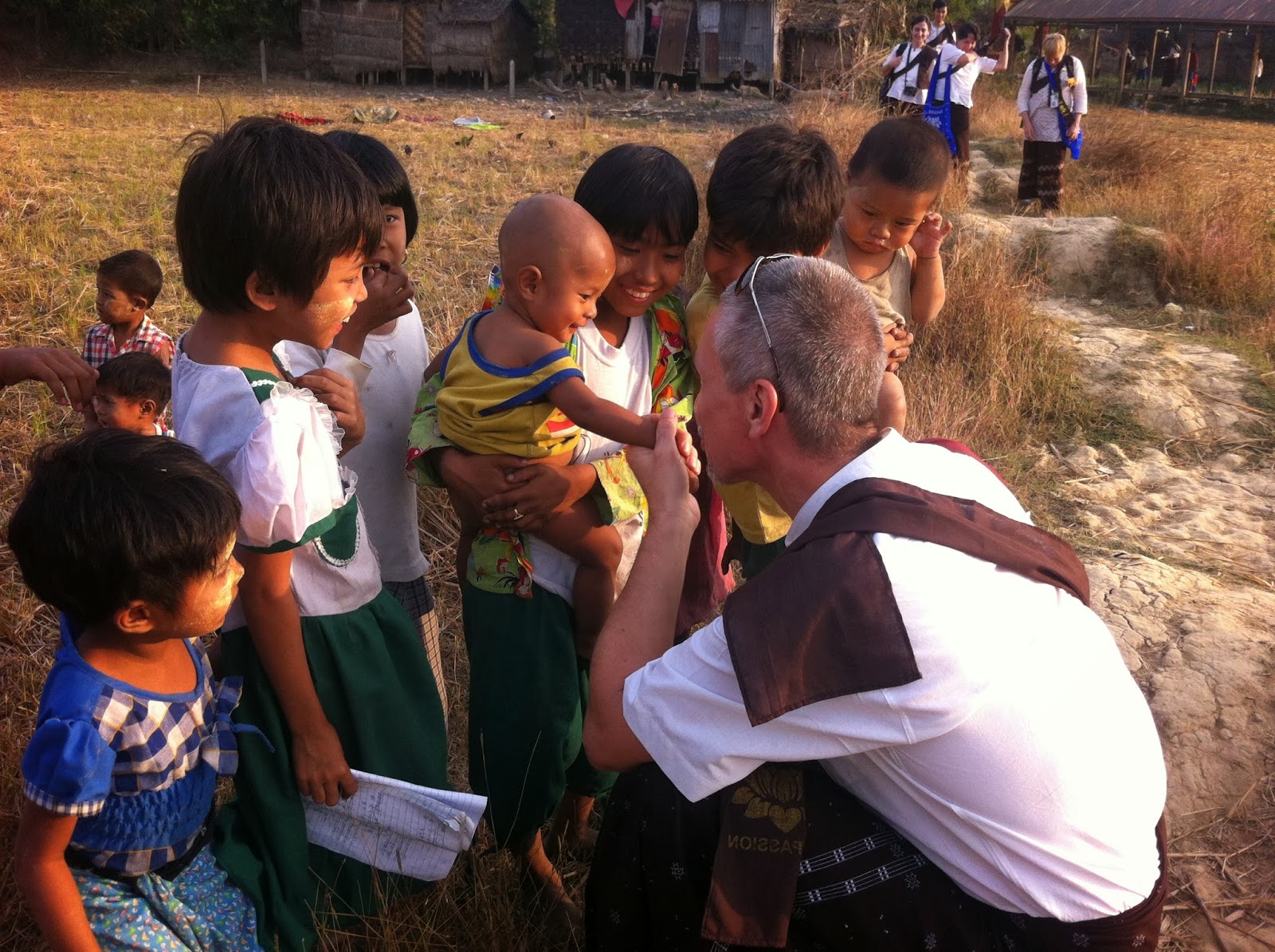
After that wonderful experience we briefly visited a rest-house that Saya Thet Gyi had built for traveling yogis and monks. The site was located amidst quiet paddy fields and the fresh country air contributed to everyone's well being. Many of us shared our desire to see this rest-house open again someday. For the time being this dream is unattainable for a host of political reasons, but this too will change. Our rickety bus then went off road, driving on a bullock cart path to get to our next destination where Saya Thetgyi opened a second meditation centre so as not to create further tension with a neighbouring monk who had a problem with the fact that a phenomenal lay teacher arose and broke convention. The centre's current head monk was very happy to welcome a group of foreign meditators. Only once before had foreigners visited this place and that had been eight years back. The highlight of the visit for some, however, was playing football with local kids, our women and theirs braiding each other's hair, and friendly smiles all around.

Pilgrims walk towards Eastern Monastery, where Saya Thet Gyi gave courses for 2 years


Pilgrims tickle local villagers


We did not have a chance to meditate at the second centre because we had to rush back to Yangon for a group meditation session with Saya Thet Gyi's students at the Yangon centre (called Hansarwaddy). We sat in silence with about 100 locals who come here for their daily evening sitting, and then took lots of photographs of each other. They want to have records of us just as much as we do them. The Sayadaw, a jolly elderly fellow, teaches a 7-day residential course each month and welcomed us all to join whenever we were free. Like him, many Sayadaws have a burning desire to share the Dhamma with others, especially those who are non-Burmese and who have not had access to a life infused with the Buddha's teachings. Of course, the visit could not end without tea, biscuits and fruits. We hesitated at first because we had a dinner reservation and man of us were tired after a long day of moving about, but refusing wasn't an option. It was all good because their volition to share was so genuine and honest that our fatigue was well worth the price to pay for such a special, non-Western moment."


Pilgrims take a group photo at Hansarwaddy Meditation Center in Yangon