Showing posts with label Dalla. Show all posts

Saturday, 8 February 2014

Burma Yatra #2, Day 2: Saya Thet Gyi Day

The scenes of the rural Dalla harbor just after the group has arrived, crossing the same river as Sayagyi U Ba Khin did many years ago. The buildings of Yangon are visible from across the water.

The following excerpt was written by an American yogi about the pilgrimage in Burma. The first pilgrimage has ended, and the second one has just begun! (To see and compare Day #2 of the first yatra, see here. 

You can also consider joining a later pilgrimage in Burma yourself.

"Today was great grandfather day. After a morning group sit at Dhamma Joti, we headed across the river to see several sights related to Saya Thet Gyi.

Getting a group of us tickets, boarded, and disembarked is no easy feat. It says volumes about the organizers that this was all taken care of, mostly behind the scenes. Once we arrived at the other side, a small bus was arranged to continue the journey. 


The group arrives in Dalla

Once we left the ferry terminal, the landscape and feel changed dramatically. Against a mostly flat, stark landscape there were small clusters of trees, with an occasional thatched home nearby.


A typical scene that the group sees from its ride from Dalla to Pyaw Bwe Gyi. Saya Thet Gyi's family was once responsible for 1,000 acres of rice fields, and one still finds such agricultural activity in the area today.
Time seems to have forgotten this small village. Dusty roads and rice mills line the path to the salas, perhaps not dissimilar to what Sayagi U Ba Khin, and perhaps Saya Thet Gyi, might have seen in their days.

The first stop was to the Saya Thet Gyi's first meditation sala. After hearing about Saya Thet Gyi's story (especially moving when one sees the joy and pride radiating from Snow's face in the recounting of this familiar tale...), we sat for an hour in the spot where it is believed that Saya Thet Gyi reached some of his attainments. Very strong...


A dog pauses in the walkway leading to Saya Thet Gyi's center

The group then moved to the second sala. There were beautiful paintings on the walls that, as with the rest of the building, had seen some better days. The last place we went to was Anauk Monastery, a monastery where Saya Thet Gyi taught from for a brief period of time. 


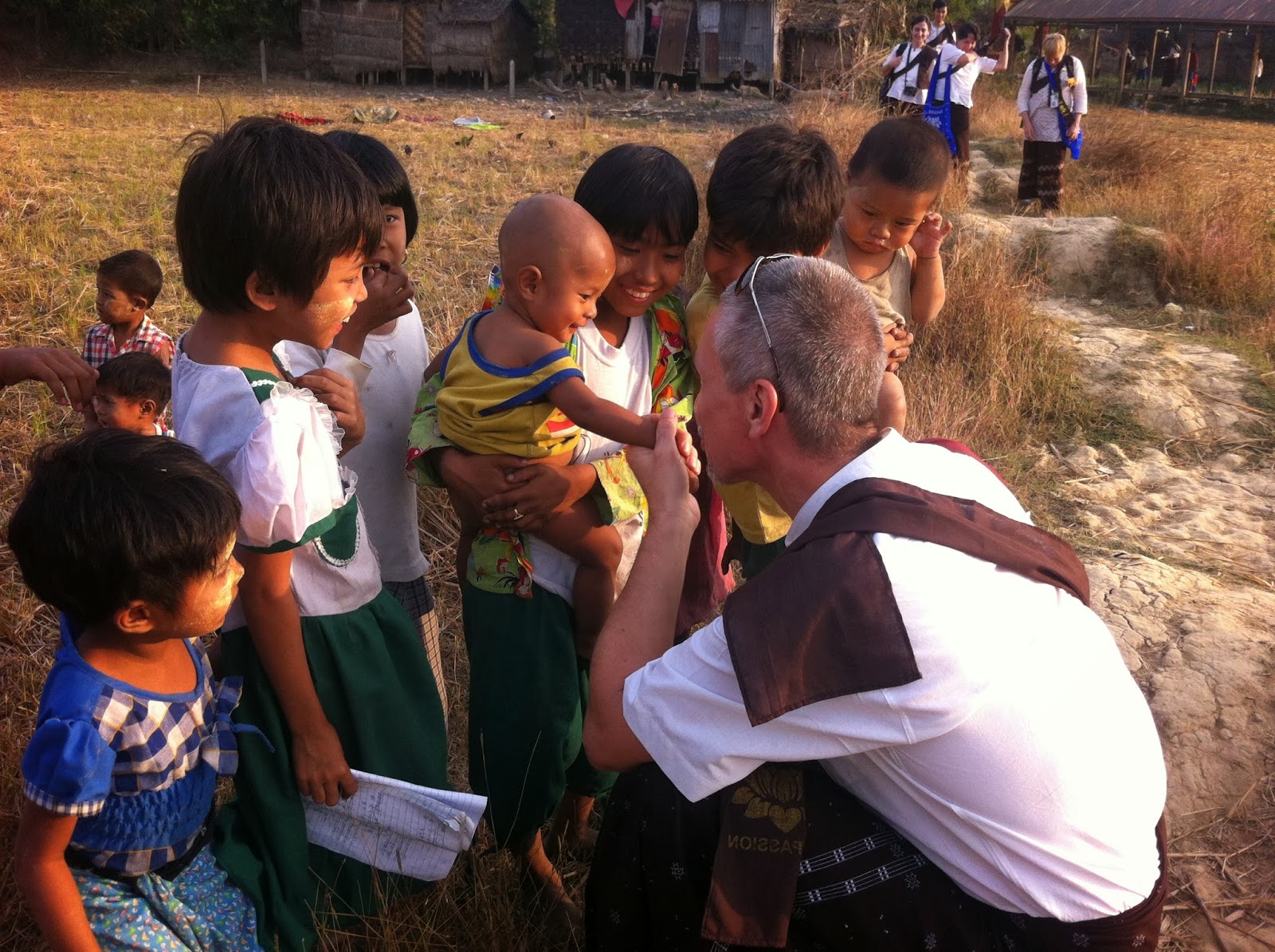
The greeting party at Anauk Monastery, a site where Saya Thet Gyi taught for two years
This side of the river appears materially poorer that their city cousins. It's in such a setting that one can appreciate the physical manifestations of the people's monastic devotion. Compared to the first two places, the last (a monastic setting) appeared much better kept. Even the dogs looked healthier!


The bus parks in a field outside Anauk Monastery, the field looking similar to what one may have found even in Saya Thet Gyi's time. The lay meditation master himself preferred this site for its quiet and distance from the main town area.
As an aside - it looks remarkably challenging to lead these groups. These yatras have been compared to long courses. If so, the group leader is akin to course manager, except they have to oversee a bunch of independent minded, talking students, who wander at their own pace... The balance between letting each individual's 'course' unfold and making sure the group stays on schedule is difficult, and the effort in just getting everyone to show up and/or leave by a certain time is tremendous...

Aside #2: There's a sense of a protective bubble around us, woven by all those involved in our care. The support from them is palpable. The motocoach assistant, for example, has walked into Yangon traffic (no small feat in any Asian country!) to herd us through. How fortunate we are!"


See here for Day 3!

Friday, 17 January 2014

Bus to Pyaw Bwe Gyi


This video shows a half minute of the one hour trip to Pyaw Bwe Gyi village. To read more about Day 2 of the Pariyatti yatra, read here! For more on current pilgrimages, see here.

"The ferry ride to Dalla consists of local passengers. We loved it: people crowd and push to get on (always with a friendly smile on their faces), pick up small plastic squat-chairs on board and sit in clusters with their family or friends. Women and babies are covered in Thanaka and on-board vendors carry their wares on their heads. It is quite a commotion to be held: squatting on the crowded ferry watching about 20 vendors call out what they’re selling and their asking price. On board you can buy fried prawn cakes, betel, watermelon, pineapple, cigarettes, personal care products, toys, key chains, and just about any other number of random bits and bobs." Western traveler

Located across the river from Yangon, the small town of Dalla has been around for almost 1,000 years, when it was first established as the principal town in the delta region (located closer to modern-day Twante). At that time, Dagon—the village that stands where the present-day, major city of Yangon now stands—was known for one thing only: its Golden Dagon (or Shwe Dagon) Pagoda. In the 16th century, the Englishman Ralph Fitch noted that Dalla “hath a faire Port into the Sea, from where goes many ship to Malacca, Mecca, and many others places.” There are many interesting places around Dalla for the yogi to appreciate. Going to Dalla takes one closer to the Delta region of the country, whose famed fertility led it to be known as the “Rice Bowl” after World War II. Opened in May 1883, the Twente Canal provided daily service between the Delta and Yangon, and later brought passengers all the way to Mandalay. The canal is 22 miles in length and connects Yangon River to the Ayeyarwaddy River and Delta area. Until only very recently, this was still the fastest way to reach the Delta, as the roads were poorly maintained, even impassable for half of the year. The Ayeyarwaddy River also extends 750 miles north to Upper Myanmar, creating hundreds of narrow channels that enrich the soil as they snake their way down towards the Andaman Sea. As one nears the sea, fishing starts to compete with rice production as the major livelihood. As Cyclone Nargis revealed in 2008, these lowlands flood easily, as most of the area lies just 10 feet above sea level.

The journey to Dalla, itself, is very interesting, as it takes you over Yangon River, closer to the rice fields of the low-lying regions of the Ayeyarwaddy Delta, close geographically but increasingly further in lifestyle from Yangon. Despite vendors now hauling new flatscreens and cellphone accessories to sell across the river, much of rural life on the other side remains traditional, with many locals engaged in farming, and the ox-cart still a widely used mode of travel. This is the river that a middle-aged Sayagyi U Ba Khin crossed to learn meditation under Saya Thet Gyi in the village of Pyaw Bwe Gyi. The boat could only carry him half way because of the low tide, so he got out, and walked through the mud for the remaining distance. The area across from Yangon River has changed little since the days of Saya Thet Gyi, and even earlier.

Dalla township includes 23 wards and runs from Yangon River in the north to the Twante Canal in the west, and Twante Township in the south. Fifty thousand people are said to use the ferries daily, and to many first-time visitors it may feel that all fifty thousand are on the same boat with them! For many locals, this is the only way to travel between Yangon and Dalla. However, like so much else in Myanmar, this, too, is now changing, as a major deal has recently been reached with a South Korean company to build a “Friendship Bridge” linking the two areas. Once this is completed, major Korean firms are expected to make parts of Dalla Township into a major industrial zone.

B.M. Croker describes an amusing incident in her novel The Road to Mandalay (1917) where a herd of 60 elephants are encouraged to swim the entire one mile between Rangoon and Dalla, and upon reaching the shore are promptly hoisted onto a ship at the pier one by one. Although it’s not clear if this is a true story or not, Dalla served as a boarding site for the Burmese rulers’ elephants, so it is certainly plausible.

Burma Day 2: Saya Thet Gyi Day

Please click here to read about Day 1. Kory Goldberg and Jorn Materne collaborate on a journal entry about the current pilgrimage now underway in Burma. You can also consider joining a later pilgrimage in Burma yourself.

The day began in the alley next to our hotel. Incidentally, the former home of U Ohn, a disciple of Saya Thetgyi, is currently on the Yuzana Hotel's property. The great meditation master resided at U Ohn's home in his last years of his life while receiving medical treatment. It's quite unfortunate that there is no indication of the site's historicity, other than a water well. Our group caught on to Joah and his enthusiasm for details and we decided then and there, if permitted, to donate a marble plaque so that the site will not be forgotten.

Our next brief stop was at the Martyr Mausoleum where Saya Thet Gyi was cremated and entombed. The cemetery itself is closed to the public, so we had to pay respect from outside the gate. In any case, STG was a living example of humility, and since he did not achieve full enlightenment he did not want anyone worshipping his remains. Across from the cemetery Sayagyi U Ba Kin built a small, unmarked pagoda in his teacher's memory, so I am unsure whether these past masters would have appreciated our visit there or not.


Pilgrims cram into the back of a lorry on the way to Pyaw Bwe Gyi Village
We took a shabby looking ferry across the Yangon River to Dallah, and from there we made our way on a dingy Japanese bus (see here!) to the village of Pyaw Bye Gyi, where Saya Thet Gyi was born, farmed, and taught Dhamma to both lay people and monks alike. Our time at Saya Thet Gyi's original meditation centre was limited because there were approximately 100 monks and 60 yogis participating on a 45-day course.We sat in the shrine room for an hour and took turns meditating in the cell where Saya Thet Gyi would sit when sending metta to his students, and meditating in front of a Buddha statue where it is believed Saya Thet Gyi reached his stage of anagami. It was a powerful moment meditating there as the group of bhikkhus were in the large hall behind us practising standing meditation (they alternate between sitting, standing, walking and lying down).

One pilgrim meditates in the cell from which Saya Thet Gyi sent metta to his students.


Some locals prepared a delicious lunch for us, after which we met with the centre manager and the Sayadaw leading the retreat. He explained to us how they practice focussing on the impermanence of the four elements, and also have a short discourse on the outward and inner cultivation while practising generosity. Snow arranged books, robes and other gifts which we offered one by one to the Sangha. Most of the group was unfamiliar with all the formalities associated with offering things to the Sangha, but the Sayadaw saw that our intentions were in the right place and he wished us to be happy and to be soon free from all suffering.

Robes are given as an offering to the Sayadaw leading the 45 day monks' course at Saya Thet Gyi's center
After that wonderful experience we briefly visited a rest-house that Saya Thet Gyi had built for traveling yogis and monks. The site was located amidst quiet paddy fields and the fresh country air contributed to everyone's well being. Many of us shared our desire to see this rest-house open again someday. For the time being this dream is unattainable for a host of political reasons, but this too will change. Our rickety bus then went off road, driving on a bullock cart path to get to our next destination where Saya Thetgyi opened a second meditation centre so as not to create further tension with a neighbouring monk who had a problem with the fact that a phenomenal lay teacher arose and broke convention. The centre's current head monk was very happy to welcome a group of foreign meditators. Only once before had foreigners visited this place and that had been eight years back. The highlight of the visit for some, however, was playing football with local kids, our women and theirs braiding each other's hair, and friendly smiles all around.

Pilgrims walk towards Eastern Monastery, where Saya Thet Gyi gave courses for 2 years


Pilgrims tickle local villagers


We did not have a chance to meditate at the second centre because we had to rush back to Yangon for a group meditation session with Saya Thet Gyi's students at the Yangon centre (called Hansarwaddy). We sat in silence with about 100 locals who come here for their daily evening sitting, and then took lots of photographs of each other. They want to have records of us just as much as we do them. The Sayadaw, a jolly elderly fellow, teaches a 7-day residential course each month and welcomed us all to join whenever we were free. Like him, many Sayadaws have a burning desire to share the Dhamma with others, especially those who are non-Burmese and who have not had access to a life infused with the Buddha's teachings. Of course, the visit could not end without tea, biscuits and fruits. We hesitated at first because we had a dinner reservation and man of us were tired after a long day of moving about, but refusing wasn't an option. It was all good because their volition to share was so genuine and honest that our fatigue was well worth the price to pay for such a special, non-Western moment."


Pilgrims take a group photo at Hansarwaddy Meditation Center in Yangon

Thursday, 29 August 2013

Dalla and Pyaw Bwe Gyi: Saya Thet Gyi's Center

For this Shwe Lan Ga Lay excerpt, we have included the introduction to the Dalla region, the gateway leading to the area south of Yangon across the river, and which leads eventually to Saya Thet Gy's village and meditation center further south.
---
“Halts are made at every village and the people swarm on board by the hundreds, and great is the haggling, noise, and confusion. It is curious to watch the manner in which this is kept up over every article purchased, until the last warning whistle drives the crowds ashore.” M.M. Shoemaker, Quaint Corners Of Ancient Empires (1899)


Getting to the sites listed below is half the fun, and as the journey takes you over Yangon River it also takes you closer to the rice fields of the low-lying regions of the Ayeyarwaddy Delta, close geographically but increasingly further in culture and tradition than Yangon. This is the river that a middle-aged Sayagyi U Ba Khin rowed across when escaping his government office to learn meditation under Saya Thet Gyi, which at the time would have been filled with ships and junks of all kind dealing in trade. B.M. Croker describes an amusing incident in The Road To Mandalay (1917) where a herd of 60 elephants are encouraged to swim the entire one mile between Rangoon and Dalla, and upon reaching the shore are promptly hoisted onto a ship at the pier one by one. Although it’s not clear if this is a true story, Dalla served as a repository for the Burmese rulers’ elephants, so it is certainly plausible. Long before this, however, Dalla was a place of great importance, and Dagon (the village that stands where Yangon is now built) was known for one thing only: its Golden Dagon (or Shwe Dagon) Pagoda. Although this was almost 1000 years ago, when Dalla was the principal town in the Delta and was located closer to what is modern day Twante. Even as late as the 16th century it was known, with Englishman Ralph Fitch noting that it “hath a faire Port into the Sea, from where goe many ship to Malacca, Mecca, and many others places,”


When looking to get out here, you can take the long and expensive way, which involves taking a vehicle from Yangon and driving far out of your way to cross the river at Hlaing Thar Yar bridge (and will take you a half day in total and cost as much as 100,000 kyat), or you can go the short and inexpensive way by ferry. To do this, go to Pansodan Boat Jetty. As you walk in the station, you’ll be directed towards the left side and into an office area, where you will be required to purchase your tickets with US dollars (or kyat if you don’t have them). The cost is $2 (or 2000 kyat) per person per way, and you might as well buy for the round trip. Make sure you bring a copy of  your passport when purchasing the ticket. The most you’ll have to wait for a ferry is a few minutes. When one pulls in it will be impossible to miss, as you’ll see a mass exodus of humanity on and off the wooden dock. Once on the boat, you can go to the upper deck, where you have a better view, and sit on one of the small plastic chairs for about 100 kyat. You’ll reach Dalla in ten minutes, but in many ways the ride feels more like 30 years or 300 miles. You’re now at the edge of the Ayeyarwaddy Delta, where the landscape has flattened out and the villages are more rural and poor. 

A Burmese man looks out on his boat across Yangon River, with Dalla stretching across the far shore