Showing posts with label U Ko Lay. Show all posts

Monday, 26 June 2017

The White Scarf and Burmese Meditation


Marie Byles records that at exactly 1:00 p.m. on Christmas Eve, something curious happened at the Maha Bodhi meditation center in Mandalay. “U Thein placed a white scarf over my shoulders, saying that I was now a Yogi and should always wear the scarf when meditating.” Her description almost seems to imply that the presentation and donning of the white scarf was symbolic of a formal, spiritual transformation, not dissimilar to a monk’s taking of saffron robes during an ordination ceremony.

Looking through the lens of Buddhist history, U Sarana notes that references to white garb are found frequently throughout the Pāḷi scriptures, occurring in all five nikayas of the Sutta Pitaka (including thirty-nine times alone in the Majjhima Nikaya). In the scriptures, white is associated with purity in general, and specifically can mean that one is following eight or ten precepts. Interestingly, Saya U Than recalls how Ledi Sayadaw had instructed Saya Thet Gyi to wear a white scarf once he began teaching meditation. Sayadaw U Vajirapani, one of the most senior students of the famous Tipiṭakadhara Yaw Sayadaw, noted that Ledi was adhering to the scriptural reference of seta paribajaka, or “white recluse,” (Also written as setavattha paribbājaka. More information is available in the Khuddakavatthukkhandhakaṃ, from the Vinaya Pitaka.) as well as odata vasana gihi, meaning “person clothed in white.” U Vajirapani suggests that Ledi reduced the practice of wearing entire white garments down to a plain white scarf, asking lay yogis to wear it when they came to the forest to learn Dhamma from him, and then the custom was carried over when meditation-oriented monasteries came to be established in later years. Photos of white scarves from the early 20th century show them as being much larger than merely covering the neck or acting as a kind of sash, as it is worn today, suggesting that it has since been reduced further in size.


 Then, U Ko Lay describes that when U Ba Khin was learning under Saya Thet Gyi, Saya Thet became pleased with his student’s meditation progress, and advised him “to sit in mental culture for seven days, and to wear a white cloth around his shoulders.” Later, when Webu Sayadaw encouraged U Ba Khin to spread the Dhamma, he is reported to have said, “Give [the lay practitioners] a method. Give him the teaching as a layman after having changed to wearing a white cloth.” Later on, many yogis at the International Meditation Center took up the practice of wearing a white shawl. The practice of the white scarf is not very common in meditation centers and monasteries in Myanmar today. However, in other Buddhist countries (such as Sri Lanka and Thailand), some monasteries continue to require a fully white garb for meditation courses and other ceremonies, as do some organized pilgrimages.


Saturday, 28 June 2014

A Visit to Webu Monastery in Kyaukse

A life size statue of Webu Sayadaw depicts the venerable monk in a palanquin that was actually used during his lifetime. This is set next to a large Dhamma Hall where Webu would preach, before which, he always played his own recording of him chanting the Maha Sumaya Sutta, which is an invitation to devas and other celestial beings.


Kyaukse has a very important place in the story of the Venerable Webu Sayadaw. It was in Kyaukse that the venerable monk reemerged after several years of intense meditation practice, the details of which even his biographers are not clear about and which may never be satisfactorily unearthed. Webu Sayadaw would go on to reside in this area for much of the rest of his life, although when the Webu Monasteries at Ingyinbin and Shwebo were established he would stay here only for the Rains Retreat. It is also believed he attained the third stage of liberation in Kyaukse, and later gained full liberation back in his native village of Ingyinbin. U Ba Khin met Webu for the first time here, and soon after he taught his first student, the train station attendant, upon Webu Sayadaw's advice.

As Webu began to get more known throughout the country, many lay supporters sought him out and monks came here hoping to learn under him, causing this center to slowly grow into its present size, a 200-acre monastery compound. U Ko Lay ordained twice at this Kyaukse center, once in 1960 and once several years later. While the old sites of significance from Webu Sayadaw’s life are still standing on the grounds, much of the original construction has been abandoned in favor of a newer monastery where monks, nuns, and lay people currently reside. Today the monastery grounds are also home to over fifty pagodas.


This is the stone stairwell leading to the San Kyaung building, where many artifacts from the First and Second Webu Sayadaw are kept. Included here are relics, paintings, original alms bowls, and other such items. 
Foreign yogis mediate inside the very cave where Webu Sayadaw spent many of his days-- and nights-- when he first came to the Kyaukse area.

A Canadian yogi ascends the stairs to San Kyaung. Above his head one can see placards hanging. One of these was sponsored by Sayagyi U Ba Khin, and his name and family and address are listed as well.


Saturday, 22 February 2014

Burma Pilgrimage #2, Day 11

The following excerpt was written by an American yogi about the pilgrimage in Burma. The first pilgrimage has ended, and the second one has just begun! To read about the previous day, go here. To read about the first pilgrimage group's experience on their own time in Ingyinbin, see here.

You can also consider joining a later pilgrimage in Burma yourself.

The pilgrims stayed in these two buildings. The large one on the left was given by Bago supporters, and as was Burmese custom, the men slept upstairs and the women downstairs. The one on the right was given by Mogok supporters, and this was where U Ba Khin and U Ko Lay stayed when they visited Ingyinbin. This became the pilgrims' meeting room and snack room.

It was on this six foot high platform that Webu Sayadaw was known to teach the devas and hungry ghosts in the evenings. The platform has no ladder and even today, villagers do not know conclusively how Webu Sayadaw scaled the platform. On this yatra, several pilgrims came here to meditate, and reported unusual experiences.

"How many special sites does one have the fortune of going to?

After a morning group sit in the place where Webu Sayadaw passed into parinibbana, Joah led the group on a tour of the patipatti side of the monastery. The pariyatti side had been a monastery before the arrival of Webu Sayadaw, but after his arrival the, patipatti side began and flourished.

Back in the hey day, multiple cities in Burma had given dana for the construction of buildings on the patipatti compound. Most of these are a shell of their former self. The kutis that remain, we are told, are not kept up, and the large dorm in which we are staying was covered in a thick layer of dust.


The site where Sayagyi U Ba Khin and U Ko Lay were ordained in 1965

There's a few people working on painting the old Dhamma hall, which is somewhat reassuring, until one tries to go down the steps to the cells and finds the place completely flooded with stagnant water. So is the rise and fall of all things...


The main Dhamma Hall has just been given a new coat of paint

Yet, not all is grim. There still are remarkable places on site that time and dust and disrepair cannot dull. The hall where we do our group sits. The bodhi tree where Webu Sayadaw deposited Sayagi U Ba Khin's hair after he took robes. And the kuti facing the lake of victory, where the Sayadaw broke all the fetters.


It was here, in this very Bodhi tree, where Webu Sayadaw deposited Sayagyi U Ba Khin's shaved hairs after his ordination, telling the government official that he would go on to play a major role in the Buddha Sassana. U Ba Khin gathered others of his hairs up and took them home to Yangon, placing them on his alter at IMC. Today, all IMC centers throughout the world have a small vial of these very hairs.

The mosquitoes, snakes, bats, dust, and
loudspeakers that blare all night long are no match for the strength of vibrations that still remain in this very special place. If anything, they remind of the fragility of existence.

Keep working, pilgrim, keep working...
***********


This is the new Sima Hall, a beautiful building with a cell in the center for meditation, and an upper raised platform where the ordinations could take place, with lay supporters all able to witness and celebrate down below


***********
The pariyatti side is still a busy working monastery. After partaking in Sangha dana, we had the opportunity sit and meditate with both Buddha relics and those of Webu Sayadaw. We then went on a tour of the pariyatti side. Some of the highlights of the afternoon included paying respects at the Sima halls where Webu ordained as a novice, then as a full monastic, sitting under the bodhi tree Webu Sayadaw planted, and meditating at the pagoda where, according to Burmese custom, the placenta from Webu's birth was buried. The latter, although not kept in the best shape, was quite a supportive place to sit.


A view of the monks' quarters at the Pariyatti side

Despite the neglect, there's still remarkable beauty - the flowering tree that serves as a refuge for butterflies, the lone bell on the old umbrella top that still chimes in the wind, the chanting that carries across the arid, dusty landscape, the devotion of a poor village.

The rate at which things change here is remarkable - within the span of a few minutes, one can feel nausea, malaise, dizziness, arise and completely resolve.

When you peel back the desolate and dusty facade, the strength in Ingyinbin is real and raw. Not for the faint of heart, but so incredibly instructive..."


To read on to the next day see here...

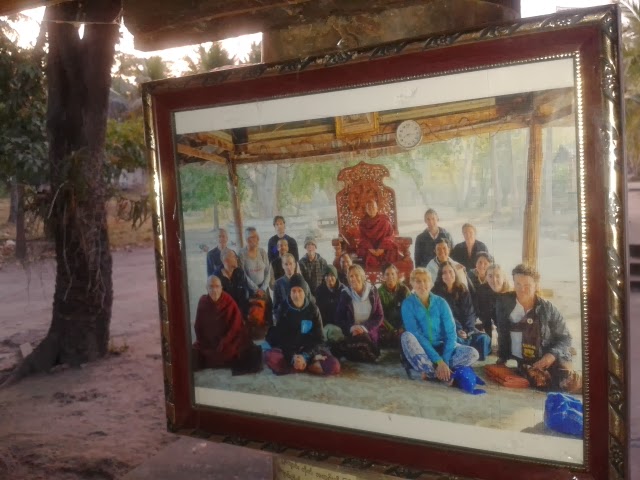
A group photo of the last pilgrimage to Ingyinbin now graces their dining hall
The dining hall has a line of paintings depicting important events in Webu Sayadaw's life. This one shows his initial emerging from the jungle to find the supernatural well water in Kyaukse.

Wednesday, 9 October 2013

Webu Sayadaw Monastery at Ingyinbin, Upper Myanmar

The Meditator Guidebook to Myanmar is in its final stages. As the guide gets closer to publication, we will begin to share excerpts of what yogis and meditators may expect... some sneak previews of what is to come. Here is an excerpt from the section on Ingyinbin Monastery in Upper Myanmar, the birthplace of the venerable Webu Sayadaw and where U Ko Lay and Sayagyi U Ba Khin ordained in 1965:
--