Showing posts with label Sitagu Academy. Show all posts

Thursday, 16 February 2017

Passing of Shwegyin Sayadaw


The most Venerable Maharathaguru Waso Sayadaw Bhaddanta Aggiya, Abhidhaja (head monk) of the Shwegyin Nikāya (myanmar's second largest monastic order), has passed away last week while undergoing medical treatment in Mandalay General Hospital. He has thus left the burden of the aggregates at the ripe age of 100, just a few weeks before his 101st birthday. Bhaddanta Aggiya had 81 vassa.

Following his demise, this Tuesday a large meeting was organised in his Monastery, with many chief monks of the Shwegyin Order such as the Venerables Dr. Nandamalabhivamsa, Yaw Sayadaw and Sitagu Sayadaw, to discuss the preparations for his cremation ceremony with his devotees and the regional chief minister.

The remains of the Sayadaw are being displayed in a coffin for public obeisance in Aungmyaythazi Monastery in the compound of Vithudayon Taikthit Kyaung on 86th street. In the last days many devotees came to pay their respects to his remains, as well as many monk communities from Shwegyin monasteries came to pay their respects and practice marananusati (contemplating death) near his body. Today evening Yaw Sayadaw will be giving a Dhamma Talk there.

The cremation will be held on Sunday afternoon on the sport fields of Shwe Mann Taung Golf Course at the western foot of Mandalay Hill.

Sunday, 15 February 2015

"The Dog Barks at the Man on the Elephant"

Zazzle


A foreign meditator's welcome to many new villages or monasteries is often a chorus of howling hounds. This was one of the things that surprised the American Bhikkhu Cintita, who observed at Sītagū Academy in Sagaing that “to announce mealtime, someone would hit a big bell outside the kitchen with a mallet and at that time all of the Sītagū dogs… would take this as cue to point their chins skyward and howl.” In the case of dogs barking at a new arrival, eventually local residents will come over to investigate, whereupon they’ll immediately call the dogs off. And as one stays in one location long enough, it will not be this constant, daily headache, as the dogs will become accustomed to one’s presence. This non-sensical—though instinctual—dog barking is such a common feature that there is one expression, sin paw ga lu kwe haun which means “the dog barks at the man on the elephant.” It refers to exerting effort toward something that will not likely be very effective.

Monday, 9 February 2015

"What's So Special About the Sagaing Hills?"


Regarding the recent news about U Sarana undertaking an intensive research trip in the Sagaing Hills, some readers who have not been to Myanmar have asked, "what's so special about this area, anyway?"

This is a fair question, and one that would require a book to answer-- or, perhaps, the upcoming Shwe Lan Ga Lay.

One cannot find the words to adequately describe such an unusual gem as these Hills. It is noteworthy that it has played critical roles in the genesis of the two major Burmese Buddhist practices that have been exported from Burma: Mahasi Sayadaw and Sayagyi U Goenka. It was in Sagaing, at Thameikdawdaya Nunnery just after World War II, in 1947, where Sir U Thwin beheld Mahasi Sayadaw speaking for the first time. He was transfixed listening to the sermon, and later remarked that “[Mahasi Sayadaw] was teaching with utmost dignity in a tranquil state of mind without any distraction….This eminent teacher is the savior I have been searching for.” Conferring with Prime Minister U Nu, Sir U Thwin invited Mahasi Sayadaw to the newly opened Sasana Yeiktha in Rangoon, asking him to be the lead teacher here. It was from this this center where the Mahasi movement swept not only Burma but the entire Southeast Asian region in unprecedented ways, an unparalleled Dhammic movement that had its origins in a humble Sagaing nunnery.

Similarly, U Goenka has suggested that Ledi Sayadaw learned Vipassana meditation deep in the Sagaing Hills from an unknown master. Although there are questions about this speculation, it is extremely significant that this region would be chosen as the origin of Ledi's Vipassana practice, for it is a region especially known for patipatti-minded monks. Ledi would be asked on two separate occasions to return to the Sagaing Hills to drive away plague epidemics, and was successful both times, according to one monk biographer. He also spent the last couple years of his life in a monastery near the Ayeyarwaddy River (although passed away in Pyinmina), where pilgrims can still today go and meditate just beyond the peaceful flowing river. It was also here where he was given the highest award by British colonials. (by this time, however, Ledi was legally blind, having exhausted his eyesight from his continual reading and writing) Also, perhaps U Goenka's greatest contemporary Dhamma friend in Myanmar was Sitagu Sayadaw, who played a critical role for the spread of U Goenka's teachings within Myanmar. And Sitagu Sayadaw, of course, established his famed Sitagu Academy just at the foot of the Hills-- and is now building a massive Vipassana Center much deeper into the Hills in the model of Borobudur in Indonesia.

Until just a generation ago, tigers roamed the dense forestation of the Sagaing Hills, and some monks even today bear tiger scars upon their bodies from attacks that occurred during alms rounds-- talk about unwholesome kamma for the great beasts! Countless arahants have been produced from these Hills, and the surviving stories of their challenges and ultimate successes make some of the most inspiring reading available to meditators today-- it is histories and stories such as these that U Sarana hopes to further track down.

Friday, 7 November 2014

Sitagu Sayadaw and President Obama


The great venerable monk Sayadaw U Nyanissara, more commonly known as Sitagu Sayadaw, is by far the most famous and well-known monk of Burma today. It is then no surprise that President Obama sought out a personal audience with the monk during his brief one-day visit to Myanmar in 2012. Now at Sitagu Academy, the innovative free Buddhist university run by U Nyanissara, this portrait with the American president hangs in a prominent place. As President Obama plans to return to visit the Golden Land next week, he may again take the time to consult and pay respects to the great monk.

For those students of S.N. Goenka, one may also remember their dear friendship over the years. U Nyanissara stayed at Dhamma Giri for three months many years ago, where he wrote a biography of Ledi Sayadaw, and he later led 500 monks in scattering Goenkaji's ashes in the Ayeyarwaddy River. It may be fitting that the first (and second) groups to hold meditation sittings in the new Sitagu Vipassana Center in the Sagaing Hills were pilgrims on the Pariyatti pilgrimage.

Tuesday, 1 April 2014

"Through the Looking Glass"


Bhikkhu Cintita, on alms rounds in Burma


Californian John Dinsmore led a full lay life for fifty years: he worked as a noted linguist, computer programmer, carpenter, and business entrepreneur in Eastern Europe just after the Soviet Union collapsed; he fathered three children and had several marriages and long-term relationships; and had several degrees in higher education and himself taught as a professor in various universities. However, despite all this, he still felt unfulfilled and in search of greater meaning. He ended up leaving most of his possessions and the trappings of lay life to devote himself entirely to Zen Buddhist practice in California and Texas, eventually becoming an integral member of the burgeoning Austin Zen Center. In time, he himself was appointed a Zen teacher and priest here. Still, the depth of renunciation for which he was searching could not be found in Zen, and so he accepted an invitation to travel to Burma on a pilgrimage. Arriving in full Zen clothing, he later ordained as a Theravadin Bhikkhu on a full moon day in Sagaing. In fact, his ordination took place at Sitagu Academy, on the very birthday of Sitagu Sayadaw. He spent the following 13 months between the Sitagu campuses in Yangon and Sagaing. Having recently turned 60 and now known as Bhikkhu Cintita, he has now written a memoir on the events leading to his life in robes. The entire book can be found here, while the monk's main blog is here.

Following is an excerpt, describing the time immediately after his ordination:

“My initial reply to the Burmese monks who had asked what felt different to me after ordination, ‘I know what I am!’ did not quite get to the heart of it. What was different after ordination was that now, for the first time, more than a few others, in fact an entire culture, an entire nation, recognized the shape of my life. It’s not so much that I know what I am — I had chosen to be it years before at the beginning of the good thinking that had earned me my name — but that others now also know who I am, and not only that, but through their respect for the robes show that they fully endorse and share my faith in this way of life. My gratitude for being held by this kind of support was and is to this very day boundless.”

A view of the Sitagu Academy campus in the Sagaing Hills

Monday, 24 March 2014

Abhidhamma Course at Sitagu during 2014 Rains Retreats


An older female yogi pays respects as monks walk past her


There is a belief in Burma that the Abhidhamma is so important, that when the Buddha's teachings start to disappear from the world, this will be the very first to be lost. Therefore, the need to preserve the Abhidhamma takes on a considerable importance in order to preserve the Sasana.

There is also an old tale, likely more mythology than reality, about a ship carrying the three books of the Tipitika crashing in the waters. Each one was saved, with the Abhidhamma Pitika going to Burma, the Vinaya Pitika going to Thailand, and the Sutta Pitika going to Ceylon (Sri Lanka). This ancient tale is often repeated today in Myanmar, as if to describe the great importance it plays in dhamma practice and Buddhist life in the Golden Land.

Study of Abhidhamma is possible only under the assistance of a skilled teacher, for the material is so dense that many first-time readers struggle to understand its profound meaning. While Abhidhamma study is to be found throughout modern Myanmar, it is rare to find an opportunity to do so in English.

This is where the extraordinary opportunity being provided by Sitagu Academy Rector Dr. U Kumara comes in. For the first time in the Academy’s history, a two month Abhidhamma course will be offered in June and July to 20 foreign meditators.

For more information about this course, and to register, please see here.


Sandals laid out neatly reflect the discipline found among young novices at Sassana Won Saung in Hmawbi


Saturday, 8 March 2014

Information about Abhidhamma Course at Sitagu Academy in the Sagaing Hills

As a recent post indicated, the Sitagu Academy Rector in the Sagaing Hills has generously offered to teach an Abhidhamma course to foreigners during the months of June and July 2014. The opportunity is open to 20 fortunate meditators, and more details can be found below.

You can also download and share the following information by going here. To download the PDF version, simply click on "Download: Abhidhamma Course at Sitagu Academy.pdf" as it appears on the top of the page.


Thursday, 6 March 2014

Abhidhamma Course for International Meditators


Most foreigners initially become attracted to the Buddha's teachings through a desire to learn formal meditation, as this is a practice which gives wonderful (and often immediate) results. Indeed, such an experience allows for direct insights that are often far more powerful than mere intellectual discussion or contemplation.

However, as one advances further in the practice, greater complexities are to be found in the inner world of the mind. This is where the Abhidhamma comes in, for the text is historically considered to be one of the most important and sacred by many Burmese Buddhists. The Abhidhamma carefully maps mind-body relationships and organizes components according to many specific classifications. Developing a greater understanding into what the Buddha actually taught regarding these factors can greatly advance one's overall understanding of the Dhamma, and provide wonderful support to one's meditation practice on the cushion.

This June and July, Sitagu Academy Rector Dr. U Kumara has announced his intention to offer a two month Abhidhamma course to foreigners in Sagaing. The course will be given entirely freely, and those accepted will be provided a meditation visa to attend. Finally, Compassionate Travels Myanmar will be offering three one-week dhamma tours around the country to coincide with the Abhidhamma course dates, allowing students/pilgrims to explore more of the country's Buddhist background while in this part of the world. Especially recommended, however, is Muditā Works.

To learn more about the requirements for applying to this Abdhidhamma course, please see this blog post. You can also directly download the PDF version here.

Many foreigners may already be familiar with the Sitagu name, as they have a branch monastery in Austin, Texas and the head Sayadaw, U Nyanissara, is one of the most respected in all of Burma today. U Nyanissara was also very close friends with U Goenka. The great lay meditation teacher regularly visited here when visiting the country and stopped at the Academy several times while leading several hundred foreign meditators on pilgrimage in the early 2000s.

Sunday, 2 March 2014

A Diary of Pilgrimages

Three young Burmese boys join a group siting at a pagoda with the pilgrims

42 days of pilgrimages have now been completed, and two groups of devoted yogis have now seen the best that Burma has to offer, with many lives transformed in the process. Some pilgrims ordained and are still in robes, with others coming in the next few weeks, months, or even years with a similar intention in mind. Others have grasped the dhamma in more profound ways than was possible in one's home country, and have returned to their local community to share their wealth of experience, understanding, and inspiration.

The following guide shows the diary entries recorded for the two yatras. The majority of the first diary entries were made by Kory Goldberg, a Canadian yogi and author of Along the Path. The majority of the second yartra entries were made by an anonymous American pilgrim.

While no yatras have as yet been confirmed for the following winter of 2015, there are upcoming opportunities for those interested to join part on such excursions in the near future. U Kumara at Sitagu Academy has indicated an interest in hosting Abhidhamma workshops in English for any interested foreigners in the Sagaing Hills in June, and brief ten-day dhamma trips will be organized both before and after these courses for those wishing to attend. Finally, one may also contact Muditā Works  (the agency which arranged for the entire following two pilgrimages) at any time to arrange such a dhamma trip according to the wishes of one's group.


The ruins of Htut Kaung Monastery in the Sagaing Hills. This was one of the world's first meditation-oriented monastery 

Pilgrimage #1
Day 1: Yangon
Day 2: Pyaw Bwe Gyi
Day 3: Yangon and Hmawbi
Day 4: Hmawbi
Day 5: The Road to Mandalay
Day 6: Mandalay
Day 7: Kyaukse and Mandalay
Day 8: Mandalay and Monywa
Day 9: Monywa
Day 10: Monywa, Sain Pyin Gyi, and Ingyinbin
Day 11: Ingyinbin
Day 12: Ingyinbin
Day 13: Ingyinbin
Day 14: Ingyinbin, Shwebo, and Sagaing Hills
Day 15 and 16: Sagaing Hills
Day 17: Mingun
Day 18: Sagaing Hills and Yangon
Day 19: Yangon
Day 20: Yangon

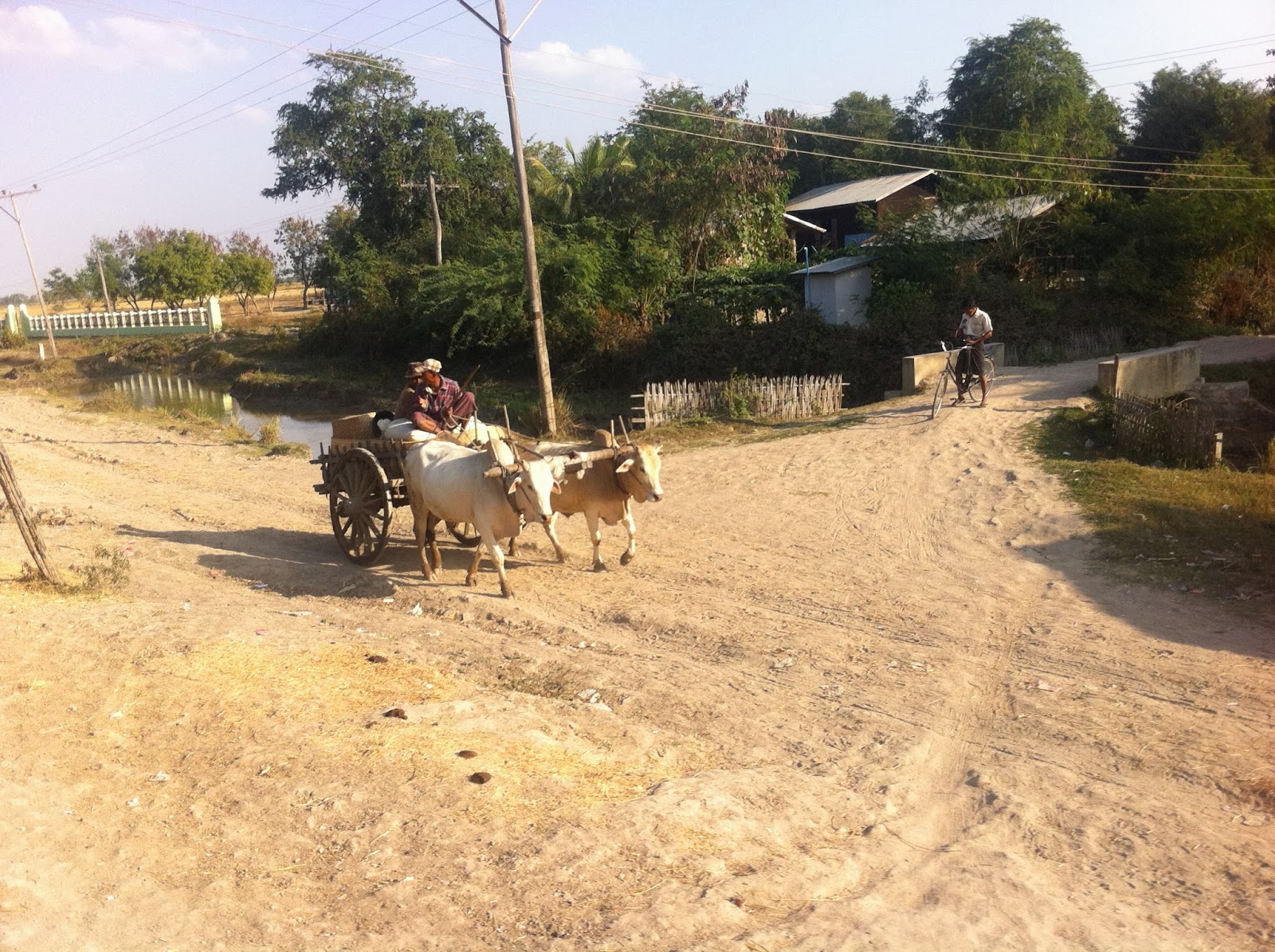
A typical rural Burmese scene

Pilgrimage #2
Day 1: Yangon
Day 2: Pyaw Bwe Gyi
Day 3: Yangon and Hmawbi
Day 4: Hmawbi
Day 5: The Road to Mandalay
Day 6: Mandalay
Day 7: Kyaukse and Mandalay
Day 8: Mandalay and Monywa
Day 9: Monywa
Day 10: Monywa, Sain Pyin Gyi, and Ingyinbin
Day 11: Ingyinbin
Day 12: Ingyinbin
Day 13: Ingyinbin, Shwebo, and Sagaing Hills
Day 14: Sagaing Hills Nunneries
Day 15: Within the Sagaing Hills
Day 16: Sagaing Hills One Day Sitting
Day 17: Mingun
Day 18: Sagaing Hills and Yangon
Day 19: Yangon
Day 20: Yangon

Pilgrims travel back from Mingun to Sagaing

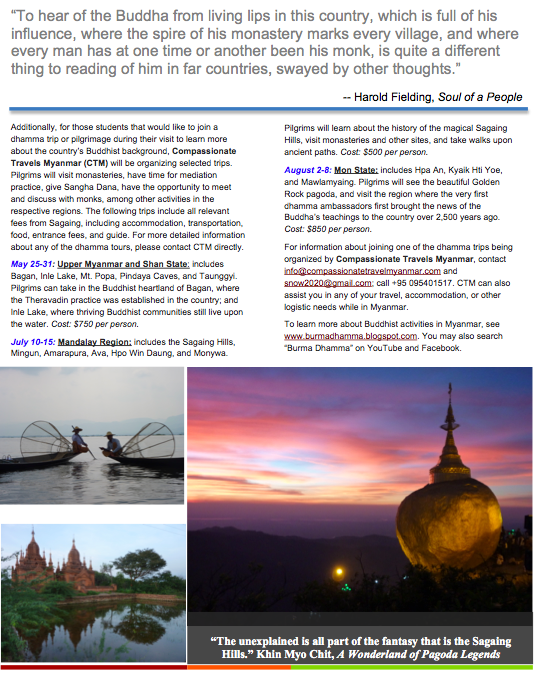
...one may ask, what is so special to have to come across the world to Burma anyway, when the practice is basically inside already? Harold Fielding, a British administrator, provided an answer to this question in 1898 in "Soul of a People":

"To hear of the Buddha from living lips in this country, which is full of his influence, where the spire of his monastery marks every village, and where every man has at one time or another been his monk, is quite a different thing to reading of him in far countries, under other skies and swayed by other thoughts. To sit in the monastery garden in the dusk, in just such a tropic dusk as he taught in so many years ago, and hear the yellow-robed monk tell of that life, and repeat his teaching of love, and charity, and compassion—eternal love, perfect charity, endless compassion—until the stars come out in the purple sky, and the silver-voiced gongs ring for evening prayers, is a thing never to be forgotten. As you watch the starlight die and the far-off hills fade into the night, as the sounds about you still, and the calm silence of the summer night falls over the whole earth, you know and understand the teacher of the Great Peace as no words can tell you. A sympathy comes to you from the circle of believers, and you believe, too. An influence and an understanding breathes from the nature about you—the same nature that the teacher saw—from the whispering fig-trees and the scented champaks, and the dimly seen statues in the shadows of the shrines, that you can never gain elsewhere. And as the monks tell you the story of that great life, they bring it home to you with reflection and comment, with application to your everyday existence."


School children gather before a backdrop of rural stupas

Thursday, 27 February 2014

Burma Pilgrimage #2, Day 17: "Here, change is in your face."

The model plan for the new ambitious Sitagu Vipassana Center. The group sat here in the morning

The upper most paogoda at the Sitagu Vipassana Center. Last month's yatra was the first group to ever meditate there, and this group was the second 

The following excerpt was written by an American yogi about the pilgrimage in Burma. The first pilgrimage has ended, and the second one has just begun! To read about the previous day sitting the self course in the Sagaing Hills, go here. To read about the first pilgrimage group's experience as they explored Mingun, see here.


You can also consider joining a later pilgrimage in Burma.


A view of the Mingun Jetty before boarding the boat back to Sagaing

"The highlight today was an Ayeyarwaddy river boat trip.

On boarding the boat consisted of walking down a sandy bank, onto a 'bridge/plank' brought into being by the alignment of a slab of wood to walk on, and a single bamboo 'railing' held by two men. Arising and passing away is never far away in this land...

The craft was remarkably low set in the water with open windows covered only with adjustable tarp. Rain started during our time on the vessel, with a drop in temperature that few of us were prepared for.

Going down the Ayeyarwaddy was the last leg of Goenkaji's ashes. As we traced his path, we passed tugboats hauling wood cargo, small wooden boats with old motors attached, some puffing out black smoke in their journeys.

All share passage in the muddy waters, in a place where change is a reality of life. The sandy banks actively evolve, with large chunks falling to join the river. Men testing water depths stand guard at the bow, guiding vessels away from swirling eddys and sand bars. The landscape is foggy, with rolling hills framing flat lands interspersed with an occasional thatched hut and flame tree.

One of the things in the West, is that we've created such comfortable (and artificial) environments that we forget that all things change. Here, change is in your face, whether it is in the dimming of the bathroom light because the electric shower head just turned on, or floating down the Ayeyarwaddy in an exposed wooden boat.

Anicca, anatta, dukkha...


A gold statue of Mingun Sayadaw

**************

This Mingun Pagoda is built on seven layers to resemble the seven layers of waves when approaching Mt. Meru

The mood is somber, as we pass near where Goenkaji's ashes were scattered.

The rain picked up, and by the time we got on the bus, we were a wet bunch. And in the moment, huddled together on the exposed bus for warmth, Goenkaji's doha chantings arise, led by a couple of CCTs... a sweet ending to a memorable Ayeyarwaddy trip..."


To read about the pilgrims' final day in Yangon, see here.

The Sitagu Academy Rector gave generously of his time, as pilgrims took advantage of his English fluency to ask him a number of question pertaining to the Dhamma

Wednesday, 26 February 2014

Burma Pilgrimage #14, Day 14: The Bull and the Cow

The following excerpt was written by an American yogi about the pilgrimage in Burma. The first pilgrimage has ended, and the second one has just begun! To read about the previous day, go here. To see an outline of the day's events, see here.

You can also consider joining a later pilgrimage in Burma.

The entrance to Sitagu Academy in Sagaing

"Sitagu Academy grounds are quite grand. It's large and clean and organized. Coconut trees are laden with fruit, and trees are blooming. The dogs here are not as skinny (and much more interactive than elsewhere). Even the mosquitoes are twice as big!

The activities today included a visit to two nunneries in the Sagaing Hills. The first of these is a patipatti nunnery - it's a small place, but it seems like the nuns do get at least several hours of meditating a day [the head nun being a disciple of Saya U Than, who studied under Saya Thet Gyi]. Alms rounds are twice a week. We are told that one can practice whatever tradition while staying at the nunnery, and that it is possible to leave for meditation courses. As a co-pilgrim noted, the energy of the place was quite different than that of a monastery - much more gentle and 'motherly' of a place.

Sayalay Daw Nu Ka Ti takes questions about the nuns' life from pilgrims. Click to enlarge the photo, and behind the nun you can see a variety of posters that include Ledi Sayadaw, Saya Thet Gyi, Saya U Than, The Phyu Sayadaw, and herself at a young age. The white Buddha statue to her right was given by a German yogi who is now a nun at Pa Auk.

The second nunnery is a thriving place with over 150 nuns. It's run by three nuns and generously supported by a Japanese donor (who also made a documentary of the nun's life here), including a mother/daughter couple (their entire family ordained together!) As a pariyatti nunnery, there is minimal time set aside for patipatti, but they apparently are well known for the quality of their education and discipline.

The daughter, who self initiated the family ordination at the age of eight (now in her early forties), answers questions with surprising grace and adeptness. As to why they've chosen to focus on pariyatti, she notes that teaching women the words of the Buddha is something important that needs to be done. And while working for liberation can help oneself, keeping patipatti alive can give benefit beyond one's lifetime, and so they've chosen to dedicate this life to this for the benefit of all. 

Excellent facilities and generous donations have given the young nuns an ideal place for study
The discipline found at the second nunnery visited can be seen even in the way the sandals are carefully arranged before entering a building

Another example they used was that patipatti is like a bull, whereas pariyatti is like the cow, and if no more cows were present, there would be no more calves.

It was a touching way to think about pariyatti, and struck a chord amongst some of the women.

We ended with a tour of the grounds. The young women were reciting, and while a few peeked the odd looking foreigners, most continued to be quite focused. Both nunneries were cleaner than many of the monasteries we had been to, but this one was especially so. Their large Buddha statue was behind floor to ceiling glass, and one of the men remarked on how spotless the glass was..."


To read about the following day in the magical Sagaing Hills, see here!

The pilgrims pay respects to the large Buddha statue at the second nunnery

These three buildings on the compound are aptly named Sila, Samadhi, and Panna

While waiting for their transportation back to Sitagu, pilgrims talk about their event-filled day

Wednesday, 29 January 2014

Burma Final Days

The pilgrims pose with the famous Sitagu Sayadaw

One can read about the previous days in the Sagaing Hills and Mingun here. Kory Goldberg continues to record in his personal journal about the current pilgrimage now underway in Burma. You can also consider joining a later pilgrimage in Burma yourself.

"We were supposed to have an early start on the road back to Yangon, but like always something came up. Sitagu Sayadaw, the most influential monk in Burma, returned to the Academy and wanted to meet our group. Sitagu Sayadaw said that he was like a brother to Goenkaji, so it was natural that he wanted to meet with his foreign “nieces” and “nephews.” This famous monk is famous not only for creating and supporting great centres of monastic learning, but has been a key figure in establishing a network of social projects involving healthcare, literacy, vocational training, access to potable water and disaster relief. Our meeting with the warm, yet tired celebrity was brief, but the rarity of such an encounter was worth the delay. 


In the Department of Meditation Hall at Sitagu Academy, Sayadaw U Nyanissara discusses dhamma with pilgrims

Day 19 in Yangon was really our last day together as a group as some were flying out that evening, many others first thing the next morning. After such a long bus ride the previous day, and from the intensity of the entire journey, many of us were feeling quite exhausted. Nevertheless, almost everyone joined the only activity planned that morning—a visit to the Kaba Aye Pagoda and a chance to meditate in the presence of the relics belonging to the Buddha, Sariputta and Mogallana. While some monasteries claim to possess such holy relics, these are genuine since they came directly from the Sanchi Stupa in India. The unique vibration, commented by many of us, in the room where they are housed also testifies somewhat to their authenticity, although I am certainly aware that the energy of the atmosphere does not constitute solid evidence. 


Kaba Aye Pagoda trustees hold the sacred relics above Kory Goldberg whilst chanting
A close-up of all three relics
That day we had a wonderful Nepalese lunch with Sayagyi U Ba Khin’s son, daughter-in-law, and grand-daughter. A very happy family they are, signifying what happens when a close-knit group of people live in wise and loving attention. They answered our numerous questions, trying their best to explain what it was like to be related to one of the greatest masters of our time. An enormous pressure, yet they seemed to handle it well. As we left each other they invited us to their home for tea, contemplation and sharing more stories together. Burma’s pace of life (in general) and generosity exemplified in the smallest details is unsurpassable. If there is one thing I hope to bring home with me is to become intimate with the characteristically Burmese joy of giving.

Our pilgrimage concluded with an evening loving-kindness meditation and circumambulation of the Shwedagon Pagoda, followed by a lovely farewell dinner. Snow, once again demonstrating her innate munificence, shared kind words to the group and offered five Teak Buddha statues to pilgrims whose names were picked out of a bowl. We then went around the table, sharing our insights and gratitude for the organizers, other participants and all our hosts. It was a delightful moment and a wonderful way to close the first—of many—Pariyatti pilgrimages."


The reader's journey need not end here! To read about the second pilgrimage that would start just days after this ended, see here.

A view of the illustrious Shwedagon from the rooms of the pilgrims.

Thursday, 16 January 2014

Burma Day 17: A Day in Mingun

One can read about the previous days in the Sagaing Hills here, and to see how the following yatra group enjoyed Mingun, see here. You can also consider joining a later pilgrimage in Burma yourself. Kory Goldberg continues to record in his personal journal about the current pilgrimage now underway in Burma:

Pilgrims pause at the very well where the "floating knife" and the Vow of Truth took place in the life of Taung Phi Lar Sayadaw

"After a quick morning meal of congee and beans we were off to visit the sites in and around Mingun. We all piled into a pick-up truck-cum-mini-bus for the pleasant, yet bumpy country drive. On the way we stopped for our morning meditation session in a cave that once belonged to the 18th century monk Htut Khaung Sayadaw, the renegade monk who freed himself from monastic convention to pursue an unfettered and disciplined yogic life in the forest. The Sayadaw became famous not only for his dismissal of traditional obligation, but for his respect for nuns and willingness to teach them and provide a space for ascetic practice. This cave, where Venerable Htut Khaung resided for much of his life, still teems with energy as a handful of bhikkhus continue to practice here regularly. It’s incredible how fast an hour flies by at such locations.


One of the pilgrims pays respect to a monk at the original site of Htut Khaung Sayadaw's 18th century monastery
Our Sangha Dana today was at the monastery founded by the late Mingun Sayadaw, the first Tipitika-dhara in modern history. Mingun Sayadaw was made famous in the 1950s on a global scale for his ability to memorize the entire Buddhist canon, approximately 18,000 pages long. He was even admitted into the Guiness Book of World Records for this incredible feat. Today, nine of his students have achieved the same textual mastery, keeping the words of the Buddha close to their hearts and minds. At first glace, spending up to 10 hours a day for years on end to memorize each and every word that the Buddha taught may seem like a waste of one’s life. However, upon deeper reflection, we see that doing so leaves very little space in one’s mind for the mundane and the useless, and serves as a form of meditation practice that purifies the mind, making space for such unique activity to take place (although he did say that he does quiet the mind every morning upon rising and every evening before retiring). The Mingun monk we met today did seem a little robotic in his mannerism, yet he also seemed quite calm and other-worldly, not bothered by the day-to-day inane issues that plague the average person’s mind. Although he did admit that despite his super-human ability to commit the Buddha’s words to memory, he still does misplace his glasses from time to time!  


The group poses for a group photo at Mingun Monastery

After the visit we struck the Mingun Bell (the second largest in the world), visited a touristy pagoda, shopped and drank coconut water. To return to Sagaing we took a pleasant 90-minute boat along the Ayerwaddy River, seeing where Goekaji’s ashes were released and merged back to nature. The boat ride was very peaceful, affording everyone a moment to relax and recuperate from all the intense inner and outer journeying. Before retiring at the Sitagu Academy, we mediated at a nunnery overseen by a 50-something year-old saint named Daw Nu Kati who has been in robes since she was nine. She welcomed this strange group of travelers into her compound, smiling wide, yet unsurprised by this unlikely event. After meditating, she patiently and gladly answered some of our questions about the life of not only a nun, but of a renowned meditation master, a rarity for a woman in Buddhist Asia. She served us snacks, engaging all the tastes: salty crackers, sour amla, sweet bananas, bitter tea. Her presence was soothing and inspiring; totally present, yet not there at all. Once again, a rare and precious moment not to be forgotten! As one pilgrim put it, “it’s like Christmas every day!” Every day while on pilgrimage in such a holy land is certainly a gift. But alas, these daily miracles will soon come to an end, or rather, they will be replaced by other, less evident daily miracles. The challenge is to see these subtle blessings with appreciation and gratitude in whatever form they may take. Doing so will reveal how much we have really learned on this journey through the Golden Land. Let’s see…"


Pilgrims embark the boat in Mingun that will take them along the Ayeyarwaddy towards Sagaing, and over the place where Sayagyi U Goenka's ashes were scattered just months before
To read about the final days, go here.


After a long day, five smiling Burmese girls wait on the pilgrims at Sitagu Academy to offer an evening fruit plate

Burma Days 15 & 16: Pariyatti and Patipatti

For Day 14, see here. Kory Goldberg continues to share his personal journal about the current pilgrimage now underway in Burma. You can also consider joining a later pilgrimage in Burma yourself.

A Sagaing Hills Sayadaw shows the relics of his teacher, a fully liberated being, to two pilgrims
"As with every spot we’ve gone to, but different, our days in Sagaing have been a real blessing. More important than the beautiful Buddhist aesthetic, the lush gardens, delicious food and medium speed WiFi, the Sitagu International Buddhist Academy has provided us with access to some of Burma’s most learned Buddhist scholars who speak fluent English. Both our days here have afforded us Q&A sessions with U Kumara, the university’s rector, whose deep knowledge of scripture and practice has quenched our philosophical thirst. Conversations have ranged from Abhidhamma analysis to meditative experience, from mystical journeys to political musings, from historical fact to mythological narrative. Between these intellectual sessions have been both guided and solitary wanderings along the trails of Sagaing, visiting 900-year old monasteries that gave birth to Buddhism in the region, caves vibrating with the energies of awakened beings, and sugar-cane juice stands that replenish lost electrolytes. On Day 15 many of us met with the very venerable Prekhemma Sayadaw whose quiet and loving presence was yet another living expression of the Dhamma. When not teaching his small retinue of dedicated monks, counseling lay people, and overseeing maintenance and construction projects, this 50-something year old bhikkhu brimming with humility and kindness walks around the forested, hill-side property practicing mettā-bhavana for approximately 3 hours. And it shows. 


View of a long cave in the Sagaing Hills where one arahant practiced for 30 years
After a brief discussion, most of our group went off to meditate in the cave where the Sayadaw’s predecessor resided for 30 years and became an arahant. Caves like these abound the Sagaing hills, which are believed to have the highest concentration of enlightened contemplatives anywhere in the world. Prekhemma Sayadaw then showed some of us his teacher’s relics, as well as those of an unknown arahant. Since being in his presence, the latter relics have multiplied and expanded, many of them growing from the size of a sesame seed to that of a chickpea. This phenomena is said to occur when the relics abide in the presence of stainless morality. After examining and photographing the multi-colored relics, we meditated with them for about half an hour. As with genuine Buddha relics and the Webu Sayadaw’s relics at Ingynbin, I felt a coolness flow through my body and a deep sense of peace in my mind. During moments like these, the mind is unhindered by the typical incessant storylines and commentaries. Some craving arises to prolong these profound moments; wisdom also arises, understanding that they too are impermanent and ultimately dissatisfying.

Pilgrims walk at a monastery in the Sagaing Hills before a cave door opening where an arahant was known to practice, eating only a few spoonfuls of beans in his later years.
On Day 16 we all meditated at the 900-year old Pa Bar Jaon monastery overseen by a humble 28-year old Sayadaw, the youngest we’ve ever come across. Some of us stayed here for three hours in the morning (many taking a brief nap following another wonderful lunch); others mindfully explored other sites in the hills. We practiced in the ancient ordination hall containing two large containers filled with arahant relics ranging from the size of a chickpea to that of my hand. Apparently the original relic casket that was dug up on the premises only 20 years back was the size of a coffee mug. Now at least two dozen coffee mugs would be needed to contain all the relics. 


Pilgrims learn about the importance of water in the Sagaing Hills. As one Sayadaw said, "to come and practice in Sagaing, you always needed two things: sila and water!"
Even more extraordinary than these relics, however, was what we came across at another monastery resting on top of one of the hill’s ridges. Guided along the vast trails by a 73-year old Sagaing yogi with deep blue eyes, gentle wrinkles and a permanent grin, we entered a small shrine housing the corpse of the Venrable U Narativi. After attempts by his disciples to cremate this arahant’s dead body failed, as it simply would not burn, they realized that the body itself was a relic to be preserved. Twenty-eight years later the corpse rests peacefully in a glass casket studded with gems. Parts of the body are slightly rotten and charcoaled, but for the most part it is quite intact. In fact, the corpse’s caretaker must shave the old bhikkhu’s head and cut the nails at least once every couple of months so that he continues to look like a respectable monk! Reflecting upon this corpse completely turns the Asubha contemplation on its head!


Even though we have all had our own unique experiences on this pilgrimage in general, and in Sagaing specifically, no one can say that they haven’t been transformed in one way or another. For the time being, it may be difficult to say how, or even what had happened since processing the experience will take weeks, if not months. But something did shift during our numerous, and sometimes exhausting, visits to pagodas, sangha-dana at monasteries, meditation sessions in caves, thought-provoking Dhamma discussions, day-dreams out bus windows, sleeping on hard and dusty floors, interpersonal relationship issues with other pilgrims, and interacting with people from a totally foreign culture whose worldview is completely unlike anything any of us are familiar with back home. All of these experiences have been etched into our minds, remaining there for years to come, coloring our perceptions in ways that are incomprehensible, yet whose transformative impact will be felt for the rest of our lives."

More can be found about Day 17 here.

Wednesday, 20 November 2013

Sitagu Academy in Sagaing

Department of Meditation at Sitagu Academy


“In other countries, I saw many academies, for example, navy academy, air-force academy, military academy, defense academy, etc. In the world today, in the Buddhist world also, we must establish Buddhist academy. In this Buddhist academy we are teaching Theravada Buddhist Scriptures…. In our academy we founded the department of Vinaya, codes of Discipline, department of Suttanta, discourses, department of Abhidhamma, Buddhist Philosophy, department of Missionary and Religion, comparative study of religions, most important department is the department of Meditation… Our Sitagu International Buddhist Academy is teaching, learning, training, practicing to realize ‘what I am, where I am, what I have to do.’ These three main points are very important to understand. This is called right understanding, to convert from evil to noble. Therefore, Dhamma is the mighty technique to solve the problems of mankind…. What we are now doing is establishing of the academy, Buddhist Academy, we invite all of the Buddhist students from various countries, and different faiths to come gather and together to learn, to practice, and to train our wicked mind to be noble and to turn a new leaf of our life from evil to noble…. May all of you be peaceful! May all of you be happy! May all of you be successful in any attempts for all of the nations!” 

Excerpt of a speech given by Sayadaw U Nyanissara on May 9th 2013 for the occasion of an inauguration of a new Yangon campus.


Sitagu Academy in Sagaing, at sunset