Showing posts with label ordination. Show all posts

Wednesday, 13 April 2016

Ingyinbin Journal: Ordinariness in Everything


John, a meditator from New Zealand, spends extended periods in Ingyinbin each year, the home of the revered Webu Sayadaw and with his friend Ashin Mandala. This winter, he has decided to keep a journal, which he has kindly offered to share with us. His journal alternates between observation and poetry, between meditation practice and commentary about Burmese Buddhist society, from his learnings and his questions. The full collection of his musings can be found here.

16 January

Back from Shwebo following a muddle over the pickup arrangements, and Karen with a heavy cold, the prominent gold pagoda spire seen at a distance of some kilometres foreshortens the distance. Return with evening-time.

Under the wispy moon in the still-blue sky
lines of white birds sweeping into the tamarinds.
Silent, graceful, landing as new leaves.
The following morning I walk with Kwau Soe to the patipatti compound, where shortly after Yan Aung Shwe joins us, wearing treble sweaters. We examine the U Ba Khin building, which Aung Shwe has recently upgraded adding new facilities and paint. He wants the small corner room with generous windows on three sides where U Ba Khin spent a week ordained to be reserved for serious mediation only. Beyond this building stands another, rather dilapidated one, used during Webu’s time by his donor, a former Burmese Railways Minister.

From a nearby tree Kwau Soe plucks from a tree vine several tiny orange berries each with a black spot at one end which he holds out in his open palm. He explains that in his childhood they used to thread these berries onto a thread of cotton to make necklaces:

Kauw Soe gathers the tiny orange berries
they once threaded onto necklaces:
the devas on their elevated platform are benign.
He also stops to pick up from a narrow ledge at the arahant’s pool a small tortoise, white on the underside and less than half the size of his palm, with two small legs occasionally emerging and flailing, while the head remains firmly ensconced within the body - until the creature is returned to the water, where its head and legs re-emerge and after a brief flurry it disappears beneath the surface of the stagnant water. Shortly after, we visit the deva platform, a place where Webu is said to have been sometimes found meditating; and to my surprise beneath the expansive banyan tree nearby there are a couple of gnat altars decorated by devotees with fresh cut sprigs placed in jars; then over we head to the monks’ quarters, where just today the aged blue Plymouth car donated to Webu some sixty years ago has been towed back from Kin-U, a mere shell but impressive still.

We enter Webu’s rooms, where Aung Shwe recounts for me the last hours of the Sayadaw’s life: a final visit to the toilet in the adjoining room followed by collapse on his return, immediately lifted and carried by his assistants to the dais where shortly he passes away, cradled in arms including those of the current Sayadaw on the pariyati side. Several events of the final days are captured in the photographs that hang on the walls and I look long at them.

Karen and I return to the hut after lunch and sit through the afternoon, re-entering it late but still bright and welcoming.


Leaving the hut, the warm sun,
the wavy leaved tree displays perfumed white flowers
which we saw yesterday cupped in the old woman’s hands.
Perhaps this is a reasonable juncture at which to digress and recount an event of a few days later concerning the now 81 year old Sayadaw and the 83 year old Indian nuclear physicist and physician recently arrived to take robes and meditate. On the morning of his ordination the Indian gentleman is sat down on a small wooden stool beside the concrete trough used for washing by the monks and a young monk proceeds to shave the remaining ring of grey hair from the elderly fellow’s head in quick straight bursts of the razor. From there Bhante leads him to the dining room, where he becomes a novice prior to receiving full ordination. Pali phrases are said and repeated, robes passed as dana to the preceptor are returned and donned with the help of a couple of attending novices. Next a large young monk directs us to the Sima Hall, where an animated preceptor Sayadaw proceeds gleefully to compare the ripened age of each the novice, he himself, and the Buddha; once again he points to the upper lip and repeats Webu’s injunction to hold the attention right there uninterrupted on the breathe 24 hours in the day. The village musicians start up prematurely, thinking the foreign guests (six of us at this time) who now vacate the hall include the entire ordination party. It’s another 30 minutes before their cymbals and drums sound again in urgent unison as the monks reappear and we have the chance to give to tach of them a modest dana.

Late in the afternoon the guests enter the Sayadaw’s quarters in the ramshackle old teak hall, rows of empty Red Bull cans lining the inner entrance. Sayadaw sidles onto the floor with us and the priceless Buddha relics are brought out. A new glass dome has replaced the old one which has been roughly glued together following an earlier mishap. It is topped with a small black carved pagoda and the same wood serves as a pedestal, studded with lips of ivory. It is an ivory lotus that houses the tiny container which contains the dozen or so ‘mustard seed’ sized bone relics, wrapped in a small piece of purple cloth. Each petal has been individually carved, so that one that is near the relics curves up from the rest of the holder almost perpendicularly. Each of us in turn has a white cloth placed on our head while another holds the relic holder over the head for a couple of minutes. This has happened for me before, and at least this time the mind remains composed even though there is a strange and unsatisfied sense that there should be a ‘special’ experience or sensation to report. Ordinariness can feel like a major disappointment! Finally, it is Snow’s turn; as I rest the relics on her head a sudden buzzing sound is immediately followed by an itchy sensation and I realise a mosquito has just landed and bitten me on the cheek.

Sayadaw scrambles after almost spilling
a ‘mustard seed’ bone relic.
Cats, medicines, newspapers, plus one freshly ordained monk.
 

Cats race the roof as the black wooden bowl
housing the Buddha relics gets held in turn
above each head. Still within the mind kicks.
 

I hold the relic holder above Snow’s head
two minutes; knees pretty unsteady; hands
occupied, a mosquito stationed on my cheek.

As if I hadn’t appreciated the ordinariness in everything, later bhanti-ji, quite hard of hearing, explains that he had heard little or nothing, and asks why the grains of rice had been treated so reverently and whether it was these that had been referred to as ‘mustard seeds’.

The Sayadaw himself, surprisingly impish and bright-faced, each day perambulates the compound with his walking poles, using them to indicate this or that or else to admonish recalcitrant novices:

81, more a jaunty 18, soiled
robes and hugely calloused feet, this
Sayadaw held Webu when he passed.

Saturday, 2 April 2016

Former President of Myanmar to Become Buddhist Monk


The Democratic Voice of Burma (DVB) announces that with the recent Burmese election, now-former president U Thein Sein will soon ordain as a Buddhist monk and intensively practice Vipassana meditation. While to many Westerners there it may seem like something of a contradiction to go from the highest echelons of power to a life of voluntary simplicity and poverty, but in over a thousand years of Burmese history it's not so odd. While past kings went in and out of monkshood, to take only the last century or so, many Burmese heads of state have flirted with renunciation before, during, and after their leadership. 

For example, the first independence leader, General Aung San, said he briefly considered leaving aside the nationalist cause in order to follow as a student of the Italian monk (and friend of Webu Sayadaw and Sun Lun Sayadaw) U Lawkanawta. The first president, Sao Shwe Thaike, learned Anapana and Vipassana under Sayagyi U Ba Khin at International Meditation Center, and later became a leader in Shan Buddhist revival. His president at the time, U Nu, was perhaps the greatest meditator-in-office, trying to encourage Vipassana meditation as a state policy of newly independent Burma and once refusing to interrupt his self-imposed 45-day course even when Karen rebels were camped out in Mingaladon and nearly took over the capital of Rangoon! Even Ne Win, the general who launched the 1962 coup that Myanmar only recovered from in 2010, spoke at the end of his days in power as wishing to leave his lavish life behind for that of cool monkhood. While Than Shwe, who was in charge for much of the recent years, seems not of the same religious bent, he did oversee the construction of the splendid and inspiring Uppatasanti Pagoda in Nay Pyi Daw. And Daw Aung San Suu Kyi has studied under Sayadaw U Thumana and Sayadaw U Pandita, and now is advised by Sitagu Sayadaw. Much attention was paid when she arranged for her sons to come to Myanmar when it was still extremely politically unstable and have the traditional shinpyu, or ordination ceremony. 

In short, post-presidency monkshood and meditation in Myanmar may be akin to American presidents setting up charities following their tenure. While some such as Carter and Clinton devote themselves wholly to those issues they care most about, others such as Ford, Reagan, and Bush have done far less. 

To read more about the Pyin Oo Lwin monastery where U Thein Sein went, see here.

Friday, 1 April 2016

Ingyinbin Journal: "I Would Stay Here Unmoved"


John, a meditator from New Zealand, spends extended periods in Ingyinbin each year, the home of the revered Webu Sayadaw and with his friend Ashin Mandala. This winter, he has decided to keep a journal, which he has kindly offered to share with us. His journal alternates between observation and poetry, between meditation practice and commentary about Burmese Buddhist society, from his learnings and his questions. The full collection of his musings can be found here.


6 January

Walk from one monastery to the other along the grooved tracks used by carts and motorcycles.
Eyes downcast; nothing
in the fields, feet dust-covered;
mind undisturbed.
It is in the ordination (sima) hall where our teacher U Ba Khin was ordained for one week where we sit. Recently refurbished, it sits under three tiers of manufactured tile sheets - clean, and the pigeons like to roost there at times, although they prefer the shallow stone shelves high on the pagoda, where their ongoing commotion reminds us of the rumbling of a train, like those passing in the distance from time to time. Birds chatter throughout the morning and, sitting late in the hut, we hear the hollow wood struck, followed by a metal gong, struck in twos, and next across the road the pariyati [side] bell, struck repeatedly in threes. The dogs howl bark and whimper en masse - their lunch too! One sits with the body welling pleasantly and the mind settled in a place where it feels content to remain:
Birds continue to clamour,
dogs howl when the meal bell is struck, pounding wood:
I would stay here unmoved.

Sunday, 14 June 2015

A Letter to an Aspiring Nun


The following is written by a Chinese meditator who had been a temporary nun in Burma; to a European meditator who is considering to become one. It is a very inspiring and authentic look at considerations for women looking to take robes in Burma.

"First, I can joyfully feel your strong aspiration to enhance your spiritual development from your inquiries. And it also reminded me of the time when I took the courage to become a nun. I suggest you have already had a clear clue of the reason why you want to become a nun? Specifically, what will be the main "theme" when you are in robes? I assume that you have known the three different aspects of exploring Buddhisim: Pariyatti(Learning the theory of Buddhadhamma), Paripatti (Dhamma practice) as well as Petivedha (Penetrate it). Which aspect do you want to focus on? I noticed that you mentioned meditation and a far-off monastery. So does it mean you want to find some quiet place for a long-termed secluded meditation course? Have you ever thought of studying the theories of Buddhism, such as Abhidhamma as well as other noble scriptures? So the first thing is to have a clear idea of your general intention. It may determine which monastery or nunnery is suitable for you in a large sense.

Second, if the nuns there can not speak adequate English while you can not speak good Burmese, the life as a nun may turn to be a hard one. Nevertheless, I do not think it is that awful even though you and other nuns can not communicate much, especially if you just want to keep a noble silence for meditation. But you need to figure out the way to communicate with meditation teacher. I think you know that very well since you have been in Burma before. Do you have the volition to study scriptures and meditation or just to obtain an unique experience as a nun? For example, if you want to study scriptures, then an international Buddhism university may be a good place for you. If you want to meditate, the monasteries or meditation center corresponding with your practicing meditation tradition will fit you better. If you want to experience the "standard" nun's life, then a Sagaing nunnery is excellent and it is an excellent place to learn how to be a nun!

Third, I ordained at an well-known nunnery in Myanmar, especially famous for the students' exam results as well as its efficient and rigid orderly management system. You will be so impressed by the nuns volition to make the nunnery a disciplined and well-respected one. The nunnery is very beautiful and people say the hardware there is among the top ones in Myanmar's nunneries. At times, there are (not many though) foreigners ordained there. Some head nun's assitants or teachers can speak English but not good enough to teach the Buddhism scriptures in English. So it means you have to study Burmese as soon as you arrive there. And there is no meditation schedule because the main task of the students there is to pass the exams held by some national department and get a degree after graduation. So they are so tied up with their study and daily duties. There is not enough time for meditation, although some nuns may sit for a while daily personally. For foreigners, they do not have the same requirement as for local nuns. You can have a flexible schedule except that you have to follow the morning chant, cleaning the compound as well as attending other important events. I found a teacher to teach Burmese three or four times a week. Also I borrowed some Buddhism books in English, such as Ahbidhamma, Buddhapada, etc and read some pages everyday and tried to look for the appropriate place for meditation everyday. Well this is not a meditation center so that it was hard to sit without "disturbance". At first, I thought others disturbed me. Then I realized that it was just ego! This is magic of meditation. After that, there was no disturbance from others when I was sitting. Besides, the nunnery is very famous so that many lay people, even the ordained came to Dana. Sadhu, Sadhu, Sadhu. And I attended several Dana ceremonies, which inspired me in many ways. Oh Alms round! I was crazy about it. I mean I enjoyed it very much. Usually the nuns goes on alms round for two whole days a week. Foreign nuns can make their mind whether they want to go or not. But I tried to follow as much as I can. For many times, feelings arose which was beyond words. Wow, I am feeling to become a nun again:)

Fourth, the following is about my own experience and reflection in. I feel much gratitude that I could have the chance to get ordained there. Much thanks goes to the other good-wishing people who helped me all the way there. Yes. I love it there. Without any doubt, I was "spoiled" by their love. We loved each other so much that once I even thought I would like to be there for my whole life. Sometimes, I just got feelings which could not be expressed by words. It was above and beyond the words. It was something only to be experienced. Everytime I need some help, they showed up. For many times, they gave me offerings anonymous. Finally, I became several nuns' "daughter" because they really felt like taking care of me. Actually some of them are much younger than me. In short, we were happy together. Even so, it does not necessarily mean that my life there was easy. Not at all. Actually before I went to Myanmar, I got health problem but I did not take it serious. So I quickly experienced a break-down after I came to Myanmar and I found myself struggling with desease almost everyday there. And even sometimes I was lamenting that why the noise was so loud that I could not meditate, why I got so fragile that even a breeze could make me get a cold, why I was so spoiled in China before that my body could not diagest the food.... My mind was trapped. I just could not accept that I was in such a low state! As the mind reacted more and more, the body got worse and worse. Finally, I felt like starting to grow strong with the living pattern. Well, it is a pity that I had to leave much earlier than I have planned before. As you may know, foreigners need to be aware of one's health in Myanmar. You may refer to Shwe Lan Ga Lay for detailed information regarding that. I think there are many reasons leading to my health problem in Myanmar. Besides the food and cold water shower that I could not get used to, the reacting mind played a main role. Actually I did learn a lot from the suffering there.

I have much to share with you and thanks for your patience to read this message. I hope it helps. And Shwe Lan Ga Lay is very powerful for the yogis who seek a Dhamma practice in Myanmar. If you have any further question, please feel free to ask me. We can discuss together:)"

Sunday, 4 January 2015

Invitation to Monkhood


Sasanarakkha Buddhist Sanctuary (SBS) located in Malaysia has produced this beautiful video showing how young men may take robes and follow the Noble Path of being a bhikkhu. Many Malaysian meditators frequently go to Burma to learn about the sacred Dhamma teachings there.

Tuesday, 30 December 2014

"What is the difference between novitation and full bhikkhu ordination?"


One yogi recently sent us a question asking about the different kinds of ordinations that are possible for men. Following is our answer. For more questions about Dhamma in Burma to be answered on this blog, shoot us an email at burmadhamma(at)gmail.


What is the difference between novitation and full bhikkhu ordination?

Full bhikkhu ordination may only happen when the aspirant reaches 20 years of age, thus anyone under this age may only be ordained as a novice. One of the main differences between the novice and full bhikkhu relates to the code of discipline: while the full bhikkhu has 227 precepts to follow, the novice has just ten. Some adults, while much older than twenty years old, may voluntarily choose to be ordained as a novice if they do not yet feel ready for the full discipline of a monk’s life. Finally, when a lay person wishes to ordain, one must first ordain as a lay person to a novice, and the next step is becoming a full bhikkhu. Although the aspirant may only be a novice for a matter of hours, it is impossible to ordain directly from being a layman to a full bhikkhu.

Saturday, 8 November 2014

The Penny and the Anna


The devoutness of the Shans are well known and acknowledged by the Bamar. There is an old saying, “If a Shan has got an anna, he will donate a penny.” As a penny is worth more than an anna, it reflects the deep wellspring of generosity that Shans are known to have. In modern times, temporary ordination is also less common with the Shan than for the Bamar, and the Shan novitation ceremony features a Tipitika placed upon a beautiful horse leading the procession.

Tuesday, 23 September 2014

A foreign monk at Chan Myay Yeiktha

A senior Burmese monk shaves the hair of Rupert Arrowsmith


.

In 2013, CNN went to Burma as part of their "On The Road" series, and ended up at Chan Myay Yeiktha Monastery in Yangon. While here, they met Rupert Arrowsmith, who was ordaining as a monk.

In this CNN excerpt, he describes briefly his time in robes. Here is a passage from the article:

"I slept on a pillowless wooden board, and my morning began at 3.30 a.m. with an icy bucket shower and the scrape of a razor over chin and head. I then meditated with the other monks for two hours before a breakfast of rice and dal -- a stew of pulses such as lentils and beans -- at dawn. After that, it was back to the mediation hall until 10.30 a.m. when the second and final meal of the day was served."
For other excerpts of foreigners who have ordained in Burma, one may see this account in Ingyinbin, or this one at Shwekyin Monastery in Mandalay. There are also the Yogi Bear chronicles, written by an Australian nun.

The ordination completed: in Buddhist robes.

Friday, 5 September 2014

A Special Tree in Ingyinbin


Three large trees are planted in a line at Webu Monastery in Ingyinbin. One is Lin Loon, and the other two are Bodhi trees. The largest one is in the northwest corner. Between the branches of the second Bodhi tree, Webu Sayadaw instructed Sayagyi U Ba Khin to place the hair that had just been shaven from his head for his 1965 ordination. With this, he also made the prediction that U Ba Khin would play an important role in spreading Buddha’s teachings, reportedly telling him that “Buddha’s teaching are in your hands.” U Ba Khin himself scooped up half of his hair and placed them in medicine bottles, putting them on his Buddha alter back at International Meditation Centre (IMC). Today, every IMC pagoda in the world has some of this hair enshrined in it. Before leaving the compound after disrobing, U Ba Khin offered dana to repair the walls and seating areas around these trees.

Pilgrims from the 2013-4 Pariyatti Pilgrimage can be seen walking around the tree. A travel diary from this trip can be read here, and information about upcoming pilgrimages can be found here.

Tuesday, 1 April 2014

"Through the Looking Glass"


Bhikkhu Cintita, on alms rounds in Burma


Californian John Dinsmore led a full lay life for fifty years: he worked as a noted linguist, computer programmer, carpenter, and business entrepreneur in Eastern Europe just after the Soviet Union collapsed; he fathered three children and had several marriages and long-term relationships; and had several degrees in higher education and himself taught as a professor in various universities. However, despite all this, he still felt unfulfilled and in search of greater meaning. He ended up leaving most of his possessions and the trappings of lay life to devote himself entirely to Zen Buddhist practice in California and Texas, eventually becoming an integral member of the burgeoning Austin Zen Center. In time, he himself was appointed a Zen teacher and priest here. Still, the depth of renunciation for which he was searching could not be found in Zen, and so he accepted an invitation to travel to Burma on a pilgrimage. Arriving in full Zen clothing, he later ordained as a Theravadin Bhikkhu on a full moon day in Sagaing. In fact, his ordination took place at Sitagu Academy, on the very birthday of Sitagu Sayadaw. He spent the following 13 months between the Sitagu campuses in Yangon and Sagaing. Having recently turned 60 and now known as Bhikkhu Cintita, he has now written a memoir on the events leading to his life in robes. The entire book can be found here, while the monk's main blog is here.

Following is an excerpt, describing the time immediately after his ordination:

“My initial reply to the Burmese monks who had asked what felt different to me after ordination, ‘I know what I am!’ did not quite get to the heart of it. What was different after ordination was that now, for the first time, more than a few others, in fact an entire culture, an entire nation, recognized the shape of my life. It’s not so much that I know what I am — I had chosen to be it years before at the beginning of the good thinking that had earned me my name — but that others now also know who I am, and not only that, but through their respect for the robes show that they fully endorse and share my faith in this way of life. My gratitude for being held by this kind of support was and is to this very day boundless.”

A view of the Sitagu Academy campus in the Sagaing Hills

Thursday, 16 January 2014

Burma Day 11: Mysteries Unravelling

If you missed Day 10, it can be found here. Kory Goldberg continues his daily journal entries while on the pilgrimage in BurmaYou can also consider joining a later pilgrimage in Burma yourself.


"We began our day with a sitting in the building where Sayagyi U Ba Khin spent 10 days as a monk. Listening to a recording of him chant the Tikipatthana in such a location was almost like guilding a lily, but not quite. At home in the West, listening to such a recording sometimes feels out of place, especially since the audio quality is quite poor and the words incomprehensible, even to someone who understands some Pali. But here, it all made sense.

The Ingynbin Webu Monastery is divided into two sections. The original part of the monastery is referred to as the Pariyatti side, or the academic side, and is where Webu ordained as a monk in his late teens. The newer compound is referred to as the Patipatti side, or meditation monastery, and this is what Webu had constructed when he returned to his native place after several years of absence. Our group is residing in the very tranquil, though run-down Patipatti side, but taking our meals at the Pariyatti side, which has much more buzzing activity and is in much better shape, physically. After our breakfast this morning, we briefly met with U Mandala, the second in command after the Sayadaw and who had ordained under Webu Sayadaw at the age of 7, or 43 years ago. Struggling with his English, he gave us an overview of the monastery and of his life as a monk and a Pali scholar.

After our meeting we had some appreciated rest, bathing and laundry time. All the men who needed to bathe and do laundry Burmese style joked and laughed, mostly about the awkwardness of bathing while wearing a longyi and then switching it for a dry one. We imagined we were village girls at the water tank, gossiping about the community. It was actually a really nice communal moment, and many agreed that these type of interactions were sorely missed at home. Afterwards, Joah and U Agga, a Dutch monk with three rainy seasons under his belt, gave us a tour of the Patipatti side. Among many of the highlights were the hut where Webu Sayadaw attained liberation, the building in which he resided four months of the year (he only spent the hot season here) and passed away in, the dhamma hall for devas and "aliens"??, and the Bodhi Tree at which U Ba Khin placed the hairs from his shaven head. One of the most memorable sites, for this group in particular, was in the building with the painting of the prophecy. We decided to replicate the painting by posing in the same marching manner as the people in the picture. We are from 10 countries: Canada, USA, Burma, Russia, Columbia, Sweden, India, Germany, Australia, and New Zealand; plus a small group of people consisting of three Thai women and a Belgian man and add U Agga, all together making representatives from 13 different countries. It was quite the historical and humorous moment.

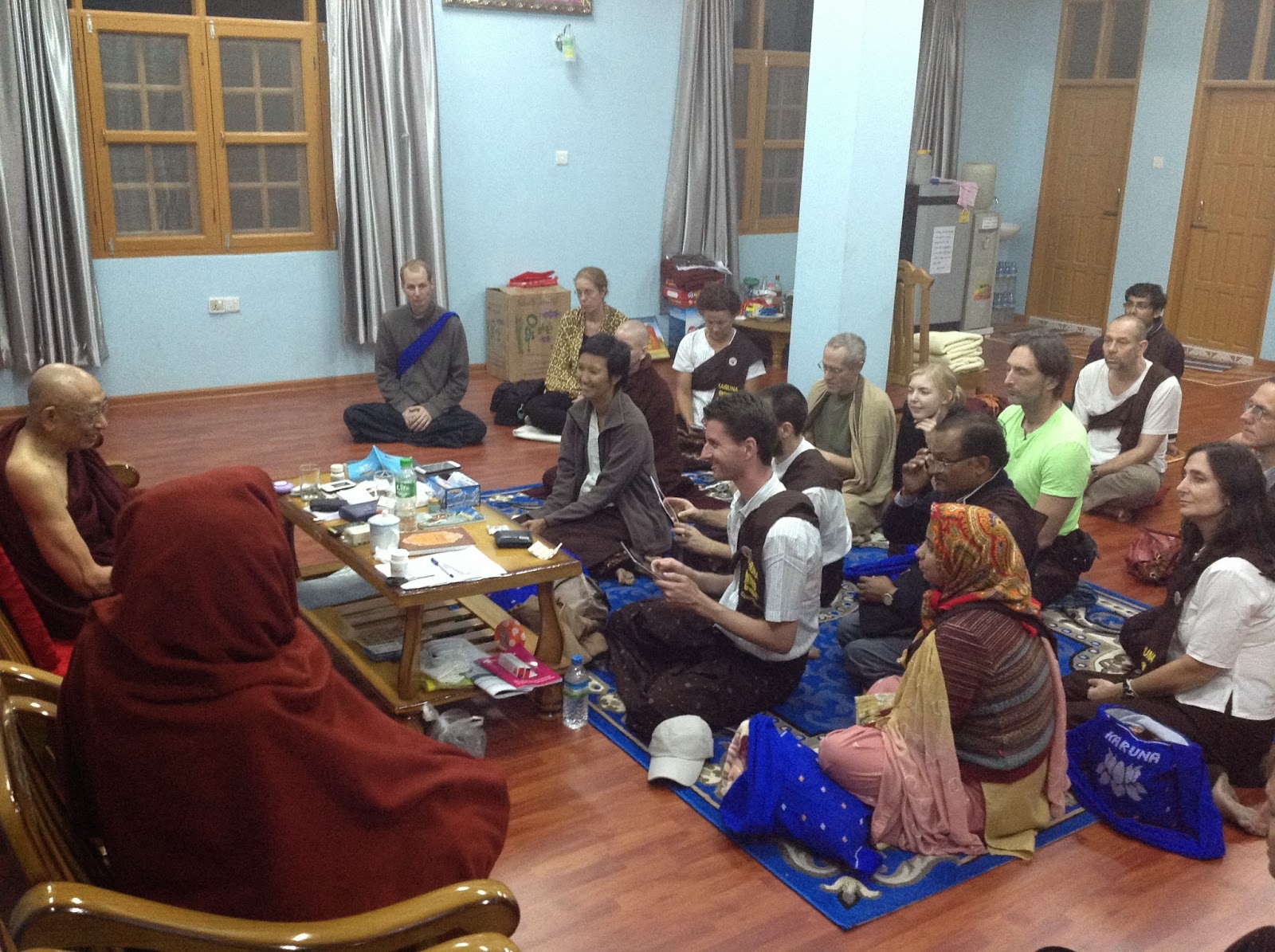
In the afternoon, Russell, a New Zealander from our group, joined the noble order of bhikkhus, becoming U Sasana. He was the second foreigner to ever ordain in the same sima hall as Webu Sayadaw. It was a very touching moment to watch him enter into a new phase of life, even if it is for just a couple of weeks. U Agga refers to the robes as meditation armour.

For me, and a few others who saw Russell through the process and prepared a private hut for him to live in, the day ended with a fantastically concentrated meditation in Webu's nibbana kuti whose spiritual charge is difficult to match. If concentration was always that easy..."


For Day 12 see here. The following photos show the transformation from the layman Russell Quinn to the monk U Sassana (the New Zealander later wrote extensively about his experience in robes, and his very inspiring words can be read by all)...


Lather is added to the hair
The shaving begins. The hair was later placed below the very tree where Webu Sayadaw also placed U Ba Khin's hair during his ten days in robes

Local villagers watch spellbound as the ordination continues

The final shaving is complete
Opening formalities to become a samanera

Paying respects

A European monk kindly helps to show the wearing of robes to this new monk

The samanera process is complete, with full bhikkhu ordination awaiting


Sunday, 5 January 2014

Burma Day 6: A Day in Mandalay

As foreign yogis meditate at Maha Muni Pagoda, a monk silently records them with his video camera

For Day 5, see here! Kory Goldberg continues his Burma pilgrimage journal for the full day experience in Mandalay, writing about the Pariyatti yatraYou can also consider joining a later pilgrimage in Burma yourself.

"Group yoga on a rooftop as the sun rises is a wonderful way to begin a day. Our morning meditation at the sacred Maha Myat Muni Pagoda was a real blessing. The living Buddha, or the Buddha surrounded by life, inspires millions of pilgrims to lead a life dedicated and devoted to Dhamma. As always, the local Burmese were delighted to see our group engaging with their culture in a meaningful way. Our time at the pagoda was an engagement both sacred and profane as we practiced mindfulness while sitting, standing, listening to the Venerable Snowadaw explain the site and answer our questions, and shopping for gongs. We came across a pre-ordination ceremony with young children dressed as royal princes. The ages of the children varied, some around twelve or thirteen, others around three or four, forcing some of us to question the intelligence and motivation for ordaining a child still not weened from mother's milk. The land of infinite wisdom doesn't exist in isolation from ignorance and greed.


So happy were the Burmese to see the yatra group that they politely requested a photo with this Swedish pilgrim and German nun
A German dasa sila (Buddhist nun) joined our group for the day, inspiring many, especially those in our group who flirt with the idea of living a monastic life. For those seriously donning the noble robe, practice is continuous and holistic. once again energies shifted as our next stops, although brief, were visits to factories and emporiums. while interesting to see the country's finest handicrafts, the visits were a bit of an energy drain and a distraction from the meditative attitude that we are/were in the process of cultivating.


At a handicrafts store of traditional Burmese wares


Ma Khaing, a long-time friend to many Western Vipassana yogis the last dozen years or so, displayed typical Burmese hospitality by cooking us a sumptuous homecooked pure vegetarian meal. the food was infused with love and the group unanimously agreed that it was the best meal so far, although we seem to hear these superlatives on a daily basis. at the end of the meal a few of us expressed our gratitude and appreciation for Ma Khaing's generosity, and one of us offered her a maple leaf shaped bottle of Canadian maple syrup. She was delighted, less so for receiving a nice gift and a series of compliments and more so from the joy that arises from giving yourself over to others. A common Burmese spirit unsurpassed by any other culture in the world.


Four foreign pilgrims take time out for a photo outside of Dhamma Mandapa

Bamaw Monastery, which allowed the U Goenka organization to establish a center on its monastic compound, the first in the Mandalay region. The architecture of this old monastery is only found in Upper Burma, and one of the few teakwood buildings to survive the bombings and fires of World War II

After lunch we briefly walked off our lunch at the Bamaw Monastery, whose rustic building is constructed from teak and carved with elaborate floral patterns and Buddhist imagery. The generous Bamaw Sayadaw allowed Goenkaji's Mandalay students to construct a centre on his land. Even though the Sayadaw's tradition has no connection to Goenkaji's lineage, the selfless monk shared his property simply out of appreciation for Goenkaji's ability to teach people from all walks of life. meditating at Dhamma Mandapa and again next door at the Mahabodhi Vipassana Yogi Meditation Centre founded by Saya Theingyi (a student of Saya Thetgyi) wad restful and nourishing, allowing many to reorient themselves in Burma's extensive and complicated Buddhist matrix. ven. Karunika Bivantha, the Sayadaw now in charge of the Mahabodhi centre, is not only a master meditator but a great scholar who has authored several books on the Abhidhamma. Like many of the Sayadaws we have met so far, this wiry and radiant scholar-monk emphasized the importance of paying attention to the four elements as an object of meditation. However, unlike the the others, he connected this contemplation to the awareness of the arising and passing away of vedana, demonstrating a profound and intimate personal experience of the meditative life, as well his relationship to Ledi Sayadaw and Saya Thetgyi. (For a short excerpt of the Sayadaw's talk on the Four Elements, see here)


The Sayadaw at Maha Bodhi Monastery smiles during a Question and Answer with foreign yogis
A Russian pilgrim stands in reverence before the Maha Bodhi temple at the center established by Saya Thet Gyi's student, Saya Thein

While the day was certainly filled with great moments, I also felt that the wounds from the inner battles were also revealing themselves for a number of people in the group. Most of us were tired and wanted to go back to the hotel. However there was one last stop of the day (actually many but it was getting dark and we needed to cancel a few stops on the itinerary). The Shwegyin Monastery is renowned for its monks who strictly adhere to the vinaya. As the monks chanted their evening prayers in their magnificent teak temple, we sat outside on the large veranda. After some time, One of the elder monks approached Snow, wondering who this curious bunch of foreigners were. Finding out that we were students of Goenkaji, he ushered us into another building where there sat one of the most illuminated old monks any of us had ever seen before. We were pleasantly surprised to discover that this old bhikkhu exuding love and light was a senior teacher under Goenkaji. Dr. Khin Maung Aye, the 82-year old bhikkhu, was a living example of what we all strove to be in one way or another. Not necessarily a monk in robes (although he did suggest that we all give it a try sometime, even for just a few days, since the spiritual benefits of doing so are immeasurable), but a stress-less, caring, bundle of joy. the constant giggles of this Dalai Lama/yoda-like figure was concrete proof of what this path can do and provided us all a brief moment that will be cherished for the rest of our lives."


For Day 7, go here!

Dr. Khin Maung Aye, a senior AT in the Goenka tradition, spoke to the pilgrims during a visit to Shwe Kyin Monastery 

U Thuttivara, seated to the left and the presiding Sayadaw at Shwe Kyin Monastery, provided an inspiring end to an already full dhammic day

Pilgrims are all smiles when listening to the deep wisdom of these two great monks at Shwe Kyin Monastery

Friday, 30 August 2013

Shwe Lan Excerpt: Laphet

In this excerpt from the book, we pick up an entry from our FOOD chapter. Following is a short piece about the place of Laphet in Burmese society:
---


“Tea is believed by some to be a gift of the gods. It is an essential item in propitiating nats or spirits. It also, along with a quid of betel, forms part and parcel of ceremonial offerings in Buddhist rituals as well as on ceremonial occasions such as weddings, novitiation ceremonies, ear-boring ceremonies. In courts of Myanmar kings, parties to a dispute ate pickled tea together before the judge as a token of having reached settlement. The losing party paid what is known as Kwan-bo, literally 'the price of betel' to the judge. A special officer collected these fees. He was called a Kwan-bo-htein, literally ‘officer in charge of kwan-bo, the old counterpart of court fees.’ ” U Tin U, Myanmar Memorabilia

Pickled Tea Leaf Salad (Lahpet): Pickled or fermented tea is arguably the most important dish in Burmese cuisine. No doubt you will encounter it frequently in your travels, as it is a common snack to offer guests.

Although laphet refers only to the pickled green tea leaves, it is almost never served alone. Often presented in a lacquer bowl, laphet comes surrounded by various condiments, including peanuts, toasted sesame, dried shrimp, fried peas, roasted beans, tomatoes, and shredded ginger. Another popular version is laphet mixed with the above condiments, and served like a salad with fresh tomatoes, garlic, chilies and other vegetables. It can also be mixed with rice to give flavor and sustenance.

In the traditional method, after the tea leaves are picked, they are steamed and then mashed by hand on bamboo platforms. The mashed tea is then placed in a large hole in the ground that has been lined with bamboo and fresh tree leaves. After being spread evenly and tamped down hard, a heavy wooden lid is placed on top, with large stones added to increase the weight. Most tea in Myanmar comes from Shan State, to be used for laphet as well as drunk with hot water.

Laphet is sold in bulk in the markets, often with sealed packets of the proper condiments, and is perfect for taking home as a gift or for your own consumption. Though it is fermented, laphet does not have a strong taste, and the fact that it comes drizzled with sesame oil and mixed with salty, crunchy peanuts and peas makes it quite an appealing snack. While laphet can be enjoyed as a tasty snack to share between friends or guests, it is also frequently offered in formal ceremonies. In times past, the parties of a lawsuit would share laphet to symbolize the end of the dispute. Some students favor them when studying late into the night as it is known to be high in caffeine as well. Packets of laphet used to be handed out to announce a couple's betrothal, and served as quasi-wedding invitations. If a man is embarrassed to express himself, sending a tea packet will gently get the message across. As the Burmese saying goes: Lu ma daq thaw ley, leq peq thout daq. “If the man doesn’t know how to do it, the tea packet does.” Indeed, no Burmese ceremony or celebration, whether religious or secular, would be complete without plenty of laphet.

J. George Scott even notes the use of lahpet in helping one to change their name. In The Burman, he writes: “Sometimes when a boy grows up he does not like the name his parents gave him. He can then change it by a very simple process. He makes up a number of packets of le'-pet and sends round a friend to deliver them to all his acquaintances and relations. The messenger goes to the head of the house and says: ‘I have come from Maung Shwe Pyin (Mr. Golden Stupid). He is not to be called by that name any more. When you invite him call him Maung Hkyaw Hpe (Mr. Celebrated Father). Be good enough to eat this pickled tea.’ ”

A villager in the Shan Hills

Thursday, 29 August 2013

Western Ordinations


In the section in Shwe Lan Ga Lay where we write about those Westerners who choose to take robes, we present the following quotation to introduce the chapter:

“The peace and quiet ate into me very bones, and I took on the yellow robe. The rest and the holy life tamed me and did my soul good.” B.M. Croker, The Road To Mandalay (1917), words spoken by an Irish soldier turned Burmese monk


Two monks at Dhamma Sukha Meditation Center, Shwe Oo Min Monastery, Yangon