Showing posts with label Dhamma Joti. Show all posts
Showing posts with label Dhamma Joti. Show all posts
Wednesday, 17 September 2014
Scattering of Goenkaji's ashes on the Ayeyarwady River
Nearly one year ago, the great lay meditation teacher S.N. Goenka passed away, as various posts in this blog shared at the time. Although Sayagyi U Goenka passed away in India, it was his final wish that his remains be returned to the land of his birth, Burma. The above video shows how his ashes were prepared in Dhamma Joti, the main U Goenka center in Myanmar. Excerpts from Dhamma speeches made at the center are partially translated, and the journey from the airport to the center and then the precious Ayeyarwaddy River are also shown in this video.
Many local meditators and monks gathered for this occasions, as many will do around the world in the coming months when the one year anniversary of his death approaches, and people will meditate and give Sangha Dana in his memory.

Monday, 10 March 2014
"The Beauty of Burmese Life is Hard to Qualify."
 |
| Pilgrims listen to a dhamma talk by monks in Sain Pyin Gyi, the small village where Ledi Sayadaw was born. |
The following essay was written by Branden Macie, an American pilgrim who attended the recent Pariyatti pilgrimage in Burma (and is at present moment sitting a Satipattana course at Dhamma Joti!). The original piece can be found on the Living Vipassana website. To read more about the pilgrimages, see here. To learn about current pilgrimage offerings, see here.
"From January 2012 to March 2012 a nickel of wisdom arose in me while serving long-term at Dhamma Patapa in Jesup, Georgia, U.S.A. I was there to strengthen my individual walk in Dhamma and to share my merits with others who came for meditation alongside other meditators who wanted to apply the technique in daily life-like scenarios. At the time of my stay, I jumped into study (pariyatti) to gain a view of the context of Vipassana being taught there at the Center. Zipping through books with the lightning evaluation capacity which comes with strong concentration episodes, the texts chronicling the lineage of the Vipassana tradition appealed to me most.
One particular book which wedged a great impression in me was the Sayagyi U Ba Khin Journal where details unrelated to the teaching of the typical 10-day courses tested and touched my faithful side, enlivening my understanding of this Path. Leaving the center and maintaining the practice for years following that service period, heavy dreams of pilgrimaging within Burma made their eruption into my conscious stream over and over. Then, Burmese folks I’d meet would lift up those dreams further by inviting me to Dhamma related outings, studies unrelated to the language and practice Goenkaji’s teaching.
For the a long while a needle of uncertainty was lodged into my mind about living Dhamma through different techniques and actions than were known to me through the 10-day retreat center’s presentation. I held on so closely, so personally. The conditioning I’d developed was strong and a barrier to outside Dhamma works, events, and representations of ‘Dhamma’ began to form — I felt a bit off the mark even knowing the Buddha’s Liberation Teachings were specific to each individual. The attachment had to be let go of.
Navigating those walls, the concepts, the emotions they arose became easier with continued acceptance that Buddha’s Dhamma can’t only fit one categorization of language and practice. More important the Real Time at each individual’s mental level, efforts, and energies is where Dhamma exists and that’s gladdening.
Therefore, seeing Burma and the way the society has structured itself while noticing my own inner pilgrimage along the way helped me realize the vastness of walking toward liberation — all the efforts one CAN make for others (regardless of tradition). When one’s mind is settled into the heart of Right Intention much can be shared.
The beauty of Burmese life is hard to qualify. Learning of enlightened Arahats, even ones so recently passed away who revealed their attainments through body relics, were Great teachers of the Dhamma in their own special ways for the Burmese locals. The amount of devotion and merit gaining on a daily level in Burma is astoundingly high. One can go from Alms round serving monks to Pagodas for paying respects to Sayadaws and end the evening with a Dhamma talk on the Abidhamma or any of the hundreds of Suttas contained in the Tipitaka.
 |
| Pilgrims arrive at Thanboddhay Monastery, established by Mohnyin Sayadaw, a disciple of Ledi Sayadaw. Thousands of Burmese were sheltered here during World War II and learned meditation during this time. When the pilgrims arrived, dozens of Burmese college students were there for meditation and devotion. |
Here’s a quote by Harold Fielding from Soul of a People to end on:
“To hear of the Buddha from living lips in this country [Burma], which is full of his influence, where the spire of his monastery marks every village, and where every man has at one time or another been his monk, is quite a different thing to reading of him in far countries, under other skies and swayed by other thoughts. To sit in the monastery garden in the dusk, in just such a tropic dusk as He taught in so many years ago, and hearing the yellow-robed monk tell of that life, and repeat His teaching of love, charity, and compassion — eternal love, perfect charity, endless compassion — until the stars come out in the purple sky, and the silver-voiced gongs ring for evening prayers, is a thing never to be forgotten. As you watch the starlight die and the far-off hills fade into the night, as the sounds about you still, and the calm silence of the summer night falls over the whole earth, you know and understand the teacher of the Great Peace as no words can tell you. A sympathy comes to you from the circle of believers, and you believe, too. An influence and an understanding breathes from the nature about you — the same nature that the teacher saw — from the whispering fig-trees and the scented champaks, and the dimly seen statues in the shadows of the shrines, that you can never gain elsewhere. And as the monks tell you the story of that great life, they bring it home to you with reflection and comment that has application to your everyday existence.”
 |
| Two pilgrims relax at the base of a pagoda stupa |
Saturday, 8 February 2014
Burma Yatra #2, Day 2: Saya Thet Gyi Day
 |
| The scenes of the rural Dalla harbor just after the group has arrived, crossing the same river as Sayagyi U Ba Khin did many years ago. The buildings of Yangon are visible from across the water. |
The following excerpt was written by an American yogi about the pilgrimage in Burma. The first pilgrimage has ended, and the second one has just begun! (To see and compare Day #2 of the first yatra, see here.
You can also consider joining a later pilgrimage in Burma yourself.
Getting a group of us tickets, boarded, and disembarked is no easy feat. It says volumes about the organizers that this was all taken care of, mostly behind the scenes. Once we arrived at the other side, a small bus was arranged to continue the journey.
 |
| The group arrives in Dalla |
Once we left the ferry terminal, the landscape and feel changed dramatically. Against a mostly flat, stark landscape there were small clusters of trees, with an occasional thatched home nearby.
 |
| A typical scene that the group sees from its ride from Dalla to Pyaw Bwe Gyi. Saya Thet Gyi's family was once responsible for 1,000 acres of rice fields, and one still finds such agricultural activity in the area today. |
The first stop was to the Saya Thet Gyi's first meditation sala. After hearing about Saya Thet Gyi's story (especially moving when one sees the joy and pride radiating from Snow's face in the recounting of this familiar tale...), we sat for an hour in the spot where it is believed that Saya Thet Gyi reached some of his attainments. Very strong...
 |
| A dog pauses in the walkway leading to Saya Thet Gyi's center |
The group then moved to the second sala. There were beautiful paintings on the walls that, as with the rest of the building, had seen some better days. The last place we went to was Anauk Monastery, a monastery where Saya Thet Gyi taught from for a brief period of time.
 |
| The greeting party at Anauk Monastery, a site where Saya Thet Gyi taught for two years |
 |
| The bus parks in a field outside Anauk Monastery, the field looking similar to what one may have found even in Saya Thet Gyi's time. The lay meditation master himself preferred this site for its quiet and distance from the main town area. |
Aside #2: There's a sense of a protective bubble around us, woven by all those involved in our care. The support from them is palpable. The motocoach assistant, for example, has walked into Yangon traffic (no small feat in any Asian country!) to herd us through. How fortunate we are!"
See here for Day 3!
Sunday, 5 January 2014
The Last Journey of S.N. Goenka
The Radiant Journey of a Most Compassionate, Most Revered Dhamma Being Global Pagoda Dhamma Service
The following is text of article ' The Radiant Journey of Padma Bhushan Global Vipassana Acharya Shri Satya Narayan Goenka'
Vipassana Research Institute newsletter, English edition, October 18, 2013:
Original article in Hindi Vipassana Patrika
"The Most Venerable Teacher Shri Goenkaji passed away peacefully at the age of 90 at his residence in Mumbai on 29th September 2013 at 10:40 PM. He remained active, aware and peaceful till his last moment. Even on the last day of his life, his daily routine remained the same without any difficulty.
Many people came to meet Venerable Goenkaji during the month and interacted with him on the Dhamma. Apart from prominent students, Deputy Minister of Religion and Culture in Myanmar, Mr. U Soe Win, paid a visit to Goenkaji at his residence along with four Burmese Monks. A meeting of “Global Vipassana Foundation Trust” was held in the presence of Venerable Goenkaji. Mr. Surinder Kumar Singh (IPS), DG of Home Guards and also Dr. Sukhdeo Soni, a student of Vipassana from America came to meet Venerable Goenkaji.
He cleared many of his important writing works. He guided selection of 500 couplets each in Hindi and Rajasthani written in his diaries and notebooks. He made necessary corrections and instructed to append them in the future editions of the books on couplets.
From the last ten days, every day until the morning of 29th September, Sangha Dana was being organized by daughter-in-law Naina at the residence of Venerable Goenkaji where Mataji herself was giving dana to the Sangha. During these days, Venerable Goenkaji also met the monks on several occasions and gave his Metta to the student monks.
At breakfast time on 29th September, Venerable Goenkaji enquired from Shriprakash about the working of the Pagoda. In response, he replied that that day being Sunday, he would be going to the Pagoda and on return he would report everything.
On 29th September while taking lunch, Venerable Goenkaji mentioned to Ven. Mataji, Sons Shyambihari and Shriprakash, sitting nearby, “Today I have given leave to the Doctors.” At that time the statement did not sound solemn to any of them. But since morning itself, it seemed as if he had decided to leave the body on that day. Therefore, most of the time, he remained confined to himself. In the night when his corporeal body became free from all medication, the meaning of his above statement was perceived by all as a form of the early indication.
In the evening after taking tea, he went through the important headlines of the newspapers. Afterwards he meditated while sitting on the chair in the room. He came to the table for dinner after 9:00 PM. Usually, after dinner, Venerable Goenkaji would ask Sriprakash about the day’s news and discuss with him the issues pertaining to Vipassana and the Centers. But today he did not talk and went straight to his room.
He remained seated in the room for some time. Then he sought help to lie down on the bed. Immediately after lying down the process of leaving the body began to take place. The breathing became faster for some time. On seeing this, Venerable Mataji called the Son, Shriprakash, and Daughter-in-law, Naina. As soon as they reached, they summoned the Doctors. The Doctor, who was residing in the same building, called for the ambulance and also requested necessary preparation in the hospital. But before the family Doctor could arrive, the situation had become critical. He indicated that the ambulance services would be of no use then. By the time the ambulance comes, we will not be in a position to shift him there. And, indeed, in a short while, after the check up, he informed that the heart had stopped beating. But there was no sign of pain or stress on the face of Venerable Goenkaji. As he has instructed the people throughout his life to learn the art of living and dying, on those very same lines, he left his body like an ideal saintly lay person.
The atmosphere was filled with a serene calmness. Nobody was able to believe that he had left this world forever. No sound of crying or grief was uttered by anybody. Prior to this, whenever he was in great pain, often tears rolled down the face of Venerable Mataji. But now the state of mind of Mataji was so inspiringly equanimous and peaceful that it was hard to believe. By observing her, one could see the greatness of Dhamma and how it helps in difficult times.
When the news was given to the few, it spread in the city of Mumbai, and thereafter the news spread like fire in the whole world. From that instant in the night, the telephone bells started ringing and the people started pouring. Many of the family members were in foreign countries. It was natural that they would take more than 24 hours’ time to reach here. Therefore, a decision was taken that his body would be kept at the residence itself in a glass case with auto-freezer and the funeral rites would be completed by afternoon on 1st October. Throughout the day people kept pouring (in thousands) to express their condolence and giving way to others.
At 10:00 PM in the night itself, about five hundred people were standing on the road in a queue outside the building. Some of those who came from far away distances stayed in a tent for the whole night. The rest were requested to come in the morning. Again in the morning from 7:00 AM onwards on 1st October, people started thronging the place. There were long queues of visitors till 10:15 AM. At 10:15 AM, his corporeal body was brought down and people formed a queue and paid their respects till 11:30 AM.
The Government of Maharashtra declared to bid farewell to Venerable Goenkaji with full State honors.Accordingly, an armed police squad in a special turnout was sent. The corporeal body of Venerable Goenkaji was wrapped in a National Flag. As the band played, the squad paid tribute by raising their rifles in unison and firing shots. The police squad accompanied the funeral procession of Venerable Goenkaji up to the cremation ground and after the funeral rites were over once again fired shorts in tribute to the departed. The government had made extensive police arrangements. Some voluntary organizations helped in clearing the 5-6 km long path leading to the cremation ground. The procession was led by some monks while people in thousands followed the procession peacefully in queues to pay their last respects up to the Electric Funeral Ground near Oshivara, Jogeshwari (West). The National Flag brought for paying State Honor was handed over by the Police Squad to the family members to keep alive the memories of Venerable Goenkaji forever.
The Urn containing his Relics reached “Global Vipassana Pagoda” in the evening on 1st October. At the moment when the vehicle stopped at the main gate, the rains started pouring. It was as if the Parjanyadev (the Rain God) and other Samyak dev (Righteous deities) were waiting in eagerness to welcome him in advance.
On 2nd October, a meeting of acquaintances and relatives was organized at Jalaram Hall, Juhu Scheme in the evening from 4 to 7:00 PM. Here also people in hundreds paid their last respects. It was published in the newspapers on 2nd October that on 6th October, the students would pay homage through the group sitting in the main meditation hall of the Pagoda.
On 6th October people came from far off places to participate in this. As usual Venerable Mataji sat in the centre of the hall and the Urn containing the Relics was placed nearby in front of a photograph of Venerable Goenkaji. About five thousand students along with thousands of meditators paid their respects. Thereafter the Relics were carried to Myanmar.
Venerable Goenkaji desired that his remains should be carried to the land of his birth, Myanmar and there consigned in the waters of Irrawaddy River. Therefore, the five Sons of Venerable Goenkaji Mr. Banwarilal, Mr. Murarilal, Mr. Shyambihari, Mr. Shriprakash, Mr. Jaiprakash and three Grandsons along with some other family members set off to Myanmar on 6th October carrying the Relics. The eldest Son Mr. Girdhalalji could not go to Myanmar owing to his ill health. However, he was present in all the programmes held in Mumbai. The flight from Mumbai to Bangkok took off at about 01:30 am on 7th October towards Myanmar. The next flight to Yangon (Myanmar) was to take off from the Bangkok airport after a gap of two and a half hours’ time.
The number of Vipassana students in Thailand is quite large as there are nine Vipassana Centers. They booked two rooms in the lounge itself with the help of the Government and the Airport authorities and made arrangements for paying homage. About 20 people walked up to the door of the airplane with the permission of the officers and gave a warm welcome to the people carrying the Relics.They wanted to take VISA, but the Officers gave them permission to reach the Lounge outside the Airport after keeping passport in their custody. The Urn containing the Relics was placed on the podium with a large photograph of Venerable Goenkaji and decorated with white lotus flowers. In spite of the incessant rains pouring throughout the night, hundreds of students assembled there. For one hour, every one of them, as per his or her turn, paid homage to Shri Goenkaji and expressed gratitude. An exceptional thing happened when the airplane touched the land: the rains which had poured incessantly throughout the night had stopped, thereby providing relief to the people.
A grand welcome was given to the arrival of the Relics at Yangon Airport in the morning of 7th October. The Urn containing the Relics was carried to the Dhamma- Joti (the first Vipassana Centre) in a special vehicle. There are twenty Vipassana Centers in Myanmar along with a great number of meditators. Everyone had been eagerly waiting for the Relics. The Urn was placed on the already decorated podium and the students paid their respects in a queue.
In the night on 7th October, tremors of an earthquake (rector 3.1) were felt at 02:27 AM. This was considered as an indication of his final welcome by nature in the Birth Place of Venerable Goenkaji. In June 1969 when Venerable Goenkaji arrived in India from Burma, at that moment also tremors of light intensity were felt in India.
In the morning at 9:00 AM on 8th October, Sanghadana was performed at the Goenka-Residence in Myanmar and 90 monks were given donations. Thereafter at 11:00 AM, the Asthi-Kalash (the Urn containing the ashes) was carried from Dhamma-Joti to Botataung Jetti. There, the Sons and Grandsons of Venerable Goenkaji reached the middle of the Yangon River (Irrawaddy) on a special motor-boat and consigned some part of the Relics. Coincidentally, 56 prisoners were released at the same time by the Burmese Government. The Ashti-Kalash was brought back and placed at the Dhamma-joti.
On the same day in the evening, a meeting was organized at the Ball-room of Hotel Royal Park from 3:00 to 5:00 PM where the relatives, acquaintances and Vipassana meditators living in Myanmar paid their homage and expressed their gratitude.
On 9th October the Ashti-Kalash was carried from Dhamma-Joti. The Relics were taken to Myitkyina on a plane from Yangon. After getting down from the plane, a part of the ashes was consigned at the Irrawaddy River in Myitkyina (the starting point of the River). As per the routine, the same flight was to return after half an hour period of stay. The people accompanying the Ashthi- Kalash were required to return to Mandalay on the same day. However, there was no other flight available. So, the same airplane waited for them for about two and half hours (instead of returning after half an hour). Thus they could return to Mandalay the same day, and the Ashti- Kalash was placed at the Vipassana Center, Dhamma Mandala so that the people could pay their respects.
In the evening, the reputed Monk of Myanmar, Venerable U Nyanissara (Thidagu Sayadaw). chalked out the next day’s program and explained it to everyone. The Chief Minister of Mandalay, the Minister of Religion and Culture in the Burmese Government, and the Police Commissioner of Mandalay reached there the same evening. They checked the whole program and approved it. They instructed their officers to work as per the wishes of Venerable Bhanteji.
A Programme of Sanghadana (Donation to the Sangha) was held in the morning of 10th October at 9:00 AM. Venerable U Nyanissara ji gave a long discourse in Burmese language about Rev. Goenkaji after the initial chanting. (It will be published in future after its translation is completed.) Then food was served to the visitors assembled in large numbers. Thereafter, prior to the start of the journey, Venerable U Nyanissara ji instructed all the Monks to recite the following Pali verse continuously from the beginning of the journey to the end, the meaning of which is also given below:
Anicca vata sankhara, uppada vaya dhammino;
uppajjitva nirujjhanti, tesam upasamo sukho.– Dighanikayo 2.221, Mahaparinibbanasuttam
Truly all conditioned things are impermanent. All the conditioned, things, individuals which arise are impermanent. Arising and passing away is their inherent nature (dhamma), their inherent characteristic. When this phenomena of constant arising and passing away is extinguished completely by the practice of the Vipassana meditation – the cycle of repeated arising stops, this is known as the ultimate happiness, the ultimate bliss of Nibbana.
In this way, with the royal paraphernalia and honor the procession began in the late afternoon. The Asthi- Kalash was placed on a special vehicle prepared in the shape of golden colored swan. This was followed by the vehicles of the Goenka family. Thereafter, followed the Monks and Nuns and the Vipassana Teachers. Then the Media and at the end were the vehicles of all other people. At the time of the program finalization, the number of vehicles present was only 69, but when the journey commenced, there were 300 vehicles.
The procession took around 1.5 to 2 hours to reach the banks of Ayeyarwady River at the Panmadee Jetti. Five specially decorated large motor-boats were arranged at the bank. The family members along with the Asthi-Kalash and the Vipassana Teachers boarded the first boat, Monks boarded the second, Nuns the third, the media people occupied the fourth, and the students and others boarded the fifth boat. The fleet of boats went to the middle of the River to consign the ashes. At the time of the immersion, darkness began to set in. The Government had banned entry of other boats and ships in that area from 12:00 Noon to 7:00 PM.
The fleet of boats circling the water made a round shape and all in consonance floated one thousand lamps with lighted candles in the River. This magnificent sight became more majestic when these lamps enwrapped in colored covers began to float over the waves while moving and dispersing all over the River. It looked as if the deities of the higher abodes were swinging with happiness. Various types of fireworks were displayed creating an extraordinary sight in the water, over the and in the sky.
At the conclusion, Venerable U Nyanissaraji said that neither such a magnificent welcome was ever organized for anyone nor is there any chance of bidding such a farewell to anyone in the times to come. Venerable U Nyanissaraji also said that the flow of Dhamma which was carried by U Goenka from the banks of Irrawaddy to India in 1969 has come back in 2013 as the Asthi- Kalash to get merged with the River. However, the work of spreading the dhamma all around the world will continue. Everyone stayed in Mandalay in the night.
On the morning of 11th October, the members of the Goenka family returned to Rangoon from Mandalay in an airplane and on the same day boarded a flight via Bangkok in the evening and reached their residence in Mumbai at about 2:00 AM in the night. The Monks were invited on the morning of 12th October and Sanghadana (donation to the Sangha) was performed. Entire family members and relatives were present on this occasion. Everyone was extremely happy to join in the Sanghadana ceremony. Sanghadana was also organized on the 13th. Thus, farewell was given to the lay saint who showed the world the way to experience the pure dhamma through Vipassana meditation.
Venerable Goenkaji may have gone away from us as far as his physical body is concerned, but his body of Dhamma, his voice, his heritage filled with wisdom will forever remain with us. Now it is our duty to make this invaluable technique part of our life and help more and more people to gain benefit from it. By living the life of Dhamma, mutual cordiality will prevail and we will become helpful in the welfare of others also. When we all come together to achieve the aim of our beloved Venerable Goenkaji, of spreading the Dhamma, only then will it be a true tribute to him. This will lead to our own true welfare and the Dhamma will truly benefit us.
Bhavatu Sabba Mangalam!
May all beings be happy!"
The following is text of article ' The Radiant Journey of Padma Bhushan Global Vipassana Acharya Shri Satya Narayan Goenka'
Vipassana Research Institute newsletter, English edition, October 18, 2013:
Original article in Hindi Vipassana Patrika
"The Most Venerable Teacher Shri Goenkaji passed away peacefully at the age of 90 at his residence in Mumbai on 29th September 2013 at 10:40 PM. He remained active, aware and peaceful till his last moment. Even on the last day of his life, his daily routine remained the same without any difficulty.
Many people came to meet Venerable Goenkaji during the month and interacted with him on the Dhamma. Apart from prominent students, Deputy Minister of Religion and Culture in Myanmar, Mr. U Soe Win, paid a visit to Goenkaji at his residence along with four Burmese Monks. A meeting of “Global Vipassana Foundation Trust” was held in the presence of Venerable Goenkaji. Mr. Surinder Kumar Singh (IPS), DG of Home Guards and also Dr. Sukhdeo Soni, a student of Vipassana from America came to meet Venerable Goenkaji.
He cleared many of his important writing works. He guided selection of 500 couplets each in Hindi and Rajasthani written in his diaries and notebooks. He made necessary corrections and instructed to append them in the future editions of the books on couplets.
From the last ten days, every day until the morning of 29th September, Sangha Dana was being organized by daughter-in-law Naina at the residence of Venerable Goenkaji where Mataji herself was giving dana to the Sangha. During these days, Venerable Goenkaji also met the monks on several occasions and gave his Metta to the student monks.
At breakfast time on 29th September, Venerable Goenkaji enquired from Shriprakash about the working of the Pagoda. In response, he replied that that day being Sunday, he would be going to the Pagoda and on return he would report everything.
On 29th September while taking lunch, Venerable Goenkaji mentioned to Ven. Mataji, Sons Shyambihari and Shriprakash, sitting nearby, “Today I have given leave to the Doctors.” At that time the statement did not sound solemn to any of them. But since morning itself, it seemed as if he had decided to leave the body on that day. Therefore, most of the time, he remained confined to himself. In the night when his corporeal body became free from all medication, the meaning of his above statement was perceived by all as a form of the early indication.
In the evening after taking tea, he went through the important headlines of the newspapers. Afterwards he meditated while sitting on the chair in the room. He came to the table for dinner after 9:00 PM. Usually, after dinner, Venerable Goenkaji would ask Sriprakash about the day’s news and discuss with him the issues pertaining to Vipassana and the Centers. But today he did not talk and went straight to his room.
He remained seated in the room for some time. Then he sought help to lie down on the bed. Immediately after lying down the process of leaving the body began to take place. The breathing became faster for some time. On seeing this, Venerable Mataji called the Son, Shriprakash, and Daughter-in-law, Naina. As soon as they reached, they summoned the Doctors. The Doctor, who was residing in the same building, called for the ambulance and also requested necessary preparation in the hospital. But before the family Doctor could arrive, the situation had become critical. He indicated that the ambulance services would be of no use then. By the time the ambulance comes, we will not be in a position to shift him there. And, indeed, in a short while, after the check up, he informed that the heart had stopped beating. But there was no sign of pain or stress on the face of Venerable Goenkaji. As he has instructed the people throughout his life to learn the art of living and dying, on those very same lines, he left his body like an ideal saintly lay person.
The atmosphere was filled with a serene calmness. Nobody was able to believe that he had left this world forever. No sound of crying or grief was uttered by anybody. Prior to this, whenever he was in great pain, often tears rolled down the face of Venerable Mataji. But now the state of mind of Mataji was so inspiringly equanimous and peaceful that it was hard to believe. By observing her, one could see the greatness of Dhamma and how it helps in difficult times.
When the news was given to the few, it spread in the city of Mumbai, and thereafter the news spread like fire in the whole world. From that instant in the night, the telephone bells started ringing and the people started pouring. Many of the family members were in foreign countries. It was natural that they would take more than 24 hours’ time to reach here. Therefore, a decision was taken that his body would be kept at the residence itself in a glass case with auto-freezer and the funeral rites would be completed by afternoon on 1st October. Throughout the day people kept pouring (in thousands) to express their condolence and giving way to others.
At 10:00 PM in the night itself, about five hundred people were standing on the road in a queue outside the building. Some of those who came from far away distances stayed in a tent for the whole night. The rest were requested to come in the morning. Again in the morning from 7:00 AM onwards on 1st October, people started thronging the place. There were long queues of visitors till 10:15 AM. At 10:15 AM, his corporeal body was brought down and people formed a queue and paid their respects till 11:30 AM.
The Government of Maharashtra declared to bid farewell to Venerable Goenkaji with full State honors.Accordingly, an armed police squad in a special turnout was sent. The corporeal body of Venerable Goenkaji was wrapped in a National Flag. As the band played, the squad paid tribute by raising their rifles in unison and firing shots. The police squad accompanied the funeral procession of Venerable Goenkaji up to the cremation ground and after the funeral rites were over once again fired shorts in tribute to the departed. The government had made extensive police arrangements. Some voluntary organizations helped in clearing the 5-6 km long path leading to the cremation ground. The procession was led by some monks while people in thousands followed the procession peacefully in queues to pay their last respects up to the Electric Funeral Ground near Oshivara, Jogeshwari (West). The National Flag brought for paying State Honor was handed over by the Police Squad to the family members to keep alive the memories of Venerable Goenkaji forever.
The Urn containing his Relics reached “Global Vipassana Pagoda” in the evening on 1st October. At the moment when the vehicle stopped at the main gate, the rains started pouring. It was as if the Parjanyadev (the Rain God) and other Samyak dev (Righteous deities) were waiting in eagerness to welcome him in advance.
On 2nd October, a meeting of acquaintances and relatives was organized at Jalaram Hall, Juhu Scheme in the evening from 4 to 7:00 PM. Here also people in hundreds paid their last respects. It was published in the newspapers on 2nd October that on 6th October, the students would pay homage through the group sitting in the main meditation hall of the Pagoda.
On 6th October people came from far off places to participate in this. As usual Venerable Mataji sat in the centre of the hall and the Urn containing the Relics was placed nearby in front of a photograph of Venerable Goenkaji. About five thousand students along with thousands of meditators paid their respects. Thereafter the Relics were carried to Myanmar.
Venerable Goenkaji desired that his remains should be carried to the land of his birth, Myanmar and there consigned in the waters of Irrawaddy River. Therefore, the five Sons of Venerable Goenkaji Mr. Banwarilal, Mr. Murarilal, Mr. Shyambihari, Mr. Shriprakash, Mr. Jaiprakash and three Grandsons along with some other family members set off to Myanmar on 6th October carrying the Relics. The eldest Son Mr. Girdhalalji could not go to Myanmar owing to his ill health. However, he was present in all the programmes held in Mumbai. The flight from Mumbai to Bangkok took off at about 01:30 am on 7th October towards Myanmar. The next flight to Yangon (Myanmar) was to take off from the Bangkok airport after a gap of two and a half hours’ time.
The number of Vipassana students in Thailand is quite large as there are nine Vipassana Centers. They booked two rooms in the lounge itself with the help of the Government and the Airport authorities and made arrangements for paying homage. About 20 people walked up to the door of the airplane with the permission of the officers and gave a warm welcome to the people carrying the Relics.They wanted to take VISA, but the Officers gave them permission to reach the Lounge outside the Airport after keeping passport in their custody. The Urn containing the Relics was placed on the podium with a large photograph of Venerable Goenkaji and decorated with white lotus flowers. In spite of the incessant rains pouring throughout the night, hundreds of students assembled there. For one hour, every one of them, as per his or her turn, paid homage to Shri Goenkaji and expressed gratitude. An exceptional thing happened when the airplane touched the land: the rains which had poured incessantly throughout the night had stopped, thereby providing relief to the people.
A grand welcome was given to the arrival of the Relics at Yangon Airport in the morning of 7th October. The Urn containing the Relics was carried to the Dhamma- Joti (the first Vipassana Centre) in a special vehicle. There are twenty Vipassana Centers in Myanmar along with a great number of meditators. Everyone had been eagerly waiting for the Relics. The Urn was placed on the already decorated podium and the students paid their respects in a queue.
In the night on 7th October, tremors of an earthquake (rector 3.1) were felt at 02:27 AM. This was considered as an indication of his final welcome by nature in the Birth Place of Venerable Goenkaji. In June 1969 when Venerable Goenkaji arrived in India from Burma, at that moment also tremors of light intensity were felt in India.
In the morning at 9:00 AM on 8th October, Sanghadana was performed at the Goenka-Residence in Myanmar and 90 monks were given donations. Thereafter at 11:00 AM, the Asthi-Kalash (the Urn containing the ashes) was carried from Dhamma-Joti to Botataung Jetti. There, the Sons and Grandsons of Venerable Goenkaji reached the middle of the Yangon River (Irrawaddy) on a special motor-boat and consigned some part of the Relics. Coincidentally, 56 prisoners were released at the same time by the Burmese Government. The Ashti-Kalash was brought back and placed at the Dhamma-joti.
On the same day in the evening, a meeting was organized at the Ball-room of Hotel Royal Park from 3:00 to 5:00 PM where the relatives, acquaintances and Vipassana meditators living in Myanmar paid their homage and expressed their gratitude.
On 9th October the Ashti-Kalash was carried from Dhamma-Joti. The Relics were taken to Myitkyina on a plane from Yangon. After getting down from the plane, a part of the ashes was consigned at the Irrawaddy River in Myitkyina (the starting point of the River). As per the routine, the same flight was to return after half an hour period of stay. The people accompanying the Ashthi- Kalash were required to return to Mandalay on the same day. However, there was no other flight available. So, the same airplane waited for them for about two and half hours (instead of returning after half an hour). Thus they could return to Mandalay the same day, and the Ashti- Kalash was placed at the Vipassana Center, Dhamma Mandala so that the people could pay their respects.
In the evening, the reputed Monk of Myanmar, Venerable U Nyanissara (Thidagu Sayadaw). chalked out the next day’s program and explained it to everyone. The Chief Minister of Mandalay, the Minister of Religion and Culture in the Burmese Government, and the Police Commissioner of Mandalay reached there the same evening. They checked the whole program and approved it. They instructed their officers to work as per the wishes of Venerable Bhanteji.
A Programme of Sanghadana (Donation to the Sangha) was held in the morning of 10th October at 9:00 AM. Venerable U Nyanissara ji gave a long discourse in Burmese language about Rev. Goenkaji after the initial chanting. (It will be published in future after its translation is completed.) Then food was served to the visitors assembled in large numbers. Thereafter, prior to the start of the journey, Venerable U Nyanissara ji instructed all the Monks to recite the following Pali verse continuously from the beginning of the journey to the end, the meaning of which is also given below:
Anicca vata sankhara, uppada vaya dhammino;
uppajjitva nirujjhanti, tesam upasamo sukho.– Dighanikayo 2.221, Mahaparinibbanasuttam
Truly all conditioned things are impermanent. All the conditioned, things, individuals which arise are impermanent. Arising and passing away is their inherent nature (dhamma), their inherent characteristic. When this phenomena of constant arising and passing away is extinguished completely by the practice of the Vipassana meditation – the cycle of repeated arising stops, this is known as the ultimate happiness, the ultimate bliss of Nibbana.
In this way, with the royal paraphernalia and honor the procession began in the late afternoon. The Asthi- Kalash was placed on a special vehicle prepared in the shape of golden colored swan. This was followed by the vehicles of the Goenka family. Thereafter, followed the Monks and Nuns and the Vipassana Teachers. Then the Media and at the end were the vehicles of all other people. At the time of the program finalization, the number of vehicles present was only 69, but when the journey commenced, there were 300 vehicles.
The procession took around 1.5 to 2 hours to reach the banks of Ayeyarwady River at the Panmadee Jetti. Five specially decorated large motor-boats were arranged at the bank. The family members along with the Asthi-Kalash and the Vipassana Teachers boarded the first boat, Monks boarded the second, Nuns the third, the media people occupied the fourth, and the students and others boarded the fifth boat. The fleet of boats went to the middle of the River to consign the ashes. At the time of the immersion, darkness began to set in. The Government had banned entry of other boats and ships in that area from 12:00 Noon to 7:00 PM.
The fleet of boats circling the water made a round shape and all in consonance floated one thousand lamps with lighted candles in the River. This magnificent sight became more majestic when these lamps enwrapped in colored covers began to float over the waves while moving and dispersing all over the River. It looked as if the deities of the higher abodes were swinging with happiness. Various types of fireworks were displayed creating an extraordinary sight in the water, over the and in the sky.
At the conclusion, Venerable U Nyanissaraji said that neither such a magnificent welcome was ever organized for anyone nor is there any chance of bidding such a farewell to anyone in the times to come. Venerable U Nyanissaraji also said that the flow of Dhamma which was carried by U Goenka from the banks of Irrawaddy to India in 1969 has come back in 2013 as the Asthi- Kalash to get merged with the River. However, the work of spreading the dhamma all around the world will continue. Everyone stayed in Mandalay in the night.
On the morning of 11th October, the members of the Goenka family returned to Rangoon from Mandalay in an airplane and on the same day boarded a flight via Bangkok in the evening and reached their residence in Mumbai at about 2:00 AM in the night. The Monks were invited on the morning of 12th October and Sanghadana (donation to the Sangha) was performed. Entire family members and relatives were present on this occasion. Everyone was extremely happy to join in the Sanghadana ceremony. Sanghadana was also organized on the 13th. Thus, farewell was given to the lay saint who showed the world the way to experience the pure dhamma through Vipassana meditation.
Venerable Goenkaji may have gone away from us as far as his physical body is concerned, but his body of Dhamma, his voice, his heritage filled with wisdom will forever remain with us. Now it is our duty to make this invaluable technique part of our life and help more and more people to gain benefit from it. By living the life of Dhamma, mutual cordiality will prevail and we will become helpful in the welfare of others also. When we all come together to achieve the aim of our beloved Venerable Goenkaji, of spreading the Dhamma, only then will it be a true tribute to him. This will lead to our own true welfare and the Dhamma will truly benefit us.
Bhavatu Sabba Mangalam!
May all beings be happy!"
(To read about a Sangha Dana that took place in California one year following Sayagyi U Goenka's passing, see here).
Sunday, 29 December 2013
A Dhamma Yatra in Burma
 | |
|
 |
| The view of Shwedagon from the pilgrims' hotel |
"What a privileged life we live! Morning stretching with spectacular dawn views of Shwedagon followed by a traditional Burmese breakfast of stirfried veggies and a fruit platter. i was not alone in the joy that I felt as was clear on the faces of all my companion pilgrims in the Golden Land. our first stop was Dhamma Joti to join the local community for a group sitting in the centre's fabulously charged pagoda. Sharing a cell with three of my companions, I observed the piti arising from a sense of well-being, security and trans-national community that dominated this mind-matter structure. After the session, our group of 23 from seven different countries shared metta with the local yogis, and I was pleasantly surprised to briefly rekindle a connection I had made with a yogi from Pyaw Bwe Gyi eleven years back.
From the Light of Dhamma our group continued onwards to the country's largest and most beautiful reclining Buddha statue at Chotagyi. On the way Snow and Joah showed us how to wear the Burmese pilgrimage uniform composed of a Brown longyi, white shirt, and brown sash. Although I understood intellectually the value of everyone in the group wearing the same thing as a marker of breaking down distinction and creating a group bond, for some reason I didn't really feel comfortable with the standardized attire, especially the sash. nevertheless, I wore the sash at Chotagyi, as did everyone else, and thought to myself this is a great ego destroying practice. As soon as we got off the bus I noticed how everyone's eyes turned on us. While the handful of foreign tourists at the site looked at us as if we were more alien than the culture that they were visiting, the Burmese were all smiles, feeling proud that a group of foreign yogis came to their country to practice the Dhamma and wear specialized local attire to boot. Listening to the monks chant at the temple and feeling the metta coming our way while we meditated and toured the site was precious. Our next stop at Natagyi Pagoda with jewel laden Buddha image wearing royal regalia was equally interesting, providing us with food for thought about the nature of appearance and the ease of projecting erroneous conceptions onto a transient, disatisfying, and impersonal reality. Whatever opinions we form about the unknowable only cause further confusion and suffering.

Next we went to IMC where Goenkaji first learned vipassana. Although we were unable to enter the meditation hall or pagoda because a course was in progress, we were permitted to meditate on a small pavillion just ouside the pagoda. Despite the sounds of nearby construction work and honking cars in the distance, the tranquility in the atmosphere was tangible. Upon opening my eyes after the session and seeing the doors of the pagoda I visualized Sayagyi standing there (as In the photo that many of us have at home). i felt waves of gratitude for what has taken place at this powerfully charged space and felt so fortunate to have the opportunity to experience it first hand. We then continued the journey to the monastery of the recently deceased arahant Pakoku Sayadaw to meditate with and examine his corporeal relics, and also have all of our questions answered about this phenomena of relics (and their multiplication) by two of his disciples-one a radiant bhikkhu and the other a knowledgable and inspiring lay yogini who spoke perfect English. Another rare and fortunate moment in all of our lives.
Next we went to IMC where Goenkaji first learned vipassana. Although we were unable to enter the meditation hall or pagoda because a course was in progress, we were permitted to meditate on a small pavillion just ouside the pagoda. Despite the sounds of nearby construction work and honking cars in the distance, the tranquility in the atmosphere was tangible. Upon opening my eyes after the session and seeing the doors of the pagoda I visualized Sayagyi standing there (as In the photo that many of us have at home). i felt waves of gratitude for what has taken place at this powerfully charged space and felt so fortunate to have the opportunity to experience it first hand. We then continued the journey to the monastery of the recently deceased arahant Pakoku Sayadaw to meditate with and examine his corporeal relics, and also have all of our questions answered about this phenomena of relics (and their multiplication) by two of his disciples-one a radiant bhikkhu and the other a knowledgable and inspiring lay yogini who spoke perfect English. Another rare and fortunate moment in all of our lives.
 |
| The Pakkoku relics on display in Yangon |
To top off this wonderful late morning, we feasted at a Chinese Buddhist Temple. Never have any of us had so much delicious vegetarian food presented to us. One dish after another kept arriving at the table, each looking and tasting more delectable than the last. Buddhist vegetarianism is a concept and practice that all of the yogis in our group embrace with open arms.
From the lofty spiritual realms we visited all morning, we then descended into the mundane, physical realm of Bogyoke Market. Most of us shopped for ourselves and for our loved ones back home. An exciting moment, but also a little draining as our attention was challenged. Fortunately, our next and final stop was Shwedagon Pagoda. Although we did not have time for a formal sitting practice, simply walking around the sacred monument containing eight of the Buddha's hair relics recharged our batteries. Snow guided us through various nooks and crannies, pointing out spots that are so evident but so easy to miss amongst the plethora of monuments, statues, paintings, ATM machines, money changers, monks, nuns, yogis, devotees, tourists, security guards and other beings whose presence contributes to the site's power and meaning. Finally, before heading back to the hotel, we stopped in for dinner at a restaurant that had already prepared us a wonderful Burmese vegetarian meal even though we weren't really hungry, allowing us to attune to Burmese sensitivity by practising the avoidance of anar. A great first day to a great first yatra."
To read about Day 2 at Saya Thet Gyi sites, click here!
To read about Day 2 at Saya Thet Gyi sites, click here!
 |
| Pilgrims begin their yatra with a group meditation sitting at Shwedagon Pagoda |
Wednesday, 11 December 2013
Five Years After Cyclone Nargis: A Reminiscence
The following is from an anonymous Burmese meditator:
"Meeting after 5 and a half years, To the Door of Light to be continued………..
Today at the middle of Inle Lake, at a restaurant I met with a girl whom I served at 2008 Cyclone Nargis was storming in Myanmar. We recalled our thoughts and memories. I have to say this will be one of my unforgettable moment of my life and also hers.
When she took her first ten days course at Dhamma Joti at 2008 April-May she was only a young girl in her late teenage years. Even though she was young her dedication to meditate was so strong. At this historic and unforgettable course, I was served as a course manager for 10 days Vipassana meditation course as taught by S.N Goenka and she was a one of 108 female meditators.
The Cyclone Nargis hit Yangon on early 3rd May morning. We did our usual procedures even the strong winds is distracting and trying to fall down age old trees in our meditation center. Meditators are meditating in Dhamma Hall, I felt really worried how I have to overcome this situation. All of us have no idea of what is happening outside, how big and dangerous this storm will be and announcements from Myanmar Radio or T.V as we were totally cut off from outside news. After sitting for 2 hours at 6:30 a.m. it was the time for breakfast. I known well that the dining hall is situated at a lower level and there are no big trees around, so it can be safer than the Dhamma Hall (which itself is surrounded by big trees). Moreover, the kitchen team was ready with preparations for breakfast, I still remember they were preparing "Milk Noodles", a dish that I will never forget in my life. But trees fell down on the covered walkway. We could not use this walk way so I had a decision to make. That is to cross in open air with stormy winds of 100 miles per hour (I learned how fast they were moving only later), or to remain there. I tried to find a way out first. Before doing all these things, I dedicated my life and body for the benefit and safety of all meditators. As a Buddhist we offer our life to Buddha and I thought if I have to be die to help all these meditators, let my life be, because I know well with this strong wind, rain and falling tress and flying roofs came I can die at any moment. But I was not afraid.
I personally led the first group to run from Dhamma hall to dining hall with 5 of youngest meditators as a test run. She was the one in this group. She voluntarily came into our choice. We reached there safely. So all the meditators followed us group by group until all were safe. We took our meal and started helping the kitchen workers, standing on the floor with water came in, rain water pouring in from the windows, we just kept cutting veggies and helping meditators to feel safe and shining lasers to keep the crows away. Helped some to go to nearby toilet, water came into the entrance, creatures crawl in, crows still away. We have 8 Dhamma Servers and all of us are like sisters for many years even passed.
Cyclone stopped around 12 noon and many people would like to go back home. Some were allowed to go back because of the dire situation. Now we had to share our bed, our clothes and water. This one girl is so young, her parents are worried and asked her to come back home three times. Her decision is so strong and sharp. She told her mum “no”, I would like to finish my course at first time. But her father kept insisting her mum to bring her back. But even though she is in her 16 she says she will stay. Her mum was in difficult situation. At last we asked permission from teacher to write her father to inform him she really want to finish her course before she go outside from Myanmar to do further studies and scholarship. She is from a well-off family and well-educated young girl. She stayed at Dhamma Joti for the remaining part of the course, when there was no running water and we had to get it from well by hand and pull it with buckets, no electricity and not even any candles for some time, with one room being shared by 4 people- double the usual amount, and a center filled with fallen trees and rubbish. But main thing I will never forget is their acknowledgement. Those volunteer Dhamma servers are serving for us and are the very reason why we can meditate and try hard, and work more diligently. After the cyclone Nargis hit, we have to move to the downstairs of the dhamma hall because upper hall is impossible to use. But the momentum of the course changed. We can see and notice everybody tried hard and no one complained. Some of the Dhamma servers I met again, they told their experience with great memory. When I have a chance to meet with my old meditators of this course, they told me this is the course they will never forget. Today her mother recalled how persistant her daughter was at that time not to stop her course. I feel so happy and my heart is warmly touched to see her again, and see how she is developed and grow up. Now she become a second year student at Singapore studying Bio Chemistry Medicine, such a real scholar. But she still remember her time at Dhamma Joti and shared this website.
I didn’t expected Cyclone Nargis to change my life so strongly. But with my amazement, it also changed my life stream. Before this event, I did only donation with my own saving but after this Cyclone Nargis to help more efficiently and effectively, I founded a new service and charity organization and can helped thousands of people. Unbelievable moment."
"Meeting after 5 and a half years, To the Door of Light to be continued………..
Today at the middle of Inle Lake, at a restaurant I met with a girl whom I served at 2008 Cyclone Nargis was storming in Myanmar. We recalled our thoughts and memories. I have to say this will be one of my unforgettable moment of my life and also hers.
When she took her first ten days course at Dhamma Joti at 2008 April-May she was only a young girl in her late teenage years. Even though she was young her dedication to meditate was so strong. At this historic and unforgettable course, I was served as a course manager for 10 days Vipassana meditation course as taught by S.N Goenka and she was a one of 108 female meditators.
The Cyclone Nargis hit Yangon on early 3rd May morning. We did our usual procedures even the strong winds is distracting and trying to fall down age old trees in our meditation center. Meditators are meditating in Dhamma Hall, I felt really worried how I have to overcome this situation. All of us have no idea of what is happening outside, how big and dangerous this storm will be and announcements from Myanmar Radio or T.V as we were totally cut off from outside news. After sitting for 2 hours at 6:30 a.m. it was the time for breakfast. I known well that the dining hall is situated at a lower level and there are no big trees around, so it can be safer than the Dhamma Hall (which itself is surrounded by big trees). Moreover, the kitchen team was ready with preparations for breakfast, I still remember they were preparing "Milk Noodles", a dish that I will never forget in my life. But trees fell down on the covered walkway. We could not use this walk way so I had a decision to make. That is to cross in open air with stormy winds of 100 miles per hour (I learned how fast they were moving only later), or to remain there. I tried to find a way out first. Before doing all these things, I dedicated my life and body for the benefit and safety of all meditators. As a Buddhist we offer our life to Buddha and I thought if I have to be die to help all these meditators, let my life be, because I know well with this strong wind, rain and falling tress and flying roofs came I can die at any moment. But I was not afraid.
I personally led the first group to run from Dhamma hall to dining hall with 5 of youngest meditators as a test run. She was the one in this group. She voluntarily came into our choice. We reached there safely. So all the meditators followed us group by group until all were safe. We took our meal and started helping the kitchen workers, standing on the floor with water came in, rain water pouring in from the windows, we just kept cutting veggies and helping meditators to feel safe and shining lasers to keep the crows away. Helped some to go to nearby toilet, water came into the entrance, creatures crawl in, crows still away. We have 8 Dhamma Servers and all of us are like sisters for many years even passed.
Cyclone stopped around 12 noon and many people would like to go back home. Some were allowed to go back because of the dire situation. Now we had to share our bed, our clothes and water. This one girl is so young, her parents are worried and asked her to come back home three times. Her decision is so strong and sharp. She told her mum “no”, I would like to finish my course at first time. But her father kept insisting her mum to bring her back. But even though she is in her 16 she says she will stay. Her mum was in difficult situation. At last we asked permission from teacher to write her father to inform him she really want to finish her course before she go outside from Myanmar to do further studies and scholarship. She is from a well-off family and well-educated young girl. She stayed at Dhamma Joti for the remaining part of the course, when there was no running water and we had to get it from well by hand and pull it with buckets, no electricity and not even any candles for some time, with one room being shared by 4 people- double the usual amount, and a center filled with fallen trees and rubbish. But main thing I will never forget is their acknowledgement. Those volunteer Dhamma servers are serving for us and are the very reason why we can meditate and try hard, and work more diligently. After the cyclone Nargis hit, we have to move to the downstairs of the dhamma hall because upper hall is impossible to use. But the momentum of the course changed. We can see and notice everybody tried hard and no one complained. Some of the Dhamma servers I met again, they told their experience with great memory. When I have a chance to meet with my old meditators of this course, they told me this is the course they will never forget. Today her mother recalled how persistant her daughter was at that time not to stop her course. I feel so happy and my heart is warmly touched to see her again, and see how she is developed and grow up. Now she become a second year student at Singapore studying Bio Chemistry Medicine, such a real scholar. But she still remember her time at Dhamma Joti and shared this website.
I didn’t expected Cyclone Nargis to change my life so strongly. But with my amazement, it also changed my life stream. Before this event, I did only donation with my own saving but after this Cyclone Nargis to help more efficiently and effectively, I founded a new service and charity organization and can helped thousands of people. Unbelievable moment."
Monday, 2 December 2013
Preparing for U Goenka's ashes upon Yangon River
This video shows scenes from Dhamma Joti in Yangon, on the night before U Goenka's ashes were scattered by special barge upon Yangon River, November 8th. One can see the care and respect given by many local meditators in honoring the great meditation teacher. One can also view the video here.
Monday, 25 November 2013
Arrival of U Goenka's final remains to Myanmar
The following procession formally brought the final remains of S.N. Goenka from the Mingaladon Airport to Dhamma Joti.
 |
| A close up of the urn in which the final remains were placed |
 |
| The vehicle which transported the final remains |
Friday, 22 November 2013
The ashes of S.N. Goenka comes to Dhamma Joti
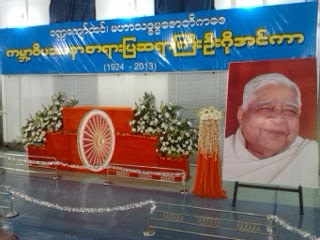
On October 7, 2013, the ashes of S.N. Goenka were ceremoniously brought from Mumbai to Yangon, and a portion were brought to Dhamma Joti for awaiting pilgrims. Below are photos of the event.
 |
| Yogis before the ashes, enshrined in a glass case |
 |
| The Dhamma Hall at Dhamma Joti |
 |
| Female pilgrims work on the garlands for the event. |
 |
| Flowers are prepared for the arrival of Goenkaji's ashes |
Monday, 7 October 2013
The Beginning of the "Last Journey"
In what they are calling "The Last Journey" in Yangon, this morning many pilgrims came to Dhamma Joti to pay respects. They will sit again together from 6 to 7 pm Myanmar time and invite all meditators around the world to join in this meritorious deed by sitting at the same time at your own location.
 |
| The ashes being ceremoniously brought to the center by the Goenka family |
 |
| Members of U Goenka's family, led by his son U Shwe, carry the ashes to the center |
 |
| U Goenka's ashes on display |
 |
| Pilgrims gather to pay their respects |
 |
| The remains of Padmabhushan Global Vipassanacharya Sri S.N. Goenka |
 |
| A local TV news crew at the event |
Sunday, 6 October 2013


Photos of Dhamma Joti preparations
The below photos show the preparations Dhamma Joti is making prior to receiving the ashes of S.N. Goenka, in an event that is being called "The Final Journey."
Sitagu Sayadaw will take the ashes toward the Ayeyarwaddy River, with over 500 monks and ten of thousands of followers in town. Ten large ships will follow along on 10th October, going towards the site where the great meditation teacher was born.


Sitagu Sayadaw will take the ashes toward the Ayeyarwaddy River, with over 500 monks and ten of thousands of followers in town. Ten large ships will follow along on 10th October, going towards the site where the great meditation teacher was born.
Saturday, 5 October 2013
Update on arrival of ashes from S.N. Goenka to Myanmar
The ashes of S.N. Goenka are scheduled to arrive in Yangon on Monday Morning (7 October) at 10 AM by air from India. They will then be taken to Dhamma Joti Meditation Centre in a special vehicle decorated with flowers and people will allowed to pay tribute overnight.
The next morning some of the ashes will be taken to Myitkyina in Kachin State by air. The first scattering is Myitkyina of Irrawaddy river.
On Wednesday (9 Oct), the remaining ashes will be taken to Mandalay, where U Goenka was born, and scattered into the Ayeyarwaddy River near the Mandalay.
On the evening of the same day, the remaining ashes will be brought back the Yangon for overnight public tribute in Dhamma Joti Meditation Centre.
The final scattering would be on Thursday (10 Oct) morning at the entrance of Yangon river by Mya Nan Dar Boat.
Due to health problems, Mataji (the widow of S.N. Goenka) is not able to accompany the ashes to Myanmar.
Thursday, 3 October 2013
Ashes of S.N. Goenka
"The ashes of the late Guruji Goenka's will be scattered in 3 places in the Irrawaddy River in Myanmar. The ashes are scheduled to arrive in Yangon International Airport, on Monday (7 October) 2:00 pm by Air from India.
The ashes will be taken to Dhamma Joti Mediation Centre (in Yangon), in a special vehicle decorated with flowers and people will be allowed to pay tribute overnight.
The next morning the ashes will be taken to Myit Kyi Nar (Capital City of Kachin State, Northern Myanmar) by air. The first scattering is site will be at the Myit Sone (beginning point) of Irrawaddy River. On Wednesday (9 October), the remaining ashes will be taken to Mandalay, (birth place of Guruji) and scattered into the Irrawaddy River at Mandalay.
On the evening of the same day, the remaining ashes will be brought back to Yangon for overnight public tribute in Dhamma Joti Meditation Centre.
The final scattering would be on Thursday (10 October) morning at the entrance of Yangon River in Yangon by Myan Nandar boat."

The ashes will be taken to Dhamma Joti Mediation Centre (in Yangon), in a special vehicle decorated with flowers and people will be allowed to pay tribute overnight.
The next morning the ashes will be taken to Myit Kyi Nar (Capital City of Kachin State, Northern Myanmar) by air. The first scattering is site will be at the Myit Sone (beginning point) of Irrawaddy River. On Wednesday (9 October), the remaining ashes will be taken to Mandalay, (birth place of Guruji) and scattered into the Irrawaddy River at Mandalay.
On the evening of the same day, the remaining ashes will be brought back to Yangon for overnight public tribute in Dhamma Joti Meditation Centre.
The final scattering would be on Thursday (10 October) morning at the entrance of Yangon River in Yangon by Myan Nandar boat."

Wednesday, 21 August 2013
Shwe Lan Excerpt: Dhamma Joti
The Meditator Guidebook to Burma is in its final stages! As the guide gets closer to publication, we will begin to share excerpts of what yogis may expect... some sneak previews of what is to come. We have one large entry on Dhamma Joti, and the following is one quote in this section by a meditator who shares his feeling after sitting a course here:
--
“It’s very difficult for me to give a top-ten list of the sites which have a special place in my heart. Dhamma Joti is not a place: I think it is a part of me, now. They welcomed me kindly, even if they were not aware of my registration because of problems with the internet connection... My room was very comfortable: it was in a high spot of the centre, with shower and toilet. The memories of every details of Dhamma Joti: the heat, the mosquitoes, the noodles, the cell, the garden full of unknown plants, the noise of the birds, the full moon...everything is so vivid that when I recall it I feel like being still there. The food was just delicious: noodles for breakfast and some fried bread which makes my mouth watering even now! The servers were so kind to me to give me an extra-mango or a sweet. The teacher did not speak English but his advices were the most effective: just try! It was the first time for me to meditate in a cell: the pagoda was beautiful, the hot inside was quite suffocating but the meditation was very strong.” Italian meditator
--
“It’s very difficult for me to give a top-ten list of the sites which have a special place in my heart. Dhamma Joti is not a place: I think it is a part of me, now. They welcomed me kindly, even if they were not aware of my registration because of problems with the internet connection... My room was very comfortable: it was in a high spot of the centre, with shower and toilet. The memories of every details of Dhamma Joti: the heat, the mosquitoes, the noodles, the cell, the garden full of unknown plants, the noise of the birds, the full moon...everything is so vivid that when I recall it I feel like being still there. The food was just delicious: noodles for breakfast and some fried bread which makes my mouth watering even now! The servers were so kind to me to give me an extra-mango or a sweet. The teacher did not speak English but his advices were the most effective: just try! It was the first time for me to meditate in a cell: the pagoda was beautiful, the hot inside was quite suffocating but the meditation was very strong.” Italian meditator
 |
| Street Entrance to Dhamma Joti Vipassana Center |
Sunday, 12 May 2013
To The Door Of Light: Cyclone Nargis hits Dhamma Joti Meditation Center in Yangon
Many readers will have already seen this message that was written and mailed just days after the devastating Cyclone Nargis struck Myanmar May 1, 2008. Following we repost it for those that may have missed it five years ago. It tells the story of a Burmese Dhamma worker at Dhamma Joti and how the cyclone impacted the course she was serving, and the center overall.
"To The Door of Light"
Date: May 3, Saturday
Time: Before 4.00 am
Venue: Dhamma Joti, Yangon, Myanmar
Situation: The No. 2 Stage Cyclone "Nargis" is passing over Yangon and Ayeyarwaddy Division
We are the Dhamma serves whom are serving for ten days Vipassana course at Dhamma Joti. There are 8 Dhamma servers and the age range between 20s to 60s. At this course 104 female students and 77 male students attended.
Today is the 8th day at Vipassana meditation course. From 11 pm last night the wind became very windy and became quite a bit worse. We had no idea at all how powerful and strong this coming cylone is going to be. But the sound of the wind is very strong and so I am waiting in my room to strike the bell for 4 a.m. to wake all the meditators. With this situation the teacher whom is conducting the course, I wonder what is his decision? But at 4.00 am sharp the main bell starts striking. So I followed with 7 strikes to wake up meditators.Then I went to the Dhamma Hall to bring back the Emergency lamp and to assess the damages at the centre from the storm, especially on the pathway to the Dhamma Hall. At this time some of the trees were broken, and branches were down, but nothing could prevent the way to the hall, so I felt quite safe for the yogis.
At 4.30 am, to call the meditators, we wait at the walkway with emergency lamps and flash lights. The electricity was cut off last night. So the center is dark and only the light of lamps and the sound of srong wind remains. But all the meditators arrived to the Dhamma Hall and were meditating as usual. Outside, the wind became so much worse and was trying to open the windows by force. When it became clearer and we can see the dawn light, most of the trees are leaning and it is more windy. At 5.00 am the teachers arrived to the hall to meditate. At 6.00 as usual, they played the chanting of Goenkaji. At this time we Dhamma servers are quite worried. Most of the trees at the centre are broken and more covered the walkway to the Dining Hall and to the Women's Dormitory. The walkway to the Ladies' Dormitory roof is nearly collapsed and only one way is left for all meditators to use. Before allowing them to go anywhere, the rain water came into the Dhamma Hall with wind and the chanting is also playing. I asked one of the male Dhamma servers to look at the walk way and he replied to me it was safe, because there were no big trees on the path. After the chanting was finished I suggested to the teachers what I thought was the best and safest idea. The teachers permitted me to choose the ten youngest yogis and with them I was heading the group to run from the Dhamma Hall to the dining room. This was the safest building as few trees are around it and it is only one story. I told them to leave all unnecessary things and not to use an umbrella. The wind is so bad that if they use an umbrella, they could fly away. The first group arrived to the dining hall safely. So next group followed by the heading of Dhamma servers. When only old and disabled people were left, two dhamma servers helped one each, so now everyone is in the dining hall safely.
A delicious breakfast of noodles was waiting for us. You can imagine within this severe storm the kitchen workers are preparing food for 200 people. After breakfast we requested to the students not to go back to their rooms as the dining hall was the safest place to be. So they stayed there, and the teachers sent a message that the course will stop for a while within this storm but all meditators should keep on meditating as they sat in the dining hall. At this time I asked fellow dhamma servers if the teachers will continue the course, although I decided that I will continue to serve for the good of all meditators. What about all of you, I asked my friends? They said they will do their utmost abiilty to continue serving the course as well.
At 10 am the storm was still too windy and rainy. The teacher arrived in the dining hall and called three of us to meet them and discuss. They wanted to continue the course, since we were already on the 8th day, and asked our advice. We said that if the teachers say yes, we will follow all the instructions of the teachers and do the best for the benefit of all meditators.
After that we needed to look around the centre to see what happened. The Dhamma Hall roof was broken and rainy and some roof went off with the wind, and had become wet inside. Most of the cushions were wet because of rainy wind. So it was impossible to use the Dhamma Hall. But fortunately we had batteries, invertors, casettes, and they were intact because some male Dhamma servers had covered it carefully before leaving the hall. So we could use an audio tape without problem. Under the Dhamma Hall is a place which we typically use for the Sunday group sittings. So we could use this hall since the Dhamma Hall was no longer suitable. Only one place was wet because of a leak from upstairs. Two female dormitories were nearly in good stage, but the two story women's building was the worst. All the roofs of the toilet and bathrooms were all gone, and the hall where female meditators are sleeping were wet and dripping with water going down to the downstairs ground. The first floor was totally unusable. So we have to reaccomodate 37 female meditators. The only way is to share dormitories more than before. Before most of the rooms are twin sharing beds, now some of them will have four in a room.
After lunch the storm finally passed and we allowed meditators to go back to their rooms and for those who were wet to move their bed. The centre had pillows, blankets, mosquito nets and bed sheets for the meditators and they could stay without problem. I borrowed some longyis, t-shirts, and sweaters and gave to those who needed them and were wet.
We re-started the course at 2.30 pm, for the group sitting. We now had 94 females and 58 males, as some had left. They had to go back home because the situation needed them; they had families to look after. We could play the CD and cassette players with batteries, but we had no generator. Only some candles and batteries. But for the discourse, we could still operate in Burmese, English, and Hindi. On Metta night there was no more electricity left in the batteries for even lighting anything. So only candles, mosquito coils, and some flash lights to be able to walk outside.
For drinking water, fortunately we had water filtering machines and 500 litre water tank, which was full. The problem, however, was the water to be used in daily life. The first day we had to use from the water tank, and all the meditators had to carry water bottles or buckets for toilet use and washing. From day to day we opened well covers and carried water with buckets to the bathrooms to take a shower.
Dhamma Joti was in good condition but in some meditating cells, the rain water came down. So from the ninth day we cleaned the cells and dried it up to use for next course.
All the big trees fell down from the very roots. Fortunately, none of these affected the main building. One tree fell hard towards the Dhamma Hall but was stopped by another large tree in its path. But on one hill we must build a retaining wall otherwise it will be a big problem in the future. Dhamma servers have to work for 18 hours for the first day of the storm, but everybody is happy and contented with what we can do for the meditators. We felt great gratitude towards Dhamma, our teacher Guruji, and teachers who keep conducting the course.
The storm is a natural disaster.
But we can pass this with Dhamma power.
We can help the meditators to run to the light of Dhamma.
Now our Dhamma Joti Centre needs a lot for repairing work and to run the course and proper facilities for meditators.
BE HAPPY
Anonymous Dhamma Server
"To The Door of Light"
Date: May 3, Saturday
Time: Before 4.00 am
Venue: Dhamma Joti, Yangon, Myanmar
Situation: The No. 2 Stage Cyclone "Nargis" is passing over Yangon and Ayeyarwaddy Division
We are the Dhamma serves whom are serving for ten days Vipassana course at Dhamma Joti. There are 8 Dhamma servers and the age range between 20s to 60s. At this course 104 female students and 77 male students attended.
Today is the 8th day at Vipassana meditation course. From 11 pm last night the wind became very windy and became quite a bit worse. We had no idea at all how powerful and strong this coming cylone is going to be. But the sound of the wind is very strong and so I am waiting in my room to strike the bell for 4 a.m. to wake all the meditators. With this situation the teacher whom is conducting the course, I wonder what is his decision? But at 4.00 am sharp the main bell starts striking. So I followed with 7 strikes to wake up meditators.Then I went to the Dhamma Hall to bring back the Emergency lamp and to assess the damages at the centre from the storm, especially on the pathway to the Dhamma Hall. At this time some of the trees were broken, and branches were down, but nothing could prevent the way to the hall, so I felt quite safe for the yogis.
At 4.30 am, to call the meditators, we wait at the walkway with emergency lamps and flash lights. The electricity was cut off last night. So the center is dark and only the light of lamps and the sound of srong wind remains. But all the meditators arrived to the Dhamma Hall and were meditating as usual. Outside, the wind became so much worse and was trying to open the windows by force. When it became clearer and we can see the dawn light, most of the trees are leaning and it is more windy. At 5.00 am the teachers arrived to the hall to meditate. At 6.00 as usual, they played the chanting of Goenkaji. At this time we Dhamma servers are quite worried. Most of the trees at the centre are broken and more covered the walkway to the Dining Hall and to the Women's Dormitory. The walkway to the Ladies' Dormitory roof is nearly collapsed and only one way is left for all meditators to use. Before allowing them to go anywhere, the rain water came into the Dhamma Hall with wind and the chanting is also playing. I asked one of the male Dhamma servers to look at the walk way and he replied to me it was safe, because there were no big trees on the path. After the chanting was finished I suggested to the teachers what I thought was the best and safest idea. The teachers permitted me to choose the ten youngest yogis and with them I was heading the group to run from the Dhamma Hall to the dining room. This was the safest building as few trees are around it and it is only one story. I told them to leave all unnecessary things and not to use an umbrella. The wind is so bad that if they use an umbrella, they could fly away. The first group arrived to the dining hall safely. So next group followed by the heading of Dhamma servers. When only old and disabled people were left, two dhamma servers helped one each, so now everyone is in the dining hall safely.
A delicious breakfast of noodles was waiting for us. You can imagine within this severe storm the kitchen workers are preparing food for 200 people. After breakfast we requested to the students not to go back to their rooms as the dining hall was the safest place to be. So they stayed there, and the teachers sent a message that the course will stop for a while within this storm but all meditators should keep on meditating as they sat in the dining hall. At this time I asked fellow dhamma servers if the teachers will continue the course, although I decided that I will continue to serve for the good of all meditators. What about all of you, I asked my friends? They said they will do their utmost abiilty to continue serving the course as well.
At 10 am the storm was still too windy and rainy. The teacher arrived in the dining hall and called three of us to meet them and discuss. They wanted to continue the course, since we were already on the 8th day, and asked our advice. We said that if the teachers say yes, we will follow all the instructions of the teachers and do the best for the benefit of all meditators.
After that we needed to look around the centre to see what happened. The Dhamma Hall roof was broken and rainy and some roof went off with the wind, and had become wet inside. Most of the cushions were wet because of rainy wind. So it was impossible to use the Dhamma Hall. But fortunately we had batteries, invertors, casettes, and they were intact because some male Dhamma servers had covered it carefully before leaving the hall. So we could use an audio tape without problem. Under the Dhamma Hall is a place which we typically use for the Sunday group sittings. So we could use this hall since the Dhamma Hall was no longer suitable. Only one place was wet because of a leak from upstairs. Two female dormitories were nearly in good stage, but the two story women's building was the worst. All the roofs of the toilet and bathrooms were all gone, and the hall where female meditators are sleeping were wet and dripping with water going down to the downstairs ground. The first floor was totally unusable. So we have to reaccomodate 37 female meditators. The only way is to share dormitories more than before. Before most of the rooms are twin sharing beds, now some of them will have four in a room.
After lunch the storm finally passed and we allowed meditators to go back to their rooms and for those who were wet to move their bed. The centre had pillows, blankets, mosquito nets and bed sheets for the meditators and they could stay without problem. I borrowed some longyis, t-shirts, and sweaters and gave to those who needed them and were wet.
We re-started the course at 2.30 pm, for the group sitting. We now had 94 females and 58 males, as some had left. They had to go back home because the situation needed them; they had families to look after. We could play the CD and cassette players with batteries, but we had no generator. Only some candles and batteries. But for the discourse, we could still operate in Burmese, English, and Hindi. On Metta night there was no more electricity left in the batteries for even lighting anything. So only candles, mosquito coils, and some flash lights to be able to walk outside.
For drinking water, fortunately we had water filtering machines and 500 litre water tank, which was full. The problem, however, was the water to be used in daily life. The first day we had to use from the water tank, and all the meditators had to carry water bottles or buckets for toilet use and washing. From day to day we opened well covers and carried water with buckets to the bathrooms to take a shower.
Dhamma Joti was in good condition but in some meditating cells, the rain water came down. So from the ninth day we cleaned the cells and dried it up to use for next course.
All the big trees fell down from the very roots. Fortunately, none of these affected the main building. One tree fell hard towards the Dhamma Hall but was stopped by another large tree in its path. But on one hill we must build a retaining wall otherwise it will be a big problem in the future. Dhamma servers have to work for 18 hours for the first day of the storm, but everybody is happy and contented with what we can do for the meditators. We felt great gratitude towards Dhamma, our teacher Guruji, and teachers who keep conducting the course.
The storm is a natural disaster.
But we can pass this with Dhamma power.
We can help the meditators to run to the light of Dhamma.
Now our Dhamma Joti Centre needs a lot for repairing work and to run the course and proper facilities for meditators.
BE HAPPY
Anonymous Dhamma Server
Saturday, 5 January 2013
Photos and Videos from U Goenka's visit to Myanmar (Burma)
 |
| A yogi capturing a picture of U Goenka while giving Sangha Dana |
 |
| A crowd converging at the Goenka home early in the morning |
 |
| Many photographers and news crews filming U Goenka |
As the purpose of this blog is to greater share and disseminate inspiring photos, videos, essays, and other media related to dhamma in Burma, we are happy to make available any such items that visiting yogis would like to share with the greater community. If you would like to share your own personal photos, videos, or written memories from this trip, please send them to us and we will post them for the benefit of many. You can email us at burmadhamma@gmail (and please be patient as the account sometimes goes unchecked for long periods of time)
 |
| U Goenka and Mata-ji |
Subscribe to:
Posts (Atom)