Showing posts with label Shwegyin Monastery. Show all posts

Thursday, 1 June 2017

"Nothing But Nothing Should Be Taken at Face Value.”


In the same way that the notion of "face" can blend into the cultural trait of indirect communication, both of those together blend into the Burmese cultural concept of anar, which is a broader notion still. In fact, the characteristics of exactly what makes and goes into anar may be untranslatable outside of Burmese culture, where it is viewed as something of a national trait. Although anar can take years of living in Burmese society to fully understand, it is a very important quality for foreign yogis to try to at least begin to be cognizant of, since it will color nearly all interactions while in Myanmar in some way.

At its core, anar is a feeling of not wanting to impose on, or cause a strain in others, avoiding embarrassing them in any way, perhaps defined broadly as a constant attention to another’s state of mind. Chit San Win attempted to describe it in Myanmar Family, writing that anar means to feel shame in “expos[ing] other’s wrongdoings, willing to give things whenever asked for by others, acceding to someone’s request, and reluctant to go against someone.” Ma Thanegi explains it this way: “Feeling anar deh means feeling reluctant to take advantage of, to offend or to upset the other person…which means not saying no to an impossible request, or telling you what they think you want to hear because doing otherwise would just be too rude. In the same way they would agree with you even if they don't.” She then further emphasizes the role of indirect communication in anar by adding, “The locals have been used to this issue practically since birth, so they have learned to read the signs about the true state of things through facial expression, tone of voice, body language, etc., of each other. Due to this very strong culture trait, nothing but nothing should be taken at face value.”

Anar is a major component of the cultural glue that governs the parameters of general, social interactions, used between people where there is some degree of social distance (that is, age, rank, etc). But it is not as much of a feature of genuine, personal relationships, when people truly know each other well, such as between and among family members and close friends. 

Ma Thanegi remarks, “With close friends or school mates or cousins, I feel no anar because it sort of implies I am treating them like strangers and keeping them at a distance, which makes them mad. Among close friends—and we Burmese tend to have lots of them—a quick ‘thanks’ is okay.” She also notes that in the West, it’s less common to have such a large circle of what-are-considered close friends. Moreover, Burmese friendships are so strong that, in her words, “we can swear at each other, borrow their clothes, disturb them at midnight, ask favors any time of day or night, drop in at their homes any time or at their work place, drag them off from work to have tea, etc. At government offices we drag off friends working there to go with us to teashops or book browsing or even movies etc.” Although, new friends who one meets may feel anar until they know one well enough to sense what will or will not offend.

Many Burmese extend this concept of anar and modesty to meditation attainments as well. The possible powers some monks purportedly attain are treated respectfully but ambiguously in much of the literature, as well as in the ways people refer to them. Of course, it goes without saying that openly referring to one’s own progress on the path would tend to negate one’s words! U Mya Thaung relates an anecdote recorded in the Shwegyin Nikaya Sasana that the famous, 19th century forest monk, Thilon Sayadaw, was suspected of having developed abhiññā, or supernatural powers. The document neither admits nor denies this fact, noting, “The wise tend to keep things to themselves.” Therefore, it is considered very bad form to praise oneself in either the worldly or spiritual sphere.

Sunday, 5 March 2017

Mandalay Dhamma Practice: Fantasy Meets Reality


“I did a solo pilgrimage to Myanmar, and it had a profound effect on my practice, particularly how I saw the Dhamma integrated in everyday life there. One story that brings that to light happened at Shwegyin Monastery. Having been told about the site, I visualized myself sitting serenely on an ancient teakwood veranda as dedicated novices intoned Buddhist suttas, plunging me deeper into concentration and insight. Instead, I found myself meditating uncomfortably on an uneven surface, getting devoured by mosquitoes, awkwardly trying not to get in anyone’s way, hot and sweaty, and amidst the flashing bulbs of cameras aimed by tourists. I was unhappy and couldn’t focus…that is, until I reflected on the fact that I was only unhappy because of the peaceful image I’d already built up in my mind. But the reality was before me! Once I realized that, I let go, and embraced and observed that reality, and Burma taught me yet another lesson.” 

---

American meditator

Thursday, 16 February 2017

Passing of Shwegyin Sayadaw


The most Venerable Maharathaguru Waso Sayadaw Bhaddanta Aggiya, Abhidhaja (head monk) of the Shwegyin Nikāya (myanmar's second largest monastic order), has passed away last week while undergoing medical treatment in Mandalay General Hospital. He has thus left the burden of the aggregates at the ripe age of 100, just a few weeks before his 101st birthday. Bhaddanta Aggiya had 81 vassa.

Following his demise, this Tuesday a large meeting was organised in his Monastery, with many chief monks of the Shwegyin Order such as the Venerables Dr. Nandamalabhivamsa, Yaw Sayadaw and Sitagu Sayadaw, to discuss the preparations for his cremation ceremony with his devotees and the regional chief minister.

The remains of the Sayadaw are being displayed in a coffin for public obeisance in Aungmyaythazi Monastery in the compound of Vithudayon Taikthit Kyaung on 86th street. In the last days many devotees came to pay their respects to his remains, as well as many monk communities from Shwegyin monasteries came to pay their respects and practice marananusati (contemplating death) near his body. Today evening Yaw Sayadaw will be giving a Dhamma Talk there.

The cremation will be held on Sunday afternoon on the sport fields of Shwe Mann Taung Golf Course at the western foot of Mandalay Hill.

Sunday, 5 January 2014

Burma Day 6: A Day in Mandalay

As foreign yogis meditate at Maha Muni Pagoda, a monk silently records them with his video camera

For Day 5, see here! Kory Goldberg continues his Burma pilgrimage journal for the full day experience in Mandalay, writing about the Pariyatti yatra. You can also consider joining a later pilgrimage in Burma yourself.

"Group yoga on a rooftop as the sun rises is a wonderful way to begin a day. Our morning meditation at the sacred Maha Myat Muni Pagoda was a real blessing. The living Buddha, or the Buddha surrounded by life, inspires millions of pilgrims to lead a life dedicated and devoted to Dhamma. As always, the local Burmese were delighted to see our group engaging with their culture in a meaningful way. Our time at the pagoda was an engagement both sacred and profane as we practiced mindfulness while sitting, standing, listening to the Venerable Snowadaw explain the site and answer our questions, and shopping for gongs. We came across a pre-ordination ceremony with young children dressed as royal princes. The ages of the children varied, some around twelve or thirteen, others around three or four, forcing some of us to question the intelligence and motivation for ordaining a child still not weened from mother's milk. The land of infinite wisdom doesn't exist in isolation from ignorance and greed.


So happy were the Burmese to see the yatra group that they politely requested a photo with this Swedish pilgrim and German nun
A German dasa sila (Buddhist nun) joined our group for the day, inspiring many, especially those in our group who flirt with the idea of living a monastic life. For those seriously donning the noble robe, practice is continuous and holistic. once again energies shifted as our next stops, although brief, were visits to factories and emporiums. while interesting to see the country's finest handicrafts, the visits were a bit of an energy drain and a distraction from the meditative attitude that we are/were in the process of cultivating.


At a handicrafts store of traditional Burmese wares


Ma Khaing, a long-time friend to many Western Vipassana yogis the last dozen years or so, displayed typical Burmese hospitality by cooking us a sumptuous homecooked pure vegetarian meal. the food was infused with love and the group unanimously agreed that it was the best meal so far, although we seem to hear these superlatives on a daily basis. at the end of the meal a few of us expressed our gratitude and appreciation for Ma Khaing's generosity, and one of us offered her a maple leaf shaped bottle of Canadian maple syrup. She was delighted, less so for receiving a nice gift and a series of compliments and more so from the joy that arises from giving yourself over to others. A common Burmese spirit unsurpassed by any other culture in the world.


Four foreign pilgrims take time out for a photo outside of Dhamma Mandapa

Bamaw Monastery, which allowed the U Goenka organization to establish a center on its monastic compound, the first in the Mandalay region. The architecture of this old monastery is only found in Upper Burma, and one of the few teakwood buildings to survive the bombings and fires of World War II

After lunch we briefly walked off our lunch at the Bamaw Monastery, whose rustic building is constructed from teak and carved with elaborate floral patterns and Buddhist imagery. The generous Bamaw Sayadaw allowed Goenkaji's Mandalay students to construct a centre on his land. Even though the Sayadaw's tradition has no connection to Goenkaji's lineage, the selfless monk shared his property simply out of appreciation for Goenkaji's ability to teach people from all walks of life. meditating at Dhamma Mandapa and again next door at the Mahabodhi Vipassana Yogi Meditation Centre founded by Saya Theingyi (a student of Saya Thetgyi) wad restful and nourishing, allowing many to reorient themselves in Burma's extensive and complicated Buddhist matrix. ven. Karunika Bivantha, the Sayadaw now in charge of the Mahabodhi centre, is not only a master meditator but a great scholar who has authored several books on the Abhidhamma. Like many of the Sayadaws we have met so far, this wiry and radiant scholar-monk emphasized the importance of paying attention to the four elements as an object of meditation. However, unlike the the others, he connected this contemplation to the awareness of the arising and passing away of vedana, demonstrating a profound and intimate personal experience of the meditative life, as well his relationship to Ledi Sayadaw and Saya Thetgyi. (For a short excerpt of the Sayadaw's talk on the Four Elements, see here)


The Sayadaw at Maha Bodhi Monastery smiles during a Question and Answer with foreign yogis
A Russian pilgrim stands in reverence before the Maha Bodhi temple at the center established by Saya Thet Gyi's student, Saya Thein

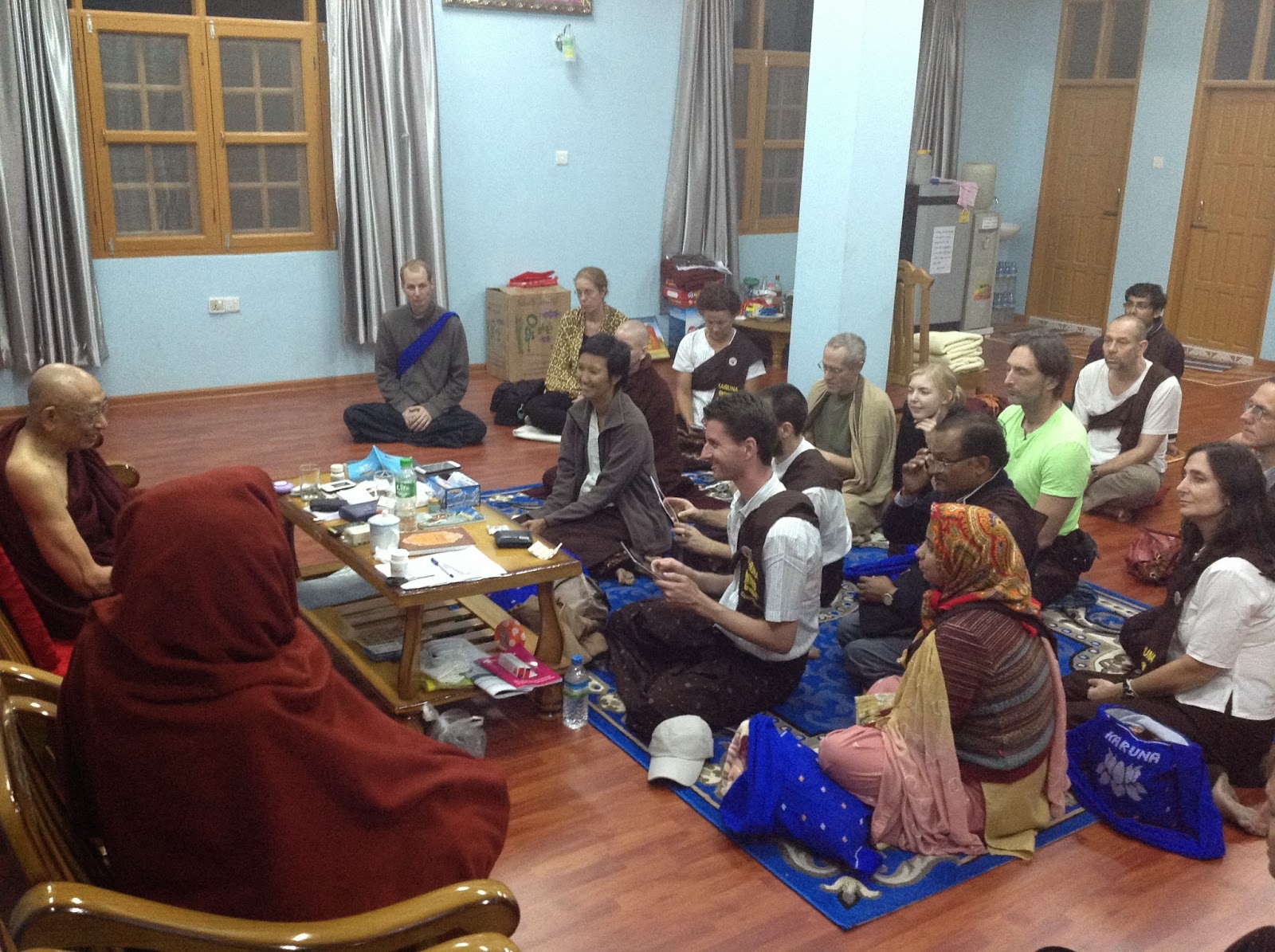
While the day was certainly filled with great moments, I also felt that the wounds from the inner battles were also revealing themselves for a number of people in the group. Most of us were tired and wanted to go back to the hotel. However there was one last stop of the day (actually many but it was getting dark and we needed to cancel a few stops on the itinerary). The Shwegyin Monastery is renowned for its monks who strictly adhere to the vinaya. As the monks chanted their evening prayers in their magnificent teak temple, we sat outside on the large veranda. After some time, One of the elder monks approached Snow, wondering who this curious bunch of foreigners were. Finding out that we were students of Goenkaji, he ushered us into another building where there sat one of the most illuminated old monks any of us had ever seen before. We were pleasantly surprised to discover that this old bhikkhu exuding love and light was a senior teacher under Goenkaji. Dr. Khin Maung Aye, the 82-year old bhikkhu, was a living example of what we all strove to be in one way or another. Not necessarily a monk in robes (although he did suggest that we all give it a try sometime, even for just a few days, since the spiritual benefits of doing so are immeasurable), but a stress-less, caring, bundle of joy. the constant giggles of this Dalai Lama/yoda-like figure was concrete proof of what this path can do and provided us all a brief moment that will be cherished for the rest of our lives."


For Day 7, go here!

Dr. Khin Maung Aye, a senior AT in the Goenka tradition, spoke to the pilgrims during a visit to Shwe Kyin Monastery 

U Thuttivara, seated to the left and the presiding Sayadaw at Shwe Kyin Monastery, provided an inspiring end to an already full dhammic day

Pilgrims are all smiles when listening to the deep wisdom of these two great monks at Shwe Kyin Monastery