Melissa Tun is an Australian-trained lawyer who came back to her homeland of Burma, and currently co-organizes the TedX annual talks. She wrote the following reflection on the holy Buddhist holiday of Kason.
"It was the evening of the eve of the Kason full moon, the second month of the Buddhist lunar calendar, and a day highly important to the Buddhist for it marks the birth, enlightenment, and nirvana (death) of Buddha. I paid a visit to the Shwe Dagon Pagoda to enjoy the wonderful serenity that envelopes it at night. Under various pavilions around the pagoda, there were groups of pilgrims chanting prayers, sharing their merits with other fellow worshippers. Their chants so ethereal and meditative it almost brought tears to my eyes. This land can be so beautiful surrounded by so much metta and loving kindness and yet be subjected to so much poverty and violence, desperate and abject poverty that no one deserves. It never fails to shake me to the core.
As I left the pagoda that night, I saw small children sleeping on cardboard at the foot of the stairs to the pagoda on the Eastern Moat; where a market sets up every night. They were young and bony, wearing tattered clothes and clearly exhausted from a hard day. By their side were sleeping a pack of small puppies, whose fortunes looked similarly unhappy. And a deep sense of sorrow washed over me. Sorrow for all the suffering, unnecessary suffering by those who were born into this world with a bleak life ahead. Sorrow for all the decades of wrongs that cannot be undone. Sorrow for all the quagmire and failed policies, the failures of institutions which were meant to serve the people.
When will deliverance come for those children? When will their brighter future appear? How can I be a part of making that future become a reality? Is there room in this country for those who want big bold change like me? A future that this country and all of its people deserve. A future that is much brighter, safer, secure, and full of opportunities.
As I left the pagoda that night, all I could do was pray. For a future when the children do not sell flowers on the streets. A future when the teashops will not be served by children who have had no schooling. For a future when the children do not beg at the foot of the Shwe Dagon. Am I asking for too much? A future without children flower sellers, child labourers and child beggars? Am I asking for too much for that future to come faster and to be this impatient for change?"


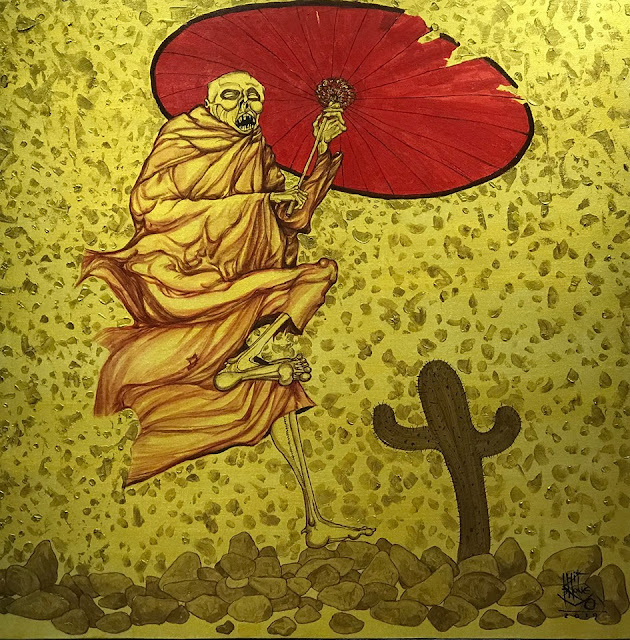


On November 2-4, artist Khit Bhone Mo displayed a series of paintings entitled "Saffron" at the WE Creation Gallery of the Yangon Book Plaza in Lanmadaw Township.
On the one hand, the art pieces present a highly thought-provoking, if not startling, view of the future dead in monastic robes. Although impossible to know the artist's intention, the work certainly can fall within the scope of the asubha practice recommended by the Buddha, in which the practitioner contemplates the inevitability of death. Some monasteries and meditation centers even have a resident human skeleton on premises, serving as a living (or rather, non-living) reminder of what we all shall become. However, Myanmar is not a free country, and freedom of artistic representation has been a controversial topic of late. Recent depictions of the Buddha have so angered Bamar Buddhists that the artist's own safety was at risk. In the end, it is a reminder that there is no legislative body that is able to monitor and approve artistic expression, and the choice comes down to the freedom that people in a society wish to live with.
If Khin Bhone Mo's artwork is allowed to provoke and nudge in the way that it is intended, the stark contrast of the walking dead in monastic robes-- coming after Halloween no less-- can be a reminder of "samvega" for some, perhaps a disturbing contemplation lodged in the subconscious for others. It is also an interesting case study testing the freedom that this generation of artists may have in expressing their views-- often deeply influenced by Buddhist wisdom-- to the wider audience.


While monks' requisites shops sell factory-manufactured robes with synthetic dyes, it is good to know that many monastics today still do things the old-fashioned way... and more so that these are foreigners who have come to the Golden Land for practice.
The German novice, Ashin Dhammosadha, shares this photo of applying natural dye to his monastic robes at Pa Auk forest monastery, Dawei, southern Myanmar. U Dhammosadha and his monastic friends boil rosewood tree bark for many hours in order to get the natural dye pigment needed. The following day, they cook the resulting pots of dye until most of the liquid becomes evaporated and only one small pot remains. Finally, they soak their robes in this, applying pressure by rolling a plywood boar to ensure the dye soaks thoroughly throughout the cloth. Finally, the robe is hung and dried, the process repeated at least two more times. U Dhammosadha shares that Thai monks he knows follow a similar process, however the dye they use is much less concentrated, resulting in the lighter colored robes that Thai monks can be seen wearing. (In Issan, however, some monks use jackfruit heartwood)
The German novice adds that it becomes evident which side of the robe faces the sun while drying, and even a fashionable stripe (where the robe was hanging) can be set as well, so clips may be a more suitable method.
How to wash after dyeing? Only with water and salt, not with any soap, for that would remove the dye, meaning that sweat becomes increasingly difficult to ever remove. Many Burmese monks who follow this tradition never actually wash their robes, but only pour hot water over it, just enough to soak it, and then roll it a few times with pressure up and down. Others, however, use a mordant like Alun, or "sourstone', several months after putting the dye on.
Professor Thiri Nyunt teaches the Dhamma to a roomful of monks, nuns, and yogis at the International Theravada Buddhist Missionary University in Yangon, Myanmar. Meditators and Buddhists come from around the world for the opportunity to study the Buddha's teachings at this state-sponsored college and learn from this highly revered Dhamma expert.
Earlier this year during Ramadan, a prominent Burmese Buddhist abbott ventured into the South Dagon region of Yangon to send metta to the Muslim community after the Jama'at Khana mosque was shut down following the violent protest initiated by a Buddhist extremist mob. While media often highlights the more concerning aspects of the current religious problems in Myanmar, it is also important to document and share these small yet important acts of kindness and harmony that do exist.
Credit to Myanmar Now for the photograph.

In the 2,500 years since the Buddha lived, his teachings have been exported and implemented in dozens of countries to various extents, and over time cultural customs and conventional practices have become integrated and influenced in the doctrine that this spiritual teacher established. As these Buddhist societies have developed over time, it may be all but inevitable that they begin to take the individual cultural leanings of their respective societies, which over many decades and centuries also begin to affect the basic vinaya (monastic discipline) that the Buddha himself laid down. In some cases these cultural tendencies can loosen up the stricter guidelines that the Buddha mandated, and yet in other cases these cultural practices do the opposite, making a tighter practice than was clearly allowed for. In the Burmese context, an example of the former is the prohibition of the Buddha that monks may never touch money, which an overwhelming number of Burmese monastics do today despite the clear violation. An example of the former is a largely rural, superstitious belief that it is bad karma to walk in the shadow of a monastic, even though no such guideline was ever uttered by the Buddha himself.
This brings us to this rather alarming photo, shared by one concerned reader of this page, in which the center subject, a Burmese woman, took and shared herself. It depicts her grasping the full body of a Buddhist novice (while he peers through a viewfinder) with a joyous expression whose underlying meaning can be interpreted according to the generosity of the viewer. According to the monastic code, any contact that a bhikkhu makes with a female is a clear violation, however in the case of a novice, while physical contact with females are surely not encouraged, it is technically not a violation unless the novice experiences feelings of lust while the contact is being made. So while one cannot say that a clear technical violation is being made as it would depend on the mental state of the novice, it is certainly concerning to see such full-bodied contact not only made at the country's most sacred Buddhist site, but then publicly shared and broadcast to garner hundreds of reactions and comments online.
Comments and captions remark that the photo no more declares a kind of sisterly or maternal care and regard the image as more cute or endearing than harmless. However the Buddha rightly foresaw the dangers that lust could cause on the spiritual path and this is why he gave the guidelines he did, so it is more than a little shocking to see such open physical contact between the genders flaunted and shared so openly, not only at the famous pagoda itself, but also across social media platforms. In other words, this was not just an unexpected act taking place at such a holy site, but also one that was intentionally and publicly broadcast for others to enjoy-- which is why it has been re-shared here after its recent popularity, although with a wholly different commentary.

There is very big news out of humble Ban Mauk village in Northern Burma.
Maha Bodhi Myaing Sayadaw is Burma's most revered living monastic, whom many believe to be a full arahant, or liberated being. A forest recluse, his identity is kept highly secret by his close lay supporters, and he has rarely been seen in public for many years. However, it appears a slight opening is now temporarily manifested, as he is suddenly receiving visitors who come to the edge of his forest abode. There is no way to know how long this opening will last, and when the public will again have the opportunity to see him.
One such highly fortunate visitor wrote this of her precious experience (translation by Ashin Sarana):
"The great lord master goes for alms and on the seventh day. (I) got the opportunity to pay (him) respect. In a pleasant shadow of a forest and hills there are only sounds of wild birds and all (people) are orderly (prepared) for offering of meal (to the Sayadaw). As the (Sayadaw) returns (to his residence) throughout that time (those people) reflect on (the qualities of) the Community of Monks (Sangha) and silently, reverently watch (the Sayadaw). It is so respectable."
It is said that the reason he is allowing this temporary access is to share his merit with those lay supporters, however he is only accepting seven spoonfuls of food daily, and only from seven villagers, no more and no less.
It is difficult to imagine more astounding and wonderful news as this to meditators everywhere looking for inspiration and guidance along the path. For any who have the paramis to meet the wise master during this special time, we say sadhu sadhu sadhu!


